

 Freedom Index
Listen to the article
Qatar has weaponised “mediation”: it has bankrolled Islamist power, posed as the indispensable broker, and sat on the leverage it had over Hamas from the start. For nearly two years, it has blamed Israel instead. Only when pressure escalated into strikes on Qatari soil—and the US sweetened the deal with guarantees and alternative investments—did Doha finally shift.
A week after the massacre of 7 October 2023, I sat with a cohort of young Jewish professionals in Washington, DC, under the auspices of the Israel Policy Forum. The air was thick with grief and confusion, and no one quite knew how to name what had happened yet. “This is a moment for humility,” said Aaron David Miller. At which point, I asked the same question I asked in every room I entered: “What are we doing about Qatar?”
The question was met with blank stares and raised eyebrows. One congressional staffer looked at me sideways, as if I was pushing a conspiracy theory. Only Hussein Ibish, senior scholar at the Arab Gulf States Institute, seemed to understand. He nodded and explained: Qatar might hold the keys to resolution, but it has compromised the United States, because it built the largest US military base in the Middle East and handed the Pentagon the keys for free.
The room fell silent. All eyes turned to me. I had spent seven years in the Gulf working on consultancy projects, particularly under the banner of the UAE’s Year of Tolerance and the Abraham Accords. I understood the differences between the UAE, Saudi Arabia, and Qatar, even if American policymakers often lazily lump them together. And I knew that behind the illusion of diplomacy and curated progressive branding, Qatar had been feeding a monster for decades. On 7 October, that monster stepped out of the shadows in an attempt to annul the Saudi–Israeli normalisation deal.
Knowledge Production and Narrative Control
Tensions between Saudis, Iranians, and Qataris had simmered for years, and I could still feel the heat at a security forum in Europe in late August 2023. After I led a teach-in on the Middle East, the Qatari ambassador to Canada, Dr Khalid bin Rashid Al Mansouri, approached me to ask if I needed funding for my initiatives. I declined. Mid-sentence, a Gazan social-media activist cut in: “Will you keep financially supporting our people in Gaza even now that Saudi is normalising with Israel?” The ambassador turned, took his hands, and answered, “We will never ever stop supporting our Palestinian brothers.”
That was not a humanitarian promise, it was policy. Qatar has bankrolled Hamas since 2007, when the group seized Gaza after a bloody rampage that overthrew the Palestinian Authority. In 2012, Qatar’s then-Emir made a red-carpet visit to Gaza and pledged US$400 million for projects, a watershed moment that signalled Doha’s unabashed embrace of Hamas’s rule. Patronage matured into a routinised cash flow, and by 2021, about US$30 million per month was entering Gaza, framed as “humanitarian” transfers that sustained Hamas-run salaries and government operations.
At the same time, Qatar was investing heavily in Western knowledge production and narrative control. Since 2001, US colleges and universities have reported an estimated US$6.25 billion in Qatari funding, making Qatar one of the five largest foreign donors in American higher education. Think tanks and policymakers were folded in, too. Qatar gave upward of US$9.1 million to US think tanks between 2019 and 2023. The Brookings Doha Center and related initiatives received US$14.8 million in a single three-year pledge, part of a broader, longer-running relationship that raised persistent questions and prompted FBI investigations about policy manipulation and censorship across the Beltway ecosystem.
Lobbying followed the same template. In a single recent year, Qatar retained 33 FARA-registered PR and lobbying firms, spending around US$18 million to create surge capacity for bookings, op-eds, and Hill and press engagement. To give you a picture of the scale of Qatari reach in DC, I spent several months after 7 October trying to publish a piece titled, “Qatar Is a Leading Saboteur of Regional Integration.” I sent it to everyone I know in media and policy, including Ambassador Dennis Ross who promised, when I begged him at a Washington Institute event in November 2023, to get it published. I had hit multiple walls, including at a think tank of which I am a member.
A friend at one of these publications told me: “I think they [the editorial team] have an issue with the fact that they have an upcoming partnership in December with Qatar. One of the directors flagged it as problematic and might put them in a delicate situation and prefer to go with another piece they had commissioned with a lighter touch on the subject. Sorry for that.” I asked if there was somewhere I could send it where there would not be a conflict of interest. “It is hard in DC,” my friend replied. “Everyone has interests with the Qataris.”
Even public grief was asked to stand down in deference to Doha’s leverage. After 7 October, several planned protests by hostage families in front of the Qatari embassy were quietly shut down. A source close to the Hostage Families Forum in DC told me they were explicitly warned not to “endanger” diplomatic talks with the only mediators deemed capable of securing releases. I do not fault the families for yielding, especially when even Jared Kushner and Steve Witkoff continue to celebrate Qatar’s role as the indispensable mediator for peace.
More recently, in late September and early October, Washington made two moves that bound Doha even more tightly to US power. First, a presidential executive order signed on 29 September pledged that:
(a) The United States shall regard any armed attack on the territory, sovereignty, or critical infrastructure of the State of Qatar as a threat to the peace and security of the United States.
(b) In the event of such an attack, the United States shall take all lawful and appropriate measures—including diplomatic, economic, and, if necessary, military—to defend the interests of the United States and of the State of Qatar and to restore peace and stability.
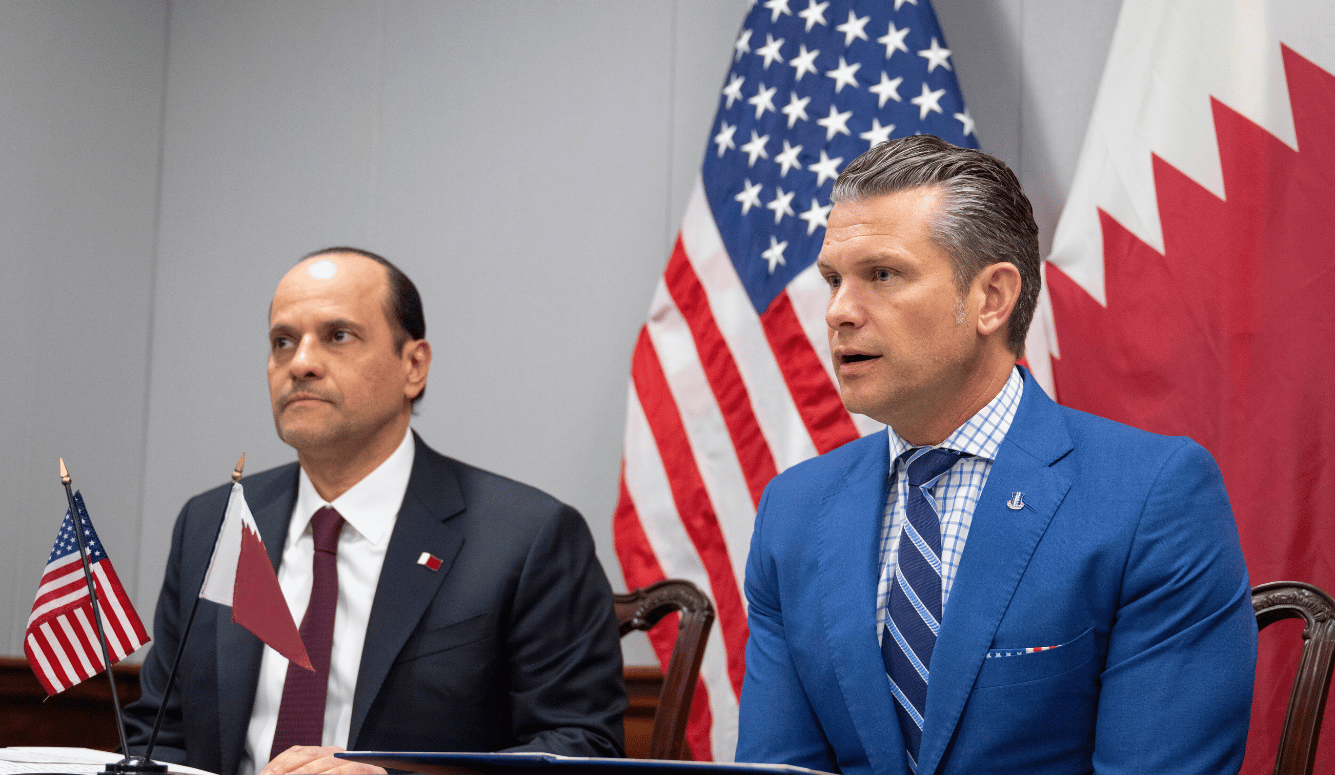
Then, on 10 October, the Trump administration announced it would permit the construction of a Qatar Emiri Air Force detachment at Mountain Home Air Force Base in Idaho to operate and train on F-15QAs alongside US units. It is a US base with a Qatari facility, not a Qatari base, but the symbolism and interoperability are unmistakable. Doha’s influence project is now codified and protected. The Pentagon’s Idaho announcement and a presidential security pledge formalise what Qatar spent two decades building: not just influence in Washington, but embeddedness in US security architecture.
The Megaphone and the Blockade
Qatar’s US influence model is media-centric. It combines state and non-state media actors, including FARA-registered PR and booking firms, as well as audience-targeted outreach to shape interviews, op-ed placement, and talking points. The Lumen8 Advisors contract is the clearest window into how that machine works, and the US$18 million spread across 33 firms shows how much capacity Doha can activate when a narrative crisis hits. A Qatari royal, Sheikh Sultan bin Jassim Al Thani, invested roughly US$50 million in Newsmax between 2019 and 2020, per filings and company representatives. This may explain why I was never invited to speak about Qatar again after I described the country’s role as that of both arsonist and firefighter in November 2023:
Tying the ecosystem together is the megaphone: Al Jazeera and AJ+, both of which are state-funded and steered by the royal court. Al Jazeera’s English-language output sounds progressive and woke, while in Arabic it follows Doha’s foreign policy, particularly on the Brotherhood and Hamas. AJ+, which the Department of Justice directed in 2020 to register under FARA, was built to speak fluent campus and creator culture, mastering the vocabulary of democracy and turning a religious forever-war into a social-justice narrative palatable to Western audiences.
In August 2015, AJ+ appointed Dima Khatib as managing director and charged her with scaling the “red–green” alliance between leftist radicals and Islamists. She established Al Jazeera’s China and Venezuela bureaus, publicly celebrated 7 October, and recently urged support for the Hamas-backed flotilla stunt. The family pedigree is telling: her father, Hussam Al-Khatib, wrote On the Palestinian Revolutionary Experience and met Fidel Castro while leading a delegation to Cuba. During the Hamas–Israel war of May 2021, she posted this on Instagram:
Read the full article here
Fact Checker
Verify the accuracy of this article using AI-powered analysis and real-time sources.