Close Menu
FSNN | Free Speech News NetworkFSNN | Free Speech News Network
  • Home
  • News
    • Politics
    • Legal & Courts
    • Tech & Big Tech
    • Campus & Education
    • Media & Culture
    • Global Free Speech
  • Opinions
    • Debates
  • Video/Live
  • Community
  • Freedom Index
  • About
    • Mission
    • Contact
    • Support
Trending

Court Says Pentagon Can’t Pick And Choose Which News Outlets Have Access

27 minutes ago

Police Had Qualified Immunity for Use of Wristlock on Capitol Sit-In Protester

28 minutes ago

Prediction market boom spurs new VC fund backed by Polymarket, Kalshi CEOs

45 minutes ago
Facebook X (Twitter) Instagram
Facebook X (Twitter) Discord Telegram
FSNN | Free Speech News NetworkFSNN | Free Speech News Network
Market Data Newsletter
Monday, March 23
  • Home
  • News
    • Politics
    • Legal & Courts
    • Tech & Big Tech
    • Campus & Education
    • Media & Culture
    • Global Free Speech
  • Opinions
    • Debates
  • Video/Live
  • Community
  • Freedom Index
  • About
    • Mission
    • Contact
    • Support
FSNN | Free Speech News NetworkFSNN | Free Speech News Network
Home»News»Media & Culture»President Trump’s New Housing Policy Should Include Massive Privatization of Federal Land
Media & Culture

President Trump’s New Housing Policy Should Include Massive Privatization of Federal Land

News RoomBy News Room3 months agoNo Comments7 Mins Read1,028 Views
Share Facebook Twitter Pinterest Copy Link LinkedIn Tumblr Email VKontakte Telegram
President Trump’s New Housing Policy Should Include Massive Privatization of Federal Land
Share
Facebook Twitter Pinterest Email Copy Link

Listen to the article

0:00
0:00

Key Takeaways

Playback Speed

Select a Voice

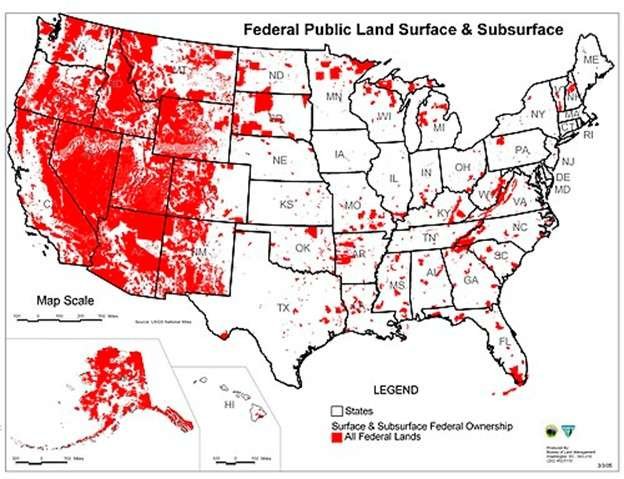
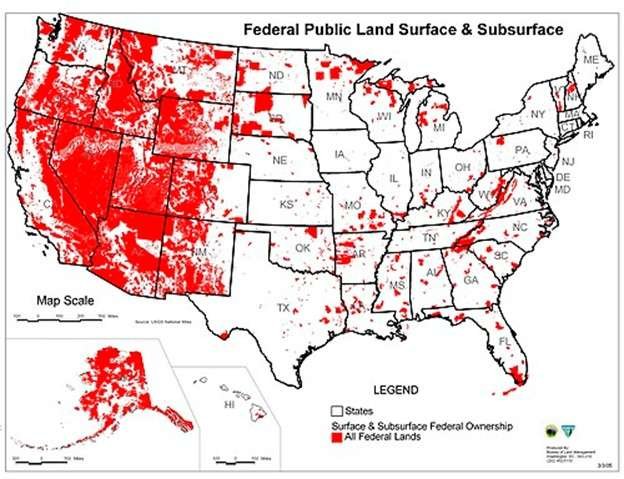
The federal government owns approximately 640 million acres of the 2.4 billion acres that constitute the United States of America. You might be astonished to know that less than one half of that total consists of our invaluable Great National Park system, our U.S. protected forest lands, and our protected grasslands. Moreover, the federal government’s holdings are almost entirely in twelve western states, where they create weird real estate markets, for reasons that can only be characterized as an historical accident. The map below shows federally owned land in red:
The enormous amounts of twelve western states that are federally owned are revealed again by this chart:
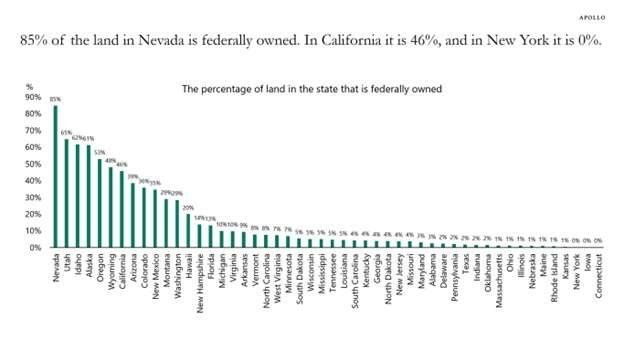
Twelve Western states account for the unequal treatment of the fifty states by the federal government, which grossly stifles private investment and skews real estate development in the States affected. The twelve Western states with skewed real estate markets include: Nevada; Utah; Idaho; Alaska; Oregon; Wyoming; California; Arizona; Colorado; New Mexico; Montana; and Washington State. 92% of the federally owned land in the United States is federally owned in these twelve Western states. There is no good policy ground for holding such huge shares of federal land in twelve states, while holding very little federal land in the other 38.

Of the 640 million acres of U.S. land, which the federal government owns, the U.S. National Parks Service manages 85 million acres, while the U.S. Forest Service manages another 193 million acres of forests and grasslands. Adding these two figures together suggests that about 278 million of the 640 million acres of federally owned land needs to be federally owned for environmental reasons.

That means, however, that 362 million acres of federal land is currently surplus government land that could be used by private people who have been squeezed out of the American dream of home ownership, suffer from a housing affordability crisis, and in the worst cases are homeless while the government squanders hundreds of millions of acres of private developable land that it owns but does not use. This crisis is especially visible in California where the federal government owns 46% of a state in which housing affordability and widespread homelessness are at crisis proportions.

To put this problem in context, the State of Texas has 172 million acres of land in total, while California has 164 million acres of land in total for a sum of 336 million acres. The federal government is thus sitting on and squandering an area of land that is 26 million acres larger than the combined size of Texas and California, which are the second and third largest states in the Union. And all of this while there is a very serious housing affordability crisis and a homelessness crisis that are separately going on.

Now it is true that some of the nationalized 362 million acres in surplus land that the federal government owns is uninhabitable because it is in Alaska, which is too cold, or in the Southwestern deserts, which are too hot for human habitation. But, having traveled to these states, I simply do not believe that 65% of Utah, 53% of Oregon, 46% of Wyoming, or 46% of California are uninhabitable, and I could go on and on down the list.

The fact is that private ownership of property under the common law yields much more efficient management of that property than does government ownership. Yale Law Professor Robert Ellickson proved as much in a famous law review article wherein he showed that the 1607 colonists of Jamestown, Virginia nearly died of starvation when all the land was all publicly owned. But they then thrived economically once the communally owned land was privatized, which saved the Jamestown colony. Ellickson, Robert C. Property in Land, 102 Yale L.J. 1315. More recently, when the Soviet Union collapsed, two-thirds of its food was being provided by the 3% of the total land in the U.S.S.R. that was privately owned. Private property owners are much better stewards of their property than is the government.

Why then did federal land not all get privatized through homesteading, which President Abraham Lincoln, after all, got enacted into law way back in 1862? The are multiple answers to that question. One is that the landowners next to federal undeveloped land want it to stay that way so they can have their own private parks in their backyards, which they pay no property taxes on, and which cost them nothing to maintain. Western hunters, hikers, miners and others have the same sort of not-in-my-backyard (NIMBY) attitude toward land privatization. Another problem is the environmental movement, which wants to reduce the human footprint on the planet more than they care about the crises of housing affordability and homelessness, which I frankly think is cruel. Finally, there is bureaucratic inertia, something a real estate developer like Donald Trump should be skilled at cutting through.

What do other nations around the world do with respect to government ownership of land? In the United Kingdom, the government own 8% of the country’s land (see the data here). In China, Vietnam, and Cuba, in contrast, the government owns nearly 100% of the land. In the United States, the federal government owns 28% of the land and the state and local governments own another 8.7% for state and local park., so in a land that prides itself on free-market capitalism 36% of the land—more than one third of the country—is government owned.

There is a reason why the homesteading privatization of federally owned land, which started in 1862, came to an end in the early 1900’s. President Theodore Roosevelt was in many ways a trust-busting advocate of progressive taxation, and he wanted the development of the Western United States to stop. A noble legacy of this effort was the creation of our great National Parks and Forests, but this came with a huge unappreciated cost—the end of privatization of more ordinary public land.

From 1901 to Margart Thatcher’s and Ronald Reagan’s Privatization Revolution of the 1980’s, Big Government in Europe nationalized healthcare, all banking in France in 1981, car production, steel mills, airline companies, electric companies, and telecommunications companies. Margaret Thatcher, Ronald Reagan, and Jacques Chirac in France reprivatized many of these industries, realizing—as President Bill Clinton famously put it in his 1996 State of the Union Address—that “the era of big government was over.” But it turned out to be much easier to privatize most industries than it was to privatize land in the United States with its NIMBY Westerners and its over-aggressive environmental lobby. This crucial sector of the economy got overlooked, contributing to the crisis in housing availability and homelessness that we see today.

We can all hope that President Trump’s housing reform policy to be announced next year takes a big look at privatizing federal land. We could use some of the proceeds to help retire the national debt. And who better than a savvy real estate investor to pull this one off. This could be the pivotal moment of the second term of Donald Trump’s presidency.

I cannot think of a better way to celebrate the 250th anniversary of the Declaration of Independence on July 4 of this year than by selling a huge amount of this excess federally owned land. Once the land is in the free market, it will naturally find its way to its highest and best use, as Professors Robert Ellickson and Richard Epstein have long argued in other contexts.

Read the full article here

Fact Checker

Verify the accuracy of this article using AI-powered analysis and real-time sources.

Get Your Fact Check Report

Enter your email to receive detailed fact-checking analysis

5 free reports remaining

Continue with Full Access

You've used your 5 free reports. Sign up for unlimited access!

Already have an account? Sign in here

#FreePress #NarrativeControl #OpenDebate #PoliticalNews #PressFreedom
Share. Facebook Twitter Pinterest LinkedIn Tumblr Email Telegram Copy Link
News Room
  • Website
  • Facebook
  • X (Twitter)
  • Instagram
  • LinkedIn

The FSNN News Room is the voice of our in-house journalists, editors, and researchers. We deliver timely, unbiased reporting at the crossroads of finance, cryptocurrency, and global politics, providing clear, fact-driven analysis free from agendas.

Related Articles

Media & Culture

Court Says Pentagon Can’t Pick And Choose Which News Outlets Have Access

27 minutes ago
Media & Culture

Police Had Qualified Immunity for Use of Wristlock on Capitol Sit-In Protester

28 minutes ago
Cryptocurrency & Free Speech Finance

Bitcoin Price Recovery Paints Familiar Pattern—And That’s the Problem: Analysis

51 minutes ago
Media & Culture

Daily Deal: The 2026 Embedded Systems Engineer Mastery Bundle

1 hour ago
Media & Culture

The DOJ Wants To Drop Charges Against 2 Cops Who Played a Crucial Role in Breonna Taylor’s Death

1 hour ago
Cryptocurrency & Free Speech Finance

Fake Influencers to Compete for Real Money in ‘AI Personality of the Year’ Challenge

2 hours ago
Add A Comment

Comments are closed.

Editors Picks

Police Had Qualified Immunity for Use of Wristlock on Capitol Sit-In Protester

28 minutes ago

Prediction market boom spurs new VC fund backed by Polymarket, Kalshi CEOs

45 minutes ago

Bitcoin Spot Volumes Drop To 2023 Lows as Rallies Lack Spot Conviction

48 minutes ago

Bitcoin Price Recovery Paints Familiar Pattern—And That’s the Problem: Analysis

51 minutes ago
Latest Posts

Daily Deal: The 2026 Embedded Systems Engineer Mastery Bundle

1 hour ago

The DOJ Wants To Drop Charges Against 2 Cops Who Played a Crucial Role in Breonna Taylor’s Death

1 hour ago

Jafar Panahi’s 2025 thriller It Was Just an Accident. Photo: Handout “We are worried about what is going to happen. Every morning, we wake up to the sound of explosions. Many places have been destroyed, and I know that some civilians have been killed as well. However, the Islamic Republic does not give us any accurate information, and the domestic news agencies are only propaganda centres for the regime. Because of this, we truly don’t know what is really happening or what awaits us.” These are the words of an Iranian dissident who has managed to contact us from inside the country after Israel and the USA started bombing Iran. They are too concerned for their safety to be named. Iran’s internet has been blocked for days now. There are reports of people protesting from their homes being shot at. The UN has warned that imprisoned Iranian protesters face “expedited” executions. There are fears about conditions deteriorating in Evin prison where a lot of political opponents of the regime are being held. Nobel Peace Prize winner Narges Mohammadi is currently in a jail in Zanjan, a city northwest of Tehran, and her situation is unknown. It is impossible to know exactly what is happening. In war the truth only comes out later – if at all – and disinformation is king. What is worrying is that there is such uncertainty about the outcome, and concern now that the USA and Israel don’t much care about the freedom of the people of Iran. Tens of thousands who bravely came out on the streets earlier this year to protest the regime were brutally murdered, many more arrested. Most shockingly, verified accounts have documented how the Revolutionary Guard swarmed hospitals, prevented medical care, took people off ventilators. Some doctors have even reported that wounded protesters who were being treated were later found with bullet holes in their heads. On Monday Index screened Jafar Panahi’s new film It was Just an Accident in advance of it coming out on Mubi this Friday, 6 March. It is a must-see if you want to understand the varying points of view of ordinary people in Iran. One of the people who talked on our panel discussion after the screening, Tara Aghdashloo, an Iranian writer, director and poet, wrote on Instagram of the current dilemma of those watching what is happening from afar: “Whoever we blame – this moment is overwhelming. There is pain, hoping for something good out of it, more pain, terror, remembering the mass murders by the regime yet fearing what these missiles and bombs could do to family and friends and innocent people, to our environment, infrastructure, our historic sites. Elation, even daring to hope that this fascist dictatorship might be gone once and for all. But remembering that the safety of my people is now in the hands of the same leaders, and that we’re expected to bet that our liberation is in a series of missiles that is shaking the city.” To be an Iranian dissident must be profoundly lonely and confusing. The autocratic ayatollah has been killed. But there is no succession plan for democracy. At Index we have always stood up for the people who want Iran to be finally free, for the women and young people, for the rappers, poets, artists and writers and all those who have put have themselves again and again in the firing line for the right to express their full selves without fear of torture and death. READ MORE

2 hours ago

Subscribe to News

Get the latest news and updates directly to your inbox.

At FSNN – Free Speech News Network, we deliver unfiltered reporting and in-depth analysis on the stories that matter most. From breaking headlines to global perspectives, our mission is to keep you informed, empowered, and connected.

FSNN.net is owned and operated by GlobalBoost Media
, an independent media organization dedicated to advancing transparency, free expression, and factual journalism across the digital landscape.

Facebook X (Twitter) Discord Telegram
Latest News

Court Says Pentagon Can’t Pick And Choose Which News Outlets Have Access

27 minutes ago

Police Had Qualified Immunity for Use of Wristlock on Capitol Sit-In Protester

28 minutes ago

Prediction market boom spurs new VC fund backed by Polymarket, Kalshi CEOs

45 minutes ago

Subscribe to Updates

Get the latest news and updates directly to your inbox.

© 2026 GlobalBoost Media. All Rights Reserved.
  • Privacy Policy
  • Terms of Service
  • Our Authors
  • Contact

Type above and press Enter to search. Press Esc to cancel.

🍪

Cookies

We and our selected partners wish to use cookies to collect information about you for functional purposes and statistical marketing. You may not give us your consent for certain purposes by selecting an option and you can withdraw your consent at any time via the cookie icon.

Cookie Preferences

Manage Cookies

Cookies are small text that can be used by websites to make the user experience more efficient. The law states that we may store cookies on your device if they are strictly necessary for the operation of this site. For all other types of cookies, we need your permission. This site uses various types of cookies. Some cookies are placed by third party services that appear on our pages.

Your permission applies to the following domains:

  • https://fsnn.net
Necessary
Necessary cookies help make a website usable by enabling basic functions like page navigation and access to secure areas of the website. The website cannot function properly without these cookies.
Statistic
Statistic cookies help website owners to understand how visitors interact with websites by collecting and reporting information anonymously.
Preferences
Preference cookies enable a website to remember information that changes the way the website behaves or looks, like your preferred language or the region that you are in.
Marketing
Marketing cookies are used to track visitors across websites. The intention is to display ads that are relevant and engaging for the individual user and thereby more valuable for publishers and third party advertisers.