

 Freedom Index
Listen to the article
Tariq Ramadan is either a predatory manipulator who belongs behind bars or a calm voice of reason victimised by a prejudiced ruling class. It really depends on whom you ask. Last week, the Paris Criminal Court sentenced Ramadan to eighteen years in prison for raping three women between 2009 and 2016. This ought to have settled the question about one of Europe’s most divisive thinkers. In fact, Ramadan’s punishment will only fortify the views of the two opposing camps.
Ramadan’s background is well known in France and his native Switzerland but less so elsewhere. His maternal grandfather, Hassan al-Banna, founded the Muslim Brotherhood in Egypt in 1928. In the late 1940s, al-Banna’s daughter Waffa married a Brotherhood activist named Said Ramadan. After al-Banna’s assassination in 1949, Said became one of the organisation’s leading figures. Expelled from Egypt in 1954 during president Gamal Abdel Nasser’s crackdown on the Muslim Brotherhood, the couple moved to Syria and then Pakistan before eventually settling in Switzerland, where Tariq was born in 1962.
According to his defenders, Ramadan rejected the illiberal fanaticism of his father and grandfather and grew up to be an urbane and moderate academic, enculturated by Western norms but with a heritage that provided him with the legitimacy to speak to and on behalf of radical Muslim communities. Western liberal elites were entranced by this paradoxical figure, and they embraced him as a figure who could explain East to West and vice-versa. This was especially true in France, where he enjoyed his highest profile, frequently appearing in debates and on talk shows.
Ramadan’s path to public intellectual and a chair at Oxford University was an unusual one, insofar as it is discernible at all, given all the conflicting information about him that exists in the public domain. He began his career as a French teacher at the Collège de Saussure, a high school near Geneva, in the late 1980s. At just 23 years of age, he rose to the rank of academic dean, the youngest in the Swiss system at the time. During the 1990s, he became more interested in Islam, which led him to undertake intensive religious studies in Egypt and to pursue higher studies upon his return to Switzerland.
In his 2009 book, What I Believe, Ramadan describes his spiritual awakening as a desire to “build bridges” between the Western and Islamic worlds. And who could be better suited to this herculean task than someone as reassuringly cosmopolitan as Tariq Ramadan? During a television interview in 2015, he was introduced as a man of “Egyptian heritage, Swiss nationality, French culture, and the Muslim religion.” He has said that he favours an interpretive rather than literal reading of the Qur’an, and that he is steeped in the Western philosophical tradition (he tells us that Friedrich Nietzsche was the subject of his Master’s thesis and PhD dissertation).
In fact, Ramadan never undertook, much less completed, a PhD on Nietzsche, just one of the claims he makes about his biography for English-speaking audiences that does not survive close inspection. As is widely known in the French-speaking world, the actual subject of his thesis was his grandfather Hassan al-Banna. To understand the objectives of the organisation that al-Banna established, one need look no further than its slogan:
Allah is our objective, the Prophet is our leader, the Koran is our constitution, jihad is our way, dying in the way of Allah is our highest hope.
Today, the Muslim Brotherhood is primarily funded by Qatar and Turkey and countries like Saudi Arabia and the United Arab Emirates have designated it a terrorist organisation.
Ramadan has repeatedly insisted that he disavows the views of his fundamentalist family members, but his analysis of his grandfather’s work was surprisingly favourable. This attracted consternation from the senior academics charged with supervising his thesis. Charles Genequand, his principal supervisor, said the dissertation was:
A compilation of encyclopaedic texts, a copy-and-paste job wrapped in apologetic discourse, seasoned with an anti-globalization, anti-imperialist sauce. … He was trying to place Hassan al-Banna within a reformist movement of Islam that existed in the 19th century, while camouflaging his very conservative vision.
Genequand had only agreed to supervise Ramadan’s work because Ramadan claimed he had access to previously unseen documents. Upon submission of the thesis, Genequand insisted Ramadan address, among other things, the violent antisemitic campaigns led by the Muslim Brotherhood under his grandfather. Ramadan refused, and according to Swiss journalist Ian Hamel, he then threatened one of the jury members, the late Ali Mérad, a highly respected Islamic scholar. “I have been a thesis supervisor for forty years in France, Belgium, and Switzerland,” Mérad said of the affair. “I have never seen a student conduct himself in such a way.” Three jury members resigned, leaving Ramadan’s thesis and academic ambitions in tatters.
Undeterred, Ramadan lobbied Jean Ziegler, a powerful Swiss academic and socialist politician, to help him redress the Islamophobic treatment he believed he had suffered in Geneva. The jury was reconstituted. With reservations and without academic honours, Ramadan was awarded his doctorate in 1999, five years after Genequand’s original request for revisions.
It was not until 2003 that Ramadan finally experienced the mainstream breakthrough he had always coveted. In an article published that October, while the second intifada was raging in the Middle East, Ramadan accused “French Jewish intellectuals” of sacrificing their universalist principles on the altar of Zionism. This sparked a fierce reaction from the French media and Ramadan was forced to defend himself from accusations of antisemitism.
A month later, Ramadan faced Nicolas Sarkozy, then minister of the interior, in a televised debate on laïcité (secularism) and Islam. Now in his forties, Ramadan was introduced as a “teacher of Islam in Geneva and of philosophy at Fribourg University.” Neither was true. Ramadan had no academic status at Fribourg, where he gave one-hour talks on Islam each week on a voluntary basis. He was still teaching French at the Collège de Saussure.
After criticising Ramadan’s recent article, Sarkozy broached the topic of Ramadan’s affiliations. Tariq’s brother Hani, Sarkozy pointed out, had justified the practice of stoning female adulterers, while Tariq himself had written the preface to a book defending the administration of corporal punishment to errant wives. Eager to clarify his position, Ramadan responded that he had a “minority position” in the Islamic world, which was that such practices should be the object of a “moratorium,” but he would not denounce the practice. French TV screens displayed the shocked faces among the Parisian crowd as the following exchange took place:
Sarkozy: A moratorium? Mr Ramadan, are you serious?
Ramadan: Wait, let me finish.
Sarkozy: A moratorium, that is to say, we should, for a while, hold back from stoning women?
Ramadan: No, no, wait. What does a moratorium mean? A moratorium would mean that we absolutely end the application of all of those penalties, in order to have a true debate. And my position is that if we arrive at a consensus among Muslims, it will necessarily end. But you cannot, you know, when you are in a community… Today on television, I can please the French people who are watching by saying, “Me, my own position.” But my own position doesn’t count. What matters is to bring about an evolution in Muslim mentalities, Mr Sarkozy. It’s necessary that you understand—
Sarkozy: But Mr Ramadan—
Ramadan: Let me finish.
Sarkozy: Just one point. I understand you, but Muslims are human beings who live in 2003 in France, since we are speaking about the French community, and you have just said something particularly incredible, which is that the stoning of women, yes, the stoning is a bit shocking, but we should simply declare a moratorium, and then we are going to think about it in order to decide if it is good. But that’s monstrous—to stone a woman because she is an adulterer! It’s necessary to condemn it!
Ramadan: Mr Sarkozy, listen well to what I am saying. What I say, my own position, is that the law is not applicable—that’s clear. But today, I speak to Muslims around the world and I take part, even in the United States, in the Muslim world… You should have a pedagogical posture that makes people discuss things. You can decide all by yourself to be a progressive in the communities. That’s too easy. Today my position is, that is to say, “We should stop.”
Sarkozy: Mr Ramadan, if it is regressive not to want to stone women, I avow that I am a regressive.
These remarks caused another media firestorm. Yet the Swiss intellectual somehow emerged stronger from what ought to have been a career-ending episode. He was now a household name.
The Professor, His Nemesis, and a Scandal at Oberlin
The story of how a liberal college promoted and defended an Iranian Islamist and betrayed its own values.
Suspicious critics began to examine his writing and rhetoric more closely. In 2004, French writer and journalist Caroline Fourest published her book Brother Tariq, in which she alleges that Ramadan employs a double-discourse to say moderate and soothing things to Western audiences but sends a much more radical message to Muslims. In June 2007, American critic and author Paul Berman wrote a 28,000 word essay for the New Republic in which he investigated Ramadan’s writings and history and found that he agreed with Fourest’s allegation of deception. Berman also criticised the Dutch liberal writer Ian Buruma for publishing an unduly sympathetic portrait of Ramadan in the New York Times magazine, and later expanded this critique into a 2010 book titled The Flight of the Intellectuals.
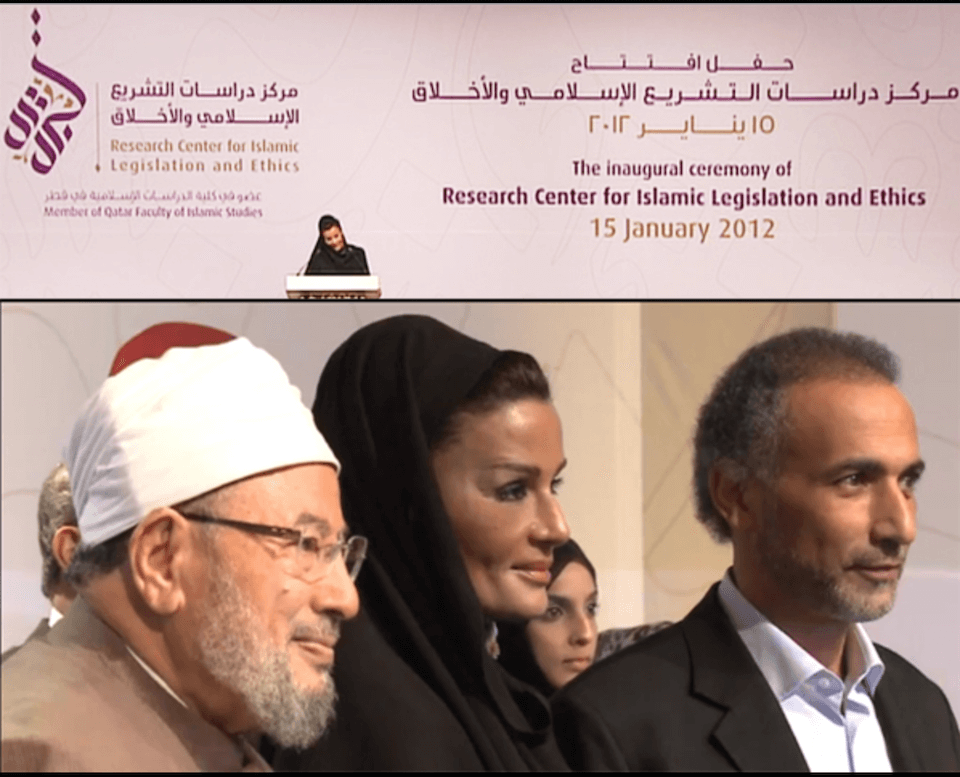
But Ramadan’s reputation survived this scrutiny largely unscathed. Instead, it was his critics who fell under suspicion for providing ammunition to reactionary forces in the West and maligning a moderating voice at a time of burgeoning extremism. And so the rise of Tariq Ramadan continued uninterrupted. In September 2005, he was awarded a fellowship at St Antony’s College, Oxford, and in 2009, he was appointed to the inaugural H.H. Sheikh Hamad bin Khalifa Al Thani Chair in Contemporary Islamic Studies at the same institution. A man with mediocre academic credentials and a shadow of controversy hanging over him had nonetheless managed to ascend from high-school teacher to Oxford don.
In 2019, French newspaper Libération revealed that, for many years, Ramadan had been receiving monthly payments of €35,000 for his work as a “consultant” to the Qatar Foundation. Naturally, Qatar was the provenance of the funds for the chair to which Ramadan was appointed, and of which the nation’s Emir was the namesake. And as mentioned, Qatar is one of the two main sponsors of the Muslim Brotherhood. Ramadan vigorously denied being close to Qatar, and alleged that his accusers were motivated by Islamophobia. When asked about these connections on French television, Ramadan replied: “I work in England. Are you going to say that I am close to English politicians? No, I am extremely critical. Are you, because you are in France, a supporter of [then French prime minister Manuel] Valls?”
But there were limits to the accusations that even this singularly gifted rhetorician could deflect. In 2009, Ramadan was dismissed from his teaching position at Rotterdam University and from his post as an “integration officer” by the city of Rotterdam due to his employment by the state-owned (and therefore regime-controlled) Iranian television station Press TV.
His associations with an Egyptian-born Imam named Yusuf al-Qaradawi—the Muslim Brotherhood’s spiritual leader who lived in exile in Qatar until his death in 2022—were another source of controversy. According to Sally McNamara, a policy analyst at the Heritage Foundation in Washington, DC, Al-Qaradawi, a friend of Ramadan’s grandfather since their days as agitators in Egypt, “has defended suicide bombings and called for the execution of homosexuals. He has also advised European Muslims to create ‘Muslim ghettos where they can avoid cultural assimilation and introduce Sharia law.’”
Finally, the #MeToo movement came for Tariq Ramadan in 2017 in the form of multiple accusations of sexual assault, allegedly committed in France and Switzerland. It also emerged that, years before, Ramadan had conducted sexual relationships with several of his female high-school students. One of those who managed to deflect his advances was just fourteen years old. Three others between fifteen and eighteen had been less successful.
The stories told by Ramadan’s sexual-assault victims were strikingly consistent. Each said she had been seduced by his charm and rhetorical skills. Each said that he had invited her to his hotel room, whether this was in Lyon, Paris, or Geneva. Each said she was initially willing but soon fell victim to Ramadan’s violent abuse.
At first, Ramadan suggested he had never had sexual relations with the women. When text messages he had exchanged with the complainants put the question beyond doubt, his story changed. He acknowledged that he had extramarital sexual relations with at least five women in violation of his own principles, but that these affairs had been entirely consensual. Predictably, Ramadan also deployed accusations of Islamophobia, the tactic that had proved so effective against his uppity thesis supervisors in Geneva. He even compared himself to Alfred Dreyfus, the 19th-century Jewish captain notoriously persecuted by the antisemitic French establishment.
Ramadan’s trial in the Paris Criminal Court was closed due to the harassment and intimidation the complainants feared they would suffer if the proceedings were open to the public. When Ramadan was placed in pre-trial detention in 2018, one of the complainants claimed she was spat upon, slapped, insulted, and followed by Ramadan’s followers. One need only look at the comments beneath any video of him speaking to appreciate the fanaticism with which his supporters defend him.
Though the full judgment is not in the public domain, the judges have stated that Ramadan raped his three victims with “great brutality,” meting out beatings, strangulation, humiliation, as well as an “enterprise of psychological destruction.” One alleged that he urinated on her. Ramadan was hospitalised in Switzerland, allegedly to receive treatment for his multiple sclerosis, so he was tried in absentia. Since Switzerland is generally reluctant to extradite its citizens, it is improbable that Ramadan will actually serve his prison sentence. In any event, he has the right to a fresh trial under French law, which he has already affirmed he will seek once his health recovers.
But nothing—not even a definitive conviction—will prove Ramadan’s guilt in the minds of his supporters. This has already been demonstrated in Switzerland, where Ramadan was convicted in 2024 of raping a woman in 2008. His appeal was rejected by the nation’s highest court last year, but the public perception of him—good and bad—does not appear to have changed.
Ramadan appeared at the very moment when Europeans felt more threatened by Islam than at any time since the crusades. His soft and exacting voice promised to bridge a divide many feared could not be crossed. In Ramadan, many European liberals and progressives thought they saw hope for a conceptual reconciliation of Islam and liberal democracy. Instead, Ramadan has brought his faith into disrepute and made his defenders look like dupes at a time when an authentic Islamic reformist is most needed.
In the broader context of the French culture for which Ramadan professes such admiration, it is not Alfred Dreyfus that he most closely resembles, but Molière’s Tartuffe, the pious interloper who uses the camouflage of virtue to manipulate those around him. As Voltaire once observed: “The comedy of Tartuffe, that masterpiece unmatched by any other nation, has done much good for humanity by exposing hypocrisy in all its ugliness.” Voltaire saw some of the Tartuffe in the Mohammed, the protagonist of his play Fanaticism, or Mahomet the Prophet.
In one of his first interventions in public affairs, Ramadan successfully agitated to shut down a production of Voltaire’s play in his native Geneva in 1993. It was a curious act on the part of a purported lover of freedom and French culture, but exactly the kind of act one would expect from a doctrinaire Islamist. But Ramadan was able to explain away this sort of contradiction because a large Western audience desperately wanted to believe him.
Quillette invites thoughtful responses to its essays.
Selected responses are published once per week as part of a curated Letters to the Editor feature. If selected, letters appear under the contributor’s real name and may be edited for clarity and length.
To submit a letter for consideration, please email [email protected].
Read the full article here
Fact Checker
Verify the accuracy of this article using AI-powered analysis and real-time sources.