

 Freedom Index
Listen to the article
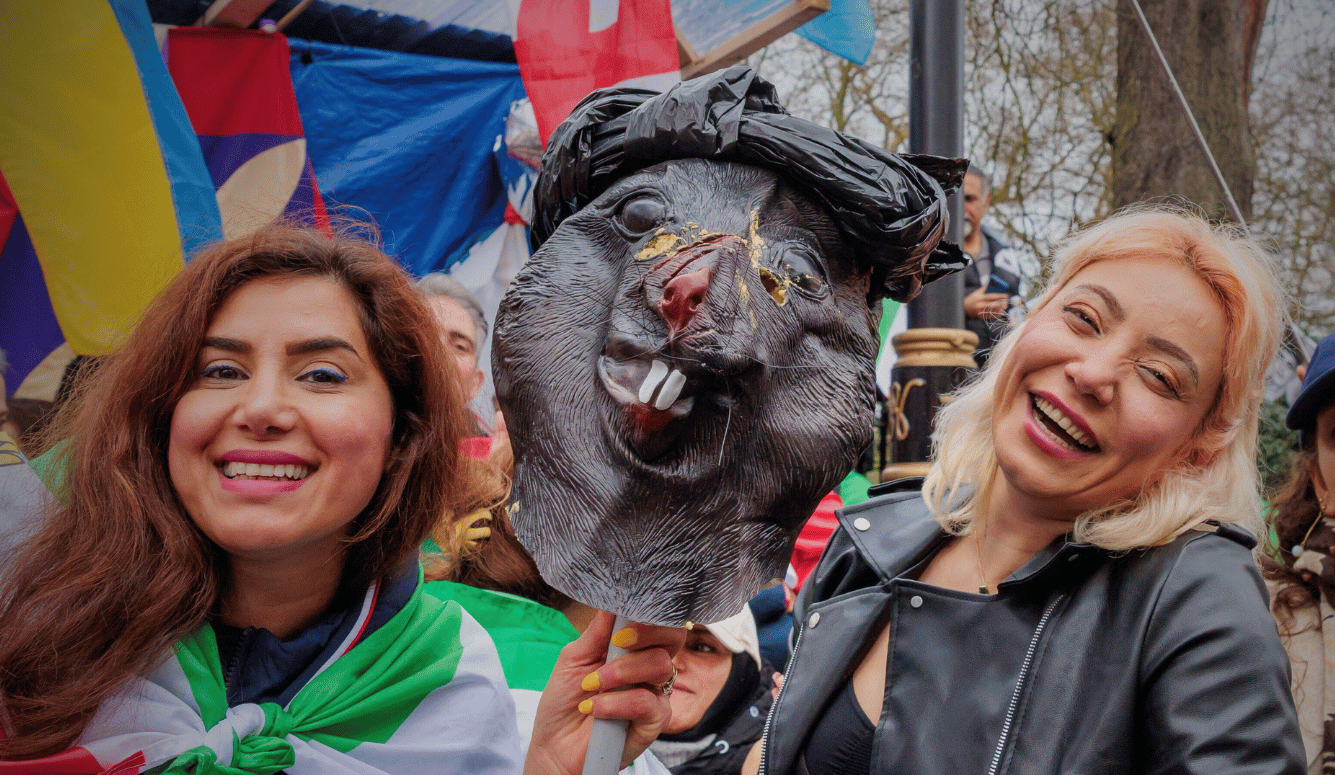
On Saturday 28 February, Ayatollah Ali Khamenei, the Supreme Leader of the Islamic Republic of Iran, was killed in a joint Israeli–American operation. There was widespread rejoicing at his death among Iranians everywhere from Tehran to Sydney (our own Zoe Booth attended the festivities here).
Party time 🦁 pic.twitter.com/3PWZrV0R7V
— Ζoë Booth (@zoecabina) March 1, 2026
Yet amid the celebrations, some people are concerned about the potential repercussions. As Simon Sebag Montefiore puts it:
This is the great gamble of the greatest gambler of all the commanders in chief in American history. Its stakes are regional if not planetary; its cause is admirable and noble; its opportunity may be unique and providential; its prizes are desirable and constructive; but its risks are colossal; its perils eye-watering, and its consequences uncertain not just in the Middle East but for the world game—and American democracy itself.
As a historian, Montefiore is keenly aware of the contingent nature of world events and the unexpected consequences that any single action can entail. And there is reason for pessimism. Khamenei’s death leaves an extensive apparatus of both military and civilian repression intact, including an estimated 125,000 Islamic Revolutionary Guard Corps (IRGC) and as many as 90,000 Basij. Even though many of the Islamic Republic’s leaders have reportedly been killed in the Israeli–American strikes and many more are likely to meet their deaths, we should assume that there are others ready to replace them. This is a hydra-headed regime. And, as Benny Morris writes here in Quillette, “Khamenei’s death will certainly increase the Islamists’ anger against Israel and the US and their desire for revenge.” Without a major military defection to the side of the protesters, it seems unlikely that the regime will swiftly fall.
After Khamenei: Can Israel and the US Topple Iran?
The assassination of Ayatollah Khamenei has opened a narrow window for regime change in Tehran.
Yet, I want to argue in favour of a cautious happiness at what has transpired. Sometimes, we must and should act—even though it is impossible to foresee the effects of our actions. There is no course of action that guarantees success and refraining from acting can be just as consequential. Khamenei’s death could be a tipping point, indeed a Schelling point—a salient event that has made the regime’s vulnerability obvious to everyone. A leak has sprung in the rotten hulk that is the Islamic Republic, in the sight of the entire world. Perhaps this will induce the rats to flee the sinking vessel.
Even when terror is institutionalised, it relies on the leadership of individuals, who can change history for better—or for far, far worse. At the centre of Ian Kershaw’s magisterial two-volume biography of Adolf Hitler is an attempt to answer the question: how much of the Nazi programme was Hitler’s invention or his doing and to what extent was he simply a representative of the zeitgeist? Virulent antisemitism, after all, had existed for millennia and when, following the First World War, the demoralised Germans were keen to find scapegoats for their defeat, the Jews must have seemed like obvious culprits to many, as they have throughout history to the paranoid and the self-pitying. Yet, while Hitler could not have come to power if his ideas had not resonated with many ordinary Germans, Kershaw believes that, under a different leader, the regime would not have gone to such genocidal lengths. As he puts it, “No Hitler, no Holocaust.”
Like Hitler, Khamenei was far from the sole responsible party for the terrors and horrors of the Islamic Republic, but he too was a malign influence on his country. As Roya Hakakian has detailed for us here in Quillette, he came to power as the result of “an evil so egregious that it changed the course of Iran’s future.” In August 1988, smarting from having accepted what he considered a humiliating peace deal at the close of the eight-year Iran–Iraq War, then-Supreme Leader Ayatollah Khomeini gave the order to kill some 4,000 of his political opponents: imprisoned supporters of the People’s Mujahedin (MKO) and communists. The prisoners—many of whom had been teenagers when they were arrested—were executed secretly. Their families were not even permitted to see their remains. When Ayatollah Montazeri, who was slated to become Khomeini’s successor, heard of this, he declared it a sin against God. Khamenei, by contrast, voiced no objections to the slaughter. As a result, Montazeri was placed under house arrest and Khamenei appointed Supreme Leader-in-waiting.
This was the beginning of a pattern of escalating bloodthirstiness over the course of Khamenei’s tenure, which began the following year. Khamenei’s 36 years in power were characterised by his willingness to resort to extreme brutality against any and all threats to the regime. At his orders, at least 1,500 protesters were killed during the uprising of November 2019; at least a further 500 in the Woman, Life, Freedom protests of 2022–23, following the brutal death in custody of Mahsa Amini for the absurd offence of “improper hijab.” And of course, it was under his rule that some 30,000 Iranians civilians were recently massacred for their opposition to the regime—this is the same number that the Mothers of the Plaza de Mayo claim were disappeared by Argentina’s military junta over the course of the entire Dirty War of 1976–83 and likely more than have died in three years of war in Gaza.
Montazeri was particularly horrified at the slaughter of young, female prisoners in 1988. Under Khamenei, the number of executions of women grew year-on-year. One particularly distressing case was that of sixteen-year-old Atefeh Rajabi Sahaaleh, accused of “crimes against chastity” after being repeatedly raped by a married 51-year-old former Revolutionary Guard, who began his abuse when she was only thirteen. On 15 August 2004, she was hanged.
Shortly after news broke of Khamenei’s death, Professor Ben Saul, who holds the Challis Chair of International Law at our local University of Sydney, tweeted, “Disappointing that Ukraine, a victim of Russian aggression who expects international support, now endorses Israeli/US aggression against Iran.” In this, he joined a chorus of leftist academics decrying the supposed illegality of the ayatollah’s assassination.
Disappointing that Ukraine, a victim of Russian aggression who expects international support, now endorses Israeli/US aggression against Iran https://t.co/y15vWeXA3r
— Prof Ben Saul – UN SR Human Rights & Counterterror (@profbensaul) February 28, 2026
As many people were quick to point out, Ukraine’s attitude is unsurprising, given the fact that Iran supplied many of the Shahed drones with which Russia has been killing Ukrainians, both military and civilian, since it invaded the country in 2022. Sentiments like Prof Saul’s can charitably be seen as an egregious example of making the perfect the enemy of the good. In a perfect world, even the worst of humanity would be given a fair trial and sentenced in court according to their deserts. In a perfect world, we would never have to resort to violence and if we did, we would be confident in the short-, medium- and long-term effects of that violence. There would be no unknowns in such a world. In such a world, the Iranian Revolution would have ended on 4 November 1979, when 66 Americans were taken hostage in Tehran.
But in this world, the law is often powerless to punish dictators of tyrannical power and merciless brutality, even when they pose a threat to the entire world, beginning with their own people. They have already made themselves outlaws. As Australian Prime Minister Anthony Albanese put it, “A regime that relies on the repression and murder of its own people to retain power is without legitimacy.” As Karl Popper astutely notes in The Open Society and Its Enemies, the most important characteristic of democracy is that “bad rulers can be got rid of without bloodshed.” Violence is a blunt instrument with unpredictable consequences, but sometimes it’s the best option we have, as far as we can tell under present circumstances. And in those cases, we should use it—albeit with trepidation and in the fervent hope that events do not prove us wrong.
Quillette invites thoughtful responses to its essays.
Selected responses are published once per week as part of a curated Letters to the Editor feature. If selected, letters appear under the contributor’s real name and may be edited for clarity and length.
To submit a letter for consideration, please email [email protected].
Read the full article here
Fact Checker
Verify the accuracy of this article using AI-powered analysis and real-time sources.