

 Freedom Index

Listen to the article
Decentralized physical infrastructure networks (DePINs) have been written off as dead by many investors, but a new “State of DePIN 2025” report from Messari and Escape Velocity argues the sector has steadily grown into a $10 billion market generating $72 million in onchain revenue last year alone.
According to the report, the “class of 2018-2022” DePIN tokens are down a massive 94%-99% from all‑time highs. Yet, leading projects now post verifiable recurring revenue and trade at 10 to 25 times revenue multiples, levels Messari characterizes as undervalued relative to growth.
Messari said the shift marks a transition from subsidy-driven growth toward networks that generate revenue through real-world usage, particularly in areas such as bandwidth, compute, energy and sensor data.
Markus Levin, co-founder of XYO, a data and DePIN established in 2018, told Cointelegraph that revenue mattered more than token price in the DePIN sector and that, as the market matures, “valuations are starting to reflect real economic activity that holds up even when token prices are flat.”
Related: Solana-based Natix brings DePIN data into self-driving AI with Valeo
DePIN: From hype to revenues
The authors contrast “DePIN 2021” with “DePIN 2025,” saying that early cycles were dominated by pre‑revenue networks with high token inflation, demand constraints and valuations driven by retail speculation.
Today’s leaders, in contrast, are generating onchain revenue, have little or no supply inflation, and see growth driven by utility and cost advantages rather than subsidies.
Levin said the DePIN sector was “fundamentally different” from the broader crypto industry because it provides “real-world utility to end users.”
Success shows up “first in usage and cash flow, not in speculative price action,” he said.
Messari’s DePIN leaders
Messari’s DePIN Leaders Index highlights 15 projects across bandwidth, compute, energy and sensor networks that meet certain thresholds, such as at least $500,000 in annual recurring revenue, and a minimum of $30 million raised.
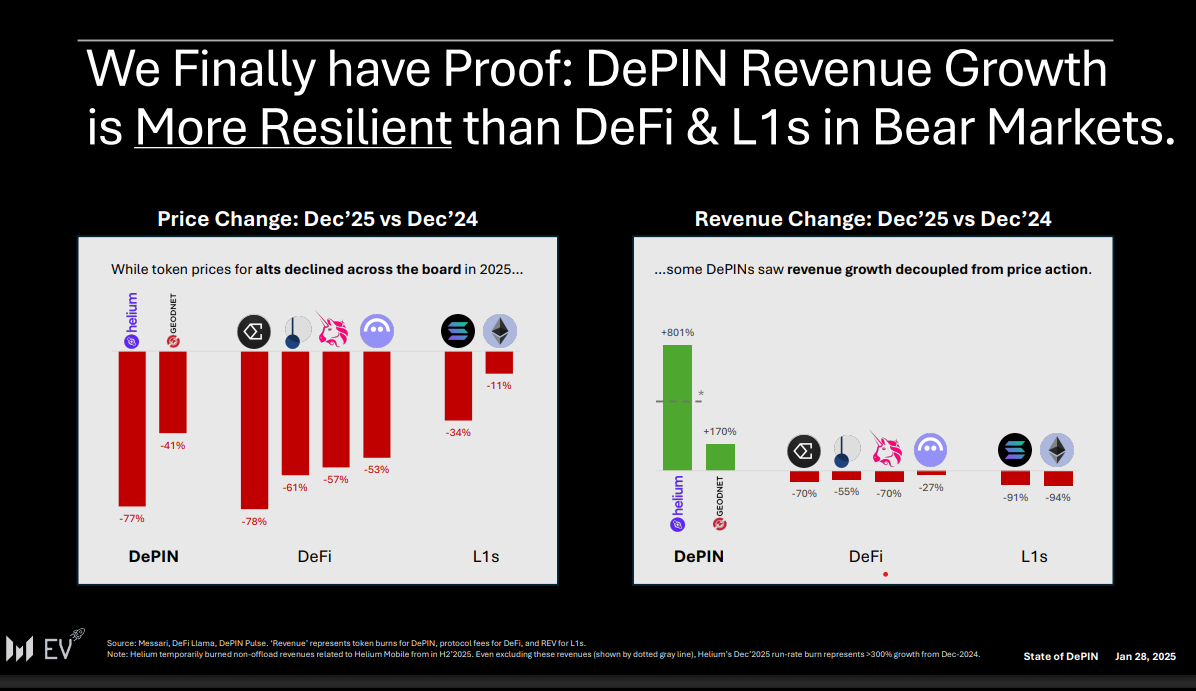
One of the report’s headline findings is that DePIN’s revenue growth has proven more resilient than decentralized finance (DeFi) and layer‑1s in the current bear market.
Related: New DePIN protocol rolls out ZK-proof processing marketplace
While DePIN tokens such as Helium (HNT) and GEODNET (GEOD) fell 77% and 41% in price from December 2024 to December 2025, their onchain revenue increased roughly 8 time and 1.7 times, respectively, over the same period, versus steep revenue declines for leading DeFi protocols and smart contract chains.
Levin said that the “big divider” across DePIN verticals was “whether the network can earn money from real customers without constantly leaning on incentives.”
He said that DePIN was “not tied to a single market economically,” and some areas, such as positioning, mapping and robotics, were beginning to show repeat use cases while others remained “more constrained by regulation and competitive pressure.”
InfraFi and DePIN’s emerging infrastructure trade
Last year was an all‑time‑high funding year for DePIN, with about $1 billion raised across the sector, up from $698 million in 2024 and well above prior cycles.
The report singles out “InfraFi” as an emerging DePIN/DeFi hybrid model in which stablecoin holders finance real‑world infrastructure and earn yield from those assets.
USDai, Daylight and Dawn are cited as early InfraFi examples in compute, energy and bandwidth, with USDai growing to about $685 million in user deposits to fund graphics-processing unit fleets.
Messari argues that the best DePIN tokens now resemble next‑generation infrastructure businesses in bandwidth, storage, compute and sensing, yet are trading at prices that “imply little chance of survival, let alone success.”
Levin said the networks that will “capitalize the most” are the ones that “can deliver to enterprise and artificial intelligence-driven demand sectors reliably.”
Magazine: Most DePIN projects barely even use blockchain — True or false?
Read the full article here
Fact Checker
Verify the accuracy of this article using AI-powered analysis and real-time sources.