

 Freedom Index
Listen to the article
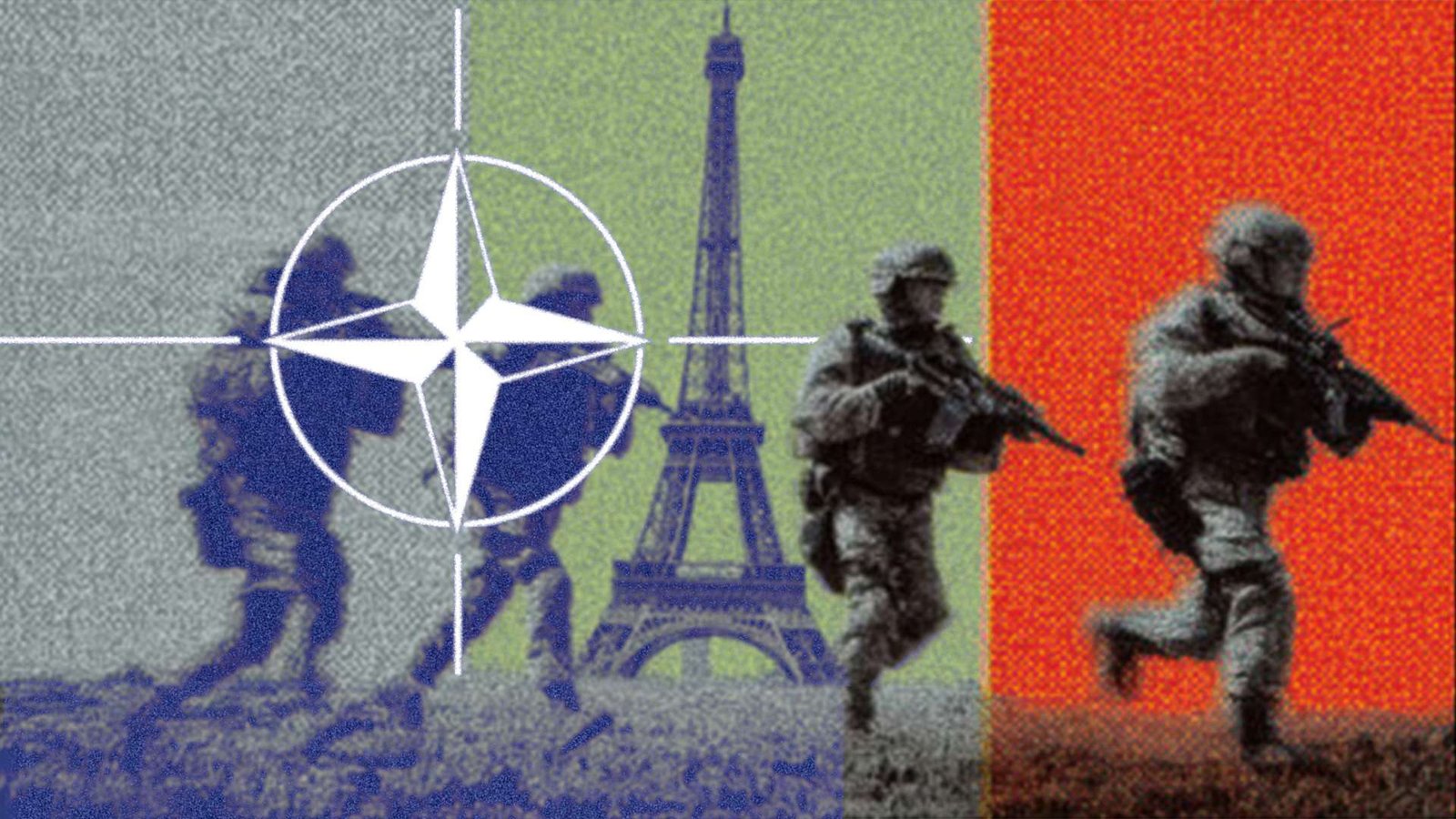
In recent days, top officials in France and Germany warned of looming confrontations between NATO and Russia. France’s top general and Germany’s intelligence chief both see violent conflicts short of all-out war by the end of the decade. The grim predictions come as the United States loses interest and ability when it comes to defending prosperous allies who have long hesitated to provide for their own security and instead sheltered under the American umbrella. Fortunately, despite their current enfeebled status, Europeans are still capable of countering Russia on their own if they so choose.
You are reading The Rattler from J.D. Tuccille and Reason. Get more of J.D.’s commentary on government overreach and threats to everyday liberty.
“Russia is a country that may be tempted to continue the war on our continent,” Fabien Mandon, France’s new defense chief, told legislators last week. “The first objective I have given the armed forces is to be ready in three or four years for a shock that would be a kind of test…. The test already exists in hybrid forms, but it may become more violent.”
Mandon’s words echoed those of Martin Jäger, the new head of Germany’s BND foreign intelligence service, who cautioned lawmakers two weeks ago that “Europe is experiencing, at best, an uneasy peace that could turn into heated confrontation at any moment.” He added that “Moscow believes it has a realistic chance of expanding its sphere of influence westward and making Europe, which is economically superior in many ways, dependent on Russia. To achieve this goal, Russia will not shy away from direct military confrontation with NATO if necessary.”
NATO was, of course, established as a counter to the late, unlamented Soviet Union and its puppet regimes in the old Warsaw Pact countries. The Soviet Union is gone, several of its onetime allies have since joined NATO, and Europe seemed safe in a much-changed world. Unfortunately, Russia’s imperial ambitions didn’t disappear with communism. And, during years of peace, most NATO countries not named “the United States” grew accustomed to largely outsourcing their defense to Americans.
As of 2021, according to the NATO Secretary General’s annual report from the year before Russia’s invasion of Ukraine, “eight Allies met the guideline of spending 2% of their GDP on defence, up from just three Allies in 2014” out of the 29 countries then in the alliance. “The United States accounted for 51% of the Allies’ combined GDP and 69% of combined defence expenditure.”
In real terms, this meant most NATO countries were unprepared to deploy their militaries for anything more serious than the occasional peacekeeping action and perhaps a few parades.
“The British military—the leading U.S. military ally and Europe’s biggest defense spender—has only around 150 deployable tanks and perhaps a dozen serviceable long-range artillery pieces,” The Wall Street Journal reported in December 2023. “France, the next biggest spender, has fewer than 90 heavy artillery pieces, equivalent to what Russia loses roughly every month on the Ukraine battlefield. Denmark has no heavy artillery, submarines or air-defense systems. Germany’s army has enough ammunition for two days of battle.”
The Ukraine invasion was a shock to the system that spurred Finland and Sweden to join NATO and convinced at last some Europeans that hoping Americans would forever do the heavy lifting was unwise. In the latest NATO Secretary General’s annual report, “22 Allies met the guideline of spending 2% of their GDP on defence…the United States accounted for 53% of the Allies’ combined GDP and 64% of combined defence expenditure.”
That is, the countries of an expanded NATO are doing better at meeting their obligations to build their military capabilities. But they’re barely catching up when it comes to their share of the alliance’s total military expenditures. Part of the issue is that even with a larger alliance, U.S. GDP represents a slightly larger share of total NATO GDP than it did a few years ago. The problem is that Europe’s tax- and rule-bound economies aren’t keeping pace with America’s generally freer system. Le Monde‘s Arnaud Leparmentier lamented in 2023 that with the growing gap, based on per-capita GDP, “Italy is just ahead of Mississippi, the poorest of the 50 states, while France is between Idaho and Arkansas, respectively 48th and 49th. Germany doesn’t save face: It lies between Oklahoma and Maine (38th and 39th).”
Even so, Europe must shoulder more of the burden. Tensions have grown globally and domestically, engaging U.S. attention far and wide, while the rest of NATO has more regional concerns. Trouble spots are proliferating even as the U.S. government spends itself into near bankruptcy; national debt now exceeds $38 trillion and the day of reckoning for an economic crisis rapidly approaches. And Americans—weary with foreign wars and long frustrated by free-riding NATO allies—have lost patience.
“With its fiscal constraints, heightened domestic issues, and a rising China, Europe has dropped down in the pecking order of America’s priorities,” defense analyst Benjamin Giltner notes for the Cato Institute.
Fortunately for the European nations of NATO (Canada seems committed to relying on its status as a neighbor that the U.S. can’t afford to not defend), they’re still—even with anemic economies—perfectly capable of taking Russia on their own. Germany’s population is smaller than Russia’s, but it’s technologically more sophisticated than its rival to the East and its $5.2 trillion GDP compares well to Russia’s $6 trillion GDP. Add in France’s $3.7 trillion GDP and its nuclear armory, the UK’s $3.6 trillion GDP and nuclear armory, or Poland’s $1.6 trillion GDP and massive conventional military buildup, and Russia should face significant opposition even without considering the resources of other NATO allies.
“A European-led NATO should adopt a defensive doctrine using a ‘defense-in-depth’ force deployment,” advises Giltner in his recent Their Own Two Feet analysis outlining a defense plan for the continent. “As part of a defense-in-depth deployment, European countries within NATO should eschew deep strikes into Russian territory, instead investing in and deploying light defenses in the Baltics and deploying their mechanized and armored capabilities throughout Germany and Poland.”
To spur transfers of responsibility, Giltner recommends “the United States should begin withdrawing American troops from Europe for several reasons, including to induce Europe to implement such policies.”
Europeans won’t be happy with a U.S. that withdraws its military umbrella (but remains economically and diplomatically engaged) but that’s a problem for Europe. The remaining countries of NATO will have to make hard decisions about priorities and should consider freeing their economies to encourage dynamism and growth. With top officials in France and Germany warning that Europe faces a threat from Russia, it’s high time that they and their countrymen act accordingly.
Read the full article here
Fact Checker
Verify the accuracy of this article using AI-powered analysis and real-time sources.