

 Freedom Index
Listen to the article
Can you judge the heat of a moral panic by the number of bills purporting to solve it? At the height of human trafficking hysteria in the 2010s, every week seemed to bring some new measure meant to help the government tackle the problem (or at least get good press for the bill’s sponsor). Now lawmakers have moved on from sex trafficking to social media—from Craigslist and Backpage to Instagram, TikTok, and Roblox. So here we are, with a House Energy and Commerce subcommittee hearing on 19 different kids-and-tech bills scheduled for this week.
The fun kicks off tomorrow, with legislators discussing yet another version of the Kids Online Safety Act (KOSA)—a dangerous piece of legislation that keeps failing but also refuses to die. (See some of Reason‘s previous coverage of KOSA here, here, and here.)
You are reading Sex & Tech, from Elizabeth Nolan Brown. Get more of Elizabeth’s sex, tech, bodily autonomy, law, and online culture coverage.
The new KOSA no longer explicitly says that online platforms have a “duty of care” when it comes to minors—a benign-sounding term that could have chilled speech by requiring companies to somehow protect minors from a huge array of “harms,” from anxiety and depression to disordered eating to spending too much time online. But it still essentially requires this, saying that covered platforms must “establish, implement, maintain, and enforce reasonable policies, practices, and procedure” that address various harms to minors, including threats, sexual exploitation, financial harm, and the “distribution, sale, or use of narcotic drugs, tobacco products, cannabis products, gambling, or alcohol.” And it would give both the states and the Federal Trade Commission the ability to enforce this requirement, declaring any violation an “unfair or deceptive” act that violates the Federal Trade Commission Act.
Despite the change, KOSA’s core function is still “to let government agencies sue platforms, big or small, that don’t block or restrict content someone later claims contributed to” some harm, as Joe Mullin wrote earlier this year about a similar KOSA update in the Senate.
Language change or not, the bill would still compel platforms to censor a huge array of content out of fear that the government might decide it contributed to some vague category of harm and then sue.
KOSA is bad enough. But far be it for lawmakers to stop there.
As part of the “Legislative Solutions to Protect Children and Teens Online,” members of the House subcommittee on Commerce, Manufacturing, and Trade will also consider the Shielding Children’s Retinas from Egregious Exposure on the Net (SCREEN) Act (H.R. 1623), which would create a federal age verification for adult websites, and the App Store Accountability Act (H.R. 3149), which would require app stores to verify the ages of everyone who uses them.
They’ll consider the Reducing Exploitative Social Media Exposure for Teens (RESET) Act, which would ban people under age 16 from creating social media accounts and require platforms to delete existing accounts, and another bill (H.R. 6257) that would ban minors from sending messages that disappear.
There’s one on chatbots: the Safeguarding Adolescents From Exploitative (SAFE) Bots Act. There’s one on gaming: the Safer Guarding of Adolescents from Malicious Interactions on Network Games. There’s an updated version of the Children’s Online Privacy Protection Act, which would extend regulations aimed at children under 13 to anyone under age 17.
All in all, the number and breath of these measures is staggering. Other bills in this suite of so-called safety measures include:
Techdirt editor in chief Mike Masnick calls this week’s hearings a sort of “shock and awe campaign,” in which lawmakers say the measures they’re debating are about protecting children but most of them “are actually about censorship and control.”
“Don’t buy the framing,” added Masnick. “It’s always the same damn thing.”
If you’ve got a masochistic streak, you can tune in to a livestream of the hearing tomorrow starting at 10:15 a.m.
Does Big Tech do more good than harm?
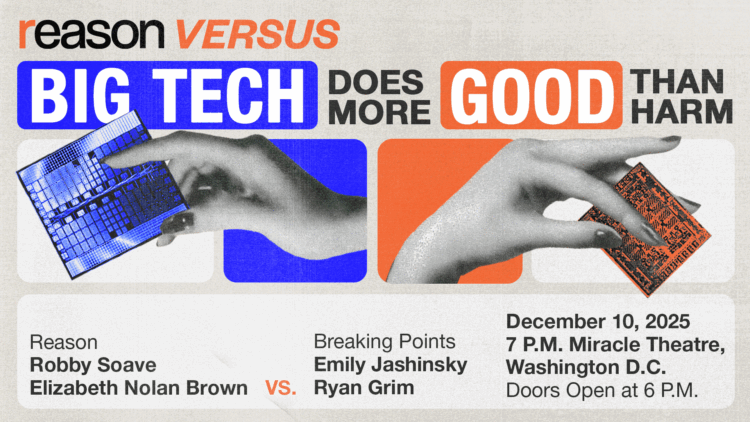
In the next installment of Reason‘s debate series, Robby Soave and I will be arguing that Big Tech does more good than harm. We’re up against Breaking Points‘ Emily Jashinsky and Ryan Grim. If you’re in the D.C. area, you can check it out live on December 10 at the Miracle Theatre, starting at 7 p.m. Tickets are $25 if you get them by December 3 ($30 after).
More Sex & Tech News
• Health and Human Services secretary Robert F. Kennedy Jr. shared a Thanksgiving greeting on X with a picture of himself enjoying what appears to be an AI-generated (or at least very badly Photoshopped) Thanksgiving feast aboard Air Force One. As many users pointed out, the image appears to be a revised version of an image from November 2024 in which Kennedy, Donald Trump, Donald Trump Jr., Elon Musk, and House Speaker Mike Johnson were eating McDonalds.

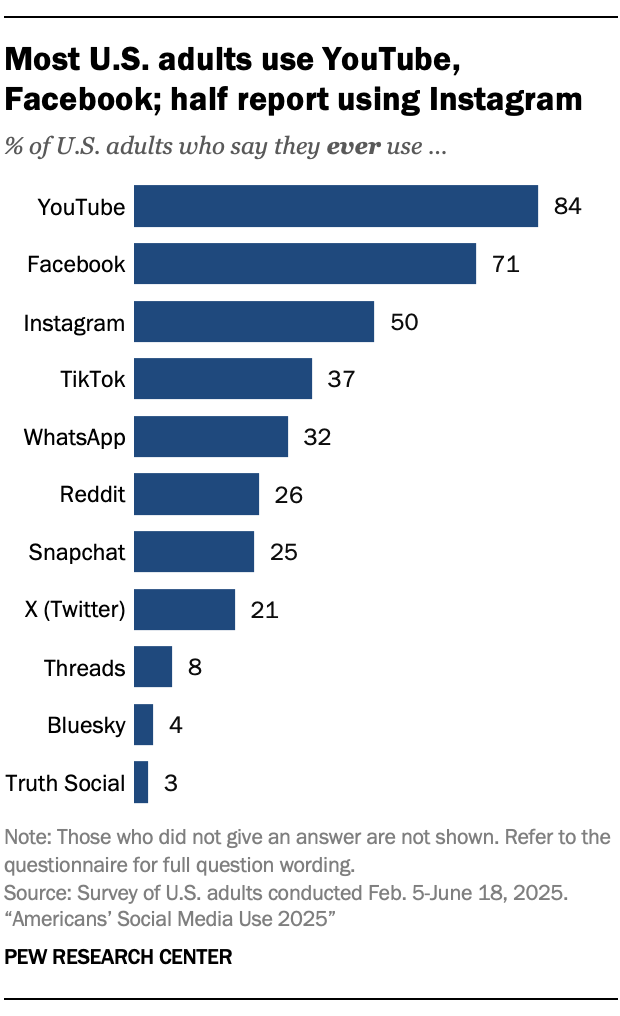
• If it seems to you like no one is using Facebook anymore…you’re wrong. According to the Pew Research Center, it’s still the second-most popular social media platform in the U.S., bested only by YouTube. Some 84 percent of the U.S. adults polled said they sometimes use YouTube, while 71 percent say they use Facebook. “Half of adults say they use Instagram, making it the only other platform in our survey used by at least 50% of Americans,” notes Pew.
• J.D. Tuccille on the European Union’s latest online surveillance scheme:
As I write, European Union (E.U.) officials are debating the details of a proposal to either require or pressure tech companies to scan all private messages for child sexual abuse material. Dubbed “chat control,” the scheme inevitably entails mass surveillance of private communications—targeting one sort of content for the moment, though it’s difficult to see how that would long remain limited in any way. It’s an illustration of the continuing decline in online liberty documented in a new report from Freedom House.
• The Atlantic‘s Charlie Warzel reflects on three years of ChatGPT.
• Missouri’s age verification for porn law took effect yesterday.
Today’s Image

Read the full article here
Fact Checker
Verify the accuracy of this article using AI-powered analysis and real-time sources.