

 Freedom Index
Listen to the article
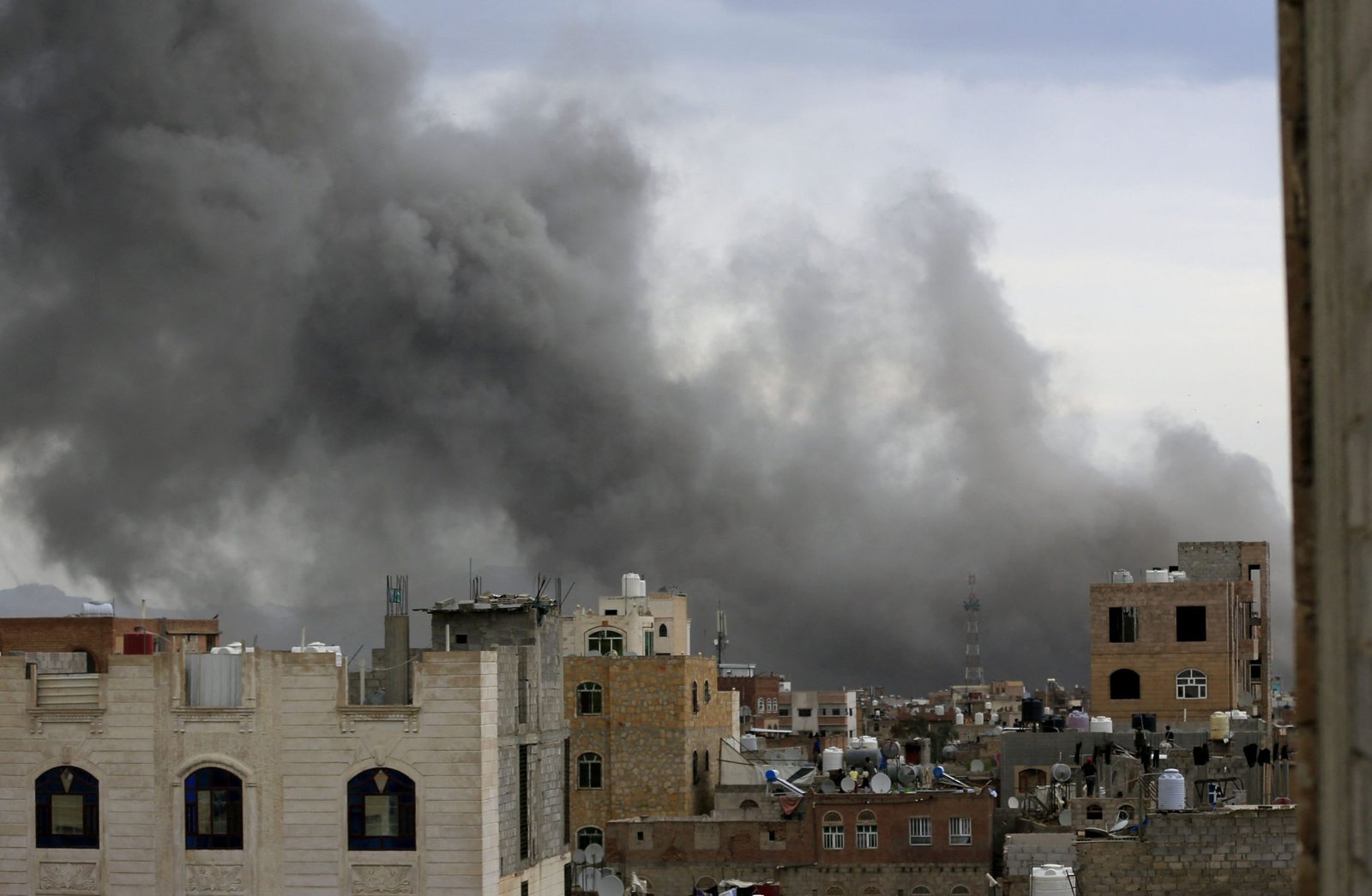
Washington, D.C., September 19, 2025—Israel’s targeted strikes on two newspaper offices in Yemen’s capital, Sanaa, which killed 31 journalists and media support workers on September 10, signal that its deadly pattern of attacking reporters and newsrooms on the grounds that they publish “terrorist” propaganda has spread firmly across the Middle East.
Yemen’s September 26 newspaper was the first to name the 31 killed by multiple strikes on its office and that of the Yemen newspaper, both in the government’s Moral Guidance Directorate’s headquarters. All but one of the dead worked for the two outlets.
Nasser Al-Khadri, editor-in-chief of 26 September, described the killings as an “unprecedented massacre of journalists,” with multiple strikes hitting its newsroom at around 4:45 p.m. as staff were finalizing publication of the weekly paper, which is the Yemeni army’s official outlet.
“It is a brutal and unjustified attack that targeted innocent people whose only crime was working in the media field, armed with nothing but their pens and words,” he told CPJ, adding that many colleagues were reduced to body parts.
A child, who had accompanied a journalist to work, was among the dead, Al-Khadri said, while 22 journalists were injured.
The incident is the second deadliest single attack on the press ever recorded by CPJ, following the 2009 Maguindanao massacre in the Philippines, in which 32 journalists were among those killed when a convoy was ambushed.
Al-Khadri called on the international community to take a firm stance.
“The Israeli military destroyed the newspapers’ facilities, printing presses, and archives. The archive of 26 September is one of Yemen’s most important historical records, documenting the country’s history since the last century, and its loss is deeply painful,” he told CPJ.
Smearing journalists as terrorists
Israel’s attack on Yemen echoes previous strikes on Gaza, Lebanon, and Iran, where it has repeatedly failed to distinguish between military targets and journalists, justifying its assassinations by smearing journalists as terrorists or propagandists, without credible evidence. As civilians, journalists are protected under international law, including those working for state-run or armed group-affiliated outlets, unless they take direct part in hostilities.
On September 10, the Israel Defense Forces (IDF) said on X that it had struck “military targets” in Sanaa and northern Al-Jawf Governorate, including the “Houthi Public Relations Department” that distributed “psychological terror.” In a September 18 email to CPJ, the IDF’s Foreign Media Desk added, “The terrorist regime’s Public Relations Department is responsible for distributing and disseminating propaganda messages in the media, including speeches by Houthi leader Abdul-Malik and statements from spokesman Yahya Saree.”
The IDF said the strikes were in response to repeated Houthi attacks on Israel, which the rebels have declared an act of solidarity with Palestinians since the Israel-Gaza war began in 2023. The Iranian-backed Houthis took control of Sanaa in 2014 and have been fighting a Saudi-backed coalition supporting Yemen’s internationally recognized government for a decade.
Abdulrahman Mohammed Mutahar, a journalist living 500 meters from the site, told CPJ the attack caused “massive explosions unlike anything Sanaa had seen since 2015.”
He said about eight missiles reduced the Moral Guidance Directorate headquarters to rubble, leaving some journalists’ bodies buried underneath.
“Targeting journalists aims to silence the truth,” Nabil Al-Asidi, a board member of the Yemeni Journalists Syndicate, told CPJ, adding that several of those killed were prominent, long-standing members of his union.
Israel extends it war on journalists beyond Gaza
CPJ has long documented Israel’s tactic of portraying journalists as combatants to excuse their killing. Months before the current Gaza war, CPJ’s 2023 “Deadly Pattern” report detailed five unsubstantiated claims of terrorism or militant activity against journalists killed by Israeli forces between 2004 and 2018.
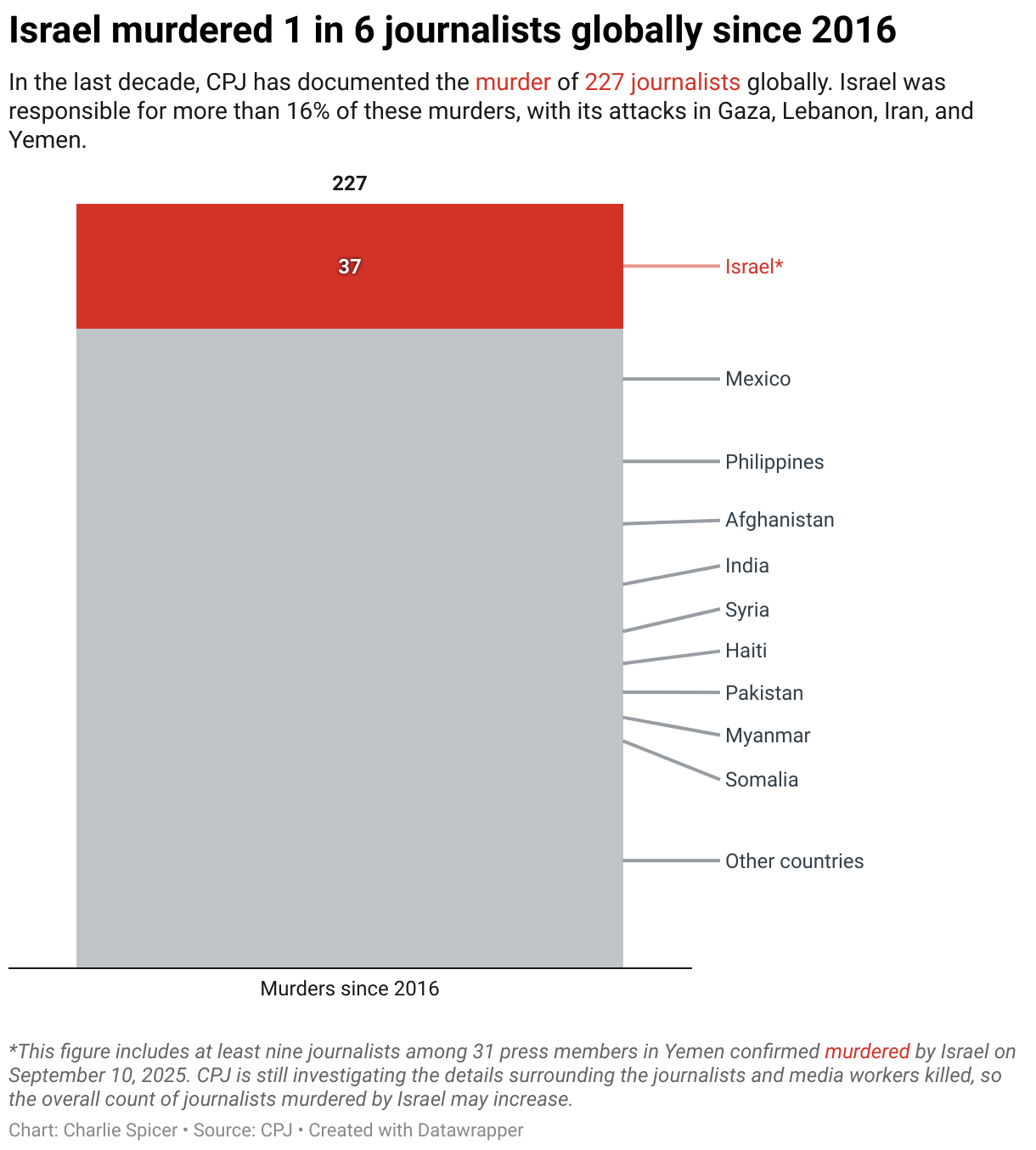
CPJ is classifying Israel’s 31 killings in Yemen as murders — deliberate targeting of journalists for their work. Prior to the September 10 attack, CPJ had determined that more than two dozen other journalists and media workers had been murdered by Israel after the start of the war on October 7, 2023.
An August investigation by the independent Israeli magazine +972, found that the IDF runs a “Legitimization Cell” that frames Gaza-based journalists as Hamas operatives, in an effort to blunt global outrage over multiple killings.
In recent weeks, condemnation has intensified with two attacks that clearly targeted the press. On August 10, six journalists were killed in media tents near Gaza City’s Al-Shifa Hospital, including Al Jazeera correspondent Anas al-Sharif, one of several journalists that Israel alleged, without evidence, were members of Hamas. On August 26, another five journalists were killed at Khan Yunis’ Nasser Hospital, sanctioned by an Israeli report that said a Hamas camera was the target and six “terrorists” were “eliminated.”
“Since October 7, 2023, Israel has emerged as a regional killer of journalists, with repeated incidents in Gaza, Lebanon, Iran, and now Yemen confirming Israel’s longstanding pattern of labeling journalists as terrorists or propagandists to justify their killings,” said CPJ Regional Program Director Sara Qudah. “Israel’s September 10 strikes on two newspaper offices in Yemen marks an alarming escalation, extending Israel’s war on journalism far beyond the genocide in Gaza. This latest killing spree is not only a grave violation of international law, but also a terrifying warning to journalists across the region: no place is safe.”
CPJ research shows that Israel has killed 193 journalists and media workers in Gaza, six in Lebanon, three in Iran, and 31 in Yemen since the start of the Gaza war. CPJ has determined that at least nine of the 31 are journalists and is still investigating details on other press members in Yemen before updating its database with these numbers.
In Lebanon, three journalists were killed in an October 2024 overnight Israeli airstrike on a compound where 18 journalists were staying. The IDF said it targeted a site where “terrorists were operating,” referring to the Iranian-backed Lebanese militant group Hezbollah, which — like the Houthis — had been firing rockets and drones into Israel, in what it described as “solidarity” with Gaza.
The journalists who died worked for pro-Hezbollah channel Al-Mayadeen and Hezbollah-owned station Al-Manar. The IDF later acknowledged that journalists were among the casualties and said the incident was under review.
In Iran, one journalist and one media worker died on June 16, 2025, after an Israeli strike hit the headquarters of Iran’s state-owned television channel, which Defense Minister Israel Katz said targeted “the Iranian regime’s propaganda and incitement broadcasting authority.” Another journalist died the day before in an Israeli strike near Quds Square in the capital, Tehran, as he was driving from a meeting.
With strict censorship, Yemeni journalists pay ‘a double price’
It has proven nearly impossible for Yemeni journalists to report on the aftermath of recent Israeli and U.S. attacks due to Houthi authorities’ strict censorship, three journalists and press freedom representatives told CPJ, on condition of anonymity, citing fear of reprisals.
Within hours of the September 10 strikes, the Public Prosecutor banned the publication of photos and videos from the target sites. This followed a May directive requiring people wishing to film or report within Sanaa to obtain prior authorization from the information ministry.
“Yemeni journalists are paying a double price for their work — first from deadly Israeli airstrikes targeting journalists and media outlets, and second from local actors, including the Houthis, who use the war as a pretext to expand repression,” Yousef Hazeb, head of the National Organization of Yemeni Reporters (SADA), told CPJ.
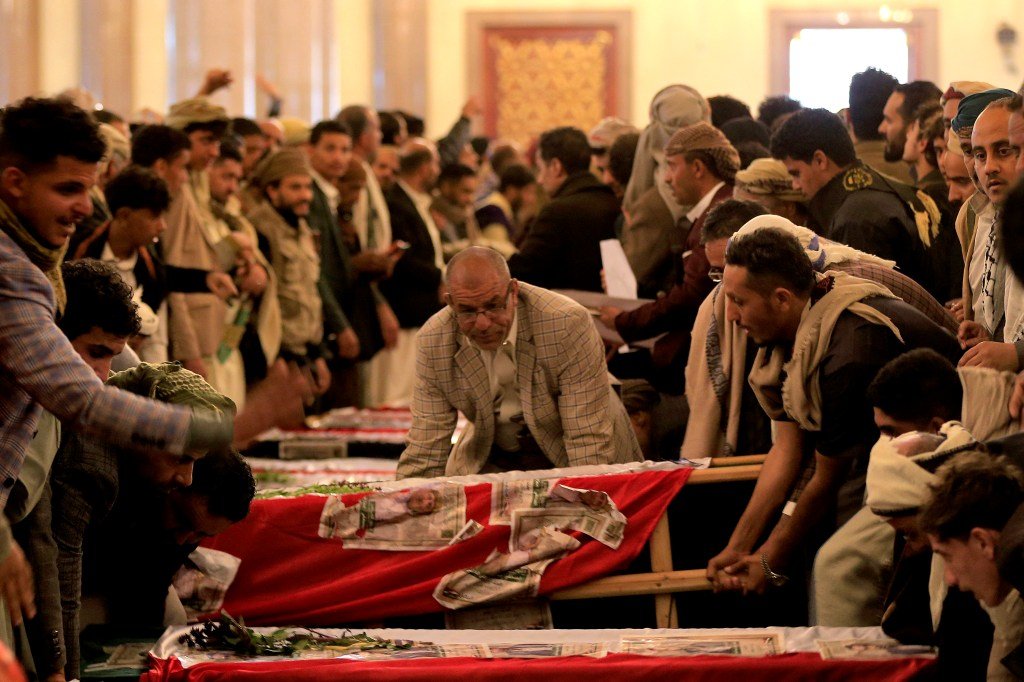
The ongoing violence in Yemen is another risk factor. On September 16, further Israeli strikes disrupted the funerals of the 31 journalists and media workers and other civilians killed on September 10.
Yemen has long been one of the world’s most dangerous countries for journalists, where they endure systematic repression from multiple warring parties. Arbitrary detention, enforced disappearances, blocking of online outlets, and unfair trials occur with near-total impunity.
“There is fear this Israeli attack will go unpunished, encouraging Israel and other parties to commit further violations and putting Yemeni journalists’ lives and freedoms at greater risk,” Khalil Kamel, Monitoring and Documentation Officer at the Yemen Observatory for Media Freedoms, a local advocacy group, told CPJ.
“The impunity of all parties — Houthis, the Yemeni government, the Southern Transitional Council, and Al-Qaeda — has emboldened them to commit even more brutal abuses against journalists,” he said, referring to four combatant groups active in Yemen.
The names of the 31 journalists and media workers killed are listed here and here.
Read the full article here
Fact Checker
Verify the accuracy of this article using AI-powered analysis and real-time sources.