

 Freedom Index
Listen to the article
The permanent U.S. presence in the Middle East started in the oil-rich Arab monarchies of the Persian Gulf. Immediately after the withdrawal of the British Empire in 1971, the U.S. Navy took over the old British fortress in Bahrain. Nine years later, President Jimmy Carter declared the security of the Gulf part of the “vital interests of the United States” in a speech later dubbed the Carter Doctrine. Four years after that, the U.S. military created Central Command (CENTCOM) to oversee the Middle East, with forward headquarters in Bahrain, Qatar, and Kuwait.
But the war with Iran has rendered several U.S. bases in the Gulf “all but uninhabitable,” forcing American personnel to disperse to nearby civilian office spaces and hotels, according to The New York Times. Those places are not necessarily safe, either: Iranian drones wounded two Pentagon employees at a Bahraini hotel early in the war. Over the weekend, a combined Iranian missile and drone attack on Prince Sultan Air Base in Saudi Arabia destroyed a valuable E-3 Sentry radar surveillance plane (the U.S. has only 16 in total), damaged several aerial tankers, and wounded 10 Americans.
The Israeli military sees this damage as an opportunity to permanently “reshape the map” of U.S. military presence and is pushing the U.S. to move its bases from other parts of the Middle East to Israel, officials told Israel’s Channel 12. (Asked for comment, the U.S. State Department referred Reason to the Pentagon, which did not respond.) From the perspective of hawks in Washington, this move may be a way to have their cake and eat it, too. While appearing to move American troops out of harm’s way, they can keep the U.S. deeply embedded in the region’s wars.
The Gulf monarchies, worried that Americans are not politically committed to defending them, have spent billions of dollars trying to keep U.S. presidents happy. Now they are discovering that they are the physically weakest link in the U.S. presence in the Middle East. Still, the U.S. military hasn’t given up entirely on the Gulf. The Department of Defense has put out contract requests for a new hardened command center in Qatar, with work set to begin in 2028, as well as mobile prefabricated bunkers that can be delivered this month. Much of the U.S. aerial fleet has continued to fly out of Saudi air bases.
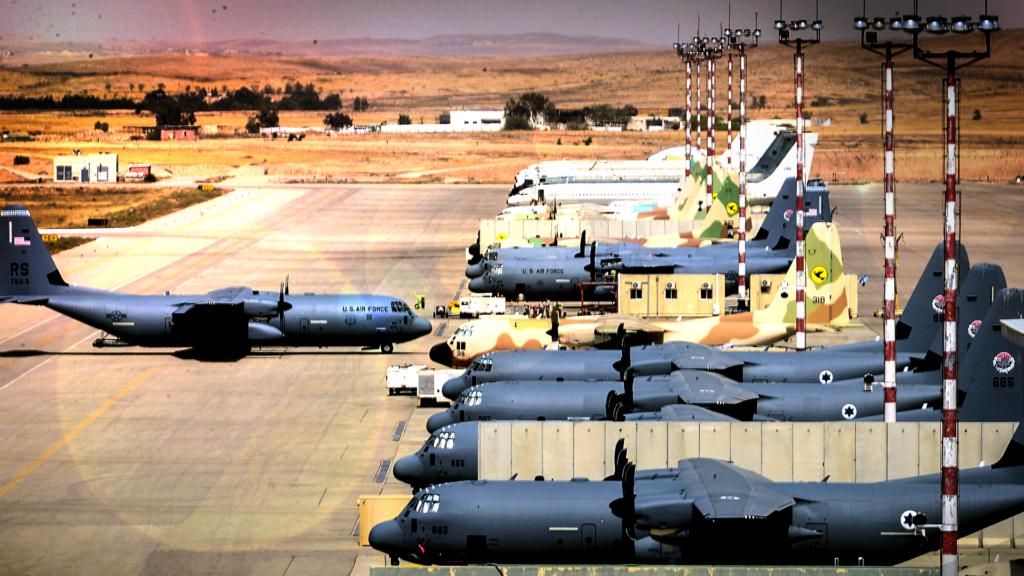
But there has been a yearslong effort to build up an alternative U.S. presence in Israel. The Bush administration sent American personnel to set up an AN/TPY-2 missile defense radar near the Israeli nuclear facility at Dimona. The Obama administration launched Juniper Cobra, the largest joint U.S.-Israeli exercises in history. The Trump administration built the first publicly acknowledged permanent U.S. base on Israeli soil in 2017, and the Biden administration shifted Israel from the U.S. European Command to CENTCOM’s area of responsibility in 2021.
Meanwhile, the U.S. military spent a quarter of a billion dollars expanding its presence at Muwaffaq Salti Air Base, in the desert oasis of Azraq, Jordan, similarly far from the Gulf. Although most of these bureaucratic and logistical moves did not get much attention at the time, they were in quiet preparation for war with Iran.
When CENTCOM moved to Israel in 2021, it inherited several publicly known bases from European Command. Site 512 is a missile defense radar in the desert of southern Israel, and Site 883 is a support base for that radar. (It is unclear whether the nearby radar at Dimona is still operated by Americans.) Sites 51 and 53 are weapons warehouses at undisclosed locations, part of the War Reserve Stock, a cache of U.S. ammunition stored in Israel for easy access. Site 61 is a command center at Hatzor Air Base, just outside the port city of Ashdod, that was later used for humanitarian aid to Gaza. And Site 81 is an underground command bunker in Tel Aviv.
An email from an American lieutenant colonel to his Israeli counterparts about the transfer, later leaked from the Israeli Ministry of Defense and published by the nonprofit Distributed Denial of Secrets, mentions two additional bases: Site P and Site 60. Details from other emails about Site P match public Israeli announcements about Palmachim Air Base, just south of Tel Aviv. It is unclear where Site 60 is. Asked about these bases, CENTCOM’s media office declined to comment.
Last year, the Israeli newspaper Ha’aretz reported on several other U.S. military construction projects in Israel, matching public U.S. Army contract tenders to other known details about Israeli bases. Some of the projects were for exclusive Israeli use, such as a new Israeli Navy headquarters, while others would make it easier to move American aircraft and weapons into the country. Site 20136 is a facility for CH-53K transport helicopters at Tel Nof Air Base, between Tel Aviv and Jerusalem. Site 911 is a mysterious five-story underground bunker at Nevatim Air Base, in the southern Israeli desert.
In November 2025, the U.S. military opened a surveillance base in the Israeli city of Kiryat Gat to monitor the ceasefire in Gaza. In the buildup to the current war, the U.S. Air Force moved F-22 fighter jets to Ovda Air Base in the southern Israeli desert and KC-135 aerial tankers to Tel Aviv’s international airport. Many of the U.S. air raids on Iran have been carried out from those places. Satellite imagery shows new construction at Ovda Air Base since the arrival of U.S. forces.
Bases in Israel are hard for Iran to hit with accuracy. The same goes for Muwaffaq Salti Air Base, which has also hosted U.S. aircraft during the war. But Iran can still hit them. Two weeks ago, CENTCOM acknowledged that American troops have been wounded in Israel and Jordan, without mentioning the specific number or circumstances. Satellite imagery also shows that the AN/TPY-2 radar at Azraq has been destroyed.
Their effectiveness against Iran may be reduced without access to the Gulf. Aircraft based in Israel and Jordan have to fly further and cannot loiter as long over Iranian targets. Israeli missile interception rates seem to have declined after Iran damaged U.S. radars in the Gulf, though it’s unclear whether the two are directly linked.
The greatest implication of moving the U.S. military presence from the Gulf to Israel would be political. Abandoning the oil-rich Gulf means abandoning the main justification for U.S. involvement in the Middle East. At the same time, a U.S. buildup in Israel means breaking the promise that decades of massive U.S. aid to Israel were built on. Israel’s selling point to Americans has always been that, unlike the Arab states, it can fight its own wars.
“I know of American troops fighting and dying on behalf of Kuwait, Saudi Arabia, Iraq’s Kurds and Shia (and so on), but not on behalf of Israel. No American soldier has ever died in the defense of Tel Aviv. Nor would Israelis want American soldiers to die on Israel’s behalf—self-sufficiency being a governing idea of Zionism,” Jeffrey Goldberg, now editor in chief of The Atlantic and a veteran of the Israeli army, wrote in 2011. Today, U.S. troops are being asked to take fire in defense of Tel Aviv. Tomorrow, that may become the main reason for staying in the Middle East at all.
Read the full article here
Fact Checker
Verify the accuracy of this article using AI-powered analysis and real-time sources.