

 Freedom Index
Listen to the article
As many Americans have learned over the past year since “Liberation Day,” tariffs can warp supply chains in a variety of ways.
Most importantly, they raise prices for consumers. In fact, consumers end up paying the full cost of a tariff and then some.
That’s according to a recent study published by the National Bureau of Economic Research that tracked how tariffs impact producers, importers, distributors, and consumers. To do that, the paper’s five authors tracked a single bottle of imported wine as it moved through the global supply chain.
Consider it a boozy, tariff-themed recreation of “I, Pencil.”
What they found is that foreign producers absorb some of the cost of a tariff by reducing prices. That’s an argument that President Donald Trump and his allies have made: that foreign companies “eat” the cost of a tariff and reduce prices to remain competitive.
However, the researchers found that consumers ended up paying higher prices anyway. “Our main finding is that the markups along a distribution chain make it possible for the consumer to fully pay for the cost of the tariffs in dollar terms even when the foreign supplier partially absorbs the tariff by lowering its price,” they conclude.
Here’s how that happens:
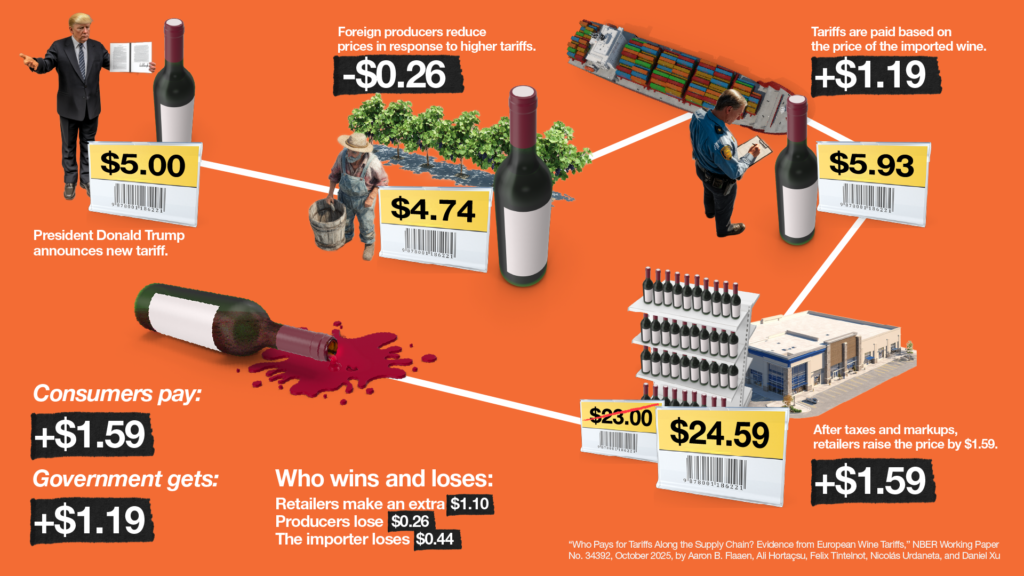
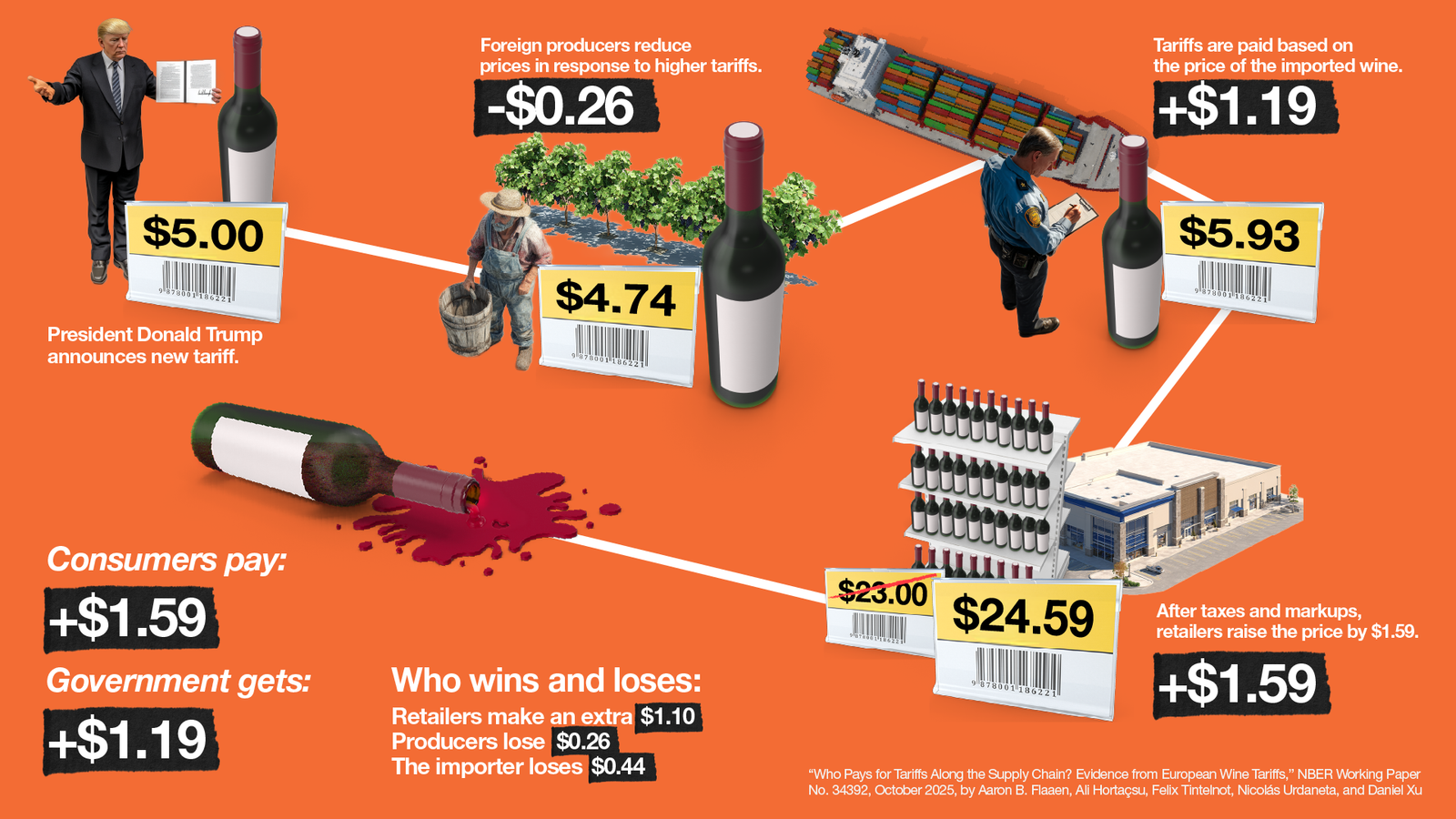
The study began with a bottle of wine that, before tariffs, would have been exported for $5 and would have cost an American consumer $23 on a liquor store shelf.
After a 25 percent tariff on wine was implemented, the researchers found that exporters would reduce their prices. The $5 bottle of wine now gets exported for an average price of $4.74, which means the producer is losing 26 cents per bottle.
When the wine is imported to the U.S., a 25 percent tariff is applied to the price. The government makes $1.19 per bottle, and the cost is passed down the supply chain.
Taxes and other markups apply, just as they did before the tariff was in effect. After those are taken into account, the retail price of that same bottle of wine is now, on average, $1.59 higher than it was before the tariff.
As a result, “tariff revenue for this particular tariff event was more than fully offset by increases in consumer prices,” the authors conclude. Consumers end up paying an average of 134 percent of the tariff increase, even though foreign producers lowered their prices.
The study illustrates a key economic problem with tariffs. They make almost every party in the transaction worse off. Producers lose out by lowering export prices, and consumers are harmed by higher retail prices.
Only the government, which now gets to collect more taxes, comes out ahead.
Read the full article here
Fact Checker
Verify the accuracy of this article using AI-powered analysis and real-time sources.