

 Freedom Index
Listen to the article
I am not one to get to the airport early. Why would I? I take no joy in sitting in a terminal. I do not need to eat at Chili’s. I will not join the Group 5 passengers who preemptively crowd around the boarding door like they’re waiting for the last chopper out of Saigon. And I am not opposed to an airport sprint (I could probably use the cardio), though it rarely gets to that point. I have never missed a flight.
So imagine my dismay when the closest I came to doing so, if memory serves, was when I arrived at the airport three hours and 40 minutes prior to takeoff on Sunday.
My flight home from a wedding in New Orleans coincided with the 37th day of the Department of Homeland Security (DHS) shutdown, which, among other things, has seen agents with the Transportation Security Administration (TSA) go unpaid. Hundreds have resigned. Several airports, including New Orleans, have seen sky-high call-out rates. On Sunday, 42.3 percent of TSA officers there called out of work, per numbers provided by the federal government.
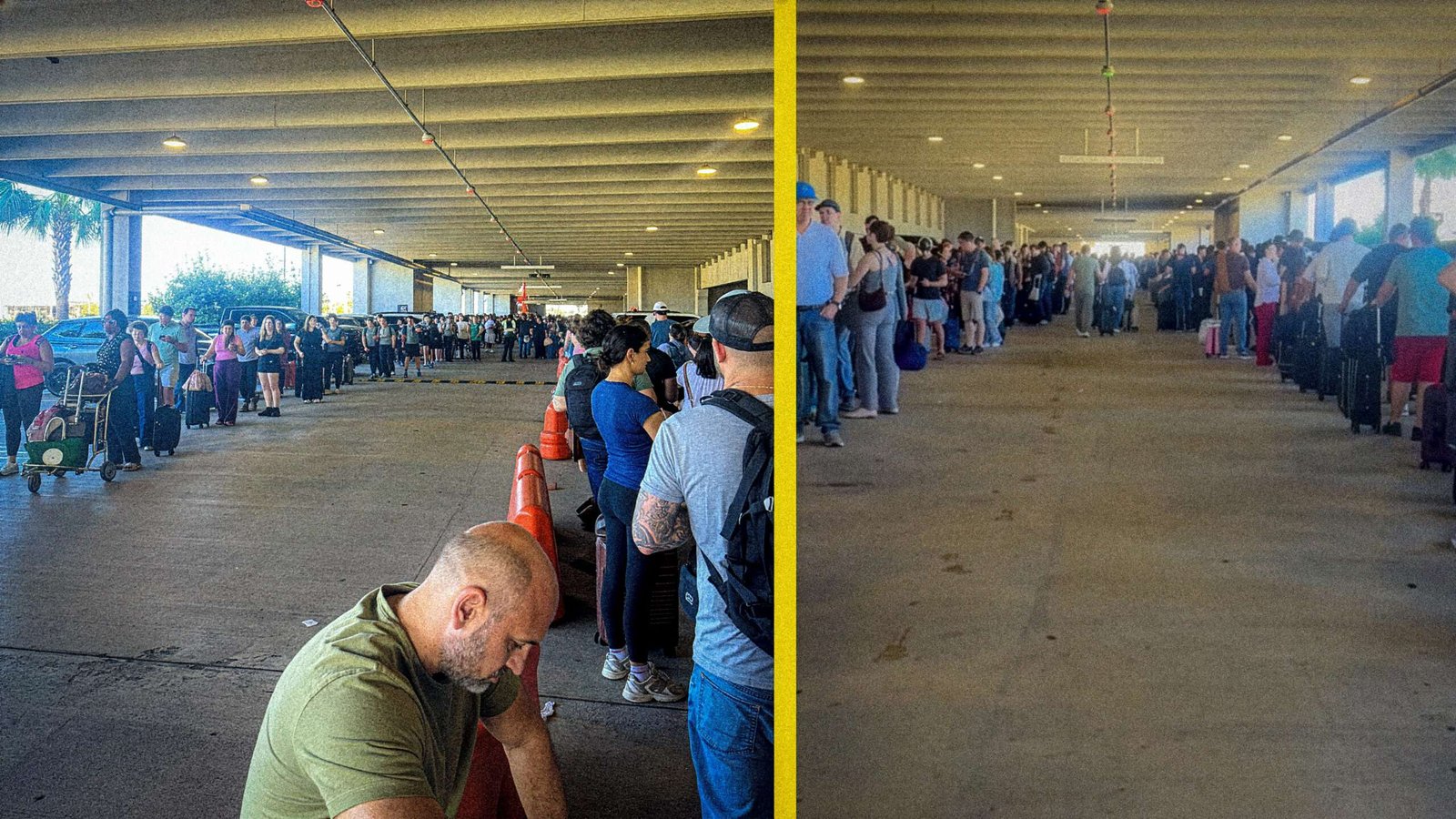
The result was more disastrous than I could have imagined. Upon entering the airport, the security line spilled down from the second floor into the lobby, where I got in line. Except that was not the end of the line. It was a break in the line, which had fractured as people filed in from the parking garage, where the line actually ended. So to the garage I went. Finding the end point was another thing entirely. Passengers were instructed that they would know they had reached their destination when they saw, hilariously, a red flag. So around and around we walked in the concrete maze, flanked by people on both sides, who were somehow standing in the same line. Which side was ahead? Which was behind? Who can say?!
The prize for finally making it to the end: a three-hour, 20-minute TSA wait, which consisted of about two hours in the garage, an hour and change inside, anxious phone-checking on a dying device, a pair of travelers concocting a business idea for a TSA-line beverage service with very high market prices we were all willing to pay, a woman doing yoga, travelers asking to cut in front because their flight was boarding (which, um, hello), and a fire alarm going off that we all just sort of ignored.
Also present in the air around us was (shockingly) a lot of frustration. Abolishing the TSA is often viewed as a kooky pipe dream. But I have never seen such a clear, obvious case for doing just that than the TSA line in New Orleans, which existed only because the functionality of airport security currently depends on whether Congress can agree on a budget. People will bicker over whether the fault lies with Republicans or Democrats. Beyond debate, however, is that scores of people have been inconvenienced or had their lives temporarily upended because federal lawmakers could not reach consensus on what is arguably the most basic part of their job: approving spending bills. The ability to get home should not be a privilege contingent on the political moment.
There are, of course, objections beyond this, including that the TSA isn’t very good at what it does. A DHS investigation in 2015 found that undercover operatives successfully got mock explosives or banned weapons through airport security 95 percent of the time. “Experts have long emphasized that the TSA is geared towards assuring the public that Something Very Important is being done to keep people safe, even as money and energy is squandered on pointless activities and useless devices,” wrote Reason Contributing Editor J.D. Tuccille in 2022. Consider that travelers were recently permitted to go through TSA lines with their shoes on after years of having to remove them. The world kept spinning, and the planes kept flying. One security measure taken after 9/11 was very important: Cockpit doors now lock, so no longer is it possible for a wannabe hijacker to break in with a box cutter, a change more consequential than the creation of an entire agency.
But more to the point of the current fiasco, also consider that several airports across the U.S. have largely privatized security. That includes San Francisco, a major hub that has not missed potential terror attacks and is currently not drowning in call-outs and lengthy lines. Those private contractors are still subject to regulations, but their ability to fund operations does not hinge on the whims of politicians. Commercial airports in Canada and most of Europe also use private screeners.
What is the argument against this? “If I was a traveling passenger, I would be so much happier to know that these TSA officers are career dedicated civil servants to have nothing else to do but to make sure that I get to where I’m supposed to be safely,” Johnny Jones, secretary treasurer for the American Federation of Government Employees, told San Francisco’s ABC affiliate.
I cannot speak for everyone. But my happiness at the airport hinges purely on whether I get to my destination safely and on time. After arriving at the New Orleans airport before 2 p.m., I found myself sprinting to the gate (hello, old friend) at 5:20 p.m., hoping to make it before the gate closed imminently. The gate agent appeared skeptical that I still had a seat, I assume because they were in the process of reassigning no-shows to those who had missed previous flights for the same reason I was about to miss mine. I was not happy about the situation, nor, I imagine, were the passengers who missed what was the last American Airlines flight to D.C. that evening. Had we been in San Francisco, that would not have been the case.
Read the full article here
Fact Checker
Verify the accuracy of this article using AI-powered analysis and real-time sources.