

 Freedom Index

Listen to the article
Key takeaways
-
Strategy funds its dip buying primarily through ATM equity sales rather than operating cash flow.
-
Preferred shares and other financing tools add buying power but create ongoing dividend and interest obligations.
-
A $1.44-billion reserve is intended to reduce “forced seller” concerns during prolonged market slumps.
-
The model’s constraint is the cost of capital. Dilution risk, market sentiment and index rule changes can tighten the loop.
Strategy just spent another $980.3 million on Bitcoin (BTC), adding 10,645 BTC at an average price of $92,098 and lifting its total holdings to 671,268 BTC.
It’s the kind of headline the company has trained the market to expect. When price weakness shows up, Strategy treats it like inventory season.
What makes this round more interesting is the backdrop. Bitcoin has been sliding sharply from recent highs, and Strategy’s own stock often feels that drawdown as a leveraged proxy.
At the same time, the firm has been building a $1.44-billion reserve to calm concerns that dividend and interest obligations could eventually force a Bitcoin sale during a prolonged slump.
So, the real question isn’t whether Strategy wants to buy dips; it’s how it keeps finding the money to do it and how durable that machine is if markets stay ugly.
The “Bitcoin treasury” model
Strategy treats Bitcoin as its balance sheet centerpiece, using public market financing to grow holdings faster than a typical company could through operating cash flow.
In practice, that means raising capital through instruments such as at-the-market (ATM) share sales and other issuances, then deploying the proceeds into BTC even when prices are volatile.
To keep the story legible for investors, Strategy leans on a set of Bitcoin-native metrics. The key one is “BTC Yield,” which the company defines as the period-to-period change in Bitcoin per share, its “BPS” ratio, tracking whether each diluted share is backed by more Bitcoin over time.
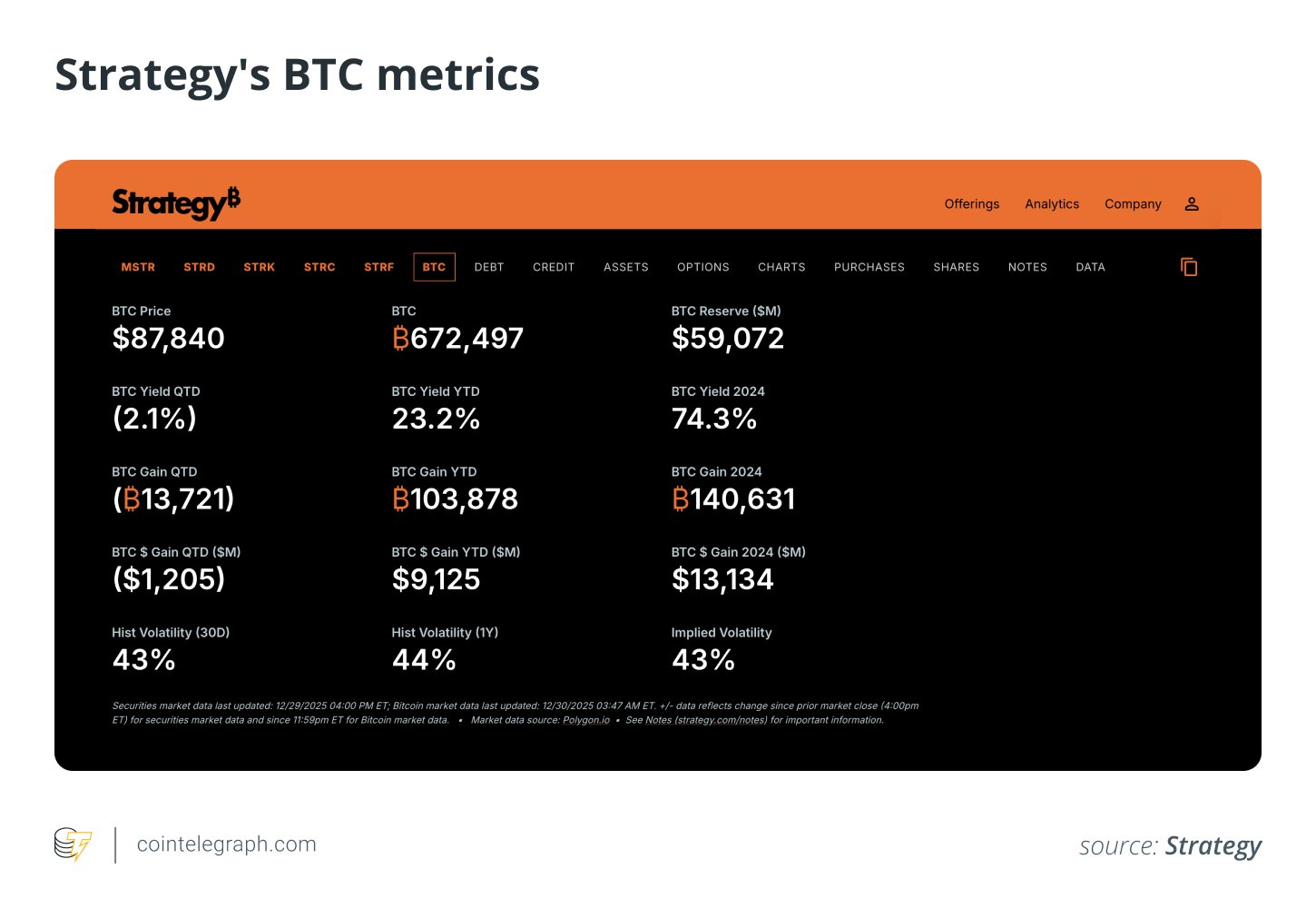
So, the pitch becomes less “we bought more BTC” and more “we increased BTC exposure per share.”
Did you know? Strategy’s Bitcoin treasury model was formally adopted on Sept. 11, 2020, when the company’s board approved a Treasury Reserve Policy, making Bitcoin its primary treasury reserve asset, alongside excess cash and short-term investments.
How Strategy funds purchases when BTC is falling
Strategy’s dip buying is financed through the capital markets, mainly by issuing securities and converting that demand into Bitcoin.
The company is unusually explicit about this in its filings. In the same Form 8-K that disclosed the latest 10,645-BTC purchase, it also stated that the Bitcoin was acquired using proceeds from sales under its ATM programs.
1) The “ATM” tap (common stock)
An ATM program is essentially a standing authorization to sell stock into normal market trading over time rather than executing a single, large capital raise.
In the week tied to the latest Bitcoin purchase, Dec. 8-14, 2025, Strategy reported selling 4,789,664 shares of MSTR for $888.2 million in net proceeds.
That setup explains how the company can keep purchasing even when the macro environment looks ugly. It allows Strategy to convert equity demand into Bitcoin quickly without waiting for a perfect “risk on” moment.
2) Preferred stock as a second funding lane
Alongside common stock, Strategy has also been issuing multiple preferred series. The Form 8-K lists STRF, STRK and STRD, among others.
During the same week, the company reported selling preferred shares as well, including STRD and smaller amounts of other series, as part of the funding mix.
The trade-off is that preferred shares typically carry ongoing dividend obligations, which matter more when prices fall and sentiment turns. But they also give Strategy another avenue to raise capital when common stock conditions are less favorable.
3) Debt and convertibles: Leverage with a long fuse
Even when near-term purchases are funded through ATM flows, Strategy’s broader approach has long included debt and convertible-style financing to scale Bitcoin exposure.
If the company believes long-term Bitcoin appreciation outpaces its long-term cost of capital, it will keep stacking as long as markets are willing to fund it on tolerable terms.
Analysts who track the structure often describe it as a premium and leverage machine. When the stock trades at a rich valuation relative to the value of its Bitcoin holdings, issuance becomes easier. When that premium compresses, the machine slows.
Put together, it’s a repeatable loop: Issue common stock, preferred shares or debt, raise cash, buy BTC, publish Bitcoin per share progress and then try to sustain investor demand for the next round.
Because of this, the durability of Strategy’s dip buying, especially during drawdowns, depends less on conviction and more on whether that loop stays open.
Why downturns can function as accumulation periods for this model
On paper, a market downturn is the worst time to be a serial buyer. Prices are falling, headlines turn negative, and lenders become more selective.
For Strategy, though, the downturn itself is part of the pitch. The company is less focused on timing the bottom and more on proving it can keep accumulating through volatility.
The catch is that “buying the dip” only works if Strategy’s cost of capital remains manageable.
When its stock trades at a meaningful premium relative to the value of the Bitcoin it already holds, issuing equity can appear accretive to the company’s Bitcoin per share narrative.
When that premium narrows, something that often happens when Bitcoin and other risk assets are sliding, issuance becomes more expensive, dilution hurts more, and each incremental purchase is harder to justify.
This is where the strategy becomes reflexive. Strong equity demand makes funding easier, which supports more Bitcoin buying and can reinforce demand.
In a sustained drawdown, the loop can run in reverse. Weaker sentiment compresses the premium, tightens funding and slows accumulation. Strategy can still buy in that environment, but the pace is dictated by market appetite for its paper, not by how “cheap” Bitcoin looks on a chart.
Did you know? Strategy is known for buying the dip. In late March 2025, it scooped up 22,048 BTC for about $1.92 billion, roughly $86,969 per coin, according to its March 31 filing covering purchases made between March 24 and March 30.
The $1.44-billion “USD Reserve” and what it’s for
The most direct answer Strategy has offered to the “What if this drawdown lasts?” question is its $1.44-billion reserve, a cash buffer explicitly set aside to pay preferred stock dividends and interest on outstanding debt.
The company says the reserve was funded using proceeds from the sale of Class A common stock through its ATM program.
This matters because Strategy’s capital stack is now part of the story. Preferred dividends and debt interest do not wait politely for Bitcoin to recover. If markets freeze and the company cannot issue comfortably, those payments become the point where critics start asking whether Bitcoin holdings might ever be used to plug the gap.
Strategy is trying to preempt that narrative. In its Dec. 1 release, the firm said it intends to keep enough in its USD Reserve to fund at least 12 months of these payments, with the goal of building toward 24 months or more over time. It also stated that the reserve currently covers 21 months of dividends.
In short, it’s a “no forced selling” signal, aimed at making the downturn survivable while the BTC buying machine keeps running.
Dilution, higher carrying costs and index-rule pressure
The first constraint here is dilution.
Strategy’s accumulation loop works because it can routinely sell new securities, especially common stock, through its ATM program and convert that demand into Bitcoin. The flip side is that the share count rises over time, which is why the company encourages investors to judge performance through Bitcoin per share metrics rather than raw BTC totals.
In a downturn, dilution becomes a louder critique because the stock price is usually weaker at the same time the company is issuing into the market.
Next comes the carrying cost.
Preferred dividends and debt interest are fixed obligations. When capital becomes more expensive, those obligations do not shrink. The company then needs fresh issuance, sufficient cash on hand — hence the USD Reserve — or another liquidity source to keep payments boring.
The longer the drawdown lasts, the more investors focus on whether financing remains open on reasonable terms.
Then there’s index and rule sensitivity.
Inclusion in major indexes can support marginal demand for the stock, but classification frameworks are still evolving for firms whose core story is digital asset treasury management. MSCI’s consultation on how to treat companies with significant Bitcoin treasuries is one of the clearest watch items because an unfavorable outcome could change how some funds are allowed to hold or size the exposure.
Did you know? During the 2022 crypto crash, Strategy, then known as MicroStrategy, recorded a $917.8-million paper loss on its Bitcoin holdings in Q2 2022, disclosed with its earnings on Aug. 2, 2022.
Why earnings can swing wildly now
There’s another reason Strategy can look “more volatile” on paper than it feels operationally: accounting. New US guidance for crypto held by companies, ASU 2023-08, moves qualifying crypto assets onto a fair value basis, with unrealized gains and losses flowing through net income each reporting period.
That means a sharp Bitcoin move late in a quarter can materially swing headline earnings, even if the company did not sell a single coin and nothing changed in its day-to-day liquidity.
For investors, reported profit can now resemble a proxy for Bitcoin’s chart. In a downturn, that can amplify negative optics, even when Strategy is still funding buys through issuance and cash reserves.
What keeps the “strategy” running
Strategy’s downturn buying looks relentless because the company has built a repeatable mechanism: sell paper, raise cash, buy Bitcoin, then measure success in Bitcoin per share terms. The question going forward is whether that mechanism stays cheap and open when markets remain stressed.
-
Watch how much room Strategy still has in its ATM programs and whether it continues converting issuance into purchases at anything close to the current pace.
-
Watch whether the $1.44-billion USD Reserve remains a growing cushion or becomes a reminder that dividends and interest are real bills that must be paid regardless of Bitcoin’s mood.
-
Keep an eye on how index providers and classification bodies treat digital asset treasury companies because shifts there can subtly change the pool of buyers that supports the entire loop.
This article does not contain investment advice or recommendations. Every investment and trading move involves risk, and readers should conduct their own research when making a decision. While we strive to provide accurate and timely information, Cointelegraph does not guarantee the accuracy, completeness, or reliability of any information in this article. This article may contain forward-looking statements that are subject to risks and uncertainties. Cointelegraph will not be liable for any loss or damage arising from your reliance on this information.
Read the full article here
Fact Checker
Verify the accuracy of this article using AI-powered analysis and real-time sources.