

 Freedom Index

Listen to the article
A “softening, not collapsing” jobs market meets a tired crypto rally
Bitcoin has spent the later weeks of November struggling to hold momentum after setting new highs earlier in 2025. At the same time, US labor data has begun to signal a different kind of warning, not a jobs crash but a clear loss of heat.
The US unemployment rate has climbed from the low-3% range seen in 2022-2023 to the mid-4% area, its highest level in several years. Monthly nonfarm payroll gains have slowed from the post-pandemic levels to more modest six-figure additions. Job openings and quits have also drifted down from their 2021-2022 peaks, according to the Bureau of Labor Statistics (BLS) and Federal Reserve Economic Data (FRED) series.
For equities, bonds and foreign exchange, this is familiar territory. Softer labor data tends to prompt fast repricing of growth expectations and central bank policy.
Crypto now sits inside the same macro web. Instead of a simple cause-and-effect narrative, the relationship is better understood this way: Changes in the labor market shift risk appetite and liquidity conditions, and those shifts often show up in Bitcoin (BTC) and broader crypto prices.
Why labor data matters for risk assets in the first place
Every month, traders around the world stop what they are doing for the U.S. Employment Situation Report, the nonfarm payrolls release compiled by the BLS. The headline numbers are straightforward: how many jobs were added, the unemployment rate, wage growth and participation in the labor force.
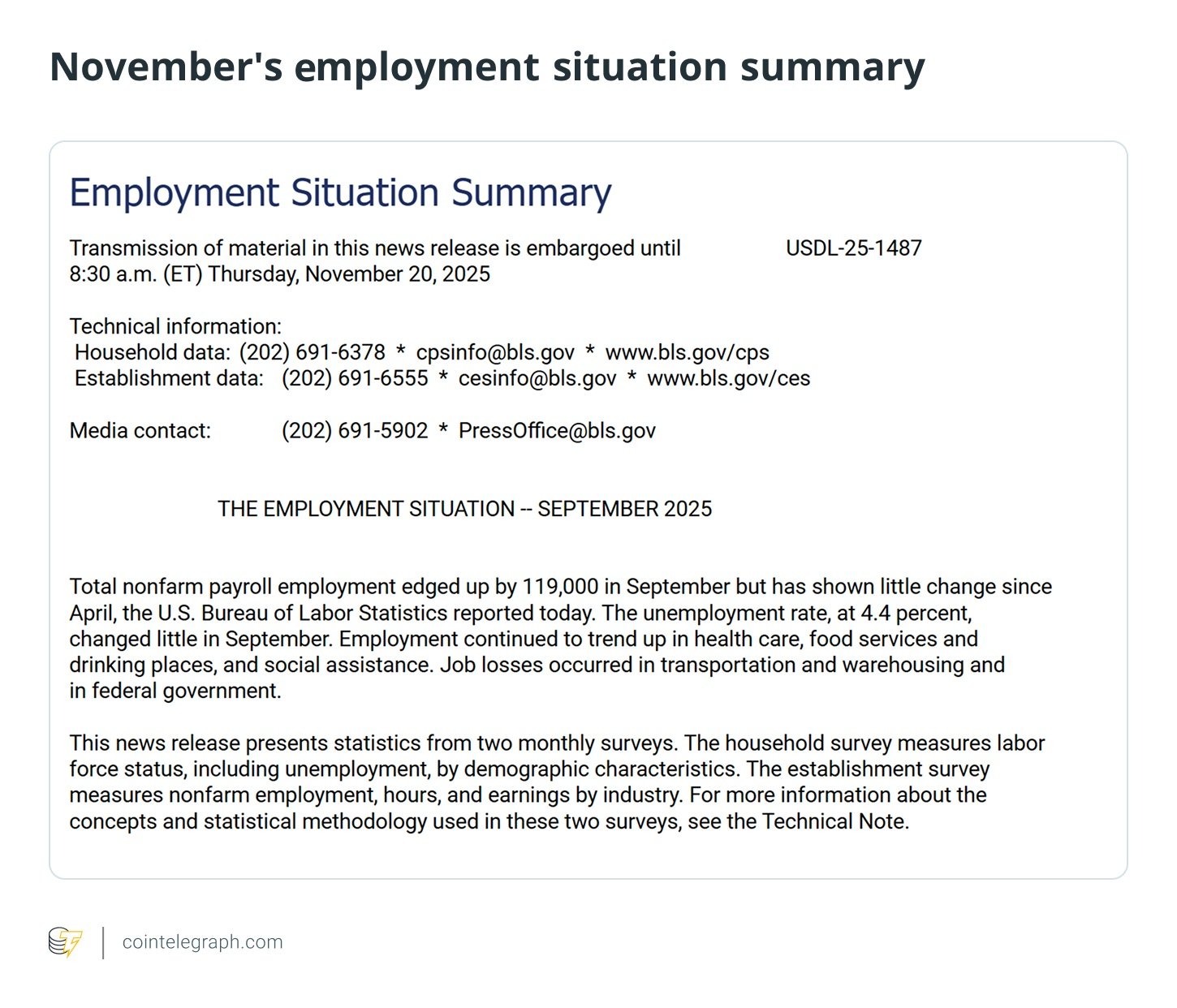
Under the surface, this data is a proxy for something bigger: the health of the US consumer and the odds of a recession. Strong job creation and low unemployment suggest households have income to spend and support corporate earnings and credit quality. Weak numbers point the other way.
For macro markets, the jobs print also feeds directly into Federal Reserve expectations. If labor data stay firm while inflation is sticky, investors infer that rates may stay higher for longer. If the unemployment rate rises and payroll growth fades, the argument for rate cuts gains strength.
Crypto now trades in that same ecosystem. Bitcoin and large altcoins are widely held by macro funds, exchange-traded funds (ETFs) and retail traders who also watch stocks and bonds. A softer labor market can therefore have two opposing effects at once:
-
It raises fears of a slowdown or hard landing, which typically pushes investors out of high-beta assets.
-
It also increases the probability of easier policy down the line, which can eventually support risk assets through lower yields and looser financial conditions.
The key point is that labor data moves expectations and probabilities, but it’s not a mechanical switch for where Bitcoin “should” trade next.
Did you know? “Nonfarm payrolls” measure how many jobs were added or lost across most of the US economy, covering everything except farm work and a few small categories. It is the single most-watched snapshot of America’s labor market.
Two main channels from a weaker jobs market to crypto
When strategists talk about labor market pressure on Bitcoin and crypto, they are usually describing two overlapping channels.
First is the growth channel. Rising unemployment, slower hiring and weaker wage gains make markets more cautious about future earnings and default risks. In that environment, investors often cut exposure to the riskiest parts of their portfolio, such as small-cap stocks, high-yield credit and volatile assets like Bitcoin and altcoins. Crypto, particularly outside of BTC and Ether (ETH), is still seen as a high-beta corner of the risk spectrum.
Second is the liquidity and rates channel. The same weak data that spooks investors can push central banks toward easier policy. If markets begin to price multiple rate cuts, real yields may fall, the dollar can soften, and global liquidity can expand. Several macro studies and digital asset research outfits have noted that periods of rising global liquidity and falling real yields have often coincided with stronger Bitcoin performance, even if the link is far from perfect.
Macro strategists increasingly describe Bitcoin as an asset whose role shifts with the regime. Sometimes, it behaves like a high-growth tech stock — other times, as a macro hedge. Around labor releases, a common pattern is a short-term risk-off wobble on bad data followed by partial recovery as rate cut narratives and ETF flows reassert themselves.
What the current US labor trends are really saying
To understand today’s pressure on crypto, it helps to look beyond a single unemployment figure.
Recent BLS reports show an economy still adding jobs but at a slower pace than the post-pandemic boom. Payroll gains have cooled, the unemployment rate has drifted higher, and survey data show fewer Americans describing jobs as plentiful and more saying they are hard to get.
The sector breakdown matters, too. A disproportionate share of recent job growth has come from relatively defensive areas like health care and government, plus services such as leisure and hospitality. More cyclical or goods-producing industries, such as manufacturing, some parts of construction and interest rate-sensitive corporate sectors, have looked weaker on various measures.
Forward-looking indicators echo that cooling. Job openings and quits, tracked in the Job Openings and Labor Turnover Survey (JOLTS), are well below their peaks. Workers are switching jobs less frequently, a sign that bargaining power has faded from the red-hot conditions of 2021-2022.
A mixed set of labor signals has left markets debating whether the US is headed for a gentle landing or something bumpier. That uncertainty alone can encourage more conservative positioning across risk assets, including a reluctance to chase Bitcoin to new highs after a strong run.
Did you know? Economists sometimes refer to today’s conditions as a “Schrödinger’s labor market” because the data shows two things at once. Unemployment is rising, yet the economy is still adding jobs. It is neither clearly strong nor clearly weak, and both narratives coexist until the trend breaks one way or the other.
How crypto has traded around recent job surprises
Recent trading around monthly jobs releases offers a useful, if imperfect, window into these dynamics.
On several occasions over the last couple of years, weaker-than-expected payrolls or a surprise uptick in the unemployment rate have produced a familiar pattern. One study found Bitcoin’s average move was about +0.7% when payrolls beat forecasts and about -0.7% when they missed, suggesting traders do trim high beta exposure when employment disappoints.
In the minutes and hours after the release, headline-driven algorithms and fast-money traders often sell equities and crypto as slowdown headlines hit the tape. Around the delayed September 2025 report, for example, BTC spiked toward the low $90,000s before sliding into the mid $80,000s, with more than $2 billion in crypto positions liquidated, including close to $1 billion in Bitcoin longs.
As the dust settles, attention pivots to the rates market. If futures and swaps start to price more aggressive Fed cuts after weak data, longer-dated yields fall. In some of those episodes, Bitcoin has stabilized or partially recovered in the following sessions as investors rotate back into duration and higher beta assets. In others, particularly when labor weakness arrives alongside banking stress or geopolitical shocks, the risk-off leg dominates and crypto trades heavily for longer.
Analysts at both traditional macro research firms and crypto native companies stress that ETF flows, stablecoin liquidity, onchain activity and idiosyncratic news such as protocol upgrades or exchange issues can easily overpower any single data print. In other words, jobs numbers matter, but they sit alongside a crowded set of crypto-specific drivers.
What crypto investors should watch in the labor data cycle
For investors trying to make sense of these correlations without treating them as a trading rulebook, a simple macro dashboard goes a long way.
Key items include:
-
Headline payrolls and the unemployment rate: These form the core of the monthly Employment Situation report. Sustained rises in unemployment alongside slowing payrolls usually signal a more meaningful cooling.
-
Wage growth and hours worked: These speak to household income and spending power, which in turn shape growth expectations and the Fed’s inflation outlook.
-
JOLTS data such as openings, quits and hires: High openings and quits suggest a tight market; declines point to easing demand for labor and less confidence among workers.
-
Weekly jobless claims: A higher frequency series that many macro and quant funds use as an early warning for labor market turns.
Different combinations send different signals. A soft but stable jobs backdrop with moderating inflation gives the Fed room to ease gradually, a scenario that has often been more friendly to risk. A rapid jump in unemployment paired with falling openings raises the risk of a sharper downturn, where investors may prefer cash, Treasurys and defensive assets.
For Bitcoin and crypto, the takeaway is less weak labor equals lower prices and more that labor data helps set the macro weather. They shape growth expectations, rate paths and liquidity, and those, in turn, influence how much risk investors will take.
Read the full article here
Fact Checker
Verify the accuracy of this article using AI-powered analysis and real-time sources.