

 Freedom Index

Listen to the article
Key takeaways
-
A temporary 2.85% pricing discrepancy in wstETH collateral triggered about $27 million in liquidations on Aave, showing how even small technical issues can have major financial consequences in automated DeFi lending systems.
-
The liquidation wave occurred because Aave’s system briefly valued wstETH at about 1.19 ETH instead of its market value near 1.23 ETH, making some borrowing positions appear undercollateralized.
-
Price oracles are critical infrastructure in DeFi because they feed external market data to smart contracts, determining collateral values, loan health and when automated liquidations should occur.
-
The root cause was not a faulty price feed but a misconfiguration in Aave’s CAPO risk oracle system, where outdated smart contract parameters created a temporary cap on the token’s exchange rate.
Decentralized finance (DeFi) protocols use automated logic to handle everything from collateral management to risk assessment. While this setup enables a truly open and permissionless financial system, it also means that minor technical issues can snowball into significant financial disruptions.
According to risk monitoring firm Chaos Labs, a market downturn on March 10, 2026, triggered approximately $27 million in liquidations for Aave borrowers, clearly illustrating this vulnerability. In a single 24-hour window, approximately $27 million in user positions were liquidated. Surprisingly, this was not caused by a massive market sell-off but by a brief 2.85% price discrepancy affecting wrapped staked ETH (wstETH) collateral.
This event serves as a stark reminder of how critical price oracles and robust risk management frameworks are to the stability of the DeFi ecosystem.
The article explains how a 2.85% pricing discrepancy in wstETH collateral triggered about $27 million in liquidations on the Aave lending protocol. It highlights how oracle configurations, smart contract parameters and automated liquidation mechanisms can amplify small pricing errors in DeFi markets.
A sudden surge in liquidations
When a wave of liquidations occurred across Aave markets, Chaos Labs, which tracks lending protocols for unusual activity, quickly identified and flagged the surge. Early speculation among observers pointed to a possible malfunction in the price oracles, which may have mispriced collateral assets on the platform.
Price oracles serve as critical bridges, supplying external market prices to onchain applications. In lending protocols like Aave, these feeds determine whether a borrower’s collateral still sufficiently covers their loan. When the collateral value falls below the required threshold, the system triggers the automatic liquidation of the position.
The asset at the center of this event was wstETH, a token commonly used as collateral across DeFi lending ecosystems.
Did you know? Liquidations on lending protocols like Aave often happen faster than traditional margin calls. Because DeFi markets operate 24/7 through automated smart contracts, positions can be liquidated within seconds once collateral ratios fall below the required thresholds.
What is wstETH?
wstETH, or wrapped staked Ether (ETH), is a token issued through the Lido protocol, a leading liquid staking protocol.
When users stake Ether via Lido, they initially receive stETH, which represents their staked ETH plus accrued staking rewards. To improve compatibility with various DeFi applications, stETH can be wrapped into wstETH.
Due to the ongoing accumulation of staking rewards, one wstETH generally holds a value slightly above one ETH. This makes it a particularly attractive and widely adopted form of collateral in DeFi lending markets.
The pricing discrepancy
During the liquidation wave, a mismatch appeared between wstETH’s actual market value and the valuation applied by Aave’s risk system. Aave’s algorithm priced wstETH at approximately 1.19 ETH, whereas the broader market valued it closer to 1.23 ETH.
This roughly 2.85% difference caused positions collateralized by wstETH to appear more undercollateralized than they actually were.
As a result, certain borrowing positions fell below their required safety thresholds, triggering Aave’s automated liquidation process.
Why price oracles are critical in DeFi
Price oracles are essential infrastructure in DeFi. Blockchains cannot natively fetch real-world market data, so oracle services supply external price feeds for assets. These feeds directly influence:
A reported drop in collateral price can lead the protocol to deem a loan insufficiently backed, prompting the automatic liquidation of the position.
Because this mechanism operates algorithmically, even minor pricing deviations can cascade into substantial consequences.
Did you know? A small price discrepancy can have outsized effects in DeFi. Even a brief deviation in an oracle or market price of just a few percent can trigger cascading liquidations. This is especially true when many borrowers use highly leveraged positions backed by volatile crypto collateral.
The real cause: CAPO risk-oracle misconfiguration
Deeper analysis confirmed that Aave’s primary price oracle was operating normally.
The root issue instead lay in the correlated assets price oracle (CAPO) risk oracle module, an additional protective layer applied to select assets.
CAPO is specifically designed to cap the rate at which the value of yield-bearing tokens like wstETH can rise. This safeguard helps protect the protocol against abrupt price surges or potential oracle exploits.
In this case, however, a configuration inconsistency within CAPO triggered the problem.
Technical breakdown of the error
Chaos Labs disclosed that the fault originated from outdated parameters stored in a smart contract.
Two key values had fallen out of alignment:
Because these were not refreshed in tandem, CAPO computed a temporary ceiling on the allowable exchange rate that sat below the prevailing market value.
This caused the protocol to undervalue wstETH by approximately 2.85% relative to its prevailing market price.
Did you know? Aave relies on price oracles, which are data feeds that supply real time asset prices to smart contracts. If these feeds briefly reflect unusual market prices from exchanges, the protocol automatically recalculates collateral values and may trigger liquidations.
The liquidation cascade
As soon as collateral ratios fell below the required thresholds, Aave’s automated liquidation engine activated.
Liquidators, typically high-speed trading bots, stepped in by repaying a portion of the borrower’s debt and, in return, acquiring the underlying collateral at a built-in discount.
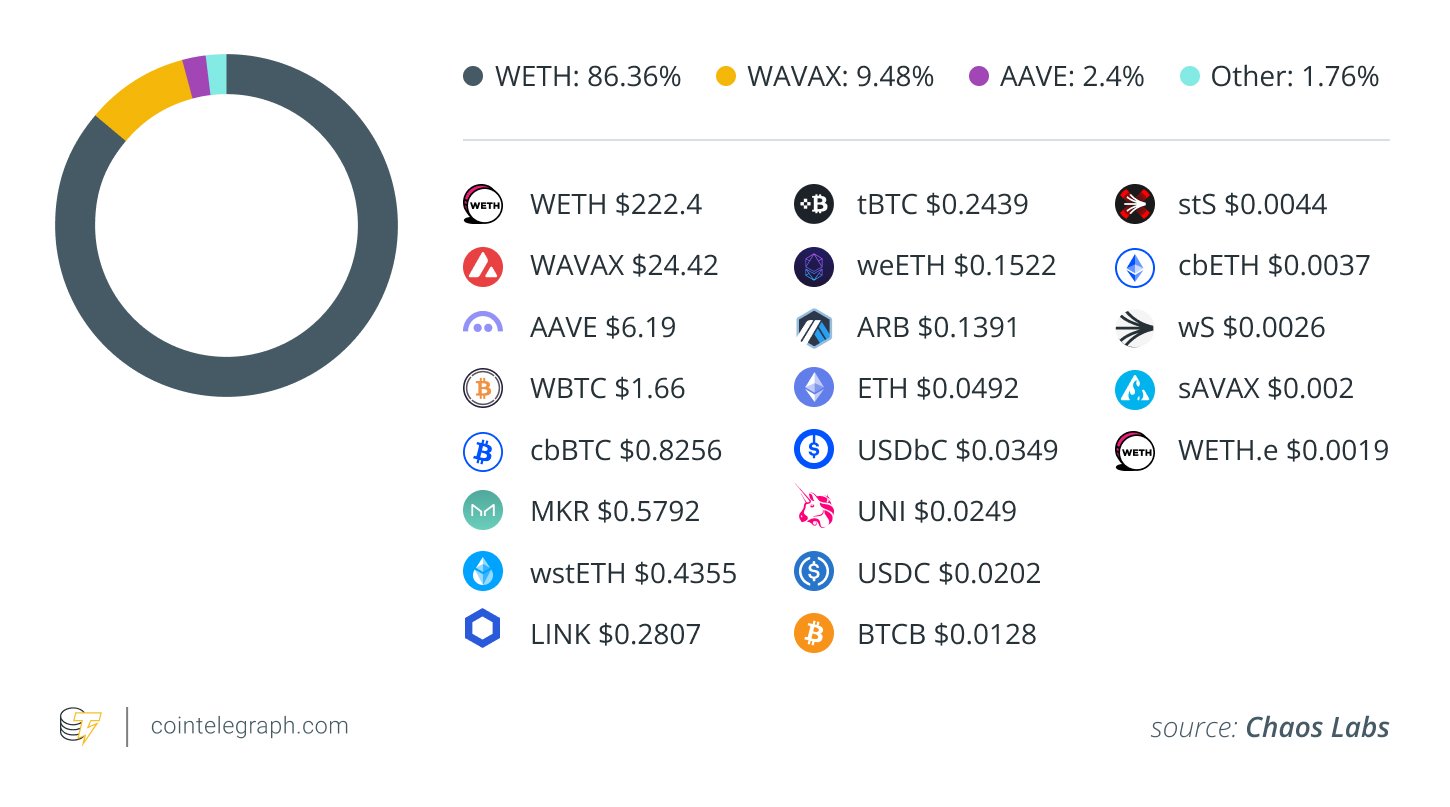
Across the event, roughly $27 million in borrowing positions were liquidated.
Liquidators ultimately extracted around 499 ETH in combined profits and liquidation bonuses, capitalizing on the short-lived pricing misalignment.
No bad debt incurred by the protocol
Even with the volume of liquidations, Aave remained at zero bad debt. Aave founder Stani Kulechov stated that there “was no impact to the Aave Protocol.”
Chaos Labs said the platform’s core risk and liquidation mechanisms functioned as designed once positions breached their thresholds. Once positions breached their safety thresholds, liquidations proceeded according to design.
The disruption therefore remained confined to affected individual borrowers and did not threaten the protocol’s overall solvency or stability. The resulting artificial depression in collateral value pushed several borrowing positions below their liquidation thresholds.
Aave governance proposed compensating affected users through refunds funded by recoveries and decentralized autonomous organization (DAO) treasury support. This approach aligns with a shifting pattern in DeFi governance, where protocols increasingly view technical incidents as systemic infrastructure risks. They may move to compensate impacted users rather than leave them to bear permanent losses.
A reminder of oracle risk in DeFi
The event underscores that oracle design remains one of the most vital and vulnerable elements of DeFi infrastructure.
Even minor configuration mistakes can trigger outsized consequences when automated mechanisms oversee billions of dollars in collateral value.
Comparable episodes have occurred on other DeFi platforms. For example, a misconfigured oracle once temporarily valued Coinbase’s wrapped staked ETH (cbETH) at around $1 instead of approximately $2,200, sparking widespread disruption.
Such cases highlight the ongoing challenges of maintaining reliable, accurate price feeds in decentralized financial systems.
wstETH and Lido were not responsible
Contributors from the Lido ecosystem made it clear that the liquidations did not stem from any malfunction or flaw in wstETH itself.
The token operated normally throughout the event, and the underlying Lido staking protocol remained fully functional and unaffected.
The primary issue appears to have stemmed from how the Aave lending protocol processed and interpreted price data through its own risk management configuration.
Lessons for the future of DeFi
As decentralized finance continues to scale, protocols are incorporating increasingly sophisticated risk management systems to accommodate yield-bearing assets such as wstETH.
These assets present unique pricing challenges because their value increases steadily over time through accumulating staking rewards.
Effective risk models must therefore properly handle:
Even minor misalignments in these elements can escalate into widespread liquidation events.
Cointelegraph maintains full editorial independence. The selection, commissioning and publication of Features and Magazine content are not influenced by advertisers, partners or commercial relationships.
Read the full article here
Fact Checker
Verify the accuracy of this article using AI-powered analysis and real-time sources.