

 Freedom Index

Listen to the article
Welcome to our institutional newsletter, Crypto Long & Short. This week:
- Nilmini Rubin on the challenge facing crypto and traditional markets to create a hybrid, shared governance structure.
- Meredith Fitzpatrick covers how financial institutions must fundamentally rethink AML risk as crypto and TradFi converge.
- Top headlines institutions should pay attention to by Francisco Rodrigues.
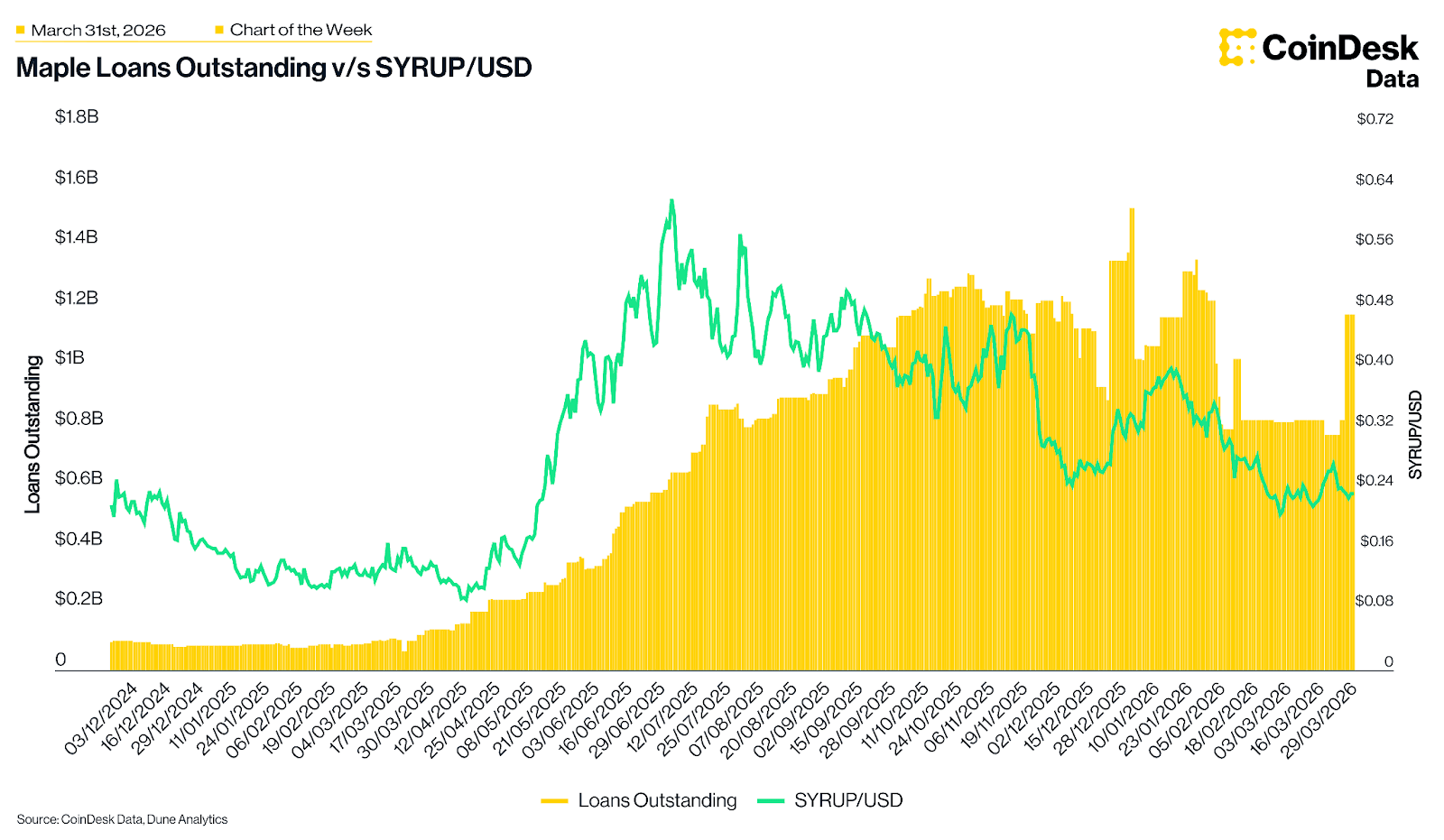
- Maple loans surge past $1 billion in Chart of the Week.
-Alexandra Levis
Expert Insights
Governance is the real Layer 1
By Nilmini Rubin, chief policy officer, Hedera
When Silicon Valley Bank collapsed in 2023, USDC briefly lost its dollar peg after billions in reserves were trapped in the bank. The impact spread quickly, stalling markets, repricing assets mid-transaction and triggering a broader confidence shock. While regulators stress-test traditional markets, this event exposed a new risk where failures in traditional finance can directly impact digital assets.
This episode raised fundamental questions about what happens if risk moves in the other direction, from crypto to the traditional market: who intervenes, who absorbs losses and how is confidence in markets restored?
As blockchains begin underpinning financial markets, the next phase of digital assets will be defined not only by innovation but by coordinated accountability. That accountability is shaped by how networks are designed.
The false binary
For years, blockchain debates revolved around a familiar divide: public vs. private networks.
Permissionless networks maximize openness and censorship resistance, but can struggle with coordinated upgrades, regulatory integration or emergency intervention. Private systems emphasize control and compliance over neutrality and interoperability.
As institutional adoption accelerates, hybrid models are emerging as the preferred solution.
Hybrid architectures combine public verifiability with open participation and predictable governance. This renders them more suitable for regulated use cases and compliance frameworks that require greater transparency and clear roles. Coordinated accountability, rather than simply public or private choices, is blockchain’s next major challenge.
Blockchain architecture is increasingly converging toward hybrid governance models.
When governance meets crisis
In complex systems, responsibilities are usually defined before problems emerge. Participants know who has authority, who absorbs losses and how emergencies are handled.
Blockchain networks should begin with that level of clarity. When stress arrives through sanctions enforcement, protocol failures or market crashes, effective governance proves a difficult test.
The industry has already seen early signals. During the March 2020 market crash, MakerDAO required emergency intervention after auction failures erased millions in value. The protocol recovered, but we cannot allow these incidents to occur frequently and at scale. In other cases, networks have used coordinated forks to address hacks or illicit activity, but only after the fact.
As tokenization expands, increasing resilience will require governance systems that anticipate crises and define decision-making before an event occurs to effectively mitigate.
Putting governance to the test
Mature financial systems routinely stress-test their governance structures to ensure resilience well before moments of disruption.
Hybrid networks must bring that discipline on-chain. Governance stress testing clarifies roles, aligns incentives and strengthens coordination under pressure, helping the industry prepare for scenarios such as stablecoin volatility, regulatory shifts and AI-driven governance dynamics.
Governance is the real Layer 1
Digital assets are reimagining ownership and participation. The next challenge is applying that same creativity to governance.
The networks that endure will not be the ones with the most tokens or the fastest throughput. They will be the ones that know how to govern effectively when the system comes under pressure.
Headlines of the Week
– By Francisco Rodrigues
The crypto industry has continued navigating the regulatory system over the week, making its way into the mortgage market while also seemingly being stopped from offering yields on stablecoin balances. Other major developments further build trust in the industry, even as prices drop.
Expert Perspectives
The new financial order: updating TradFi risk for crypto
– By Meredith Fitzpatrick, partner and head of cryptocurrency, Forensic Risk Alliance
The convergence of traditional finance and cryptocurrency is no longer theoretical sci-fi — it’s here. Regulatory clarity across major jurisdictions is accelerating institutional entry into digital assets, from Europe’s Markets in Crypto-Assets (MiCA) framework to expanding U.S. legislative momentum with the Guiding and Establishing National Innovation for U.S. Stablecoins (GENIUS) Act. For financial institutions, the question is no longer whether to engage with crypto, but how to do so safely.
The critical misstep many institutions make is treating crypto as an extension of existing products. It is not. Crypto fundamentally changes how anti-money laundering (AML) risk must be assessed, monitored and controlled.
At its core, blockchain introduces three defining characteristics: immutability, pseudonymity and borderless value transfer. These reshape both financial crime risk and the tools required to manage it.
Control shifts from accounts to keys
In traditional finance, assets are secured through centralized systems and reversible transactions. In crypto, control rests with private keys. When institutions offer custody, AML risk becomes inseparable from cybersecurity risk. A compromised key is not just a breach — it is an irreversible transfer of value, often beyond recovery. This requires controls such as multi-signature authorization, cold storage, strict access governance and wallet segregation — all of which sit outside traditional AML frameworks but are critical to risk mitigation.
Non-custodial wallets mean dynamic risk assessments
Traditional AML relies heavily on customer identity and static risk profiling. In crypto, this model breaks down. Customers can transact through non-custodial wallets that exist outside institutional onboarding frameworks, and illicit activity often hides in transaction behavior rather than identity.
As a result, risk assessment must evolve from “who the customer is” to “what the wallet does.” This requires continuous monitoring of on-chain activity, including exposure to high-risk counterparties, mixers and decentralized protocols. Risk becomes dynamic, not periodic.
Crypto financial crime is structurally more complex
Cryptocurrency money laundering can involve newer technologies, such as chain-hopping and the use of privacy-enhancing technologies like mixers, that have no direct parallel in traditional finance. Transactions can traverse multiple jurisdictions in minutes, rendering legacy screening systems insufficient. Effective AML now depends on blockchain intelligence: the ability to trace funds, identify direct and indirect exposure to risky parties and interpret transaction patterns across networks.
These shifts require a corresponding evolution in governance and risk management. Boards and risk committees must redefine risk appetite to reflect crypto-specific exposures. Institutions should introduce specialized teams (e.g., digital asset approval committees and high-risk customer panels) to manage rapidly changing risks.
Most importantly, the Enterprise-Wide Risk Assessment (EWRA) must become dynamic. Static, point-in-time assessments are inadequate in an environment where risk profiles can change with a single transaction.
The table below illustrates how customer risk assessment must evolve:
Area of focus |
TradFi |
Crypto |
|---|---|---|
| Customer identity | Typically, through identification and verification using government-issued IDs, physical addresses and relevant databases (e.g., credit history). | Most centralized virtual asset service providers (VASPs) have KYC/CDD/EDD procedures like TradFi institutions. However, “non-custodial wallets” (wallets where the user retains private key control) exist outside of a centralized body that collects KYC. In this case, on-chain activity may be used when assessing the risk of the customer. |
| Risk indicators | Based on factors like employment, income, geography and transaction history with the institution. | Based on wallet behaviour, age, transaction counterparties, interactions with high-risk services (e.g., mixers), and exposure to certain smart contracts, non-custodial wallets, or DeFi platforms. |
| Transaction transparency | Transaction data is private and accessed through internal banking records. | On-chain transactions are publicly available, enabling advanced analytics, but only for those with the tools and expertise to interpret them. |
| Dynamic risk monitoring | Risk profiles are usually static or periodically updated. | Risk can change dynamically with wallet activity, based on real-time blockchain analysis and ongoing monitoring. |
Finally, institutions must invest in new capabilities. Fluency in blockchain analytics for transaction monitoring and forensic investigation are no longer niche skills — they are core AML functions. Most organizations will require a hybrid model combining internal expertise with external specialists.
Professionals in this space must recognize that cryptocurrency compliance is not merely adapting existing frameworks but requires fundamentally different approaches to transaction monitoring, due diligence and incident investigation. Success requires compliance teams to understand traditional regulatory requirements and crypto-specific investigation challenges. Institutions approaching crypto adoption with appropriate forensic rigour — treating it as a fundamental compliance transformation rather than simple product addition — will be best positioned for sustainable success.
Chart of the Week
Maple loans surge past $1B on record $350M single-day issuance
Maple’s loans outstanding jumped back above $1 billion last week as the protocol issued $350 million in loans on a single day. With total AuM now exceeding $4.6 billion, there is a divergence between the protocol’s strong fundamentals and the associated SYRUP token price action. This growth, in spite of broader market conditions, continues to highlight the resilient demand for institutional-grade lending among crypto-native firms.
Listen. Read. Watch. Engage.
Looking for more? Receive the latest crypto news from coindesk.com and market updates from coindesk.com/institutions.
Note: The views expressed in this column are those of the author and do not necessarily reflect those of CoinDesk, Inc., CoinDesk Indices or its owners and affiliates.
Read the full article here
Fact Checker
Verify the accuracy of this article using AI-powered analysis and real-time sources.