

 Freedom Index

Listen to the article
Key takeaways
-
Stablecoins are nearing a $300-billion market cap, but adoption remains limited due to risks around depegging, collateral and trust.
-
The depegging of stablecoins such as NuBits (2018), TerraUSD (2022) and USDC (2023) has revealed vulnerabilities across both algorithmic and fiat-backed models.
-
The collapse of TerraUSD wiped out roughly $50 billion in value and exposed the systemic fragility of algorithmic designs.
-
In 2025, Yala’s Bitcoin-backed YU lost its peg following an exploit, underscoring issues of thin liquidity and cross-chain security.
Stablecoins just crossed a major milestone, with total market capitalization now above $300 billion. As of Oct. 6, 2025, CoinMarketCap reports roughly $312 billion.
Despite rapid growth, stablecoins still haven’t achieved mainstream adoption. One major reason is the recurring instances of these tokens losing their peg to the assets that back them — whether fiat currencies like the US dollar, commodities like gold or even other cryptocurrencies.
This article discusses real examples of stablecoin depegging, why it happens, the risks involved and what issuers can do to prevent it.
Historical overview of stablecoin depeggings
Stablecoin depeggings have repeatedly exposed flaws in how these assets are designed. Early examples, such as the 2018 collapse of NuBits, showed how fragile unbacked algorithmic models can be. Even Tether’s USDt (USDT) briefly fell below $1 in 2018 and again in 2022, driven by market panic and liquidity shortages — events that fueled concerns about its reserves.
One of the biggest collapses came in May 2022, when TerraUSD — an algorithmic stablecoin — unraveled after a wave of redemptions set off a bank-run-like spiral. Its sister token, LUNA, went into hyperinflation, wiping out about $50 billion in market value and sending shockwaves through the broader crypto industry.
Fiat-backed stablecoins have also depegged. USDT briefly dropped to $0.80 in 2018 amid solvency fears, and USDC (USDC) lost its peg in 2023 after Silicon Valley Bank collapsed — showing how even fiat reserves face traditional banking risks. Dai (DAI) and Frax (FRAX) — both partially backed by USDC — also dipped during the same period, deepening concerns about reserve interlinkages across the market.
Together, these episodes highlight liquidity shortfalls, eroding trust, and systemic risks that continue to challenge stablecoins — even as the market nears the $300-billion mark.
Did you know? Most depegs occur when liquidity pools run thin. Large sell-offs drain available liquidity, making recovery harder. Terra’s Curve pool imbalance in 2022 and Yala’s small Ether (ETH) pool in 2025 showed how limited depth can magnify market shocks.
Case study: The TerraUSD collapse
The May 2022 collapse of TerraUSD (UST) was a major blow to the crypto market, triggering a chain reaction across the industry and exposing the risks of algorithmic stablecoins. Unlike traditional fiat-backed versions, UST tried to maintain its $1 peg through an arbitrage mechanism with its sister token, LUNA.
Adoption of TerraUSD was fueled by the Anchor protocol, which offered unsustainable, subsidized yields of nearly 20% to UST depositors. As doubts about this model grew and crypto markets weakened, confidence collapsed, triggering a bank-run-like spiral. Large, sophisticated investors exited first, accelerating UST’s depeg. The first clear signs appeared on May 7, 2022, when two large wallets withdrew roughly 375 million UST from Anchor.
This triggered a massive wave of swaps from UST to LUNA. In just three days, LUNA’s supply jumped from around 1 billion to nearly 6 trillion, while its price crashed from about $80 to almost zero, completely breaking UST’s peg. The crash exposed major flaws in decentralized finance (DeFi), from unrealistic yield models to how smaller investors, often without timely information, ended up taking the biggest hit.
Did you know? Stablecoin depegs tend to spiral when panic spreads online. During UST’s collapse, social media buzz and forum discussions likely fueled a rush of withdrawals. The speed at which confidence vanished showed how quickly fear can spread in crypto, much faster than in traditional finance.
Case study: Yala’s YU stablecoin
In September 2025, Yala’s Bitcoin-backed stablecoin, YU, suffered a depegging event following an attempted attack. According to blockchain company Lookonchain, an attacker exploited the Yala protocol by minting 120 million YU tokens on the Polygon network. The attacker then bridged and sold 7.71 million YU tokens for 7.7 million USDC across the Ethereum and Solana networks.
By Sept. 14, 2025, the attacker had converted the USDC into 1,501 ETH and distributed the funds among multiple wallets. According to Lookonchain, the attacker still held 22.29 million YU tokens on Ethereum and Solana, with an additional 90 million YU remaining on the Polygon network, which had not been bridged.
The Yala team stated that all Bitcoin (BTC) collateral was safe, but YU still failed to regain its peg. They disabled the Convert and Bridge functions and began an investigation with security partners.
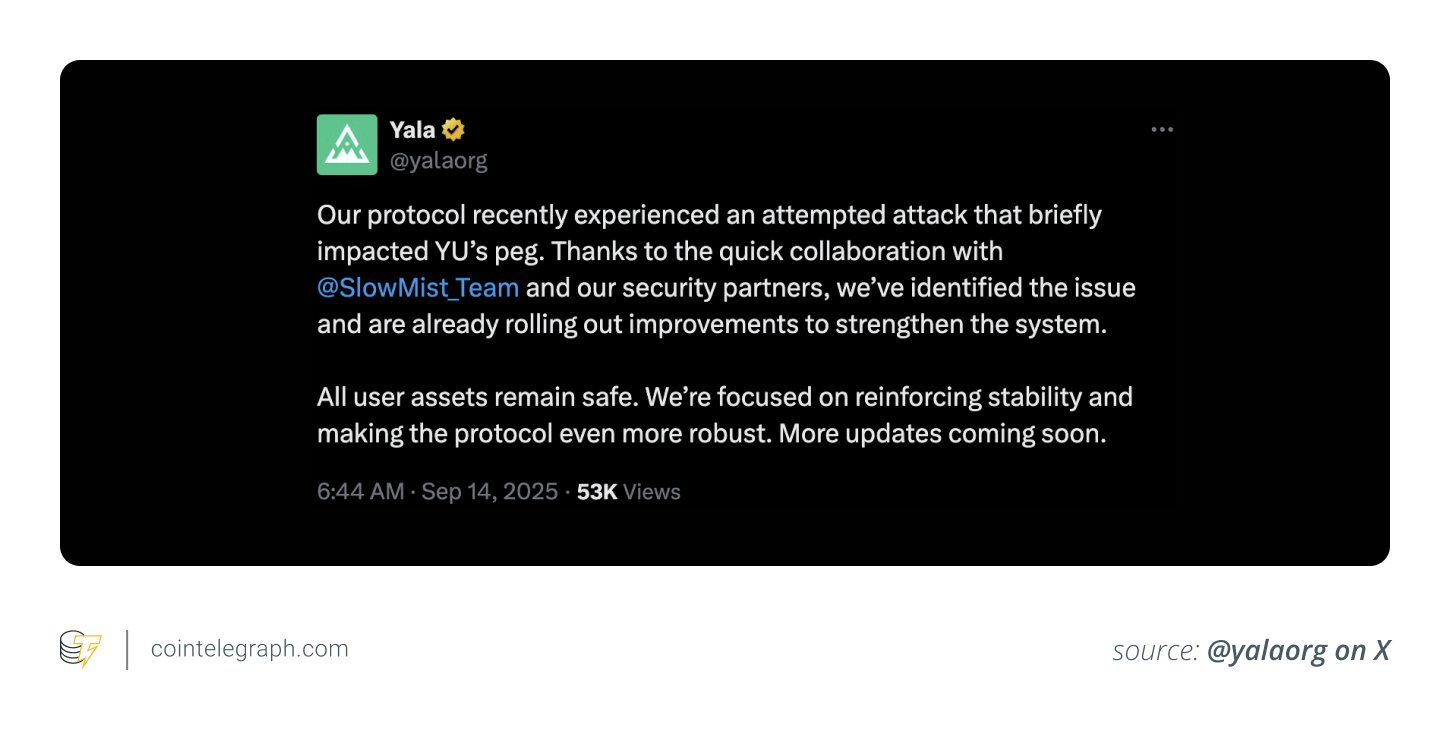
The event highlighted a critical vulnerability. Despite a $119-million market cap, YU had extremely thin onchain liquidity, making it susceptible to such attacks. By Sept. 18, 2025, YU had regained its peg on DEXScreener.
Why stablecoins fail to hold their $1 peg
Stablecoins aim to maintain steady prices, but past events show they can lose their $1 peg during stress. Failures arise from design weaknesses, market sentiment, and external pressures that reveal flaws even in robust systems. Key reasons for depegging include:
-
Liquidity shortages: When trading pools have low funds, large sell orders cause significant price drops. Yala’s small Ether pool and Terra’s Curve swaps demonstrate how limited liquidity fuels instability.
-
Loss of trust and runs: Panic can spark bank-run scenarios. Once confidence falters, mass withdrawals can push prices downward, and social sentiment or noisy market reactions may accelerate the spiral.
-
Algorithmic flaws: Mechanisms using mint-burn, like Terra’s UST, fail when redemptions overwhelm controls. Exploits or market shocks can destabilize these fragile designs.
-
External pressures: Wider crises, such as bank collapses, hacks or economic downturns, can strain pegs across the market, heightening volatility and systemic risks.
Did you know? To prevent future depegs, projects are experimenting with proof-of-reserves, overcollateralization and real-time audits. These innovations mark a shift from algorithmic fantasies to transparent, trust-building mechanisms, though investors know $1 stability is never guaranteed in crypto.
The risks investors can’t ignore
Stablecoins are designed to offer reliability, but when they lose their peg, they can create serious risks for investors and the broader crypto market. Here are some of the key risks investors should be aware of:
-
Financial losses: Depegs can lead to irreversible value erosion. In the case of stablecoins, the annual risk run is higher than that of conventional banks, increasing the risk of financial losses for investors.
-
Security flaws: Attacks, like the one on Yala that minted unauthorized tokens, can disperse assets across blockchains, often leaving investors with little chance of recovery.
-
Regulatory and reputational concerns: The stablecoin market is approaching $300 billion, led by major players like USDT, USDC and USDe. Growing regulatory scrutiny has raised concerns about the financial stability of issuers. It has also highlighted how limited mainstream adoption still is.
-
Systemic impacts: A single stablecoin failure can trigger widespread market disruptions. For example, Terra’s collapse wiped out billions and destabilized related DeFi systems, showing how interconnected risks can amplify damage across the crypto ecosystem.
Lessons learned from stablecoin collapses
Repeated stablecoin failures have shown both the potential and the fragility of dollar-pegged digital assets. Each collapse exposed how liquidity gaps, weak collateral and overreliance on algorithms can quickly erode trust.
To address these risks, issuers can focus on stronger collateral — using over-collateralized models and high-quality, liquid assets. Transparency is equally vital. Proof-of-reserves, independent audits and clear disclosures on reserves and redemption policies help restore confidence. Backstop funds can also absorb sudden sell-offs and stabilize the peg.
On the technical side, thorough contract audits, multi-signature controls and limited cross-chain exposure reduce security risks. Solid governance and regulatory alignment — under frameworks like Markets in Crypto-Assets (MiCA) regulation or US stablecoin bills — together with insurance coverage, add further protection and strengthen investor trust.
This article does not contain investment advice or recommendations. Every investment and trading move involves risk, and readers should conduct their own research when making a decision.
Read the full article here
Fact Checker
Verify the accuracy of this article using AI-powered analysis and real-time sources.