

 Freedom Index
Listen to the article
Hello and welcome to another edition of Free Agent! Get out there and get a hit today—or don’t, and maybe you’ll win anyway.
This week’s newsletter has a bit of a motorsports focus. It’s a sports broadcasting regulations sandwich, with open-wheel racing serving as the bread slices. Take a bite!
Don’t miss sports coverage from Jason Russell and Reason.
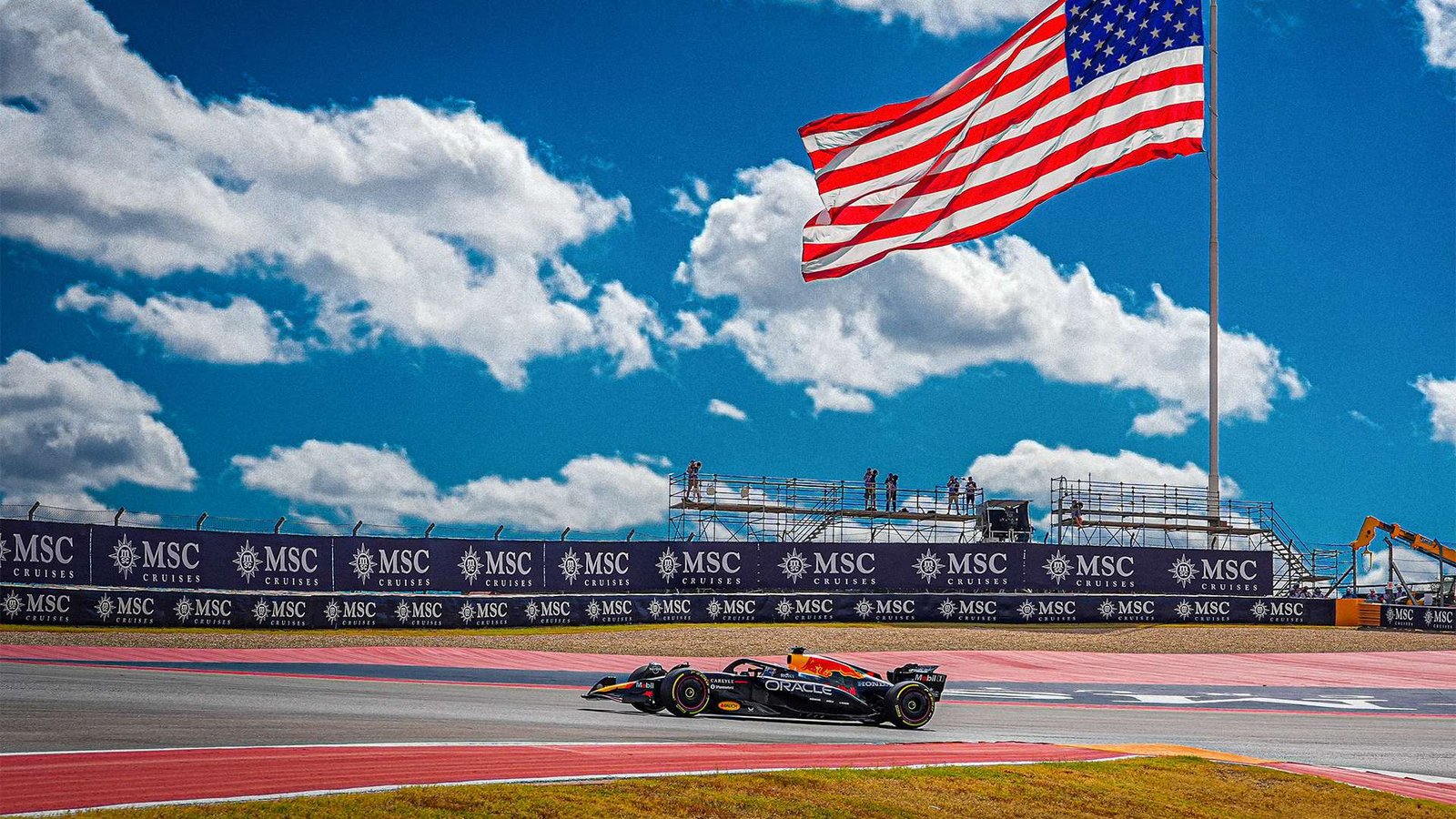
For a long time (too long!), Americans have viewed Formula 1 racing as something for those fancy Europeans to enjoy, with its luxury brands (Ferrari! McLaren!) and European drivers (Michael Schumacher! Lewis Hamilton!) spraying champagne on each other after races. NASCAR, on the other hand, was for red-blooded Americans with its roots in Prohibition-era bootleggers and later with Fords and Chevys going at each other.
An American hasn’t won the Formula 1 World Championship since Mario Andretti in 1978. The last time an American driver had a significant presence in the series was the ’80s, and the series even skipped American tracks from 2008 through 2011 because the market was too tough to crack.
Now, though, Formula 1 seems to be more American than ever.
For the fourth year in a row, there are now three grand prix in the U.S. (hosted in Austin, Texas; Las Vegas; and Miami). But the biggest American news is the addition of another American team (Cadillac) and the return of Ford engines, now powering the two Red Bull teams. (Ford engines powered 10 Formula 1 constructors to championships from 1968 through 1981.) That means a Ford and General Motors rivalry has invaded Europe’s most popular motorsport. Another American team, Haas, has been on the grid since 2016, although they haven’t done a whole lot to pitch themselves as America’s team (at least in this American Haas fan’s opinion).
There aren’t any American drivers this season, although that’s somewhat due to Formula 1’s relatively small fields: This year it will have 22 drivers per race, compared to 40 in NASCAR and at least 25 in IndyCar. But Americans are certainly knocking on the door of Formula 1, hoping to impress and join the series in future seasons: American driver Colton Herta left IndyCar for the “minor league” races of Formula 2, and two more Americans are trying to work their way up from Formula 3. Meanwhile, Formula 1’s sanctioning body just made it easier to move there from IndyCar, so IndyCar may become more of a Formula 1 training ground rather than a landing zone for Formula 1’s washouts.
Apple’s big bet on the American broadcasting rights is a sign it thinks a boom in American interest is coming. They bid $140 million a year to put the series on Apple TV, much more than the $85 million per year ESPN most recently gave them. ESPN owner Disney isn’t abandoning F1 altogether, though—it’s sticking around in the form of a bigger marketing collaboration that involves F1-themed Disney products and a cartoon.
Maybe you’ve tried watching F1 in the past and decided it wasn’t for you. But between the new American presence and rule changes that are sure to cause some chaos, there are plenty of reasons to try it again, especially if you already have Apple TV. The only problem? The first few races are in Australia and Asia, and not especially well-timed for a U.S. audience (although night owls might be fine with this weekend’s Saturday, 11 p.m. Eastern start time for the first grand prix of the season).
As I said last week, “Beating other countries at weird sports that they’ve made up is a great American pastime.” Hopefully it won’t be long until an American team or driver wins a grand prix and has stunned Europeans looking on as the national anthem plays.
The Federal Communications Commission (FCC) has put out a request for comment on sports, broadcast rights, and streaming. It sounds innocuous, but the request itself could be a big blow against streaming services that aren’t connected to a broadcast TV network (Netflix, Amazon Prime Video, Apple TV, etc.).
The issue is, as FCC Chairman Brendan Carr said: “Watching your favorite team play isn’t as easy these day [sic]. Many games are still on broadcast, but an increasing number are on a range of different online platforms.”
For decades, Americans enjoyed turning on their TV & quickly finding the game they wanted to see.
Yet watching your favorite team play isn’t as easy these day. Many games are still on broadcast, but an increasing number are on a range of different online platforms.
Today, the… pic.twitter.com/0NkscbH0FB
— Brendan Carr (@BrendanCarrFCC) February 25, 2026
Basically, in the olden days, if you knew your team was playing, you probably knew what channel they were on. But now they might be on a regional sports network, or on national TV, or on a streaming service (possibly multiple).
Complaints about this seemed to peak around the Bears vs. Packers playoff game in January, shown primarily on Prime Video. The game was also simulcast on local networks in the Bears and Packers media markets (i.e., most of Wisconsin and Illinois). But despite being only available on Prime Video for most of the country, a record 31.6 million people streamed it anyway. That was more viewers than two of the other NFL playoff games that weekend, which were on network TV, and more viewers than the college football championship game on ESPN. Clearly, people didn’t have trouble finding it.
But the issue is bigger than one NFL playoff game. Certain NHL games are exclusive to ESPN+, some NBA games are only shown on Peacock, and some MLB games are only on Apple TV.
The FCC’s request for comment does not necessarily mean it will be followed by regulation, but it’s clearly a shot across the bow of sports leagues—a warning that the FCC may consider regulating games on streaming services in some way, or requiring leagues to broadcast every game on TV or the old-school regional sports networks. Any such regulation seems likely to be bad news for streamers and great news for old-school networks—another example of the government leaning on private businesses to pick winners and losers (especially problematic considering how huge sports broadcasts are for culture and for business). It might also be bad news for younger audiences who are more interested in cutting the cord and just watching sports through various streaming subscriptions.
Between the rise of streaming and the impending deaths of regional sports networks, the sports broadcast landscape is in a state of upheaval. It’s not exactly a good time for the federal government to get involved and try to design what it thinks will be the best system for fans, leagues, and broadcasters. It may end up entrenching an outdated system if it doesn’t allow for innovation.
With everything going on, is the ESPN+ portfolio really something the federal government should be worried about?
I somewhat accidentally found myself at IndyCar’s season debut last weekend in St. Petersburg, Florida. Even though I’m a big racing fan, it was my first time at an IndyCar race, and my first time watching any kind of motor race at a road course instead of an oval. I’d heard these sometimes turn into a parade, with the cars going by grandstands one by one and in-person viewers not having much idea what’s going on.
There was some truth to that. I definitely would have been more informed had I been watching the TV broadcast, but the group viewing experience made it more fun and engaging than watching on TV (the Victory Lane celebration was also a lot more fun to watch in-person than on TV). My brother and I used his radio headsets to listen in on Scott McLaughlin’s radio (because he started the race in first). But the cars weren’t as loud as I expected, and if I’m ever at another race, I will probably just put my AirPods in and listen to the radio or TV broadcast.
Having watched a lot of IndyCar lately (usually by catching up on full-race replays when my newborn son wouldn’t sleep through the night), this one unfortunately might have been the series’ most boring race in the last couple seasons. There were only a couple chaos-causing crashes, and after defending champion Alex Palou took the lead roughly 40 percent of the way in, he mostly ran away with it.
My brother and I agreed that it was a good time, but that we probably wouldn’t be making any special trips to attend an IndyCar race that wasn’t within an hour or two of our homes. That said, I hope to make it to the IndyCar race on the National Mall in Washington, D.C., this summer since it should be easy to get to, even if it does seem like a cockamamie plan that could become a farce.
College hockey remains vastly underrated and wild. Last week, it had a shootout go 13 rounds, and an arena turned the lights off when the rival team was on a breakaway. (It worked—Connecticut lost in a shootout).
If your team is in danger of losing in OT just turn the lights off and act like nothing happened
— Barstool Sports (@barstoolsports) March 1, 2026
That’s all for this week. Conference basketball tournaments are underway, so enjoy watching the real game of the week in the Horizon League’s bonkers tournament format, Oakland vs. Northern Kentucky on Wednesday.
Read the full article here
Fact Checker
Verify the accuracy of this article using AI-powered analysis and real-time sources.