

 Freedom Index
Listen to the article
As established in Tinker, students do not “shed their constitutional rights to freedom of speech or expression at the schoolhouse gate.” But Tinker also “emphasized the need for affirming the comprehensive authority of the States and of school officials, consistent with fundamental constitutional safeguards, to prescribe and control conduct in the schools.” Here, as in Tinker, “[o]ur problem lies in the area where students in the exercise of First Amendment rights collide with the rules of the school authorities.”
The Supreme Court has recognized “three specific categories of student speech that schools may regulate in certain circumstances: (1) indecent, lewd, or vulgar speech uttered during a school assembly on school grounds; (2) speech, uttered during a class trip, that promotes illegal drug use; and (3) speech that others may reasonably perceive as bearing the imprimatur of the school, such as that appearing in a school-sponsored newspaper.” Mahanoy Area Sch. Dist. v B.L. (2021).
Speech that does not fall into one of these categories is nonetheless subject to the balancing test in Tinker. In Mahanoy, the court noted that under Tinker, “schools have a special interest in regulating speech that ‘materially disrupts classwork or involves substantial disorder or invasion of the rights of others'” and “[t]hese special characteristics call for special leeway when schools regulate speech that occurs under its supervision.” … “[I]n order for the State in the person of school officials to justify prohibition of a particular expression of opinion, it must be able to show that its action was caused by something more than a mere desire to avoid the discomfort and unpleasantness that always accompany an unpopular viewpoint.” Rather, schools may regulate speech only when the speech (1) “materially disrupts classwork or involves substantial disorder,” or (2) creates an “invasion of the rights of others.” …
[A.] The age of the students is a relevant but non-dispositive factor in the Tinker balancing test.
… Tinker “did not, by its own terms, address the rights of elementary students ….” However, elementary students’ First Amendment rights have been recognized since West Virginia Board of Education v. Barnette (1943). Four of our sister circuits have concluded that Tinker applies to elementary student speech….
[S]tudents’ ages are relevant to evaluating whether a school’s actions were reasonably designed to protect the safety and well-being of its students…. But age is not dispositive. This is consistent with our general approach in student speech cases in which we “treat the Tinker rule as a flexible one dependent upon the totality of relevant facts in each case.” …
[B.] Under the Tinker balancing test school officials have the burden of showing that their actions were reasonably undertaken to protect the safety and well-being of their students.
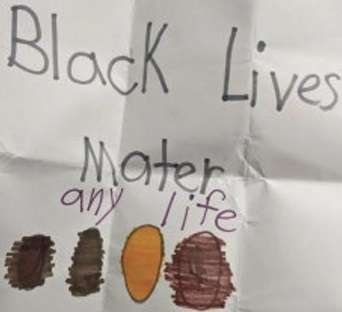
As there is no suggestion that B.B.’s drawing created a reasonable likelihood of material disruption of classwork or substantial disorder at her school, we focus on the second prong of Tinker: whether B.B.’s drawing interfered with M.C.’s right to be secure and let alone.
“The precise scope of Tinker‘s interference with the rights of others[‘] language is unclear” because we have rarely applied it. But a few principles are clear. On the one hand, “speech that is merely offensive to some listener” is not sufficient and does not fall within Tinker‘s scope. To regulate student speech under this prong of Tinker, a school “must be able to show that its action was caused by something more than a mere desire to avoid the discomfort and unpleasantness that always accompany an unpopular viewpoint.” …
[T]argeted speech that threatens, harasses, or bullies a specific student interferes with the right to be secure and let alone, and may be regulated by schools under Tinker. See Mahanoy (describing how schools may regulate “severe bullying or harassment targeting particular individuals” and “threats aimed at teachers or other students”). But what of student speech that does not bully, threaten, or harass a specific student but has potential consequences beyond avoiding discomfort and unpleasantness? We tackled this gray area in Harper v. Poway Unified Sch. Dist. (9th Cir. 2006), vacated as moot. There, a high school student wore a shirt to school that “displayed derogatory remarks about homosexuals.” He wore the shirt on the day that the school’s Gay-Straight Alliance held an event, but his speech did not target any particular student.
We held that the school could lawfully regulate the student’s speech because “verbal assaults on the basis of a core identifying characteristic such as race, religion, or sexual orientation” interfere with other students’ “right to be free from such attacks while on school campuses.” We reasoned that “such attacks on young minority students can be harmful to their self-esteem and to their ability to learn,” and thus fall under Tinker‘s second prong. Although the student’s right to wear the t-shirt is protected outside of school, we held that Tinker allowed the school to regulate or prohibit this speech given its “special need to maintain a safe, secure and effective learning environment.”
Harper thus clarified that, under Tinker‘s “rights of others” prong, schools may regulate not only speech that bullies or harasses particular students, but also speech that generally denigrates other students on the basis of a core identifying characteristic. Although “political speech, even when it is offensive to others, is an important right of all Americans and learning the value of such freedoms is an essential part of a public school education,” the school may restrict “instances of derogatory and injurious remarks directed at students’ minority status such as race, religion, and sexual orientation.” We focused on “the type and degree of injury the speech involved cause[d] to impressionable young people” in high schools and elementary schools.
Although Harper was vacated as moot, we find its reasoning sound: schools may regulate student speech under Tinker‘s second prong when it involves “derogatory and injurious remarks directed at students’ minority status such as race, religion, and sexual orientation.” Indeed, the First Circuit recently adopted a similar rule. See L.M. v. Town of Middleborough (1st Cir. 2024) (allowing schools to regulate speech under Tinker if it demeans other students’ personal identities and will have a “serious negative psychological impact on” those students and “poison[s] the educational atmosphere”). Several other circuits have similarly recognized that derogatory comments about other students’ personal identity, when sufficiently severe, may be regulated under Tinker. See Nuxoll ex rel. Nuxoll v. Indian Prairie Sch. Dist. #204 (7th Cir. 2008) (upholding a school rule forbidding derogatory comments about personal identity, but determining that a specific phrase could not be prohibited because it was “only tepidly negative,” and not “derogatory” or “demeaning”); Sypniewski v. Warren Hills Reg’l Bd. of Educ. (3d Cir. 2002) (upholding a school policy prohibiting racial harassment and intimidation “by name calling, using racial or derogatory slurs, wearing or possession of items depicting or implying racial hatred or prejudice … [or] that is racially divisive or creates … hatred” under Tinker). {B.B. notes that at least one circuit previously limited the second prong of Tinker to school regulation of speech that would render the school liable for torts. See Kuhlmeier v. Hazelwood Sch. Dist. (8th Cir. 1986), rev’d on other grounds. We reject such a limited reading of Tinker, which has not been endorsed by the Supreme Court.}
Of course, the students’ ages affect what is derogatory or injurious. Certain speech may be merely negative or controversial to high schoolers, but may constitute derogatory and injurious remarks against elementary students given their greater vulnerability.
In sum, we reaffirm that although a school’s decision is entitled to deference, the school has the burden of showing that its actions were reasonably designed to protect the safety and well-being of its students. Age is relevant as younger students are more vulnerable than students who are approaching adulthood. But, as all students, including elementary school students, have First Amendment rights, the school has the burden, under the Tinker balancing test, of showing that its actions were reasonably undertaken to protect the safety and well-being of its students.
[C.] Applying the Tinker balancing test, Becerra is not entitled to summary judgment.
We now turn to this case. Has Becerra shown that the restrictions on B.B.’s First Amendment rights were reasonably necessary to protect the safety and well-bring of the students?
Becerra presents some evidence suggesting that the school could reasonably believe the drawing invaded M.C.’s right to “be secure and let alone” at school. M.C.’s mother emailed Becerra that she would “not tolerate any more messages given to [M.C.] at school because of her skin color.” She also testified that M.C. “was the only black child” to get such a message and that she “does not go to school to be judged because she’s a black girl.” M.C.’s mother further stated that, although she knew that B.B. did not intend to hurt M.C. by including the phrase “any life” in the drawing, “those kind[s] of things hurt.” Additionally, her statement that she “did not want this to become a larger issue” could be interpreted as threatening additional action if Becerra did not act. Accordingly, Becerra may have believed that B.B.’s drawing interfered with M.C.’s right to be “let alone” because it targeted her based on her race, a core identifying characteristic. At a minimum, M.C.’s mother’s email required Becerra to investigate the situation to determine whether some action was necessary to protect M.C.’s right to be “let alone.”
But there is also evidence that M.C. was unaffected by the drawing and thus did not experience the kind of expressive attack on the basis of a core identifying characteristic required for a restriction on speech under Tinker. M.C.’s mother testified that M.C. did not understand the drawing, and she told M.C. not to worry about it. Nor is there evidence connecting the phrase “any life”—used by B.B. in the drawing—to the somewhat controversial phrase “All Lives Matter” or to show that M.C. made that connection. {The district court cited a news article that commented that “the phrase ‘All Lives Matter’ gained popularity in response to the growth of the Black Lives Matter movement (“BLM”), a social movement protesting violence against Black individuals and communities, with a focus on police brutality.” The article noted that the phrase is seen by some as an offensive response to BLM because it obscures “the fact that [B]lack people have not yet been included in the idea of ‘all lives.'”} B.B. argues that Becerra could not reasonably think that the drawing communicated a denigrating message that required a reprimand.
The parties also dispute whether B.B. was punished for the drawing. For instance, Becerra denies telling B.B. that the drawing was “inappropriate” or “racist” and denies that B.B. was prohibited from playing at recess in the weeks following the incident. {It appears that B.B.’s suspension from recess was not documented. B.B., however, testified that although Becerra did not tell her she had to miss recess, after Becerra talked to her, her teachers told her she wasn’t allowed to have recess. Denying a student recess may constitute punishment.}
He does not, however, deny that he spoke to B.B. We assume the facts in B.B.’s favor for the purposes of summary judgment. But if a factfinder later determines that B.B. was not actually punished for her drawing, her First Amendment claim will fail.
Thus, there is conflicting evidence about whether Becerra could reasonably conclude that the drawing interfered with M.C.’s rights and whether the actions taken were reasonably necessary. Applying the Tinker balancing test, B.B. has raised genuine disputes of material fact, and Becerra is not entitled to summary judgment.
The district court emphasized that B.B. and M.C. were in first grade at the time of the incident. But while age is a relevant factor under Tinker, it does not negate the existence of a genuine dispute of material fact. The students’ very young ages gave the school broader discretion, but it does not relieve the school and Becerra from meeting their burden of showing that their actions were reasonably undertaken to protect the safety and well-being of the school’s students. Tinker remains a “demanding standard,” and schools must prove that they meet it….
Caleb R. Trotter and Wilson Freeman (Pacific Legal Foundation) represent B.B.
Read the full article here
Fact Checker
Verify the accuracy of this article using AI-powered analysis and real-time sources.