

 Freedom Index
Listen to the article
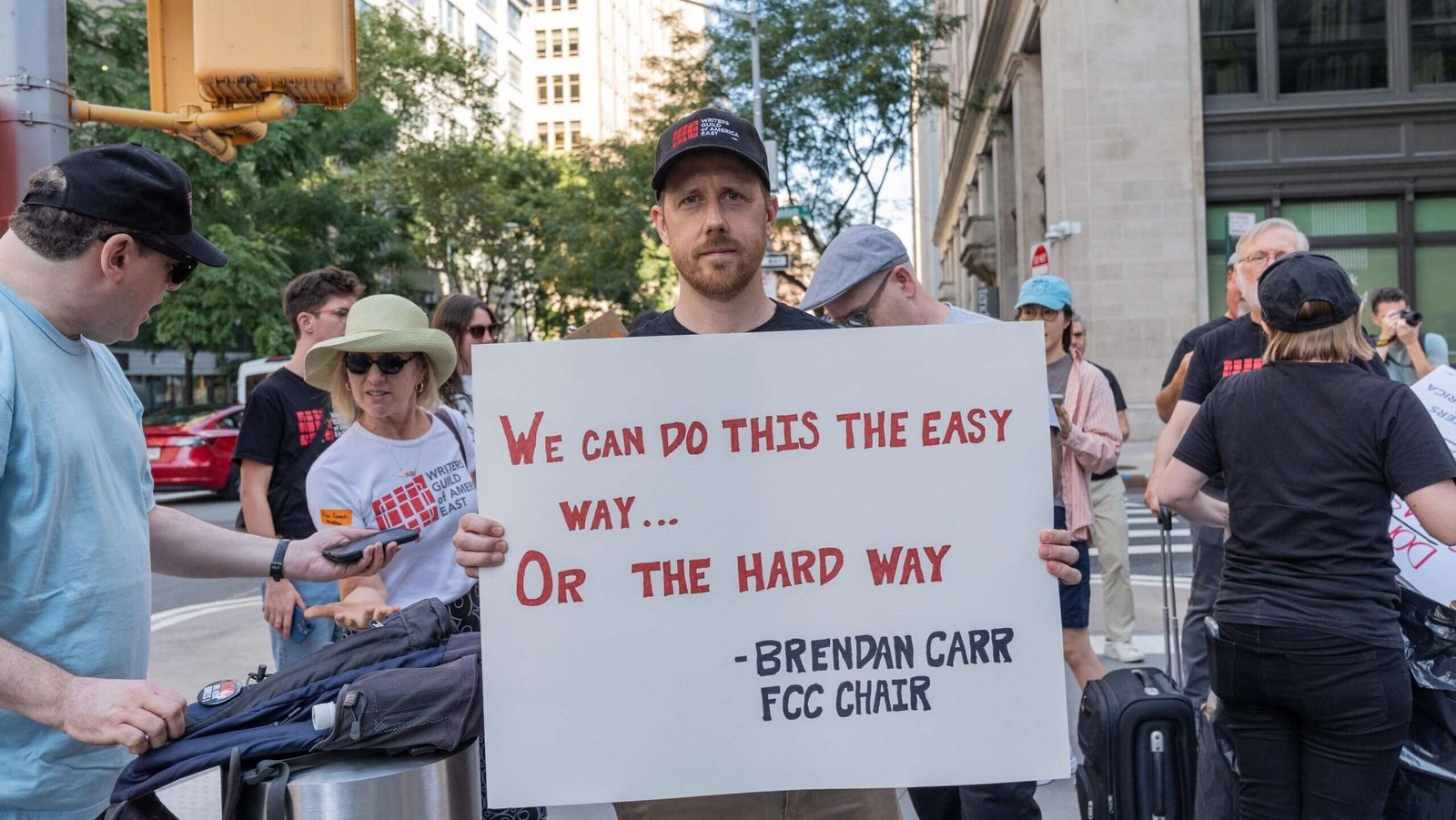
Days after the murder of conservative activist Charlie Kirk, Kimmel joked on his show that the “MAGA gang [was] desperately trying to characterize this kid who murdered Charlie Kirk as anything other than one of them, and doing everything they can to score political points from it.” This prompted Federal Communications Commission (FCC) Chairman Brendan Carr to threaten network broadcasting licenses, alleging that Kimmel’s show violates “public interest, convenience or necessity,” and to tell ABC that this could be resolved “the easy way or the hard way.” The following day, ABC announced the indefinite suspension of Jimmy Kimmel LIVE!—a decision it reversed on Monday after public outcry.
Many conservatives, trying to remember where they put their keys and their beefs about cancel culture, see this as the way the cookie crumbles. Sen. Ted Cruz (R–Texas), however, believes that Carr was wrong and called this “mafioso” behavior “dangerous.” The dispute highlights a century-old tension: political control over broadcast licenses and the power to shave free speech.
Broadcast TV and radio authorizations—held by stations in the ABC network—state that private companies cannot claim ownership of the radio spectrum. Access to airwaves is a privilege, not a right. This dates to the 1927 Radio Act, proposed by then–Commerce Secretary Herbert Hoover and signed by President Calvin Coolidge. Its rules were repeated virtually verbatim in the 1934 Communications Act, amended in the 1996 Telecommunications Act, and constitute today’s law of the land.
The greatest problem with censorship is the ease with which subtle demands by politicians slant the news, particularly in the choice (or rejection) of controversial topics. But it is the law backing up the government’s powerful authority that makes that influence work. Fred Friendly’s fascinating book The Good Guys, the Bad Guys, and the First Amendment, describes one of the sensational cases where a permit to speak was actually cancelled. In the WXUR case, a Philadelphia station was operated by the highly opinionated Rev. Carl McIntire, a “suspended” Presbyterian minister. Although his organization raised $5,000 to support Israel in the Six-Day War of 1967, McIntire was considered an antisemite by the National Council of Churches, the Urban League, and the B’nai B’rith. They objected to his “intemperate attacks on other religious denominations…and political officials.” The organizations called for McIntire’s broadcast license to be revoked (denied for renewal) by the FCC because its programs “help[ed] create a climate of fear, prejudice and distrust of democratic institutions.”
McIntire lost WXUR in 1973—the only time such a right was extinguished under the so-called Fairness Doctrine. But legions of speakers have been cowed and hushed. As early as 1929, the left-wing stations WEVD (named for Eugene V. Debs) and WCFL (owned by the Chicago Federation of Labor) were warned about espousing their radical views. WEVD was accused in a 1929 renewal at the Federal Radio Commission of being “the mouthpiece of the Socialist Party.” WCFL was branded a “propaganda” outlet. Both enterprises read the room and backed away from their edgy politics and full-time line-ups. WCFL merged into the NBC conglomerate, while WEVD—cadging donations to stay alive—limped along by sharing most of the week’s broadcast time with commercial outlets.
One of the great 20th century judicial liberals, D.C. Senior Court of Appeals judge David Bazelon, originally supported the FCC’s attack on McIntire’s ownership of WXUR. His First Amendment rights were compromised, under the 1943 NBC Supreme Court verdict, based on the “physical scarcity” doctrine. This posits that there are only a limited number of frequencies—a limit imposed by nature, not the government—and so the regulator has to select the best content to fill those slots. It was an uncompelling argument at the time: Resources in limited supply are sold to bidders every day without FCC (or other) administrative assignment. There are actually unlimited spectral slots, not just counting what technology might deliver (tell me the top limit on satellite radio channels or Internet radio stations), but in divvying the old AM dial into finer slices.
But Bazelon, after more carefully considering what broadcast licensing had achieved and would likely bring, switched sides: “In silencing WXUR, the Commission has dealt a death blow to the licensee’s freedom of speech and press….It is beyond dispute that the public has lost access to information and ideas.”
This regulatory carve-out created a chilling effect that could be wielded by political officials, thereby creating just the hazards that the Bill of Rights sought to foreclose. The chair of the FCC under President Richard Nixon, Dean Burch, coined the term “regulation by raised eyebrow” to denote how the system actually worked. In 1969–1970, Nixon dispatched aide Chuck Colson to the offices of the three broadcast networks to remind them of their perilous legal standing, and of the reality that the White House (with its friends at the FCC) would be reviewing their coverage. The industry titans were “almost apologetic,” wrote Colson in a gleeful memo to his boss. And, he said, “ABC will do anything we want.”
So, what’s the problem for Republicans? Well, not only do Democrats often control the eyebrows. The policy—even when exercised by members of one’s own party—is risible in a nation boasting the First Amendment.
In 1987, President Ronald Reagan’s deregulation-minded FCC was moving to abolish the Fairness Doctrine. The policy required stations to present news of importance to their local communities, and to do so from balanced perspectives. But “importance” and “balance,” being in the eye of the beholder, made it elementary to impose regulatory demands. And license revocations, if rare, were expensive in attorneys’ fees, financial risks, and blocked merger deals. Abolishing the easy enforcement device of a “fairness complaint” would undermine the political leverage of Washington, D.C. Congress blanched. To preserve the policy, it passed the Fairness in Broadcasting Act of 1987. Prominent conservatives, including Sen. Jesse Helms (R–N.C.), Rep. Newt Gingrich (R–Ga.), and activist Phyllis Schlafly, endorsed the measure. It passed, but Reagan vetoed it, writing that the scarcity carve-out in the First Amendment was no longer relevant and that content-based regulation of the press was unconstitutional.
Conservatives who supported the Fairness Doctrine soon discovered just how wrong they had been in terms of their competition in the marketplace of ideas. So did their opposite numbers. By 2000, the Democratic National Platform called to reinstate the Fairness Doctrine.
Some argue that Jimmy Kimmel’s cancellation moment was a result of market forces and consumer judgment. True, almost by definition. But how much did raised eyebrows, or explicit regulatory threats, top off the corporate incentives? It is impossible to say, as the chilling effect works its own magic in the shadows. President Donald Trump embraces the view that threats from the FCC were a force multiplier, and pledges to “let Jimmy Kimmel rot in his bad Ratings.” Sure. No artificial additives or eyebrows need compromise the free speech rights of American viewers, creators, speakers, stations, or networks.
Read the full article here
Fact Checker
Verify the accuracy of this article using AI-powered analysis and real-time sources.