

 Freedom Index
Listen to the article
Last year, Luc Besson’s Dracula: A Love Tale arrived in cinemas wrapped in claims of fidelity to Bram Stoker’s 1897 novel. In an interview with the Red River Horror website, Besson explained that he wanted to recapture something about Stoker’s story that other adaptations had missed:
When we asked Besson how he wanted to put his own spin on a story that’s been retold more times than a campfire ghost tale, his answer was disarmingly blunt. He didn’t want to compete with other Draculas. He didn’t even watch them. Instead, he went back to the novel and fixated on one thing: the romance. For Besson, Dracula isn’t really horror at all; it’s closer to Beauty and the Beast. The fangs, the blood, the gothic trappings? Those are just toys in the sandbox. The real story is about love.
In Besson’s film, a 15th-century prince renounces God and becomes a vampire after he loses his wife. Centuries later, he discovers that she has been reincarnated as Mina, the fiancée of Jonathan Harker, a conveyancer who travels to his castle in Transylvania. He imprisons Harker and travels to find Mina so that he can claim her for all eternity.
This narrative, however, does not originate in Stoker’s novel. In the original story, there is no dead princess, no reincarnation, and no grieving widower gloomily searching for his lost bride across centuries. Stoker’s Count is an invasive and uncanny presence, who arrives in England as a figure of foreignness, disease, and religious anxiety. His relationship to Mina is a violation that must be undone, not a tragic courtship that promises redemptive transcendence. The men around Mina hope to rescue her from contamination and restore her to domestic life. She is never the lost half of an immortal love story. Stoker’s Dracula is many things, and one can argue about the symbolic freight of blood and sexuality in the novel, but he does not function as a romantic antihero suspended in eternal longing.
The Dracula who fits Besson’s description was created almost a century later by Francis Ford Coppola and his collaborators for the 1992 film Bram Stoker’s Dracula. Screenwriter James V. Hart built a new take on the story by introducing a prologue in which Vlad Ţepeş returns from battle to discover that his wife, Elisabeta, has killed herself upon receiving false news of his death. Because the Church condemns suicide, a priest informs Vlad that her soul is damned. He rebels against God in the chapel and desecrates the altar—acts for which he is cursed with vampiric immortality. Centuries later, he arrives in Victorian London and encounters Mina, who looks exactly like Elisabeta. Hart gave Dracula the line that convinced Gary Oldman to accept the role: “I have crossed oceans of time to find you.” The entire emotional architecture of Coppola’s film depended on this invention. Dracula, once a pure predator, now appears as a man who has turned monstrosity into a way of inhabiting grief, while Mina finds herself torn between her present fiancé and her past self.
The result belongs in the landscape described by Mario Praz in The Romantic Agony, that long catalogue of European figures whose love is bound to death, cruelty, and sacrilege. Coppola’s Dracula is recognisable as one of Praz’s agonists, a man who can only love through ruin. This shift in emphasis also created the conditions in which the film’s visual language could operate.
Costumes as Cathedral
That visual language was largely constructed by costume designer Eiko Ishioka. In the 1992 volume that she co-authored with her director, Coppola and Eiko on Bram Stoker’s Dracula, Coppola recalled eliminating traditional sets and pouring resources into the film’s wardrobe, telling Ishioka that “the costumes will be the sets” and that this is how the film’s world would be built. Ishioka did not see costumes as decorative or secondary. She saw them as central to cinema’s visual narrative, capable of shaping character, architecture, mood, and myth at once. She believed that costumes should challenge the audience, the director, even the actors, and carry the psychological and symbolic weight of the story.
Ishioka’s work on Bram Stoker’s Dracula was elegant and transformative. She discarded the tropes made famous by Universal Studios’ and Hammer Film Productions’ versions of the story—the black cape, the slicked-back hair, the gothic widow’s peak. Instead, she built Dracula from contradictory archetypes: male and female, young and old, human and animal. She rendered him in a flowing red robe with a train like a sea of blood, in muscle armour that exposed his grief as sinew, in velvets and silks that shimmered like paintings. She made Mina’s friend Lucy Westenra a frilled lizard of sexuality and death. She shaped Mina’s veils and lines as tightly as her inner tension. Every frame of Coppola’s film bore Ishioka’s touch, and the spectacle she curated becomes a worldview: it tells us who this Dracula is, how grief sits in his body, how desire and dread move through a room. In that sense, the film’s visual design carries narrative weight independently of dialogue.
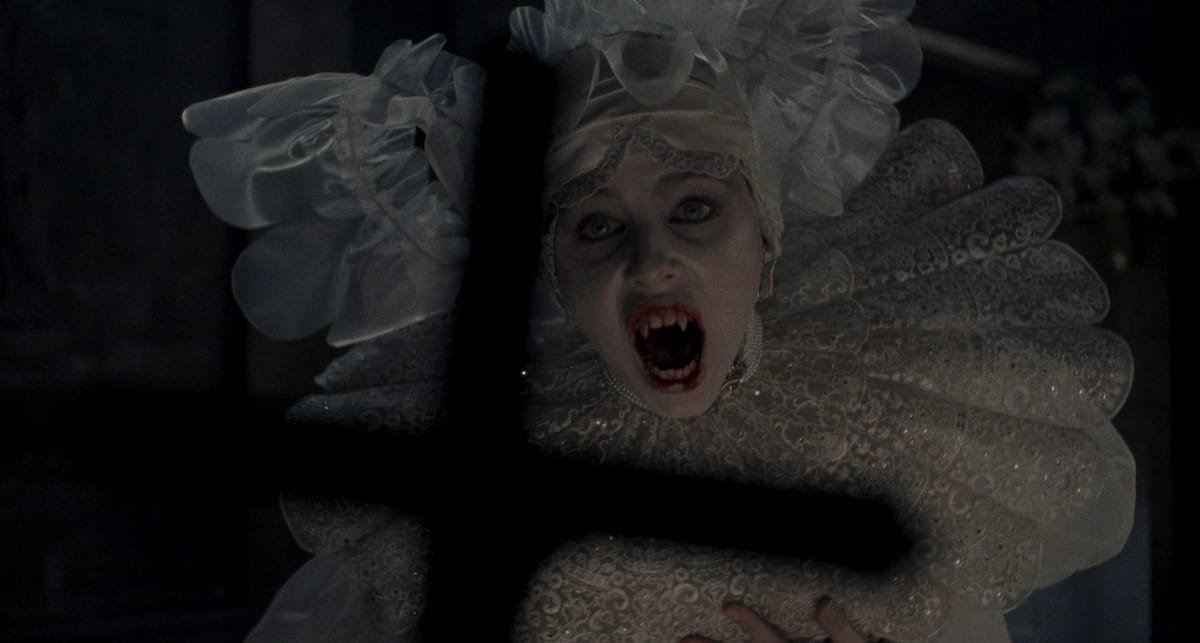
Coppola praised Ishioka as a visionary, and the Academy recognised her contribution with an Oscar. But in popular memory, her name is often lost. People talk about Coppola’s Dracula, as if the look of the film sprang from his visionary mind alone. The designs live on—copied, referenced, imitated—but their origin has been obscured.
Borrowing Without Acknowledgment
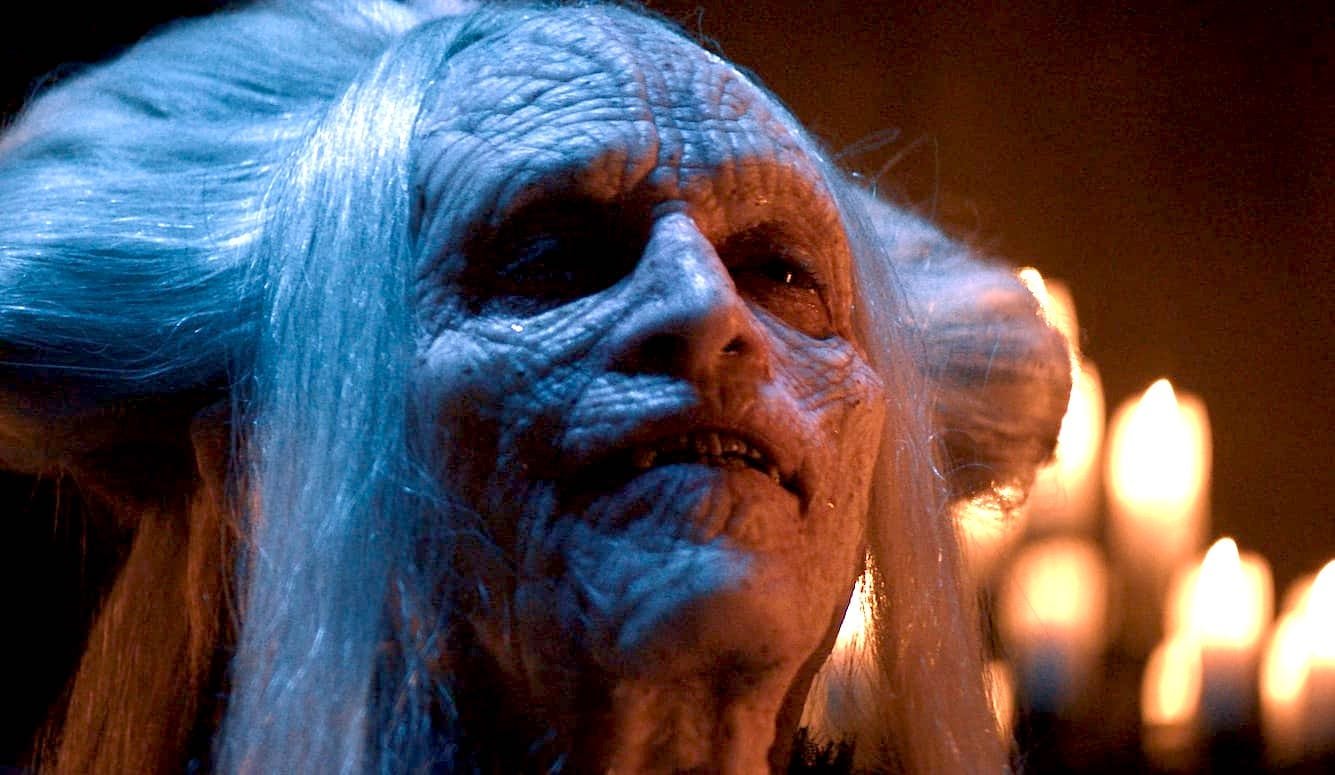
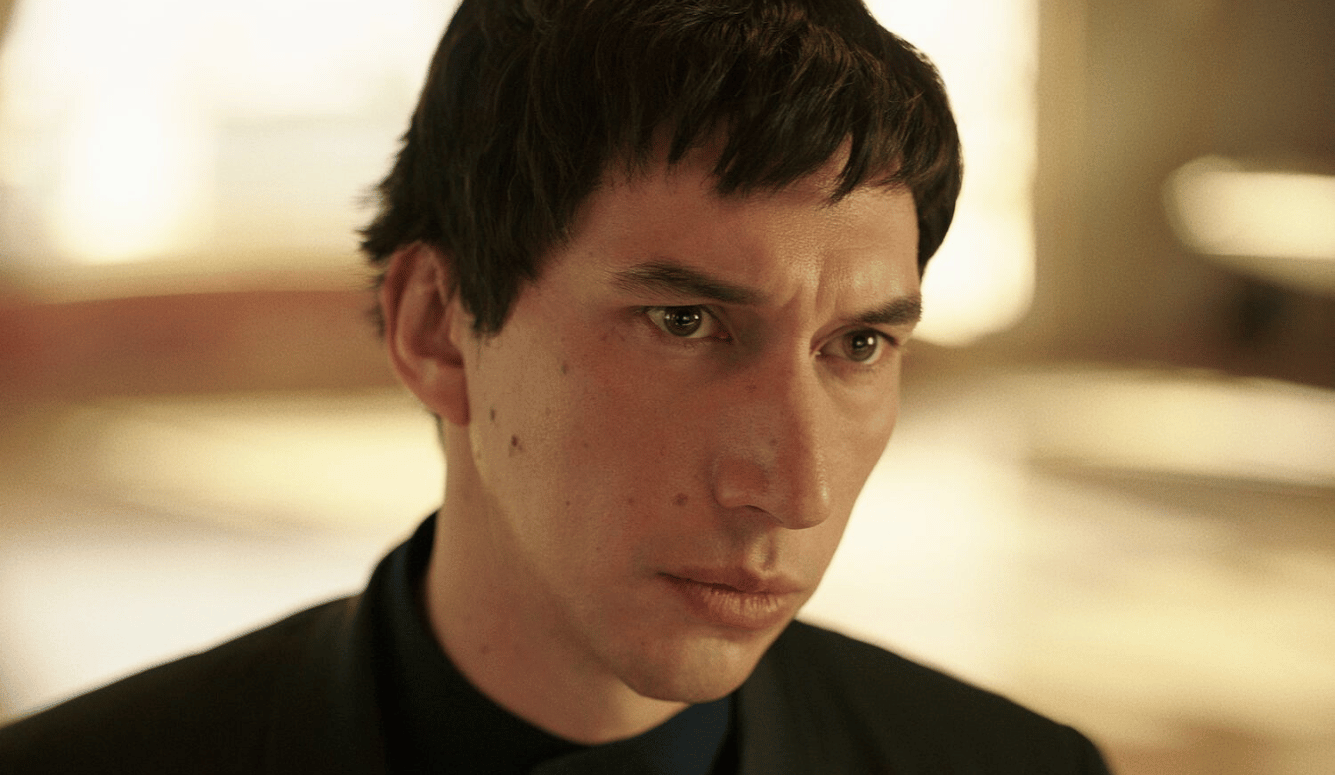
This is the world into which Luc Besson has trespassed with his new adaptation. Dracula: A Love Tale is an English-language French production starring Caleb Landry Jones as the Count. The synopsis reads almost like someone had paraphrased Hart’s script but merely changed the map. A prince in Wallachia loses his wife, renounces God, becomes a vampire, and wanders the earth grief-stricken for four hundred years until he discovers Mina, the reincarnation of Elisabeta. He imprisons her fiancé, travels to Paris, awakens her to her past identity, and prepares to spend eternity with her until a priest-led expedition storms his castle and confronts him with the spiritual consequences of what he has done.
Besson relocates much of the later action to a stylised Belle Époque Paris around the centenary of the French Revolution, and he sprinkles in some new details, such as Dracula destroying a perfume that had repressed Mina’s memories. Yet the structure and the emotional centre of gravity remain the same as in Coppola’s film. Here is a widower who believes that time and blood may be bent to the service of one idea of love.
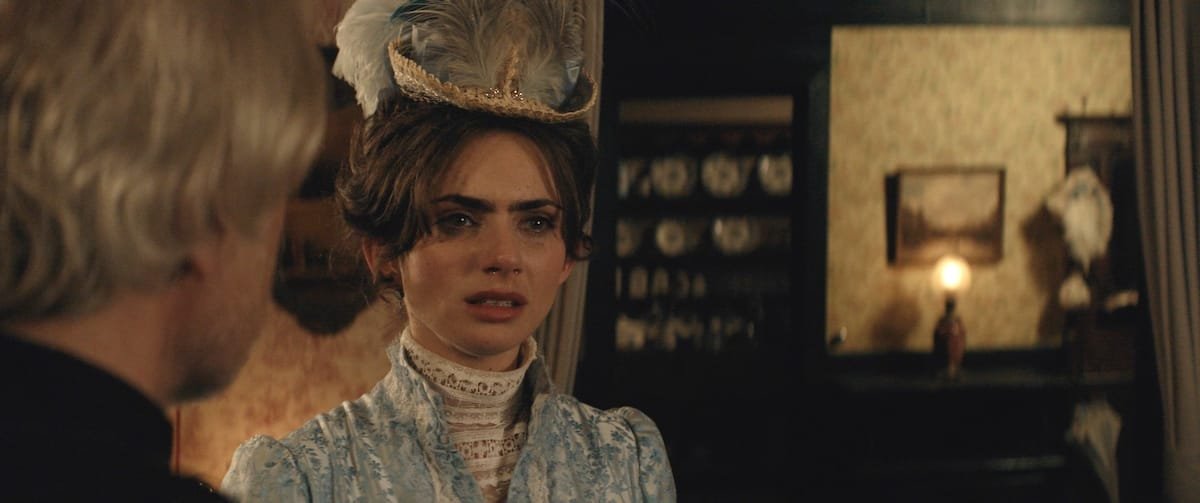
Visually, Besson’s film sits firmly in Ishioka’s territory, but he borrows her design logic rather than any particular image. Armour reads as sculpted flesh rather than protection; saturated reds operate as emotional scaffolding; costume overwhelms interior space as moving scenery rather than period detail. These similarities operate at a structural level. They derive from a philosophy in which wardrobe generates narrative force. Place images from Besson’s film beside frames from Bram Stoker’s Dracula and the reliance becomes hard to ignore. Long coats with architectural shoulders; blood red fabrics that act like mobile backdrops; the play between hairline, forehead, and crown; dresses that flatten historical accuracy in favour of strong silhouettes—all of this comes straight out of Ishioka’s system, adjusted somewhat in period and palette, though rarely reconsidered at the level of conceptual design.
Besson has sometimes acknowledged a debt to Coppola’s film, but he is always at pains to stress that his first fidelity was to Stoker’s text. In interviews, he has emphasised this romantic reinterpretation and his personal frame, but I have found no instance in which he names Ishioka’s contribution or acknowledges his debt to her visual philosophy. His film’s publicity leaned heavily on Stoker’s name, but the influence of Hart and—especially—Ishioka has not been part of the authorship narrative.
Decline and Folly
‘Megalopolis’ and the rise and fall of Francis Ford Coppola.
Public Domain and the Cost of Forgetting
Legally, this is all easy to defend. Stoker has been in the public domain for a long time now. No one owns the idea of a vampire prince who loved once and lost. And visual influence is, by its nature, diffuse and cumulative. Cinema has always advanced through quotation. The more significant question concerns what artists owe to the particular, identifiable inventions that have reshaped the audience’s sense of a classic work.
In this case, three key innovations stand out: the reincarnated lover as the engine of the plot; Dracula recast as a bereaved husband transformed by grief; and the construction of the film as a total costume environment rather than treating wardrobe as secondary. The first two inventions rose from Hart’s pages. The third—and most striking—belonged to Ishioka. What she altered in 1992 was not merely the appearance of Dracula but the ontology of the film. Texture, silhouette, colour, and shadow function as structural elements within the drama. In Coppola’s film, fabric does dramatic work. In Besson’s, similar elements recur, but they function as quotation rather than as generative material.
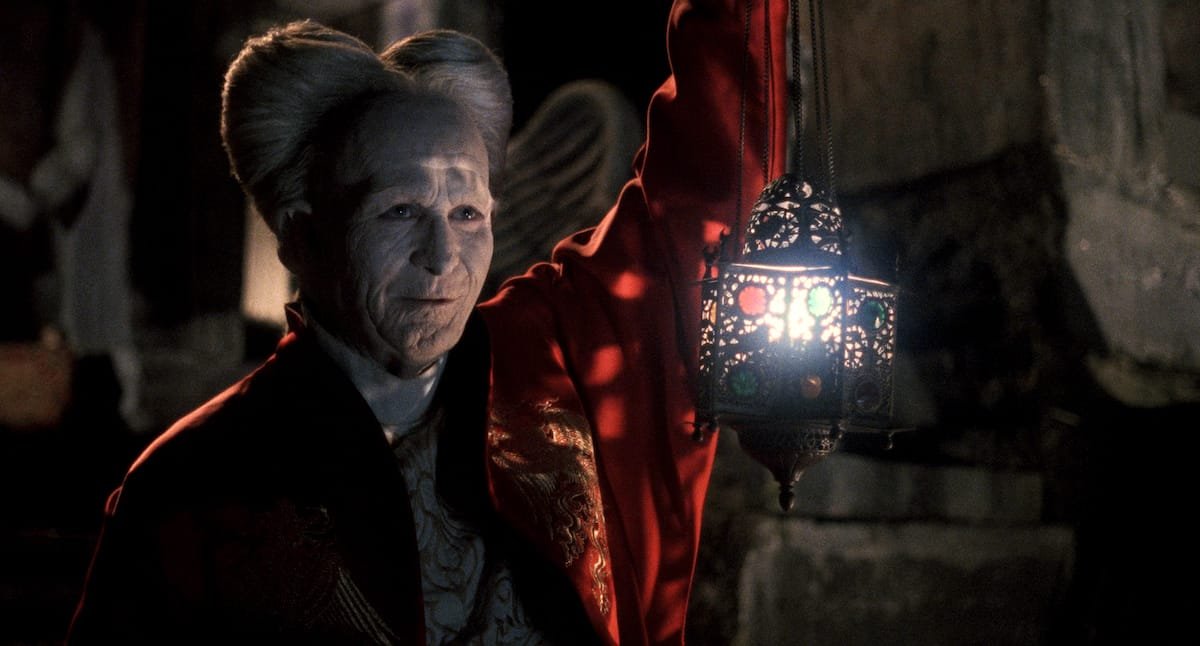
Hart is still alive and occasionally gives interviews about his legacy as the writer of Hook and Bram Stoker’s Dracula. His authorship is at least recoverable for those who care to look. Ishioka died in 2012, aged 73, so she can no longer speak for herself. She left a career that included Miles Davis album covers, Olympic uniforms, and work for directors like Paul Schrader and Tarsem Singh. Still, the Oscar she won for Bram Stoker’s Dracula did not prevent her name from sliding out of popular memory. When people talk about the visual impact of the 1992 film they seldom acknowledge the Japanese designer and her precise sensibility.
When Besson calls his film a rediscovery of Stoker’s romanticism, he contributes to the ongoing occlusion of Ishioka’s startling contribution. The romantic Dracula had already passed through one round of simplification, from Hart and Ishioka’s labour to a shorthand that credited Coppola alone. A second round now routes the entire structure back to a Victorian clerk in a London office who never wrote such a character.
Lineage, Influence, and How to Inherit
There are ways to work with a classic text that avoid this kind of simplification. Guillermo del Toro’s 2025 adaptation of Frankenstein is a recent example. Del Toro had been talking about his love of Mary Shelley’s novel for years, but he has also spoken openly about his debt to the Universal cycle, particularly James Whale’s films with Boris Karloff. Del Toro moved Shelley’s story into the era of the Crimean War, reshaped Victor’s family history, and filled the screen with his own mixture of religious imagery, baroque colour, and industrial detail. Yet critics at Venice and elsewhere immediately read it as a synthesis of Shelley, Whale, and del Toro’s private mythology rather than a derivative copy.
The film’s visual and material environment, and its elaborate sets and costumes, bear the mark of del Toro’s own sensibility. These works extend the idea Ishioka helped detonate: that costume can be cathedral, mood, myth, argument, a way of telling the story in its own register instead of serving as embellishment on top of it. Del Toro is working inside a field she opened, showing how much range there is once costume is allowed to carry the weight of a world. Ishioka blasted open that possibility with Dracula, and del Toro advanced it, in his own idiom, without quoting her.
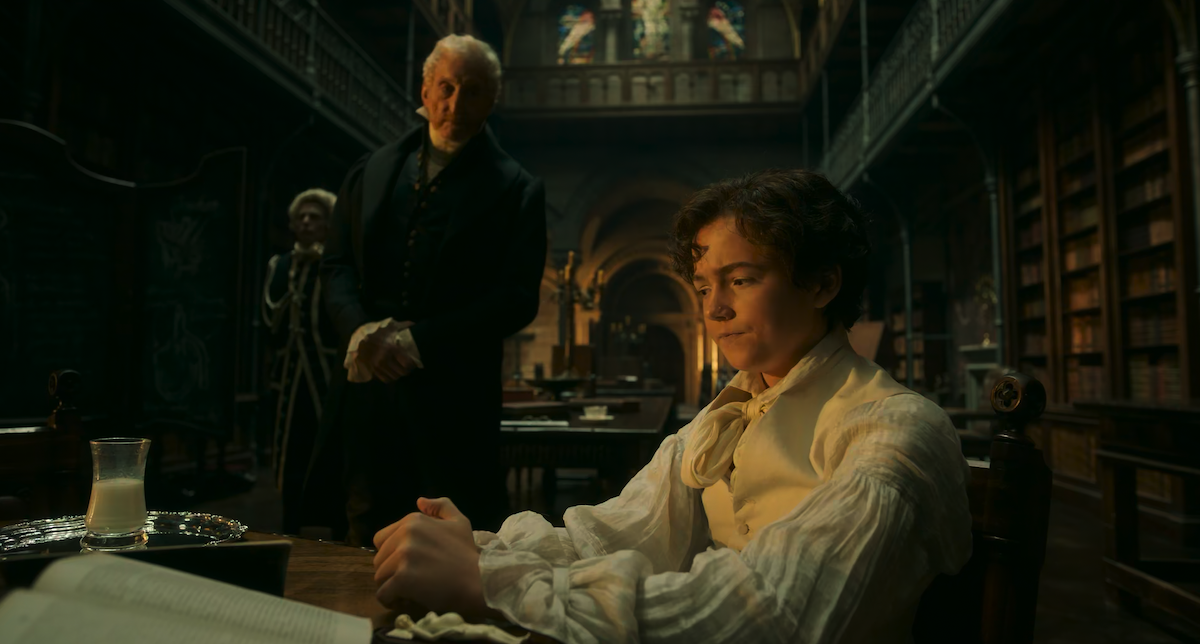
Besson, on the other hand, lacks del Toro’s respectful affection for the horror genre and its masters. He brings too little of his own sensibility to Dracula, and so his film feels more like unattributed reproduction than homage. It is easy to shrug and say that this is all part of the usual churn of pop culture. Stories are retold, details blur, one generation’s experiment becomes the next generation’s common sense. The romantic Dracula feels inevitable now because audiences have been living with Coppola’s version for more than thirty years. Yet the way that we talk about these things matters. When journalists repeat Besson’s claim that he has rediscovered Stoker’s love story, but neglect to mention Hart’s script or the powerful visual revolution led by Ishioka, they are helping to propagate a fiction.
What ultimately matters is which names survive when a myth moves from one age to another. The cost of pretending that Besson’s Dracula is simply a direct line from Stoker is paid by the people who did the truly groundbreaking imaginative work. A screenwriter from Texas who wrote a widower into existence and gave him the words that hooked an actor. A Japanese designer who turned that widower and his world into moving images so brilliant that a later director could borrow them almost intact and feel that he was merely doing what the story required.
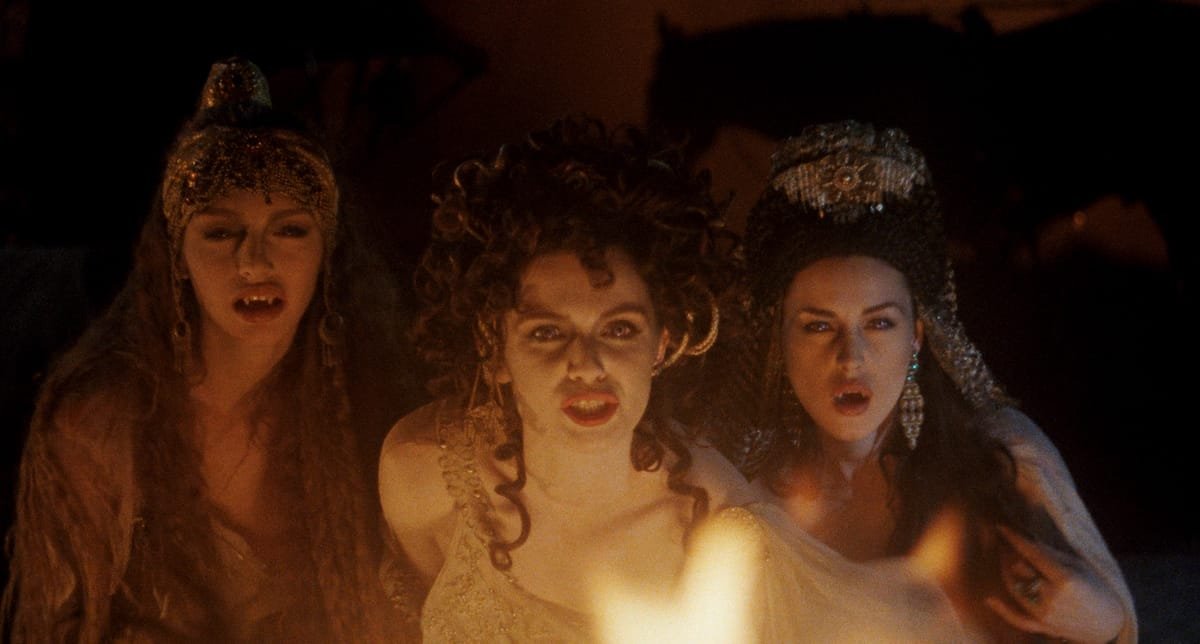
There is no legal requirement for Luc Besson to end his film with “with thanks to James V. Hart and Eiko Ishioka.” The standard that matters here belongs elsewhere, in the long, fragile practice of artistic memory. When a film leans so heavily on solutions devised by others—from the engine of its plot to the psychology of its hero and the clothes that give the images their unique force—it is a mere courtesy to let those names resurface.
Designing Fear: Bram Stoker’s Dracula – The Art of Costume
The Art of Costume explores Bram Stoker’s Dracula and the costumes designed by Academy-Award winner, Eiko Ishioka.
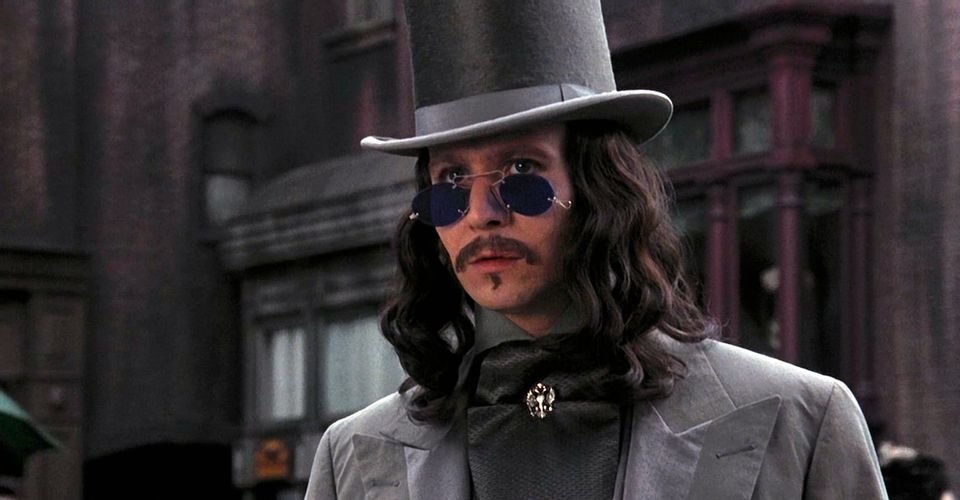
In this case, the heaviest loss falls on Ishioka. She is no longer here to explain what she did, or to insist on her place in the story. Yet it was her eye that fixed the romantic Dracula in the collective imagination: the visual coding of grief as armour, the choreography of predatory movement, and the rendering of erotic threat through collar, train, and sleeve. She answered, once, the question of what this version of Dracula should look like, and that answer has been feeding directors ever since. Her images continue to circulate, detached from their point of origin and increasingly thinned of their original force, and as that detachment continues, her place in the historical record erodes.
Quillette invites thoughtful responses to its essays.
Selected responses are published once per week as part of a curated Letters to the Editor feature. If selected, letters appear under the contributor’s real name and may be edited for clarity and length.
To submit a letter for consideration, please email [email protected].
Read the full article here
Fact Checker
Verify the accuracy of this article using AI-powered analysis and real-time sources.