

 Freedom Index
Listen to the article
Discord has begun rolling out mandatory age verification and the internet is, understandably, freaking out.
At EFF, we’ve been raising the alarm about age verification mandates for years. In December, we launched our Age Verification Resource Hub to push back against laws and platform policies that require users to hand over sensitive personal information just to access basic online services. At the time, age gates were largely enforced in polities where it was mandated by law. Now they’re landing in platforms and jurisdictions where they’re not required.
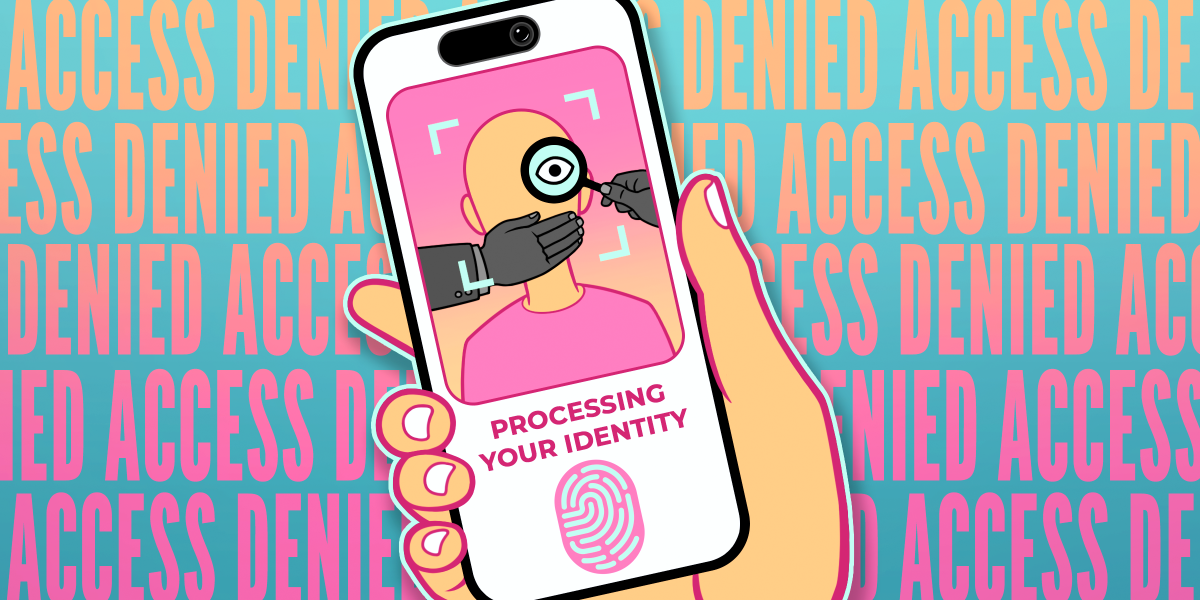
Beginning in early March, users who are either (a) estimated by Discord to be under 18, or (b) Discord doesn’t have enough information on, may find themselves locked into a “teen-appropriate experience.” That means content filters, age gates, restrictions on direct messages and friend requests, and the inability to speak in “Stage channels,” which are the large-audience audio spaces that power many community events. Discord says most adults may be sorted automatically through a new “age inference” system that relies on account tenure, device and activity data, and broader platform patterns. Those whose age isn’t estimated due to lack of information or who are estimated to not be adults will be asked to scan their face or upload a government ID through a third-party vendor if they want to avoid the default teen account restrictions.
We’ve written extensively about why age verification mandates are a censorship and surveillance nightmare. Discord’s shift only reinforces those concerns. Here’s why:
The 2025 Breach and What’s Changed Since
Discord literally won our 2025 “We Still Told You So” Breachies Award. Last year, attackers accessed roughly 70,000 users’ government IDs, selfies, and other sensitive information after compromising Discord’s third-party customer support system.
To be clear: Discord is no longer using that system, which involved routing ID uploads through its general ticketing system for age verification. It now uses dedicated age verification vendors (k-ID globally and Persona for some users in the United Kingdom).
That’s an improvement. But it doesn’t eliminate the underlying potential for data breaches and other harms. Discord says that it will delete records of any user-uploaded government IDs, and that any facial scans will never leave users’ devices. But platforms are closed-source, audits are limited, and history shows that data (especially this ultra-valuable identity data) will leak—whether through hacks, misconfigurations, or retention mistakes. Users are being asked to simply trust that this time will be different.
Age Verification and Anonymous Speech
For decades, we’ve taught young people a simple rule: don’t share personal information with strangers online.
Age verification complicates that advice. Suddenly, some Discord users will now be asked to submit a government ID or facial scan to access certain features if their age-inference technology fails. Discord has said on its blog that it will not associate a user’s ID with their account (only using that information to confirm their age) and that identifying documents won’t be retained. We take those commitments seriously. However, users have little independent visibility into how those safeguards operate in practice or whether they are sufficient to prevent identification.
Even if Discord can technically separate IDs from accounts, many users are understandably skeptical, especially after the platform’s recent breach involving age-verification data. For people who rely on pseudonymity, being required to upload a face scan or government ID at all can feel like crossing a line.
Many people rely on anonymity to speak freely. LGBTQ+ youth, survivors of abuse, political dissidents, and countless others use aliases to explore identity, find support, and build community safely. When identity checks become a condition of participation, many users will simply opt out. The chilling effect isn’t only about whether an ID is permanently linked to an account; it’s about whether users trust the system enough to participate in the first place. When you’re worried that what you say can be traced back to your government ID, you speak differently—or not at all.
No one should have to choose between accessing online communities and protecting their privacy.
Age Verification Systems Are Not Ready for Prime Time
Discord says it is trying to address privacy concerns by using device-based facial age estimation and separating government IDs from user accounts, retaining only a user’s age rather than their identity documents. This is meant to reduce the risks associated with retaining and collecting this sensitive data. However, even when privacy safeguards are in place, we are faced with another problem: There is no current technology that is fully privacy-protective, universally accessible, and consistently accurate. Facial age estimation tools are notoriously unreliable, particularly for people of color, trans and nonbinary people, and people with disabilities. The internet has now proliferated with stories of people bypassing these facial age estimation tools. But when systems get it wrong, users may be forced into appeals processes or required to submit more documentation, such as government-issued IDs, which would exclude those whose appearance doesn’t match their documents and the millions of people around the world who don’t have government-issued identity documents at all.
Even newer approaches (things like age inference, behavior tracking, financial database checks, digital ID systems) expand the web of data collection, and carry their own tradeoffs around access and error. As we mentioned earlier, no current approach is simultaneously privacy-protective, universally accessible, and consistently accurate across all demographics.
That’s the challenge: the technology itself is not fit for the sweeping role platforms are asking it to play.
That’s the challenge: the technology itself is not fit for the sweeping role platforms are asking it to play.
The Aftermath
Discord reports over 200 million monthly active users, and is one of the largest platforms used by gamers to chat. The video game industry is larger than movies, TV, and music combined, and Discord represents an almost-default option for gamers looking to host communities.
Many communities, including open-source projects, sports teams, fandoms, friend groups, and families, use Discord to stay connected. If communities or individuals are wrongly flagged as minors, or asked to complete the age verification process, they may face a difficult choice: submit to facial scans or ID checks, or accept a more restricted “teen” experience. For those who decline to go through the process, the result can mean reduced functionality, limited communication tools, and the chilling effects that follow.
Most importantly, Discord did not have to “comply in advance” by requiring age verification for all users, whether or not they live in a jurisdiction that mandates it. Other social media platforms and their trade groups have fought back against more than a dozen age verification laws in the U.S., and Reddit has now taken the legal fight internationally. For a platform with as much market power as Discord, voluntarily imposing age verification is unacceptable.
So You’ve Hit an Age Gate. Now What?
Discord should reconsider whether expanding identity checks is worth the harm to its communities. But in the meantime, many users are facing age checks today.
That’s why we created our guide, “So You’ve Hit an Age Gate. Now What?” It walks through practical steps to minimize risk, such as:
- Submit the least amount of sensitive data possible.
- Ask: What data is collected? Who can access it? How long is it retained?
- Look for evidence of independent, security-focused audits.
- Be cautious about background details in selfies or ID photos.
There is unfortunately no perfect option, only tradeoffs. And every user will have their own unique set of safety concerns to consider. Amidst this confusion, our goal is to help keep you informed, so you can make the best choices for you and your community.
In light of the harms imposed by age-verification systems, EFF encourages all services to stop adopting these systems when they are not mandated by law. And lawmakers across the world that are considering bills that would make Discord’s approach the norm for every platform should watch this backlash and similarly move away from the idea.
If you care about privacy, free expression, and the right to participate online without handing over your identity, now is the time to speak up.
Join us in the fight.
Read the full article here
Fact Checker
Verify the accuracy of this article using AI-powered analysis and real-time sources.