

 Freedom Index

Listen to the article
The latest rise in the consumer price index (CPI) was “in line with estimates,” and rising inflation has already been priced into the macroeconomic data for the March CPI print, according to market analysts at exchange-traded product (ETP) issuer 21Shares.
Shelter rose 0.2% in February, while the food sector of the CPI rose 0.4%, energy increased by 0.6%, and the index for all items, excluding food and energy, rose by 0.2%, according to the US Bureau of Labor Statistics (BLS) February CPI report.
Stephen Coltman, head of macro at 21shares, said the upcoming CPI prints place even more pressure on the Federal Open Market Committee (FOMC), the body that decides interest rate policy. He said:
“What matters now is the Fed’s reaction function to the coming higher CPI prints. Do they ‘look through’ this temporary shock despite having been burned in the previous inflation cycle? Or do they tilt hawkish as a precautionary measure?”
Crypto markets remain resilient following the February CPI report, with the Total 3 market indicator, which tracks the entire crypto market capitalization excluding Bitcoin (BTC) and Ether (ETH), only declining by about 1% from the intraday high of about $722 billion.
Related: Finance job openings fall to 13-year low as US economy loses 92K jobs
What does this mean for BTC’s price?
“In the immediate term, Bitcoin is likely to remain rangebound between $68,000 and $74,000. However, a breakout past the $75,000 resistance zone appears imminent,” according to Matt Mena, crypto research strategist at 21Shares.
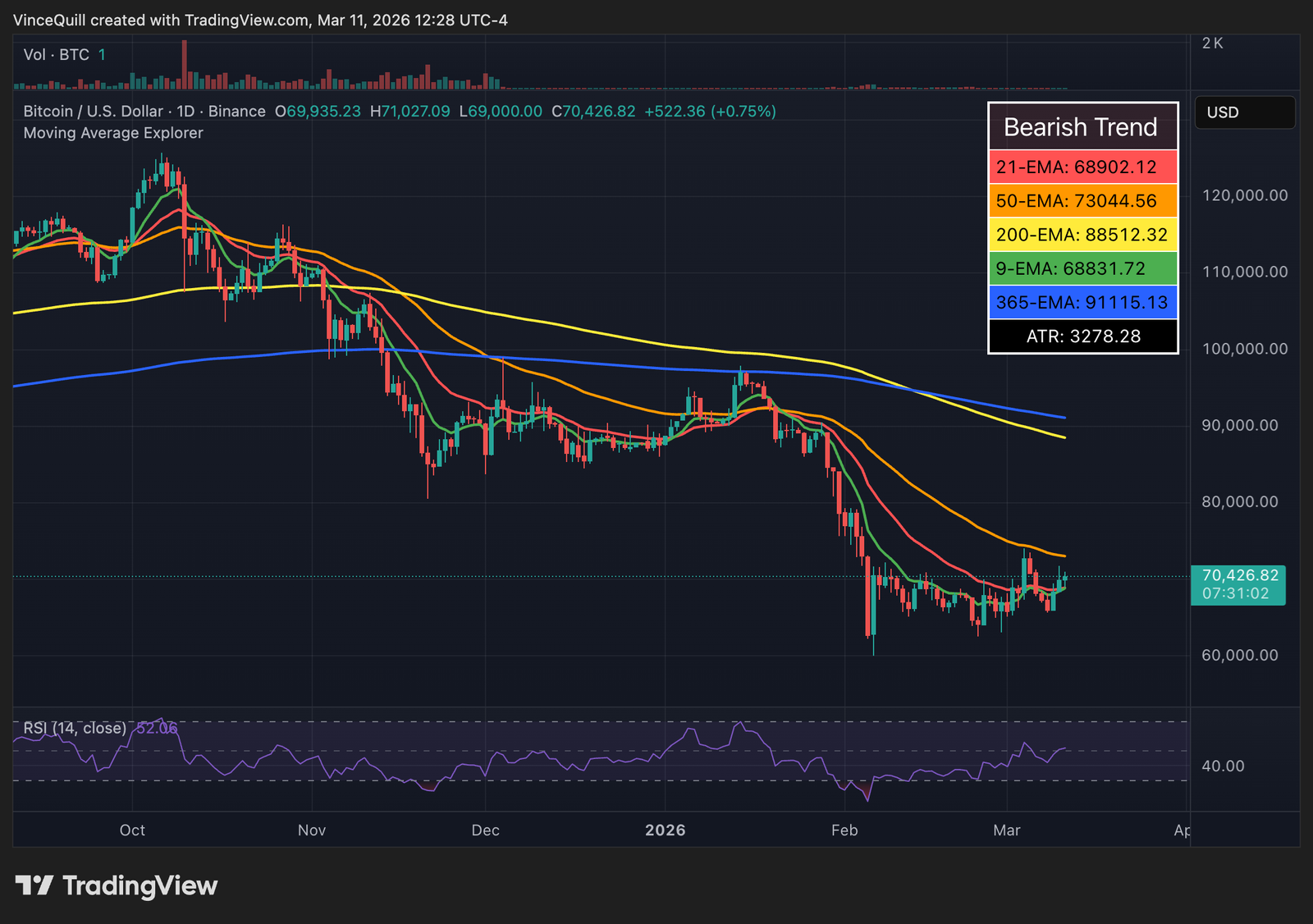
If BTC manages to break above the $75,000 level, it could enter a consolidation phase between $75,000 and $80,000 in the medium-term, Mena said.
Historic price data shows that BTC typically rebounds by 15% or more after geopolitical market shocks, which would put its price in the $77,000 to $80,000 range, he said.
A market recovery to these levels could also be “accelerated” if the FOMC resumes easing interest rates in 2026, according to Mena.
Only 0.6% of traders expect an interest rate cut from the current 3.50%-3.75% range at the March 18 FOMC meeting, according to the CME FedWatch tool.
Magazine: The debate over Bitcoin’s four-year cycle is over: Benjamin Cowen
Read the full article here
Fact Checker
Verify the accuracy of this article using AI-powered analysis and real-time sources.