

 Freedom Index
Listen to the article
I.
Cambridge’s promise to protect lawful speech has now been tested. Earlier this month, it was reported that the university had dismissed all 58 student complaints alleging that philosopher Nathan Cofnas’s views amounted to discrimination or harassment. The decision is the first substantive application of Cambridge’s new Code of Practice on Freedom of Speech and an early measure of the Higher Education (Freedom of Speech) Act’s reach.
Cofnas has drawn controversy for years. In 2020, he published a defence of free inquiry on taboo topics in a respected philosophy journal and a number of philosophers promptly mounted a campaign against him. When he arrived at Cambridge in 2022 as a Leverhulme Fellow in the faculty of philosophy, cancellation attempts followed almost immediately. But his latest troubles began in February 2024, when he published an essay titled “A Guide for the Hereditarian Revolution” on his personal blog. Students launched a petition calling for Cofnas to be dismissed, which swiftly gathered over 1,000—mostly anonymous—signatures. Angela Breitenbach, the chair of the philosophy faculty, told the student newspaper Varsity: “The views expressed in these blogs do not represent the views of the Faculty of Philosophy. The Faculty strives to be a leader in defending equality and fostering inclusion. There is no place for racism at the University of Cambridge.” (Curiously, no one seems to have been bothered by his January essay, “Why We Need to Talk About the Right’s Stupidity Problem,” arguing that people on the political Right have, on average, lower intelligence than those on the Left.)
Philosophy Is Being Hijacked by Woke Twitter Mobs
Van Leeuwen and Herschbach wrote a statement on Facebook reiterating that the review process had been carried out properly, and declaring, “Efforts to silence unwelcome opinion… are doing a disservice to the community.”
Most experts in behavioural genetics agree that genes significantly influence individual differences in intelligence, a consensus supported by large-scale meta-analyses and review papers. Cofnas, however, was using “hereditarian” in reference to variation between human groups. On this view, genetic factors make a non-trivial contribution to average differences between racial and ethnic groups—including in cognitive traits such as measured IQ. This hypothesis is highly controversial. Some scholars, like the linguist Noam Chomsky, have said that it is of “no scientific interest and of no social significance, except to racists, sexists, and the like.” Others, including cognitive psychologists Stephen Ceci and Wendy Williams, educational psychologist Linda Gottfredson, and social scientist Noah Carl, argue that inquiry into this question is ethically justifiable, scientifically and educationally valuable, and that suppressing it leads to misguided policies and other tangible harms.
The hereditarian hypothesis is notoriously difficult to test because of pervasive confounding factors and the non-inferability of between-group heritability from within-group heritability. But one common objection—that it must be false because “race” is socially constructed—proves unconvincing on closer examination. Social racial categories are not identical to genetic-ancestry clusters, but the overlap is often sufficient to conclude that, if average differences exist by ancestry, they will show up as average differences across socially defined races. As the psychiatrist and influential essayist Scott Alexander has argued, insisting on perfect biological precision for “race” while accepting rough categories elsewhere is an isolated demand for rigour.
Soon after Cofnas’s blog post appeared, Dr Bronwen Everill, director of the university’s Centre of African Studies, told Varsity that the university’s continued employment of Cofnas was “like having a flat earther on the physics faculty.” That invites a question: do experts regard hereditarianism as they do flat-earthism? Ask physicists today to rate their confidence in a flat Earth from zero to a hundred and all would choose zero. In contrast, a recent study by Clark et al. asked 470 psychology professors at leading US universities to rate their confidence (zero to a hundred) in the claim that genetic differences explain a non-trivial share of race differences in intelligence test scores. The responses they received spanned the scale, including some at both endpoints, with a mean of 29.1. By any ordinary standard, this remains a contested rather than a discredited question.
Cofnas’s essay is not primarily a case for the truth of hereditarianism; it takes hereditarianism (which he calls “race realism”) as a working assumption and examines its strategic and philosophical implications. He contends that elite “wokeism” follows from the “equality thesis”: if groups don’t differ innately, persistent disparities must be blamed on hidden discrimination—therefore, in his view, durable opposition to misguided diversity, equity, and inclusion (DEI) policies requires breaking the taboo on hereditarianism. He critiques legal or institutional fixes and culture-only “soft realism” as insufficient without that shift in elite beliefs, and argues that a hereditarian turn is feasible and—relative to the harms he attributes to DEI—less dangerous than critics fear.
II.
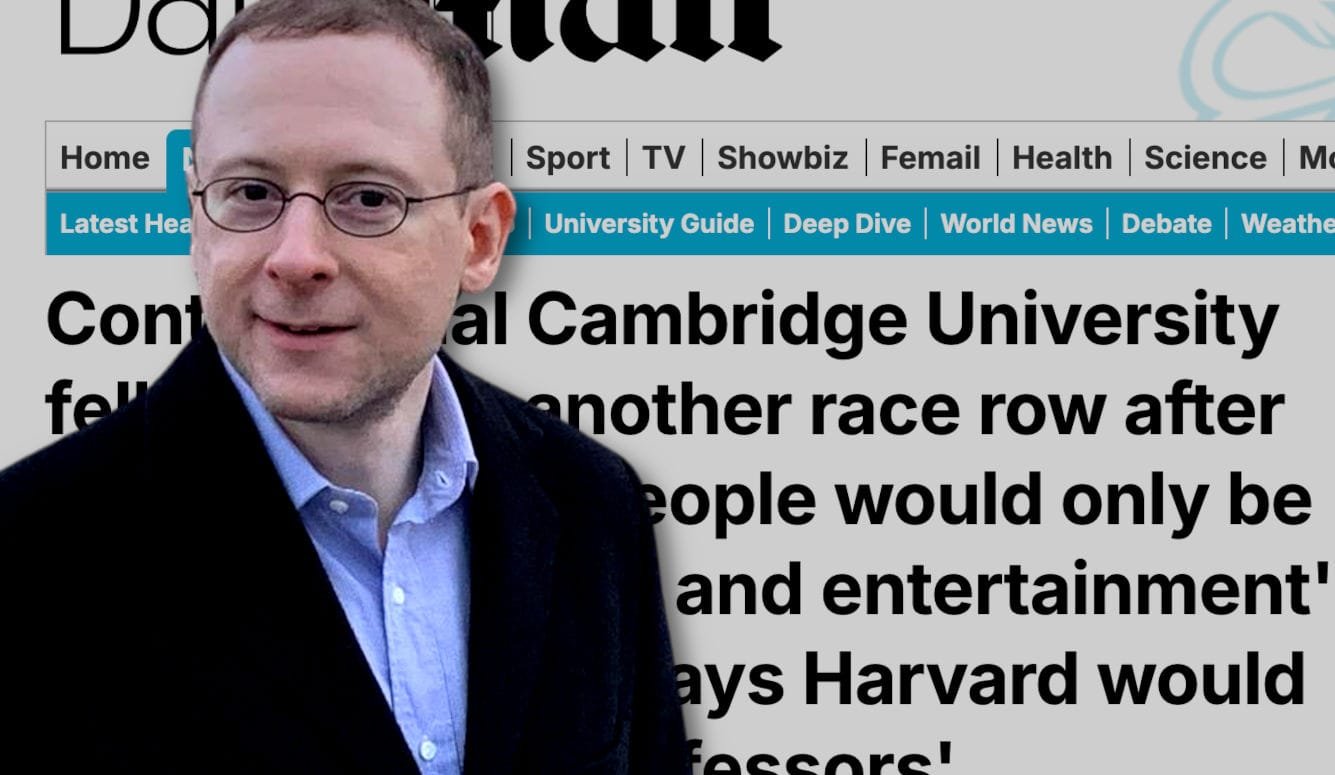
It is not clear how carefully Cofnas’s detractors read his essay. The petition to fire him alleged that he wrote that, in a meritocracy, Harvard would have no black professors. This claim then migrated to a Daily Mail headline, now inside quotation marks. In fact, the essay says no such thing. It cites internal Harvard data showing that, if admissions were strictly colourblind and based on academic qualifications alone, the student body would be 0.7 percent black; from this he infers that, if the same criterion governed hiring, the number of black professors “would approach 0%.”
Cofnas held two roles at Cambridge University: a salaried Leverhulme Fellowship in the faculty of philosophy, with teaching and research duties, and a research associateship at Emmanuel College that conferred access and affiliation but no formal duties. Activists inside and outside the university demanded that he be dismissed from one or both posts.
At first, both the university and the college were supportive. Cofnas recalls speaking with Emmanuel’s master, Doug Chalmers, who was emphatic that he would defend free speech and understood the stakes. Chalmers made similar remarks in public. In a letter to students, Chalmers wrote: “The College is committed to providing an environment that is free from all discrimination and affirms the right of all members to be treated with dignity and respect.” However, he also defended Cofnas’ “academic right, as enshrined by law, to write about his views” and the college’s “commitment to freedom of thought and expression.”
Professor Bhaskar Vira, pro-vice-chancellor for education at the university, told Varsity: “Freedom of speech within the law is a right that sits at the heart of the University of Cambridge.” He then made the obvious point that “the voice of one academic does not reflect the views of the whole university community.” Given the pressure on the faculty, Cofnas voluntarily stepped back from student contact, expecting to resume teaching once matters were resolved.
Protests escalated. Students posted flyers with Cofnas’s face across campus, which he says made it unsafe for him to walk around. In late February, students and some academics marched through campus chanting “Hey hey, ho ho, Nathan Cofnas has to go,” led by a student in military fatigues using a megaphone. In a large undergraduate messaging group, some suggested the problem could be solved by assaulting Cofnas—threats the university somehow deemed not credible.
Read the full article here
Fact Checker
Verify the accuracy of this article using AI-powered analysis and real-time sources.