Close Menu
FSNN | Free Speech News NetworkFSNN | Free Speech News Network
  • Home
  • News
    • Politics
    • Legal & Courts
    • Tech & Big Tech
    • Campus & Education
    • Media & Culture
    • Global Free Speech
  • Opinions
    • Debates
  • Video/Live
  • Community
  • Freedom Index
  • About
    • Mission
    • Contact
    • Support
Trending

CBS Decides That NOT Airing Associates Of Sex-Trafficking Pedophiles Would Be Woke

21 minutes ago

My New Dispatch Article, “In Defense of Sanctuary Cities”

24 minutes ago

Why bitcoin’s rare oversold RSI crash signals a long, slow grind ahead

41 minutes ago
Facebook X (Twitter) Instagram
Facebook X (Twitter) Discord Telegram
FSNN | Free Speech News NetworkFSNN | Free Speech News Network
Market Data Newsletter
Thursday, February 19
  • Home
  • News
    • Politics
    • Legal & Courts
    • Tech & Big Tech
    • Campus & Education
    • Media & Culture
    • Global Free Speech
  • Opinions
    • Debates
  • Video/Live
  • Community
  • Freedom Index
  • About
    • Mission
    • Contact
    • Support
FSNN | Free Speech News NetworkFSNN | Free Speech News Network
Home»Cryptocurrency & Free Speech Finance»Bundesbank President Wants Euro-Pegged Stablecoins to Prevent Dollarization
Cryptocurrency & Free Speech Finance

Bundesbank President Wants Euro-Pegged Stablecoins to Prevent Dollarization

News RoomBy News Room2 hours agoNo Comments5 Mins Read1,412 Views
Share Facebook Twitter Pinterest Copy Link LinkedIn Tumblr Email VKontakte Telegram
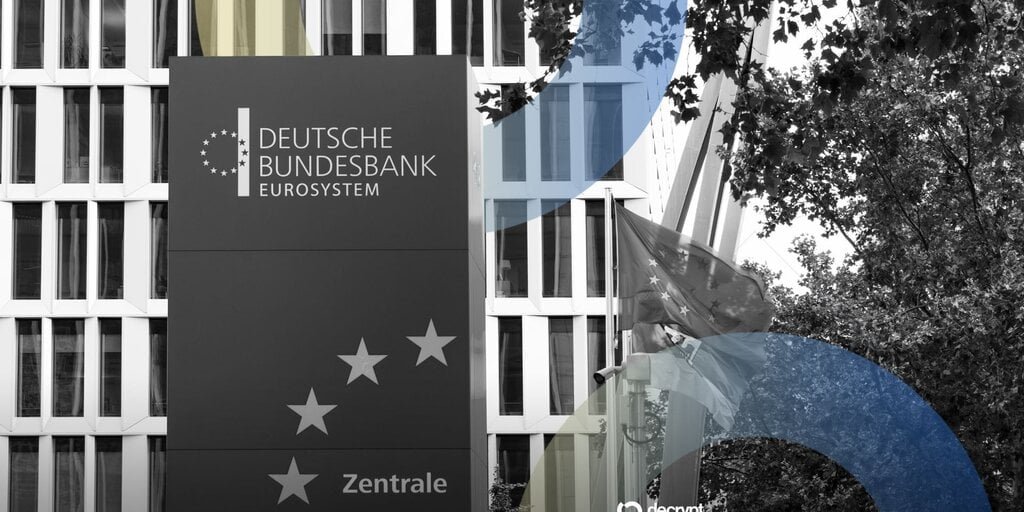
Bundesbank President Wants Euro-Pegged Stablecoins to Prevent Dollarization
Share
Facebook Twitter Pinterest Email Copy Link

Listen to the article

0:00
0:00

Key Takeaways

Playback Speed

Select a Voice

In brief

  • The ECB’s Joachim Nagel has said that euro-denominated stablecoins could provide fast and cheap remittances, while also countering any risk of dollarization from USD-pegged stablecoins.
  • The ECB is aiming to introduce a digital euro by 2029, with work already underway on a wholesale central bank digital currency.
  • Some commentators suggest that, given the downsides of stablecoins, tokenized deposits may be a better way of preventing dollarization.

Euro-pegged stablecoins could provide low-cost payments and counter the threat of dollarization from USD-pegged counterparts, according to European Central Bank Governing Council member Joachim Nagel.

Speaking at the American Chamber of Commerce in Germany earlier this week, Nagel—who is also the President of the German Bundesbank—addressed how Europe might adapt to its changing relationship with the United States.

One of his proposals was to “channel efforts into supporting the international role of the euro,” which would include developing European payment systems.

And for Nagel, this could mean introducing euro-denominated stablecoins, “as they can be used for cross-border payments by individuals and firms at low cost.”

Not only could such euro-based stablecoins provide cheaper remittances and payments, but Nagel suggested last week that such stablecoins could protect against the dollarization of the Eurozone.

“A hypothetical replacement of a domestic currency with [USD-pegged] stablecoins would be equivalent to a dollarisation of the corresponding economy,” he said. “In this scenario, the effectiveness of domestic monetary policy could be severely impaired, not to mention that European sovereignty could be weakened.”

In the face of this risk, Nagel said last week that the ECB and European central banks are considering new technological opportunities, with one of these being a wholesale CBDC, which would enable “institutional actors on financial markets to execute programmable transactions in central bank money.”

The Eurosystem is also evaluating the possibility of using distributed ledgers for non-central bank money, including “tokenised deposits and euro-denominated stablecoins.”

According to Nagel, both wholesale CBDCs and euro-pegged stablecoins would give the Eurosystem the ability to “utilise cutting-edge digital technologies to maintain our monetary policy effectiveness in an uncertain geopolitical future.”

These remarks were echoed by Nagel’s speech in Germany on Monday, with the ECB official reiterating that the Eurosystem is working on the digital euro, which will be “the first pan-European retail digital payment solution, based solely on European infrastructures.”

The ECB and the digital euro

The ECB is aiming to launch a digital euro in 2029 amid some disagreement over details, with German Vice-Chancellor Lars Klingbeil saying last week that the CBDC’s delay is “harming” Europe.

His comments came as the European Parliament approved an amendment that would introduce an online and offline version of the digital euro, marking a shift from its earlier stance in favor solely of offline payments.

Despite the apparent drive towards introducing stablecoins in Europe and elsewhere, some economic commentators warn that they may come with downsides.

This is the view of economic author and journalist Paul Blustein, who told Decrypt that not only would stablecoins violate the singleness of money principle, but that “there’s a big risk to developing countries of dollarization that would undermine the ability of central banks to maintain control over their nations’ money supply.”

While this is precisely a concern Nagel has addressed in his two recent speeches, Blusten—who has written extensively about the U.S. dollar’s status—played down the possibility that dollarization (via stablecoins) could occur in Europe to any significant extent.

“I don’t think the dollarization threat is nearly as big a deal for Europe as it is for developing countries,” he said. “Europeans generally have confidence in the euro and the ECB.”

A senior associate at the Center for Strategic and International Studies, Blustein suggested that while Nagel is not really panicking over the threat of dollarization in Europe, the Bundesbank president is aware and right that it “poses a big threat elsewhere in the world.”

In view of this danger, Blustein argues that a better approach for Europe is to push forward as rapidly as possible on tokenized deposits, which “don’t have the drawbacks” commonly associated with stablecoins.

“If tokenized deposits are successful in Europe, that might expose the weaknesses of stablecoins,” he said. “Trying to beat the U.S. at the stablecoin game may be a losing proposition; trying to beat stablecoins with a superior instrument strikes me as more promising.”

Matt Osborne, Policy Director, UK & Europe at Ripple, argued that the future of the monetary system is a “mixed money ecosystem,” telling Decrypt that the EU “needs global stalecoins.”

“Concerns around risks to monetary sovereignty are valid but should not be over-stated,” Osborne told Decrypt, noting that the euro is stable and trusted, and there is “little reason” for dollar adoption in EU domestic payments. He added that the dollar is “already widely used for cross-border payments, trade invoicing and cross-border lending,” with dollar-backed stablecoins making these existing use cases “more efficient.”

“Far from being a threat, stablecoins are complementary to the current monetary system,” Osborne added.

As for the drawbacks of stablecoins, Blustein said that he sees some big downsides, even if such tokens may provide cheap and fast cross-border payments.

He said, “The main one is the likelihood that stablecoins will facilitate illicit transactions.”

While acknowledging that blockchain transparency can aid law enforcement in clamping down on bad actors, Blustein also contended that it provides a range of means for criminals to “abuse the system and evade AML/KYC requirements, for example with self-hosted wallets and mixers.”

Daily Debrief Newsletter

Start every day with the top news stories right now, plus original features, a podcast, videos and more.


Read the full article here

Fact Checker

Verify the accuracy of this article using AI-powered analysis and real-time sources.

Get Your Fact Check Report

Enter your email to receive detailed fact-checking analysis

5 free reports remaining

Continue with Full Access

You've used your 5 free reports. Sign up for unlimited access!

Already have an account? Sign in here

Share. Facebook Twitter Pinterest LinkedIn Tumblr Email Telegram Copy Link
News Room
  • Website
  • Facebook
  • X (Twitter)
  • Instagram
  • LinkedIn

The FSNN News Room is the voice of our in-house journalists, editors, and researchers. We deliver timely, unbiased reporting at the crossroads of finance, cryptocurrency, and global politics, providing clear, fact-driven analysis free from agendas.

Related Articles

Media & Culture

CBS Decides That NOT Airing Associates Of Sex-Trafficking Pedophiles Would Be Woke

21 minutes ago
Media & Culture

My New Dispatch Article, “In Defense of Sanctuary Cities”

24 minutes ago
Cryptocurrency & Free Speech Finance

Why bitcoin’s rare oversold RSI crash signals a long, slow grind ahead

41 minutes ago
Cryptocurrency & Free Speech Finance

Voltage Unveils USD Credit Line Over Bitcoin Rails

45 minutes ago
Cryptocurrency & Free Speech Finance

Morning Minute: OpenAI and Paradigm Turn Focus to Smart Contracts

47 minutes ago
Media & Culture

Harlan Virtual Supreme Court Semifinalists

1 hour ago
Add A Comment
Leave A Reply Cancel Reply

Editors Picks

My New Dispatch Article, “In Defense of Sanctuary Cities”

24 minutes ago

Why bitcoin’s rare oversold RSI crash signals a long, slow grind ahead

41 minutes ago

Voltage Unveils USD Credit Line Over Bitcoin Rails

45 minutes ago

Morning Minute: OpenAI and Paradigm Turn Focus to Smart Contracts

47 minutes ago
Latest Posts

Harlan Virtual Supreme Court Semifinalists

1 hour ago

Stablecoin volume reached $35 trillion in 2025 as illicit share stays below 0.5%

2 hours ago

Blockchain Data May Predict Drug Overdose Surges, Chainalysis Says

2 hours ago

Subscribe to News

Get the latest news and updates directly to your inbox.

At FSNN – Free Speech News Network, we deliver unfiltered reporting and in-depth analysis on the stories that matter most. From breaking headlines to global perspectives, our mission is to keep you informed, empowered, and connected.

FSNN.net is owned and operated by GlobalBoost Media
, an independent media organization dedicated to advancing transparency, free expression, and factual journalism across the digital landscape.

Facebook X (Twitter) Discord Telegram
Latest News

CBS Decides That NOT Airing Associates Of Sex-Trafficking Pedophiles Would Be Woke

21 minutes ago

My New Dispatch Article, “In Defense of Sanctuary Cities”

24 minutes ago

Why bitcoin’s rare oversold RSI crash signals a long, slow grind ahead

41 minutes ago

Subscribe to Updates

Get the latest news and updates directly to your inbox.

© 2026 GlobalBoost Media. All Rights Reserved.
  • Privacy Policy
  • Terms of Service
  • Our Authors
  • Contact

Type above and press Enter to search. Press Esc to cancel.

🍪

Cookies

We and our selected partners wish to use cookies to collect information about you for functional purposes and statistical marketing. You may not give us your consent for certain purposes by selecting an option and you can withdraw your consent at any time via the cookie icon.

Cookie Preferences

Manage Cookies

Cookies are small text that can be used by websites to make the user experience more efficient. The law states that we may store cookies on your device if they are strictly necessary for the operation of this site. For all other types of cookies, we need your permission. This site uses various types of cookies. Some cookies are placed by third party services that appear on our pages.

Your permission applies to the following domains:

  • https://fsnn.net
Necessary
Necessary cookies help make a website usable by enabling basic functions like page navigation and access to secure areas of the website. The website cannot function properly without these cookies.
Statistic
Statistic cookies help website owners to understand how visitors interact with websites by collecting and reporting information anonymously.
Preferences
Preference cookies enable a website to remember information that changes the way the website behaves or looks, like your preferred language or the region that you are in.
Marketing
Marketing cookies are used to track visitors across websites. The intention is to display ads that are relevant and engaging for the individual user and thereby more valuable for publishers and third party advertisers.