

 Freedom Index
Listen to the article
Key takeaways:
-
Bitcoin market data shows that pro traders are avoiding risk and paying extra to protect against a price drop.
-
Gold is hitting record highs, but Bitcoin remains stuck as investors favor traditional safe havens.
Bitcoin (BTC) rose 1.5% following a retest of the $86,000 level on Sunday as traders weigh the risks of a US federal government shutdown by Saturday. This week features multiple high-stakes catalysts, including earnings reports from global tech giants and the US Federal Reserve’s monetary policy decision on Wednesday.
Despite gold hitting record highs, Bitcoin traders remain cautious. Derivatives metrics suggest skepticism regarding further gains; demand for leveraged bullish positions is weak, and professional traders are currently pricing in higher odds of a negative price swing in the options markets.
The annualized BTC futures premium (basis rate) stood at 5% on Monday. This level is barely enough to compensate for the longer settlement periods inherent in these derivative contracts. Typically, when traders turn bullish, this indicator jumps above 10%. Conversely, bearish periods can cause the rate to turn negative. Overall, market sentiment has remained neutral-to-bearish for the past two weeks.
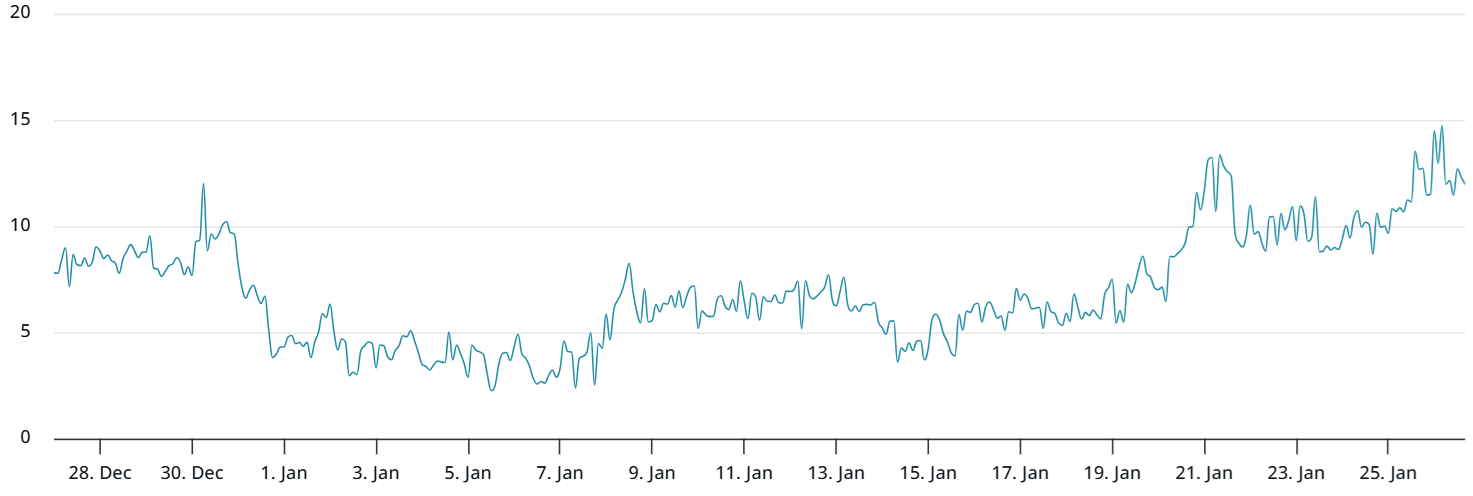
Similarly, the BTC options delta skew reached 12% on Monday. This indicates that put (sell) options are trading at a premium, reflecting a strong reluctance among traders to hold downside exposure. In a neutral market, this indicator usually fluctuates between -6% and +6%. The last time the skew reached these levels was Dec. 1, when Bitcoin plummeted from $91,500 to $83,900 in just a few hours.
Bitcoin lags as gold surges amid rising US debasement fears
Attributing Bitcoin’s bearish momentum solely to the US fiscal standoff seems counterintuitive, especially as the S&P 500 climbed 0.6% on Monday. Meanwhile, gold surged to $5,100 for the first time in history. This rally has led analysts to wonder if a “debasement trade” is accelerating. While the US dollar losing value against scarce assets is a common theme, it currently reflects a broader lack of trust that is not necessarily translating into immediate gains for Bitcoin.
Investors have become increasingly risk-aware after the Federal Reserve Bank of New York signaled a potential rescue of the Japanese yen—a move not seen since 1998. Over the past year, other major fiat currencies have outperformed the US dollar, making US imports more expensive and exerting upward pressure on inflation. If the Fed proceeds with an intervention, traders may interpret the move as a desperate measure to stabilize global markets.
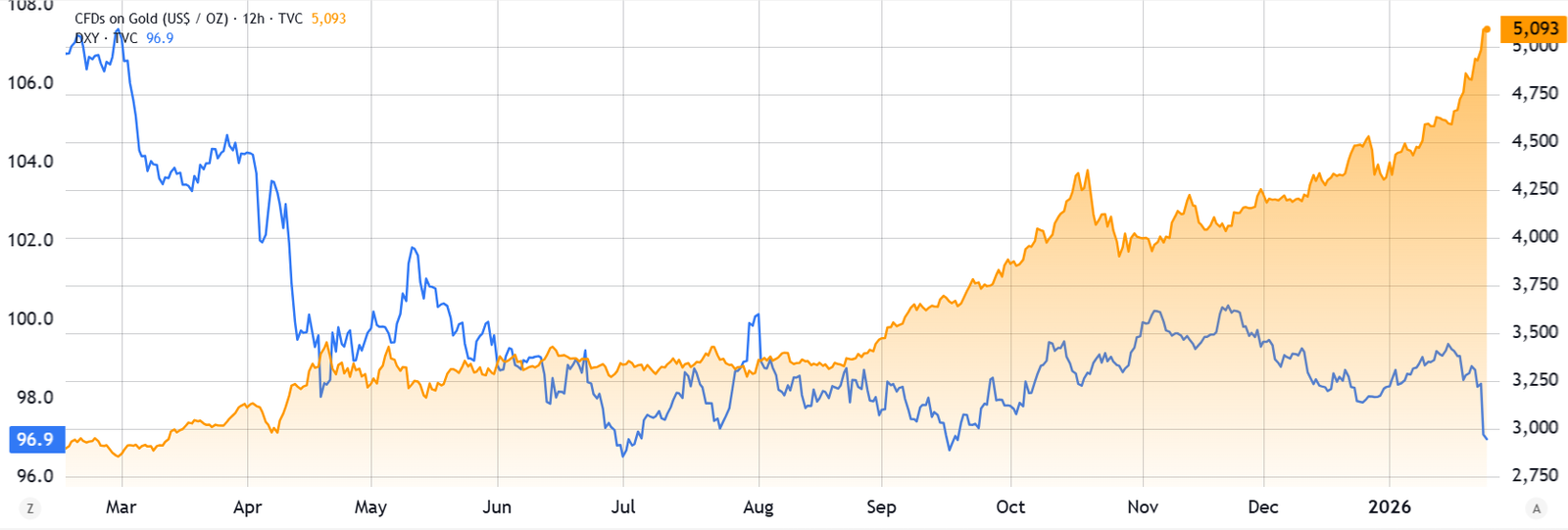
The US Dollar Strength Index (DXY) dropped below 97 for the first time in four months on Monday as traders sought protection in rival fiat currencies.
Interestingly, even with 5-year US Treasury yields surpassing those of Europe and Japan at 3.8%, investors are still bracing for higher US inflation. It is becoming increasingly evident that the US will adopt a softer monetary policy, particularly as Fed Chair Jerome Powell’s mandate ends in April.
US President Donald Trump has made it clear that Powell’s successor must focus on trimming Fed funds rates. Such a move would provide more breathing room for the US Treasury by reducing interest expenses. While a more expansionary monetary policy typically supports the stock market, it does not always create an immediate or direct incentive for Bitcoin investment.
Related: Crypto funds see $1.7B outflows, biggest since November 2025
If corporate earnings from major tech companies surprise to the upside this week, there may be even less incentive for investors to rotate into alternative scarce assets. Ultimately, Bitcoin’s path to reclaiming the $93,000 level hinges on professional traders regaining their confidence. This recovery might take longer than expected as macroeconomic shifts and the corporate earnings season dominate the spotlight this week.
This article does not contain investment advice or recommendations. Every investment and trading move involves risk, and readers should conduct their own research when making a decision. While we strive to provide accurate and timely information, Cointelegraph does not guarantee the accuracy, completeness, or reliability of any information in this article. This article may contain forward-looking statements that are subject to risks and uncertainties. Cointelegraph will not be liable for any loss or damage arising from your reliance on this information.
Read the full article here
Fact Checker
Verify the accuracy of this article using AI-powered analysis and real-time sources.