Bitcoin has fallen 52.44% from its October all-time high, dangerously approaching the 2018 bear market drawdown of 56.26%.
The crypto market lost 1.33% in the last 24 hours, with a total market cap at $2.33 trillion
On Myriad, prediction market traders say there’s a 60% chance BTC touches $55K before $84K.
The crypto market is bleeding. And the wounds keep deepening.
Bitcoin trades at $67,621 today, down 1.70% in the last 24 hours. But this isn’t just another bad day—it could potentially help mark one of the most prolonged bear runs in Bitcoin history.
If February closes red, Bitcoin will complete five consecutive months of losses, the longest streak since June 2018 when Bitcoin was down for six months. With February already down 13.98%, the signs aren’t promising.
The accumulated losses from October 2025’s all-time high now reach 52.4% over 123 days. For perspective, the previous longest losing streak—that 2018 nightmare—registered a 56.26% drop over 153 days. Bitcoin is just 3.82 percentage points away from matching that record in less time.
The total cryptocurrency market capitalization stands at $2.33 trillion, down 1.33% in the last 24 hours. The Fear & Greed Index rose marginally from 8 to 12 points, but still in “extreme fear.”
The macro backdrop looks equally fragile. The S&P 500 and Nasdaq have slipped amid tech-sector jitters after Microsoft shed roughly 10% despite strong earnings, spooking investors. Meanwhile, precious metals have turned volatile: on Jan. 30, silver futures plunged about 31%—their steepest one-day drop since 1980—while gold also pulled back from recent highs.
Forced liquidations—when derivatives traders’ positions are automatically closed at certain prices—continue battering the market. Since January 12, there has not been a single day in which bear liquidations beat bullish positions, according to Coinglass data.
Source: Coinglass
Speaking of bearish sentiment. On Myriad, a prediction market developed by Decrypt’s parent company Dastan, odds shifted again from bullish to bearish on bets wagering on Bitcoin’s near-term future. Currently, prediction market traders are favoring a scenario where BTC touches $55K before $84K with 60% odds. That sentiment shift in prediction markets—where participants put money behind their opinions—is hard to ignore.
Bitcoin (BTC) price analysis: The signals don’t lie
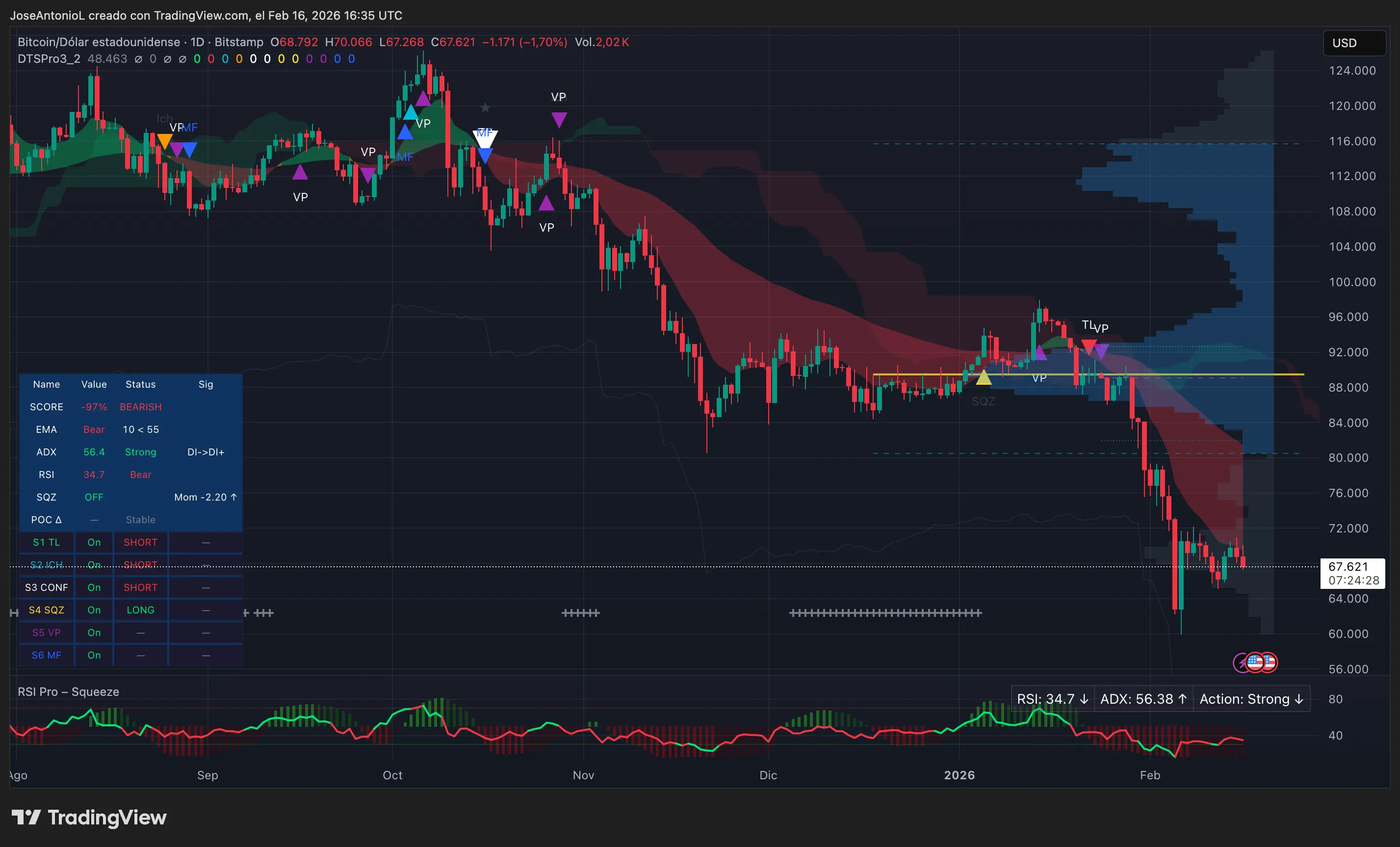
Bitcoin’s charts paint an equally grim picture on the daily timeframe. Bitcoin is currently trading sideways after the big spike on February 6. However, the price has not been able to resume an upwards trend and remains below the average price of the last 200 days, which traders identify as the EMA200. This shows how weak bulls currently are.
Bitcoin (BTC) price data. Image: Tradingview
This setup (current price trading below the EMA200 and this being lower than the average price of the last 50 days, or EMA50) typically signals solid bearish momentum. When both EMAs, otherwise known as exponential moving averages, sit above the current price, they act as dynamic resistance—levels where sellers tend to appear.
The Relative Strength Index, or RSI, sits at 34.7. RSI measures buying and selling momentum on a 0-100 scale. An RSI of 34.7 places Bitcoin in bearish territory, though it hasn’t reached extreme oversold levels. This means negative momentum dominates, but there’s still room for further declines before technical conditions suggest a bounce.
The Average Directional Index, or ADX, stands at 56.4—well above the 25 threshold that confirms trend strength. ADX measures trend strength with readings above 25 indicating a strong trend is in place. With ADX at 56.4 and price falling, this confirms the bearish trend has very strong momentum.
Can Bitcoin Recover?
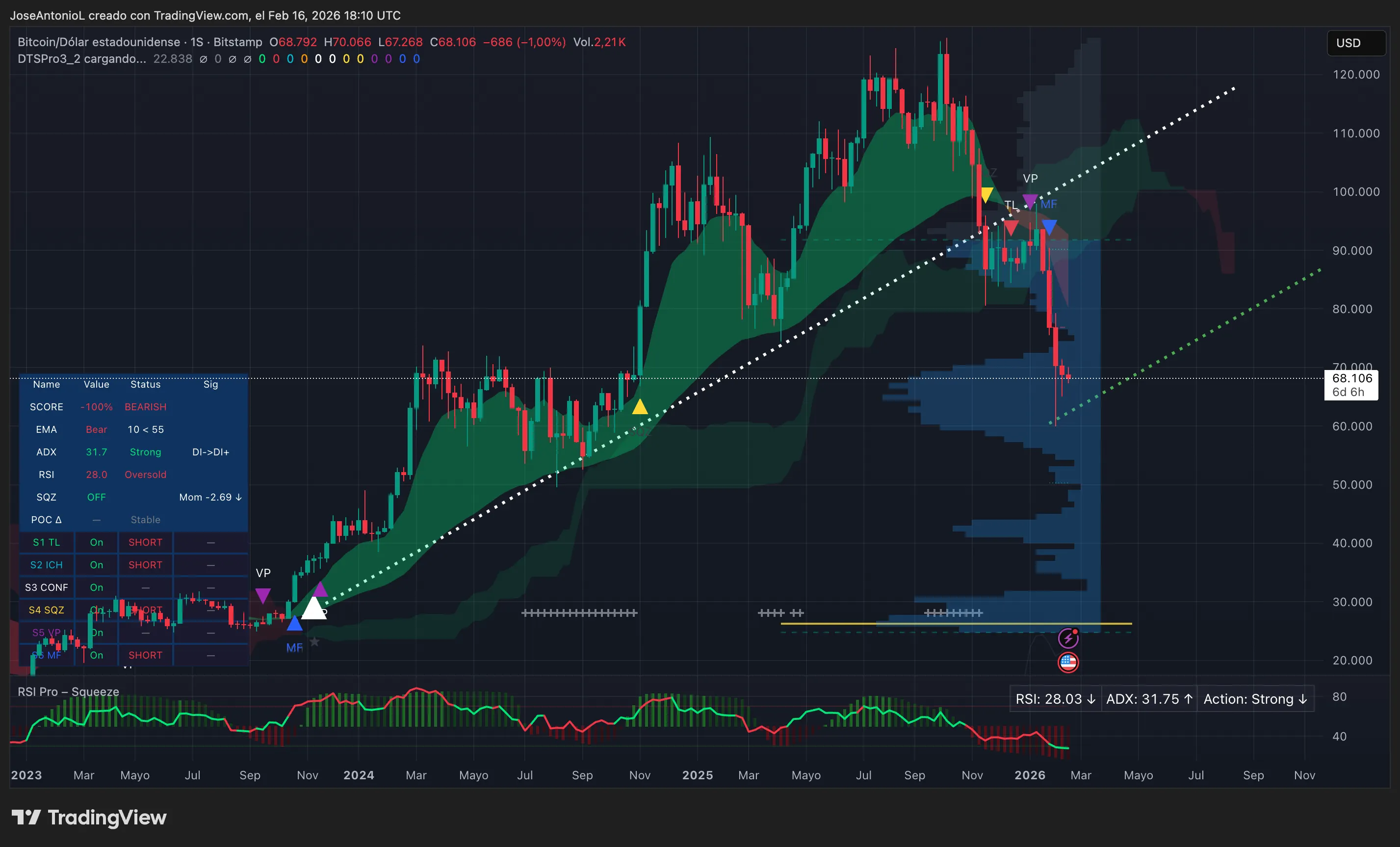
A Bitcoin bounce after such a sharp drop is definitely possible, but even if it does, it would be premature to call it a trend reversal.
For traders to begin talking about a bullish movement, the price of Bitcoin would need to show at least one of two unlikely scenarios: Either a massive recovery past the $100K mark to resume the 2024-2025 trend, or a consistent series of candlesticks with higher lows respecting at least a support similar to the one shown in the dotted green line below (extension of the previous trend).
Bitcoin (BTC) price data. Image: Tradingview
For now, Bitcoin remains trapped in one of the most persistent downtrends in its history. And with just two weeks left in February, the clock is ticking to avoid that fifth consecutive red month.
Disclaimer
The views and opinions expressed by the author are for informational purposes only and do not constitute financial, investment, or other advice.
Daily Debrief Newsletter
Start every day with the top news stories right now, plus original features, a podcast, videos and more.
The FSNN News Room is the voice of our in-house journalists, editors, and researchers. We deliver timely, unbiased reporting at the crossroads of finance, cryptocurrency, and global politics, providing clear, fact-driven analysis free from agendas.
We and our selected partners wish to use cookies to collect information about you for functional purposes and statistical marketing. You may not give us your consent for certain purposes by selecting an option and you can withdraw your consent at any time via the cookie icon.
Cookies are small text that can be used by websites to make the user experience more efficient. The law states that we may store cookies on your device if they are strictly necessary for the operation of this site. For all other types of cookies, we need your permission. This site uses various types of cookies. Some cookies are placed by third party services that appear on our pages.
Your permission applies to the following domains:
https://fsnn.net
Necessary
Necessary cookies help make a website usable by enabling basic functions like page navigation and access to secure areas of the website. The website cannot function properly without these cookies.
Statistic
Statistic cookies help website owners to understand how visitors interact with websites by collecting and reporting information anonymously.
Preferences
Preference cookies enable a website to remember information that changes the way the website behaves or looks, like your preferred language or the region that you are in.
Marketing
Marketing cookies are used to track visitors across websites. The intention is to display ads that are relevant and engaging for the individual user and thereby more valuable for publishers and third party advertisers.


 Freedom Index