

 Freedom Index

Listen to the article
Bitcoin mining runs the risk of becoming more centralized as time goes on, while artificial intelligence could be moving in the opposite direction, according to Galaxy Research head Alex Thorn.
Thorn said that while Bitcoin mining began decentralized, with users mining Bitcoin on their personal computers, it has since become far more centralized, requiring ASIC miners or industrial-scale farms.
“AI may follow the opposite path,” said Galaxy’s research head Alex Thorn on Sunday, explaining that AI started centralized in giant hosted clusters, but as frontier models experience “data scarcity, context limits, and memory bottlenecks, open-source models could close the gap.”
“If local models keep getting smaller, cheaper, and more efficient, AI may become increasingly personal and on-device.”
The divergence strikes at the heart of crypto’s core promise: decentralization. If Bitcoin mining were to continue down a path of centralization, it could begin to raise concerns about the network’s long-term resilience.
Edge AI market to grow 300% in the next eight years
Edge AI computing refers to the deployment and running of AI models directly on local devices or “at the edge” of the network, rather than sending all data to centralized cloud servers or massive data centers for processing.
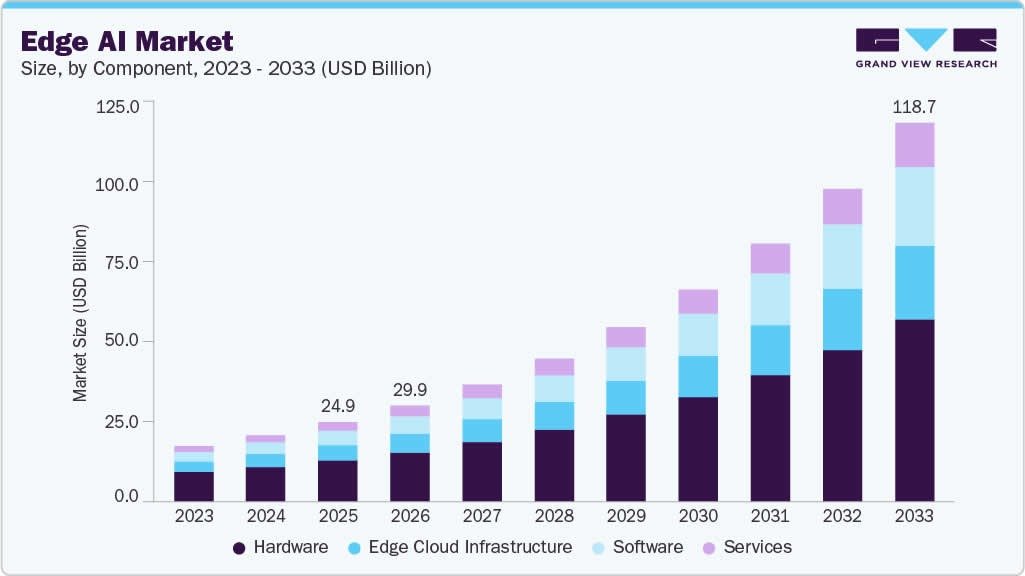
The global AI edge market is anticipated to grow from about $25 billion in 2025 to a projected $119 billion by 2033, according to Grand View Research.
Related: Researchers discover malicious AI agent routers that can steal crypto
The edge market is experiencing significant growth driven by the “rapid expansion of IoT (Internet of Things) and connected devices,” stated GVR.
This increases the demand for real-time and low-latency data processing, growing the adoption of AI-enabled automation across industries, and “rising focus on data privacy and localized intelligence at the network edge,” GVR added.
Bitcoin mining is decentralizing geographically
Crypto exchange KuCoin reported on Friday that Bitcoin mining has become increasingly unviable in the United States as the cost to mine a single BTC has surpassed $100,000 in some regions due to surging energy costs.
This is resulting in a geographic migration with hash rate actively moving toward the “Global South,” with Paraguay and Ethiopia emerging as the leading destinations due to surplus hydroelectric power.
This could help to decentralize mining, at least from a geographical perspective.
“This decentralization of mining power across different continents enhances the security of the network by making it less vulnerable to any single country’s political or environmental shocks,” it stated.
Magazine: Bitcoin quantum-safe without upgrade? CZ’s 2031 crypto vision: Hodler’s Digest
Read the full article here
Fact Checker
Verify the accuracy of this article using AI-powered analysis and real-time sources.