Close Menu
FSNN | Free Speech News NetworkFSNN | Free Speech News Network
  • Home
  • News
    • Politics
    • Legal & Courts
    • Tech & Big Tech
    • Campus & Education
    • Media & Culture
    • Global Free Speech
  • Opinions
    • Debates
  • Video/Live
  • Community
  • Freedom Index
  • About
    • Mission
    • Contact
    • Support
Trending

Ethereum Foundation Outlines Ethos and Responsibilities in New Mandate

47 minutes ago

Review: A Period Drama About the Price of Progress in the American West

1 hour ago

Bitcoin can survive 72% of the world’s submarine cables being cut, but a targeted attack on five hosting providers could cripple it

2 hours ago
Facebook X (Twitter) Instagram
Facebook X (Twitter) Discord Telegram
FSNN | Free Speech News NetworkFSNN | Free Speech News Network
Market Data Newsletter
Saturday, March 14
  • Home
  • News
    • Politics
    • Legal & Courts
    • Tech & Big Tech
    • Campus & Education
    • Media & Culture
    • Global Free Speech
  • Opinions
    • Debates
  • Video/Live
  • Community
  • Freedom Index
  • About
    • Mission
    • Contact
    • Support
FSNN | Free Speech News NetworkFSNN | Free Speech News Network
Home»Cryptocurrency & Free Speech Finance»Bitcoin can survive 72% of the world’s submarine cables being cut, but a targeted attack on five hosting providers could cripple it
Cryptocurrency & Free Speech Finance

Bitcoin can survive 72% of the world’s submarine cables being cut, but a targeted attack on five hosting providers could cripple it

News RoomBy News Room2 hours agoNo Comments4 Mins Read1,932 Views
Share Facebook Twitter Pinterest Copy Link LinkedIn Tumblr Email VKontakte Telegram
Bitcoin can survive 72% of the world’s submarine cables being cut, but a targeted attack on five hosting providers could cripple it
Share
Facebook Twitter Pinterest Email Copy Link

Listen to the article

0:00
0:00

Key Takeaways

Playback Speed

Select a Voice

Bitcoin’s network has been running nonstop since 2009. The question nobody had rigorously answered until now is what it would actually take to break it.

Researchers at the Cambridge Centre for Alternative Finance last week published the first longitudinal study of Bitcoin blockchain’s resilience to physical infrastructure disruption, analyzing 11 years of peer-to-peer network data against 68 verified submarine cable fault events.

The headline finding is that between 72% and 92% of the world’s inter-country submarine cables would need to fail simultaneously before Bitcoin experiences significant node disconnection.

In a world where the Strait of Hormuz is currently disrupted and infrastructure vulnerability is front of mind, the study provides the first empirical benchmark for how hard Bitcoin actually is to knock offline.

The numbers tell a story of a network that degrades gracefully rather than collapsing catastrophically. The researchers ran 1,000 Monte Carlo simulations per scenario across the full dataset and found that random cable failures barely register.

Over 87% of the 68 real-world cable fault events they studied caused less than 5% node impact. The largest single event, when seabed disturbances off Côte d’Ivoire damaged 7-8 cables simultaneously in March 2024, knocked out 43% of regional nodes but affected only 5-7 bitcoin nodes globally, roughly 0.03% of the network.

The correlation between cable failures and bitcoin’s price was essentially zero, at -0.02. Infrastructure disruptions are invisible against daily price volatility.

But the paper’s most important finding is the asymmetry between random and targeted attacks.

While random cable failures require 72-92% removal to cause damage, a targeted attack on the cables with the highest betweenness centrality, the ones that serve as chokepoints between continents, drops that threshold to 20%.

And targeting the top five hosting providers by node count, Hetzner, OVH, Comcast, Amazon, and Google Cloud, requires removing just 5% of routing capacity to achieve the same impact.

That’s a fundamentally different threat model. Random failures are acts of nature. Targeted attacks are acts of state, coordinated regulatory shutdowns of hosting providers or deliberate severing of critical cable routes. The study essentially maps two very different adversaries: one Bitcoin can easily survive, and one that remains a credible risk.

How threats to bitcoin change over time

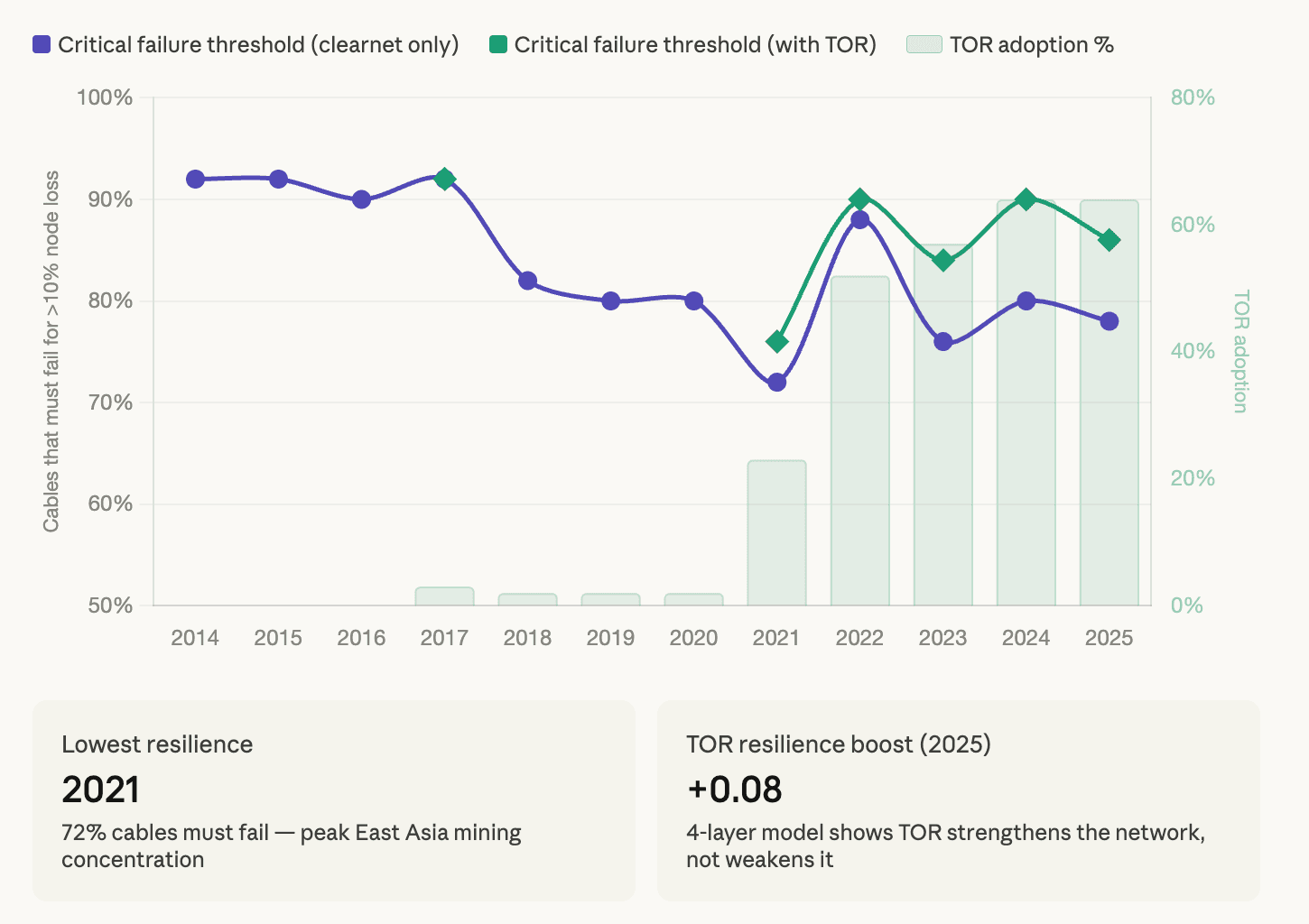
The paper tracks how resilience evolved over time, and the trajectory isn’t a straight line. Bitcoin was most resilient in its early years from 2014-2017, when the network was geographically diverse and the critical failure threshold sat around 0.90-0.92.

Resilience declined sharply during 2018-2021 as the network grew rapidly but concentrated geographically, hitting its lowest point of 0.72 in 2021 during peak mining concentration in East Asia. The China mining ban in 2021 forced redistribution, and resilience partially recovered to 0.88 in 2022 before settling at 0.78 in 2025.

The TOR finding is the one that challenges conventional thinking. As of 2025, 64% of Bitcoin nodes use TOR, making their physical location unobservable.

The assumption has been that this inability to observe might hide fragility, that if TOR nodes turned out to be geographically concentrated, the network could be more vulnerable than it appears.

The Cambridge researchers built a four-layer model to test this and found the opposite. TOR relay infrastructure is heavily concentrated in Germany, France, and the Netherlands, countries with extensive submarine cable and land border connectivity.

An attacker trying to disrupt TOR relay capacity by cutting cables faces a compound problem because those countries are among the hardest to disconnect. The four-layer model consistently showed higher resilience than the clearnet-only baseline, with TOR adding between 0.02 and 0.10 to the critical failure threshold.
(CoinDesk)

The paper frames this as “adaptive self-organization.” TOR adoption surged after censorship events like Iran’s internet shutdown in 2019, the Myanmar coup in 2021, and the China mining ban.

The Bitcoin community shifted toward censorship-resistant infrastructure without any central coordination, and that shift happened to also make the network physically harder to disrupt.

With the Strait of Hormuz effectively closed and a regional war disrupting infrastructure across the Middle East, the question of what happens to Bitcoin if submarine cables get damaged isn’t theoretical.

The study suggests the answer is probably nothing, unless someone is deliberately targeting the specific cables and hosting providers that matter most.

Read the full article here

Fact Checker

Verify the accuracy of this article using AI-powered analysis and real-time sources.

Get Your Fact Check Report

Enter your email to receive detailed fact-checking analysis

5 free reports remaining

Continue with Full Access

You've used your 5 free reports. Sign up for unlimited access!

Already have an account? Sign in here

Share. Facebook Twitter Pinterest LinkedIn Tumblr Email Telegram Copy Link
News Room
  • Website
  • Facebook
  • X (Twitter)
  • Instagram
  • LinkedIn

The FSNN News Room is the voice of our in-house journalists, editors, and researchers. We deliver timely, unbiased reporting at the crossroads of finance, cryptocurrency, and global politics, providing clear, fact-driven analysis free from agendas.

Related Articles

Cryptocurrency & Free Speech Finance

Ethereum Foundation Outlines Ethos and Responsibilities in New Mandate

47 minutes ago
Cryptocurrency & Free Speech Finance

Bloomberg Strategist Warns of 2008 Replay for Global Markets

2 hours ago
Cryptocurrency & Free Speech Finance

Bitcoin Strength Stuns Bears But They Haven’t Given Up Yet

3 hours ago
Cryptocurrency & Free Speech Finance

U.S. sanctions network that allegedly laundered $800 million in crypto for North Korea

4 hours ago
Cryptocurrency & Free Speech Finance

Stablecoins Could Power Global Payments: Druckenmiller

4 hours ago
Cryptocurrency & Free Speech Finance

Circle’s (CRCL) strong trading volumes noted by Mizuho as it raises price target

5 hours ago
Add A Comment
Leave A Reply Cancel Reply

Editors Picks

Review: A Period Drama About the Price of Progress in the American West

1 hour ago

Bitcoin can survive 72% of the world’s submarine cables being cut, but a targeted attack on five hosting providers could cripple it

2 hours ago

Bloomberg Strategist Warns of 2008 Replay for Global Markets

2 hours ago

At The WBC: Mark DeRosa Screwed Up & Then MLB Streisanded The Story

2 hours ago
Latest Posts

Firing Government DEI Executive Didn’t Violate First Amendment

2 hours ago

Bitcoin Strength Stuns Bears But They Haven’t Given Up Yet

3 hours ago

Who’s Being Pornographic Here? (And Were Pornography Allegations Related to School Library Book Reading Defamatory?)

4 hours ago

Subscribe to News

Get the latest news and updates directly to your inbox.

At FSNN – Free Speech News Network, we deliver unfiltered reporting and in-depth analysis on the stories that matter most. From breaking headlines to global perspectives, our mission is to keep you informed, empowered, and connected.

FSNN.net is owned and operated by GlobalBoost Media
, an independent media organization dedicated to advancing transparency, free expression, and factual journalism across the digital landscape.

Facebook X (Twitter) Discord Telegram
Latest News

Ethereum Foundation Outlines Ethos and Responsibilities in New Mandate

47 minutes ago

Review: A Period Drama About the Price of Progress in the American West

1 hour ago

Bitcoin can survive 72% of the world’s submarine cables being cut, but a targeted attack on five hosting providers could cripple it

2 hours ago

Subscribe to Updates

Get the latest news and updates directly to your inbox.

© 2026 GlobalBoost Media. All Rights Reserved.
  • Privacy Policy
  • Terms of Service
  • Our Authors
  • Contact

Type above and press Enter to search. Press Esc to cancel.

🍪

Cookies

We and our selected partners wish to use cookies to collect information about you for functional purposes and statistical marketing. You may not give us your consent for certain purposes by selecting an option and you can withdraw your consent at any time via the cookie icon.

Cookie Preferences

Manage Cookies

Cookies are small text that can be used by websites to make the user experience more efficient. The law states that we may store cookies on your device if they are strictly necessary for the operation of this site. For all other types of cookies, we need your permission. This site uses various types of cookies. Some cookies are placed by third party services that appear on our pages.

Your permission applies to the following domains:

  • https://fsnn.net
Necessary
Necessary cookies help make a website usable by enabling basic functions like page navigation and access to secure areas of the website. The website cannot function properly without these cookies.
Statistic
Statistic cookies help website owners to understand how visitors interact with websites by collecting and reporting information anonymously.
Preferences
Preference cookies enable a website to remember information that changes the way the website behaves or looks, like your preferred language or the region that you are in.
Marketing
Marketing cookies are used to track visitors across websites. The intention is to display ads that are relevant and engaging for the individual user and thereby more valuable for publishers and third party advertisers.