

 Freedom Index
Listen to the article
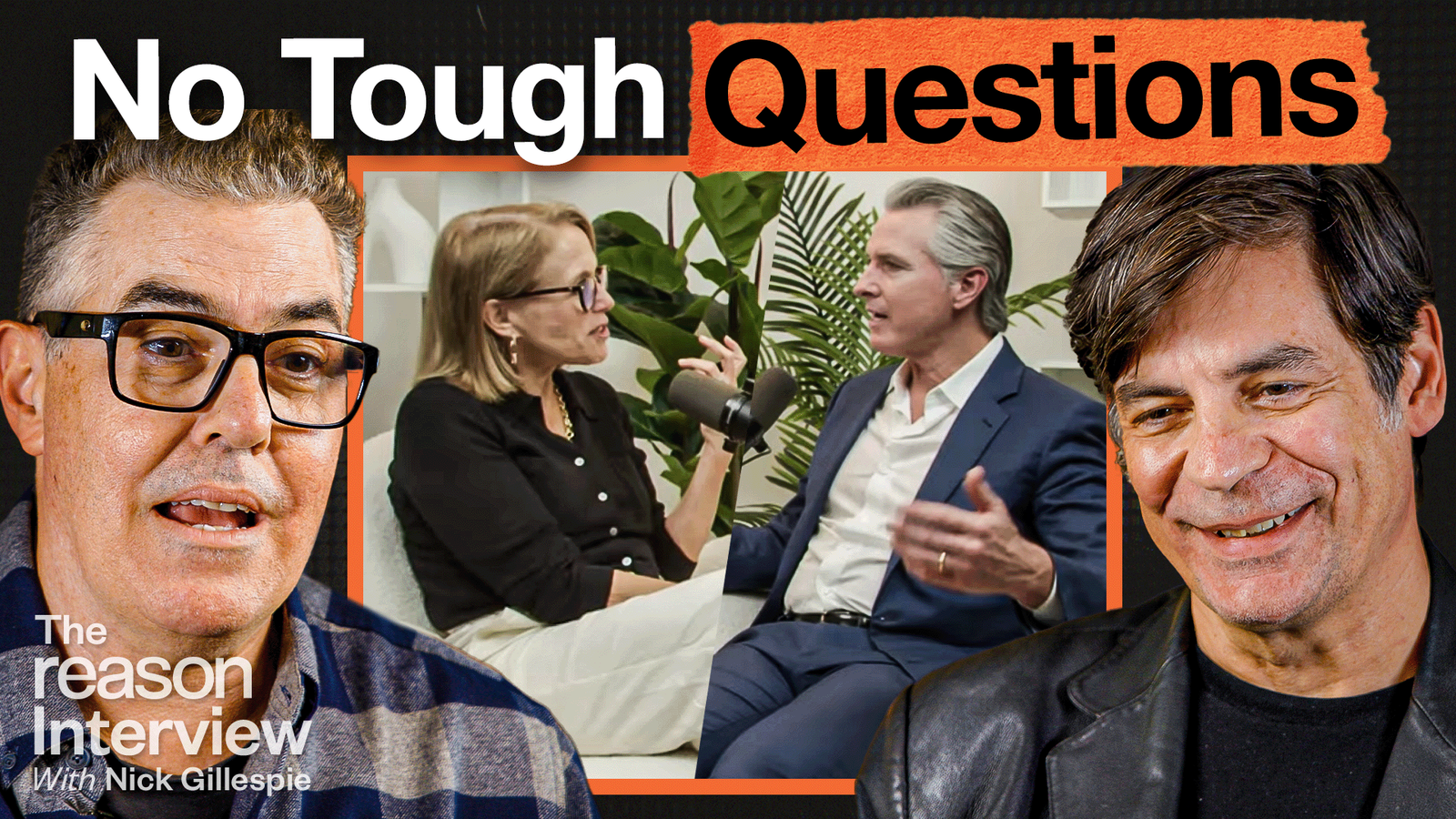
In a recent interview with California Gov. Gavin Newsom, a likely contender for the Democratic presidential nomination in 2028, veteran news anchor Katie Couric asked him whether he “had a Zoolander” problem, fretting that being “so ridiculously good looking” might make it hard for him to be taken seriously.
That exchange set off today’s guest, podcaster Adam Carolla, who saw in it a microcosm of much of what’s wrong with contemporary media and politics. Couric’s fawning betrays a clear political bias, he said, and it overlooks Newsom’s longstanding incompetence as a governor who has overseen a decline in people and businesses since taking office in 2019.
In a wide-ranging conversation with Nick Gillespie, the former construction worker and Comedy Central host lays into how legacy media has traded in its watchdog role for access and skepticism toward power for affirmation. Carolla talks about how the Golden State’s regulatory dysfunction makes everything more expensive and time-consuming, squeezes tax-paying and law-abiding residents, and has created a place that puts “safetyism” and the status quo at the center of every policy decision.
They also discuss the rise of independent journalism and podcasting—a field Carolla helped pioneer in the late aughts—and why, compared with President Joe Biden in 2024, President Donald Trump successfully appealed to people who wanted to build homes, businesses, and a future in the United States.
0:00—Softball interviews
4:41—Legacy media monocultures
9:53—Why Carolla started his own podcast network
11:35—Why are people leaving California?
16:24—Overregulation in California
25:33—The importance of meritocracy
28:39—How Carolla developed his work ethic
38:15—Why Carolla likes Trump
41:40—California high-speed rail
44:09—Is Carolla optimistic about the future?
Reason is hiring! Check out the two open roles on the video team now:https://reason.org/jobs/associate-producer/https://reason.org/jobs/producer/
This is an AI-generated, AI-edited transcript. Check all quotes against the audio for accuracy.
Nick Gillespie: Adam Carolla, thanks for talking to Reason.
Adam Carolla: My pleasure, Nick.
Let’s start this interview talking about Katie Couric. Recently, you went to town on her. She was interviewing Gavin Newsom, the wonderful, fresh-smelling governor of California, next president of the United States and maybe Canada.
She was great. She was like, “Gavin, is your dick too big for porn?”
She literally said, like, “You may have a Zoolander problem,” but not meaning you might be so fucking stupid…
Right.
That you won’t be able to find your way out of your car door, get out of your car to the election booth, but that you’re too good looking for politics. Why did that set you off?
OK, here’s what I sort of realized with journalism. There’s this sad tacit agreement, which is you can’t ask tough questions or follow-up questions because then that person would never come back. Right? And so that’s, you know, Gavin Newsom did my show 13 years ago, and he’s never come because I asked follow-ups, you know, and…
And you even had, I mean, that was not, it was a tough interview, but it was not a hostile one.
No, it was not hostile at all. I just kept asking. And so people don’t do it now because Katie wants to get Gavin again down the road after he announces he’s running for president. But that’s not journalism. Journalism is asking the questions. And so if everyone just did it at once, then they wouldn’t have a choice because there’d be no friendly confines for them to go. If all journalists just started acting like journalists and we all did it at once, then they’d still have to come back to you. They just have to answer your questions.
Katie Couric, in this case, is a kind of standing for the legacy media. What we’re calling it.
And I don’t have anything against her personally. My feeling is, and here’s my beef with her. She is the legacy media and all these people are, you know, they’re all, you know, Don Lemon is right down the middle of everything. As soon as they get off the reservation they’re all hard leftists, which is who they were the whole time. So it’s sort of like you’re sitting around going, “I’m not vegan, I’m not vegan, I’m not vegan.” And as soon as you quit your job, “Meat is murder.” Right? Well, that’s how you were thinking the whole time. So now I don’t really believe that you were doing a sort of fair and balanced…
Do you think…was Katie Couric’s famously televised colonoscopy, was that part of a left-wing agenda for America?
That was a rear wing agenda.
Who else in the media do you, either people who have recently left or are currently there that you are like, “Come on, just be honest for a minute.”
Any time somebody interviews Gavin Newsom or Barack Obama and I see the hard deep leg cross of the person which is inviting them in going, “No tough questions from this fella, I got a deep leg,” it’s the deep leg crossers that I never trust. If you watch Obama and if you watch Newsom, Newsom gets into positions that they don’t get into in hot yoga. Getting those deep leg crosses then Obama does the same, but the guys interviewing them do the same too. Whereas Trump makes a diamond with his thumb and forefinger that accentuates his nutsack
It’s something from like a 1970s pick-up manual or something.
Right, right.
He learned that.
I just want people…I don’t want there to be safe places to go to be interviewed, you know what I mean? Like I want all interviewers to do their job.
And that’s particularly with politicians, but also with celebrities or anybody.
You know, look, I don’t care, if you’re a celebrity, who you’re having an affair with. That’s not policy. But you’re interviewing a politician to find out what their policy is and so they come on your show and then you ask what their favorite ice cream is. And then there’s also a trait that bothers the hell out of me where they… at some point, everyone caught on to these people, right? So they go, “You didn’t even ask them about the border. You didn’t even ask about the border.” So they go, “OK, so they caught on.” So they go, “And Mr. Biden, what about the border?” And he goes, “The border’s secure”, and they go, “OK. Now, I hear you have a birthday coming up.” And it’s like, “I asked about the border.” Yeah, you asked about the border. He gave a bullshit answer, and you left it. You let it go.
Do you feel like more right-coded media outlets, something like Fox News or One America News Network, stuff like that, do they do the same thing? Do they kind of shield their people?
I think everybody does it to an extent, you know, like, OK, this is your team and the coach of your team is coming on for an interview. But I feel like the right still asks, you know, “It’s fourth and seven and you’re on your own 40 and you went for it, Coach. I mean, you didn’t think about punting.” And I’ll tell you why I know this and I think this is true or I think this is proof of being intellectually honest. I said to Tucker Carlson once, several years ago, I said, “Why don’t you break off and form your own media company, bringing in all the people from the right, all the conservative people to be under the umbrella — under your umbrella.” And he said, “None of them get along.” And I said, “What do you mean?” He goes, “They all disagree with each other.” And I was like, you go to CNN, COVID comes out, Ivermectin, hydroxychloroquine, they know everything. They’re all on the same page. No one at CNN or MSNBC went, “Well, hold on a second. Wet market? I don’t think so. Maybe it came from a lab. Come on, use your brain.” No, they were all on the same page, But amongst the right, Ben Shapiro feuding with—
Candace Owens
Tucker Carlson. Everyone’s going at it. And you can say, “He’s right, she’s right. They’re wrong.” But they’re intellectually being honest.
Let’s say they’re being honest. I’m not sure that Candace Owens is being intellectual.
Yeah, I don’t know about intellectually. Yeah, and I’m not going to vouch for Candace Owens. But what I’m saying is, they did not get their talking points because they’re going at it in five different directions on everything from vaccines to Iran.
The rapture versus Jews versus Christians.
They’re all over the place, right. So at least, here’s my thing. I at least believe they believe what they’re saying.
There are really popular and far-reaching outlets or things that have been created like the Daily Wire, you know, what Ben Shapiro has done, and obviously there’s a range of opinions. Do you feel like that’s a good solution to kind of legacy media monocultures? Is it enough? And obviously your whole career has kind of been moving out of what was legacy media, or kind of like mainstream entertainment to running your own empire. Is it enough to counter the media?
I think it’s, all right, let’s look at it this way. In 1972, the big three American auto manufacturers had 85 percent of the market. And then someone goes, “These Japanese cars, is that enough?” It’s like, well, not enough in 1972, it was 12 percent. But fast forward to 1980. And it’s starting to add up a little and then smash cut to 2020. And Big Three are trying to catch up to the Japanese imports. So it’s like if you went back pre-COVID, you’d kind of go, “Hmm.” But after COVID, with the rise of a lot of podcasts and these independent networks and things like that, it’s there. And it’s going to…my son’s 19, he doesn’t watch CNN or TV…
He doesn’t even watch cable, right? I mean, it’s just something might come on a TV, but more likely it’s a phone or a computer screen, right?
You’re right, right, they talk about Joe Rogan or this comedian or that comedian and you know so…
Which is kind of fascinating, we’re about the same age and it is like the idea that you’re not even talking about cable anymore, it’s just like this stuff shows up in my hand and I know who I trust and not.
Yeah, I know who I trust. I trust this guy, I trust that guy, I don’t trust that guy. I’m harking back on a weird conversation. I could probably date it about 10-years-ago. I moved into a house and the house didn’t have a landline working or something. And I was saying to my assistant, “We gotta get the landline, we gotta get the phone working.” And he’s like, “What do you need a land line?” I said, “What you mean? You need a phone. How are you not going to have a phone?” He’s like, “Well, you could use your cell phone.” I’m like, “Yeah, for some stuff. But you need a landline. Don’t be stupid. Call the phone company. Arrange it, whatever. And wait for the guy to show up in a van.” And it’s like I look back on that and it’s like, oh my gosh, he was 100 percent right. He was 26 at the time saying, “Hey, old man.”
You started your, what has become a podcast empire, in like 2008-2009?
Yes.
What prompted you to do that because I mean you actually were one of the first people, not necessarily to podcast per se, but to kind of create this—”OK, this is a system or a kind of related shows that are going to go big”—I mean, where did that come from?
I’ve been kicking around in this system for a long time and had a radio background and kind of understood what that world was. Also I had a radio job and I lost my radio job and I was kind of at this crossroads where I had like nine or 10 months left on my contract, so I was sort of getting paid to stay home.
Were you allowed? I mean, you couldn’t appear on other networks, but were you allowed to?
Well, I could appear, but I couldn’t.
But couldn’t host, yeah.
I mean, I couldn’t take another job, or I could take another job, I’d stopped being paid when I took the other job.
But could you podcast and that’s…?
Yeah.
Really? That’s fascinating.
Well, yeah, because who knew and who cared? I don’t know if they didn’t know what a podcar was, you know, “Like go to your den and have fun with your friends.” Yeah, like then it was what the Big Three did with Datsun, you know what I mean? Like little pea shooters. Who wants that Jap shit? “You know, let’s buy that shit.” You know what I mean? So they were sort of that way. But, you know, they’re that way about everything.
So, let’s go back to Katie Couric for a second. What should she have asked Gavin Newsom? Like what would — you interviewed him years ago on, you know, on a wide variety of issues, including how difficult it is to just do anything in California, business-wise, housing-wise but also about, marijuana legalization. What should she have been asking? It’s not just that the legacy media is kind of soft on people, but what are the questions they need to be asking somebody like Newsom?
Well there’s a kind of a bottom line which is, “People are leaving California, why?” And then he’d go, “We have the fourth largest economy” and they go, “OK, well then there’s a perception about California, and maybe they’re all wrong, but they’re still packing up U-Hauls and leaving. So what is it that they think is going on even if… You’re telling me it’s the greatest place in the world, we’ve never been better, fine.” There goes another U-Haul for Texas. “Venture a guess as to why they’re leaving,” and then you know it’s like, “we got a shortage on housing.” Or OK, I’ll give you what I would’ve said to him, “Gas is $5.50 a gallon, it’s $3.50 everywhere else, right? Why is that?” “Exxon is is gouging us.” “OK why are they just gouging California? Why aren’t they gouging Nevada? Gouge the whole nation Exxon and make good money. Why just here? Do you think that’s reasonable that they would just gouge California?”
What about something like the housing issue, which is coming up everywhere, but especially in places like California and New York. Talk a bit about one of your ongoing kind of complaints about California, a place you love, obviously, because you’re staying here. How does the state just artificially make it so difficult to build and maintain housing?
It’s so heavily regulated that it’s stifling. And so when you make something so difficult that it’s not practical to comply, then people don’t do it, whether it’s fast food franchise or it’s building a home. I’ll give you a perfect example. California would love everyone to put solar panels on their house, and we’d be green, and we’re on the vanguard of green, let’s just say.
So many years ago, probably 20 years ago or a little bit more, I bought a big sprawling place on top of Lake Hollywood, a big Spanish place. And it was in very bad shape, and I was going to do a huge renovation on it. And there was space on one of the roofs and one part of the house that was big and broad and flat and I said, “I want solar panels on this roof,” so like I’m not an environmentalist but fine if I can generate kilowatts from the sun and a little less out of my pocket, a little less coal burning, then good I’ll do it. So I started to talk to some solar guys and plan out putting solar panels on my roof. I was told that in California that – maybe it was even Los Angeles – that the problem was that there needed to be a main shut off for the solar that was outside of the front gate. Meaning, if there’s an issue, I don’t know what the issue would be but the fire department could hit the master on it. Now, in every other municipality and every other state that solar shutoff was on the panel, the electrical panel. So the fire department could come in, see the panel, see the big solar shut off, and shut it. The regulation in Los Angeles was it had to be separate and on the street. Well, the gate was 200 feet from where the solar panels were and by code, I needed a two foot deep trench with conduit, the two-inch wide conduit that ran and I was like I’m not gonna pay a hundred grand to put a switch on the outside of…
So you know what I said? “Fuck solar,” I had no solar. So I didn’t pay for solar. I didn’t get solar, the solar company didn’t get money, we didn’t save anything. More kilowatts, more fossil fuel. They made it too difficult for me to get solar. And they look at that as sort of a win — not me not getting solar but more safety. More safety, more rules, more regulation.
Drill down into that a little bit, because when you were saying Newsom, what Newsom would say, like he must understand this. The regulators at some level must understand this. Where does common sense come back into the equation?
I don’t know.
Or what is just driving this insanity?
First off, I do not know what Newsom understands. I truly don’t. I’ve heard him interviewed a bunch of times. I’ve interviewed him for over an hour. I don’t know what he understands. I think there’s a part of people like us that’s almost a little generous, like, “Well, he must know what he’s doing,” but obviously he’s doing something else. I don’t know that anymore. And I’ll tell you this about regulators, like you go, “Well, they must understand.” Regulators make regulations. It’s in the title. And I used to have this saying about producers in Hollywood, but I’ll say this about regulators. I said, “If you take beavers and you put them on the roof of the Empire State Building, they start looking for wood to build a dam. ‘And someone goes, what do you need a dam for? We’re 2,000 feet in the air.’ And the answer is, ‘we’re beavers. This is what we do.'” They’re regulators, they make rules. So get rid of rules, they add them and they keep adding
I mean you’ve lived your whole life in California, was there a period where this was not the case?
Yeah.
So then what happened?
Well, I’ll blow your mind if you want to know, period, of ‘not the case’. Carroll Shelby, famed automotive manufacturer, Shelby Cobra and beyond, lived in Texas, is a Texas guy, was at like a chicken ranch in Texas. Moved from Texas to Venice Beach, California to build cars. Now, could you imagine anybody coming to Venice Beach to build cars with all the paint and the lacquer and the materials. You know how physically impossible this state would be? That would be physically impossible. Right. But there was a time when people came here to do what they wanted to do.
So what is it?
I’ll tell you what I think it is. It makes me unpopular, I think the regulation is always propelled by safety—so we needed a master cutoff switch for the solar outside the gate, why? Safety. But what do you mean safety? Just safety. But explain…safety. Right, we just got screwed by COVID because of safety, that schools closed down for two years, blah, blah. Women are much more safety oriented. And so the regulations are almost always about safety. So if you take more women and put them in those positions of regulating and city council and that kind of stuff, you are gonna get many more safety related rules.
Where does somebody like Margaret Thatcher fit into that? Or where did that go to die?
Yeah, so that, so there are women that are wired like men, which is Megyn Kelly, and then there are men who are wired like women, that’s Gavin Newsom. That’s where you get this leg crossing…
Now I cannot…I wanna cross my legs, but I’m not going to.
Women cross their legs. So you get Obama, and you get these guys, and you get the sort of chick wiring, and then you get Thatcher, Megyn Kelly, and handfuls of others. So then there is crossover, which is, you know, but it’s sort of like when people go, “Oh, there’re no Jewish guys starting in the NFL,” and like someone will go, “I had a Jewish friend and he was a starting outside linebacker for Cornell.” And you go, “Ok, all right, there was that guy.” But it’s not a thing.
But is safetyism, I mean, is that a kind of predictable consequence of people getting richer and softer? I would disagree that it’s a gender thing as much as I think it’s more of an income thing.
It is a gender thing, but it’s not necessarily pejorative.
All right. The mom, the dad, the 9-year-old kid wants a dirt motorcycle. The dad’s, “Give him a dirt,” and “He’s going to kill himself.” And then by the way, that’s a balance. So then what you end up with is, “We give him the dirt bike, but he has to wear the helmet, he has to be supervised, and we’re not doing it in the street, we have to go to a place.” That’s all fine.
But so in California, though, is it, you know, when did that, when did Carroll Shelby come here? Was that in the ’50s or postwar era?
Early, super early, ’62.
Oh ok, is it…there were enough people here who were like, “You know what? We like it this way so screw anybody who’s coming after us.” Or you know, is it you know, how do you get to a point where like California is losing people, it’s losing businesses, and like I guess my question is like: how bad does it have to get before people either vote out the types of people who are here or the people who are in power are like, “Oh, Jesus Christ, we have to be more like Texas and Florida”?
Well, you know, they’re trying to roll back a lot of the stuff as it pertains to runaway productions and it’s weird because they get it. You know, they just did a whole thing where it’s like, “Hey, we’re going to give you a 70 percent break. Come back and film,” you know, because they chased everyone out with the regulatory and taxes and all the whole burden system. And they chased everyone to New Mexico and Atlanta and Prague and everyone laughed. And now they miss the revenue. So they’re trying to entice people back by going, “No, we’re not that greedy and we’re gonna make it easy. We’re gonna expedite.” And my thing is, why don’t you just take the film industry and use it as a metaphor for all the citizens. You know what I mean? Like you got too burdensome, you got too expensive, oh, you’re over-regulated and people went somewhere else to live. Now in this case, they went somewhere else to film. But now people are just leaving to live somewhere. So use that model, rein it in, and bring them back. But they never… They just want the millionaire tax.
What would it take for you to leave California?
I’m building a house in Nevada.
Oh yeah?
Yeah, so I’m ready to go.
And how pissed will you be if you move to Nevada but then they’re like, “No you still owe us money in perpetuity?”
Well you know that’s another kind of interesting concept, if you’re like sitting around trying to figure out ways to get money from people you’re driving away, maybe you should think about why they’re being driven away, not how to get the money after you’ve driven them away. It’s an interesting mindset like New York’s trying to figure that out. California’s trying to figure that out. All these successful people who have completely soured on our state, how do we extract more money from them? Well, I’ve got a novel idea, how about you make it enticing for them to stay?
You know, in an interview with Reason done around 2011, you described yourself as pretty libertarian, that if you’re minding your own business, you’re working hard, you pay your taxes, then they should be lowered, like just let things go. And you were a vocal proponent of marijuana legalization. But it seems to me, in a lot of ways, you’re not as much ideological as it is more like, “I believe in competency versus incompetency.”
Is that a fair characterization?
I would like confident people and sort of meritocracy-based stuff and I think we are a nation that is based on meritocracy.
What do you mean by meritocracy?
Well, whoever the best person for the job is, they get to do the job and we are not really going to factor in anything else. It exists in sports, for sure. And that’s why we’re attracted to sports, because we assume…I’ll tell you the day football would be over. Football would be over if there was some middle-aged spindly white guy on defense, and I’d go, “What’s that guy doing?” “That’s the coach’s son, that’s the owner’s son.” I’m now done watching this, because I feel like he’s not the best person to be out there. But the thing that’s attractive about sports, even though it’s kind of unspoken, it’s like a meritocracy.
And it took a while to get there, right? Because it’s fucked up that Jackie Robinson or Marion Motley in the NFL it took forever for them to get that.
Yeah, running back, Browns?
Yeah. That’s right. Fullback.
No, ’86. Oh, a non-fullback number. Yeah, what it takes… I mean, the way it works is there’s no black quarterbacks. So they go, “Well, blacks can’t play quarterback because we have no black quarterbacks.” And then at some point, we get a black quarterback. And then they’re good. And then now we can do it. So if you take the Oscars versus the Super Bowl, as a young guy, the Oscars and the Super Bowl were equally as big when I was a kid. Both were poignant viewing…
Once a year and you’re gonna watch it…
And everyone’s going to gather around, figure out who’s got a color TV, and go find them. And we’d all watch. And it was kind of equal. And now it’s the Super Bowl. I can’t tell you the number of people where I go, “Well, did you guys see the Oscars?” “The Oscars? Was that last night? I didn’t know it was on.” “I didn’t know it was on,” is like the worst thing you could say about any entity. So it went from appointment viewing anytime it was on and I think it’s because they screwed with the meritocracy. People stopped going, “I don’t think that was the best. I thought Mission: Impossible was the best movie and you gave it to Moonlight? I didn’t like that movie,” and now we’re screwed.
Talk a bit about…Meritocracy also is based on people’s ambition and willingness to work hard. Very few people are naturals at anything. You know, your work, and we were talking before the interview. I’m a big fan of Not Taco Bell Material, your mid-teens memoir.
How did you develop your work ethic?
Well, I think it started out of desperation for me.
Maybe it sort of happened with sports. I had a strange trajectory with football, which in sports — I went from like naturally gifted, sort of stand out, to sort of middle lower pack. Sort of riding the bench by the time I got to high school. And I got to some weird crossroads where I was like, “Wow, you’re just not that good at this thing you used to kind of dominate at and now you’re just not that good.” And so it was like this crossroads where I was like 15 and a half. I was like, “You either have to essentially quit and just not be good at anything,” because I wasn’t good at school. I was only good at football. So it was quit and do nothing, “or you’re gonna have to live your life like it’s a Rocky training montage.” Drinking raw eggs and living and running up a sand dune with a tire on your head or something. And I just kind of committed to the Rocky montage. And I ended up starting on varsity the next year, and then the next I was like an all-valley player, best defensive player, stuff like that. And I kind of got it in my head that if you’re willing just to really gut it out and kind of push through the pain kind of thing, that you could get from this middle of the pack, lower middle of the pack. Not gifted, not ability beyond anybody else’s to just kind of willing yourself into this all-star player using a work ethic with also like a lot of technique. You know, you’re not gonna run faster than people. You’re not stronger than them, but you can out technique them and you can kind of outwork them. And so I guess I kind of got it in my head. And then we were poor, I was poor. My parents didn’t do anything for their kids. And so I had a very strong understanding, “You’re on your own. You are on your own.” Like, I knew it when I was nine, but certainly by the time I was 18, I was like, “You’re 100 percent on your own, so you can starve, you could sleep outside. Or you could drive a Ferrari, or whatever it is, it’s just gonna be all you.” And so I kind of did it like I did it with football, like I was like, “All right, I’m not gonna say anything, I’m not gonna make a lot of noise, I’m just gonna go to work.” And I just set about going to work, and I ended up in construction, which you just have to work. And then later on when I got into show business, I’m like, “Well, this isn’t work. I know what work is, work is pushing a blocking sled in the middle of the summer.”
Right, or pouring hot tar on a roof.
Yes, scraping shingles on a roof in July in the San Fernando Valley—but this is we’re sitting in air conditioning, you know making shows…
Obviously, the necessity of work helped you really propel you to have a great work ethic. Are there any negatives to that, of where it’s just you are…it’s do or die and the world is an unfriendly place?
I mean, I guess the negative would be that if somebody…Usually when I commit to something then it just is. You know, and if somebody said “Your mom’s sick and she has maybe days to live” I’d be like, “Well after the podcast, I’ll come visit her. Well, I’m going to Texas to do shows this weekend.” They go, “Well your mom’s sick” and I’d go, “We already sold all the tickets for the show. I got to do the show and then I’ll come by.” Like I have…it’s probably a little too much of that. It’s not even a work ethic. It’s like a whole bunch of people bought a whole lot of tickets and we’ve already committed to this and we just can’t.
Was Arnold Schwarzenegger an inspiration to you? Because that story, and obviously it’s a scenario, but it sounds like the story he told, which was not his own, in Pumping Iron, where he said he skipped his father’s funeral because he was training. I don’t know, but who were your idols? Because in a way, I mean, you are very much of a self-made man. Did you have idols growing up, or was it?
I really didn’t, I mean my idols would have been Dr. J or Terry Bradshaw or something you know…
Well, Bradshaw made it happen and I mean there was that string of quarterbacks like him or Ken Stabler. Not pretty to look at but they knew how to win.
Yeah, I would have been more like Jack Lambert or something, you know? But I just like sports guys. I didn’t really have…I did listen to the radio a lot. And I’d listen to morning radio and afternoon talk and I would listen…I wouldn’t go, “that guy is my idol,” but I’d go, “I would love to be doing what that guy’s doing. I’d love to be on in the afternoons giving advice or on in the morning, telling jokes.” I wanted to be where they were. I was very much, I’m driving, my life is, I have a ’79 Datsun pickup truck with a bench seat and no head rest and a plastic steering wheel and a four speed and no air conditioning, and it’s a piece of junk. And I’m living in an apartment in North Hollywood on Laurel Canyon, and I working in a strip mall, cabinet shop in Chatsworth, and it’s the summer, and it 110 degrees outside, and all I can do is roll, crank the windows down on the truck, and I sitting on the 118 in traffic at 6:45 in the morning. And I’m listening to the radio, and I’m hearing these guys laughing, interviewing rock stars. And I’m like, “To be out of this truck and in that studio, God, would that just be awesome.”
How do you transmit that hunger and that motivation to your kids? And I don’t necessarily mean on a personal level all that something, but also societally because we’re much richer now and it’s hard to get richer people to be “OK, well really fucking go to the floor for something.”
Yeah, I’m now kind of realizing that the things that drive people or motivate people are either desperation, which I had. I wanted air conditioning. I didn’t have an air-conditioner in my apartment, I didn’t have an air conditioner in my truck, and no one in my family had a car with it. I wanted some cold air. So I had a sort of desperation drive. My kids, that’s done because they grew up in 7,000 square feet with lots of air conditioning. They had their own zone.
So that’s off the table. What is still on the table is a passion. Like, “I want to design, or I want to do comedy, or I want to produce, or I want to make music.” You know what I mean? Like that can still be, you can come from a rich, well-to-do family and have a pampered upbringing and still have an incredible passion for music, for instance. Now you’re not going to have an incredible passion for being a roofer or swinging a hammer somewhere else or working at the post office. And these are low percentage jobs, musician, comedian, DJ, whatever journalists.
But I think some of those people, when you remove the misery index and they lose the eye of the tiger, a passion can replace that. And I actually was lucky to some degree in that I had a misery and a passion, so I was sort of dual motivated.
And you’re clearly motivated by Rocky, the Rocky franchise, right? It seems to loom large in your imaginary.
Let’s shift to Donald Trump, because is Trump the equivalent of Gavin Newsom on the national level? You seem to have, I would say, an ambivalent relationship toward Trump. There’s things about him that are…
I like Trump. I realize why people don’t like Trump. It’s hard, there’s certain…
What do you like about Trump first?
I like that he’s a commercial builder and he’s always in a hurry. He’s like, “Why? Let’s go. Let’s do this.” You know what I mean? Which I identify with as a builder. Builders are always like, “What’s taking so long?” You know, when you saw him with that presser with Karen Bass after the fire in Palisades, he’s like, “People should be clearing their own lots themselves. They should be going tonight.” She’s like, “whoa, whoa, whoa, whoa, slow down, safety. Do it safe.” And she’s like that’s a process person talking to a ‘let’s get it done’ builder. That’s a career bureaucrat talking to someone who builds skyscrapers. Whose like, “let’s go.” So I like the, “get it done” I like that kind of ‘why not?’ part of him. Like a sort of like “You can’t do that.” And he goes, “Why not?” You know what I mean? Like I sort of, it’s a sort of reason why I like Elon Musk. You know, like it’s just, I like those guys who go, “Why not, we’ll just do it.”
“How are you going to get to Mars?” “Because we’re going to Mars.” That’s admirable. He talks shit about Rob Reiner after he dies, and then he can’t, that’s indefensible. I also think people get too caught up in…and it shows a kind of naivete and a narcissism where they go, “That guy would be a good guy to have a beer with.” You know what I mean? “Like Barack Obama. That’d be a cool guy to have a beer with.” Right, with horrible policies. This guy would be a horrible guy to have a beer with, but he’s got policies. Like, I don’t know, just stuff like, “We’re gonna start a savings account for all these kids, by the time they’re 18, they’ll have $100,000 in the bank.” I’m like, yeah, good, do it.
What are the limits on that though? Because, you know, I mean, you’ve talked a lot about government does too much, it spends too much. Under Trump, spending has gone up, it went up last year, it’s going to be even more this year. How do you, how do you gauge that kind of stuff? And part of it is like the Trump accounts, right?
Yeah, I mean, for me, in a world where…I’m from California, we got, you know, 24 billion on homeless and no homeless apartments. We’ve got, you know, 18 billion on a bullet train that’s never going to get finished. We have God knows what on the hospice care now.
Yeah, yeah, yeah.
I’m sort of over the part of, “Look how much we’re spending.” If something comes out the other end, I’m now happy. Like when people go, “Oh, that tram that they’re building at LAX cost a billion dollars.”
But if it moves…
If I can ride it, I’m at the point where if I can get on that goddamn tram at some point, I am OK with it.
It’s almost unique in California, the dream of the high-speed bullet train from Bakersfield to Corcoran State Prison or something. I mean, Newsom could have jettisoned it, he backed it—Jerry Brown. Like, what is it in California that people…you know a state that is famous for driving or flying. But it’s like, “No, what we really need is a 19th-century technology to go nowhere.”
The left has an obsession with Europe. And I know it because I grew up with these idiots and it was always like, you know, “In Paris, the whole family eats together and the children eat and drink wine and the mom’s topless and everyone takes a four-hour nap and they don’t care about money and they get they take nine months for summer vacation.” It’s like ok, all right, you love that. “And they have their bullet trains, they love… And they give out free needles so that the people… and the prostitution is legal but it keeps it safe,” you know and they have these kind of…They’ve glorified Europe so a lot of it is just kind of, “They got bullet trains over there you know so they must… we need to be like them” there’s that. Then there’s a lot of—we always do this shit where we’re like, “We’re the tip of the spear. Everyone looks to us. ‘California, what’s the future? What’s the future?’ So we need to have a bullet train because everyone is looking to us for like, what’s the future.” We never really think, is it feasible? Is it practical? Can we pull it off? No, we can’t. But there’s this sort of utopian. You know, “Here’s where the innovators are, here’s what the artists are,” it’s very sort of Euro-centric, you know? And I think the Newsoms of the world, like when he’s talking about California, he’s always talking about doing it first, being on the tip of the spear, being on a vanguard, the nation looking to us for the next trend. And we used to do that, like people, all the movies came out of here, and the music came out here…
Yeah, bell-bottoms and fashion and so yeah if you lived in Japan you watched our movies; you wore Levi’s, you wanted a Corvette. That’s what you did, you know, you did a sort of United States California thing, but that’s that’s in the rearview.
Are you optimistic about the future and the world that your kids are growing up in?
Yeah, I mean, the thing about them in that world is it has a lot of possibilities mixed with lots of pitfalls and potential. You know, it’s like, “You know, well, they’re not going to be morbidly obese because there’s this Ozempic shot,” you know. And like that kind of stuff.
Do you like that or is that like you don’t because you should lose weight by not eating, not through…
I’ll tell you what I worry greatly about and I worry about Ozempic and universal income and all this kind of stuff. Like, “Let’s give them $3,000 a month so they can live in dignity.” Like, live in dignity and not work? That’s not living in…
But what about the baby bonds for Trump?
Well, I like that, but you know, “You go, what’s the difference?” Well, babies can’t work, that’s number one.
Well, maybe they, maybe we can change those laws, right, finally.
They can model, yeah. But I mean like if somebody just said: Look, Social Security, like first off retiring at 64, that’s insane. Everyone lives till 85 and people could work and no one’s in a salt mine and we’re like bump that to 70, and by the way the people that don’t need it shouldn’t get it. Who cares if rich guys get Social Security? And then why do we take that money and put it into some sort of bond or something that could get a yield like you brought up at the beginning? Like, those kinds of things, perfectly good. I like all that stuff. The kids are like the phone gives you the ability to look up every date, and every historian, and every thing ever, or you can stare at porn 19 hours a day.
Society is basically a gun, and a gun is great when it’s in the hands of a hero. And it’s bad when it’s in the hands of a gangbanger. But when it’s left alone it’s still just a gun. Like we can use it for good. You can use it for evil. And we’re now at the point where every kid’s got—they’re gonna all have a gun, metaphorically. We have to just teach them to use this for good. And yeah the fact that my kids get to do what they want or at least dream of a world where they get to have a job that they enjoy, whereas I grew up, it was like, no one even talked about career. They just said, “Get a job, you gotta get a job, you make 11 bucks an hour, you have a job.” Like, yeah, all that’s good. I do think there’s a big dose of reality that is like not washing over these kids, and people are getting really soft and lethargic and I’m sort of an RFK Jr. guy, like let’s get out there and eat good food…
Can you explain to me why whenever he works out, he wears jeans and work boots? Does he have metal legs? What’s going on?
I’ll tell you what, I think what happens is, stuff starts off as like a goof, like Minnie Pearl leaves the tag on her hat, you know? Hey kids, there’s a timely reference. And at some point everyone starts laughing, and then she buys a new hat, and she goes, “I gotta cut this tag off.” And then someone goes, “no, no no no, that’s your thing, Minnie. You gotta have the tag hanging, that’s, that’s your thing.” I think he’s doing it.
Final question. If you could change one law in California or the country that would make things better, what would it be?
Ah, one law. I’m trying to think of what law that would be nationwide that I would write. I would make it a law that doors couldn’t have the word push or pull on them. It would be push and yank because they both start with the same two letters and people bang them.
Lord, that’s what’s holding us back. That’s why the Chinese are beating us.
I ordered cheese enchiladas the other day, which I love. I got chicken enchilada, which I hate, and the reason is because they start with the same two letters and people are too screwed up. If I was in control of California, I would go on an insane tear saying, “You can turn right on a red in this state and not enough of you do it. And I’m gonna write your ass a ticket if you don’t go. Stop sitting there.” They sit there, cars pile up, no cars, because the guy who’s driving is either from Honduras or New Jersey, but wherever they’re from, it’s illegal to turn right on a red. But we can do it here and they just sit there. And no one honks, and everything backs all the way up, and it drives me insane. I would do an entire nationwide awareness campaign on turning right on reds.
All right, we’re going to leave it there. Adam Carolla, thanks for talking to Reason.
Thanks, Nick.
- Producer: Paul Alexander
- Audio Mixer: Ian Keyser
Read the full article here
Fact Checker
Verify the accuracy of this article using AI-powered analysis and real-time sources.