

 Freedom Index

Listen to the article
Bitcoin and the leading cryptocurrencies staged a recovery this week following initial shockwaves from the outbreak of the US-Israel conflict with Iran.
Bitcoin (BTC) initially fell to $63,245 on Sunday, before briefly recovering to $73,000 on Thursday, assisted by renewed demand from US-listed spot Bitcoin exchange-traded funds (ETFs), which logged $1.1 billion in net weekly inflows leading up to Thursday.
In the broader DeFi space, Aave’s governance dispute continued, with the Aave Chan Initiative (ACI) saying it will not renew its engagement with the Aave DAO and plans to wind down operations in the next four months.
Aave Chan Initiative to exit Aave DAO after governance clash over funding
The ACI, a major governance delegate and service provider within the Aave ecosystem, said it will not renew its engagement with the Aave DAO and plans to wind down over the next four months.
In a statement on Tuesday, ACI founder Marc Zeller said the organization would continue governance activity and complete outstanding commitments before transferring its infrastructure and responsibilities to the DAO or successor providers.
“The Aave Chan Initiative was built for Aave. Without a future in the Aave ecosystem, the name no longer applies. ACI will wrap up as our obligations conclude,” Zeller wrote.
ACI said its decision to exit was driven by concerns over governance standards and voting dynamics during the proposal process, marking a significant shift in Aave’s governance landscape as its funding plan advances to the next stage.
Continue reading
Strive strategist says AI deflation could push Bitcoin to $11 million by 2036
Technological deflation driven by artificial intelligence could help push Bitcoin above $10 million within a decade by pressuring central banks to keep expanding the money supply, according to a report from Strive strategist Joe Burnett.
Burnett, Strive’s vice president of Bitcoin strategy, said in a report published Monday that faster productivity gains from AI will push down prices across goods and services, squeezing margins and prompting policymakers to respond with sustained monetary expansion. His “base case” calls for Bitcoin (BTC) to reach $11 million in the first quarter of 2036, he wrote.
”My base case for Q1 2036 is $11 million per Bitcoin.”
The forecast rests on a set of aggressive assumptions, including that Bitcoin would grow to about 12% of the value of global financial assets and that global wealth would compound at 7% annually through 2036. With Bitcoin currently accounting for about 0.2% of all financial assets, this would involve an over 176-fold increase in Bitcoin’s market capitalization during the next decade to hit $230 trillion.
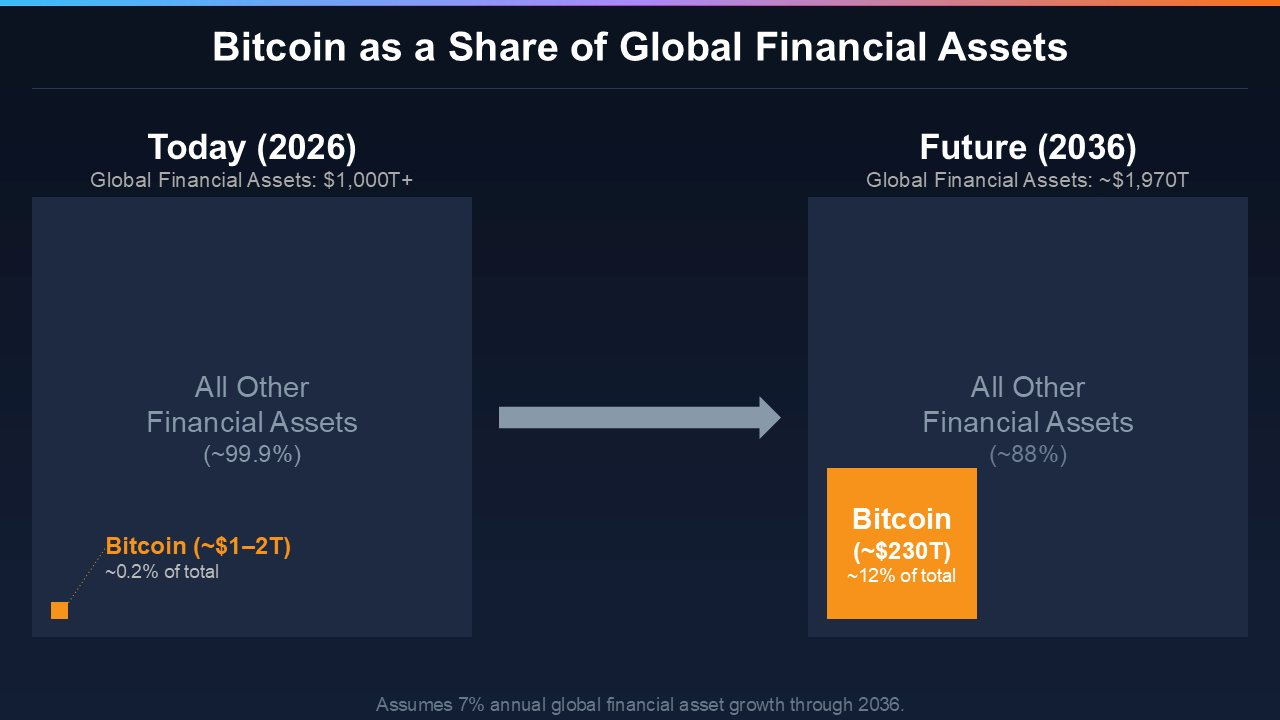
The forecast would imply that Bitcoin will become the dominant global reserve asset along with structurally loose monetary policy over the next decade, Nic Puckrin, co-founder and lead market analyst of educational platform Coin Bureau, told Cointelegraph.
”The forecast implies Bitcoin would become around 10 times as large as the current US M2 money supply, nearly four times as large as the US equity market today, and nearly double current global GDP.”
The prediction would also imply a compound annual growth rate (CAGR) of around 53% per annum, which is not unprecedented considering Bitcoin’s average 60% CAGR between 2015 and 2024, but a slowdown may be expected due to its larger market capitalization, added Puckrin.
Shawn Young, chief analyst at MEXC Research, agreed, warning that the prediction would imply a “huge” 16,318% increase for Bitcoin during the next decade, which looks unlikely due to Bitcoin’s declining volatility.
“The more liquidity flows into the asset from both institutional and retail investors, the less likely sharp price spikes will be recorded,” the analyst told Cointelegraph, adding that the “realistic price range is at most $1 million.”
Continue reading
Stablecoin inflows rebound to $1.7 billion as Washington battles over yield rules
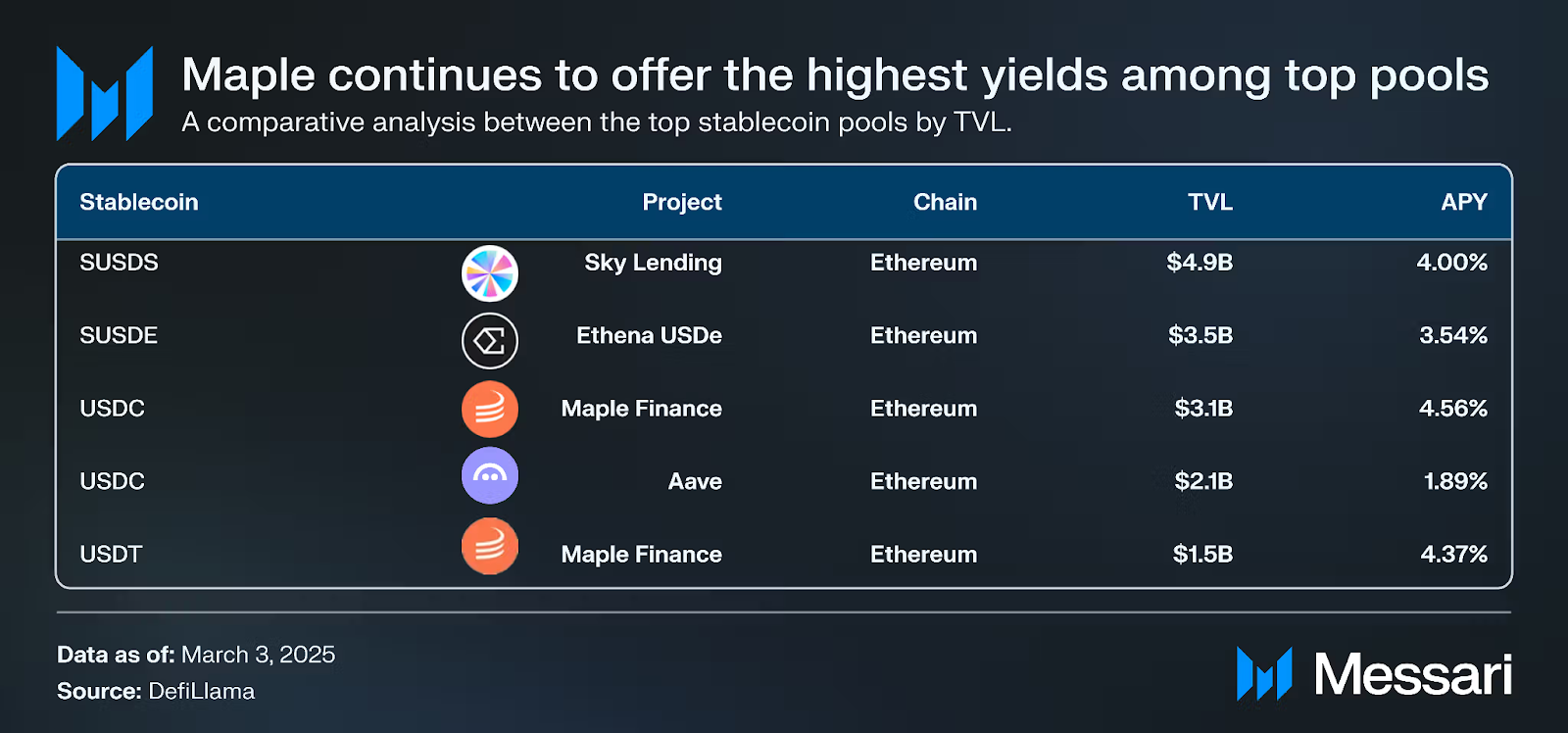
Weekly net stablecoin inflows rebounded last week as onchain activity picked up even while US lawmakers and banking groups sparred over whether third parties should be allowed to pay stablecoin yield, according to a new report from Messari.
Weekly net stablecoin inflows accelerated to $1.7 billion, a 414.5% increase week-on-week, according to the report published on Wednesday.
The recovery flipped the 30-day average to a positive $162.5 million in daily inflows. Transaction volumes rose 6.3%, while average transaction size continued to decline, reflecting renewed stablecoin issuance demand and “strengthened” onchain activity amid retail investors, the report said.
Stablecoin inflows track net new stablecoins entering circulation after accounting for redemptions.
The surge follows a weaker period earlier in the year. Messari data showed $249 million in weekly inflows two weeks earlier and $4.4 billion in net outflows over the 30 days leading up to Feb. 18.
Continue reading
Solv Protocol offers 10% bounty after $2.7 million vault exploit
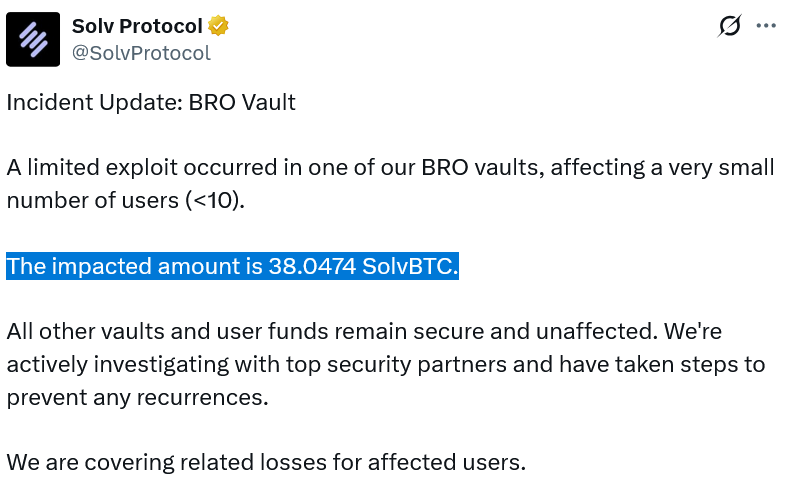
Bitcoin-based decentralized finance platform Solv Protocol says one of its token vaults was exploited for $2.7 million and has offered the attacker a 10% bounty in exchange for returning the stolen funds.
Solv said in an X post on Thursday that fewer than 10 of its users were impacted, but it would cover the loss of 38.05 Solv Protocol BTC (SolvBTC), a token pegged to Bitcoin (BTC).
The project added that it had implemented measures to prevent the attack from recurring and was investigating the exploit with crypto security firms Hypernative, SlowMist and CertiK.
Solv allows users to deposit Bitcoin for Solv Protocol BTC, which they can then use to lend, borrow or stake on other blockchains. The project has 24,226 Bitcoin worth over $1.7 billion and claims it is the largest onchain Bitcoin reserve.
Solv hasn’t confirmed how the exploit occurred, but two crypto security researchers said it stemmed from a vulnerability in one of Solv’s smart contracts that allowed the attacker to mint excessive amounts of a token used on the protocol.
The attacker exploited the vulnerability 22 times before swapping hundreds of millions of tokens for just over 38 SolvBTC, according to CD Security co-founder Chris Dior.
Continue reading
Bybit claims new fraud system stopped $300 million of risky withdrawals in Q4 2025
Bybit said it blocked or disrupted more than $300 million worth of suspected scam-related withdrawals in the fourth quarter of 2025 after rolling out an AI-assisted risk monitoring system designed to flag malicious transactions before funds leave the exchange.
In a company blog post, Bybit said its system flagged about $500 million in withdrawal requests during the quarter and that more than 4,000 users were “protected” after the platform issued real-time risk alerts or blocked transactions outright.
Bybit’s head of group risk control, David Zong, told Cointelegraph that much of the $300 million total reflects withdrawals users voluntarily cancelled after seeing warnings, meaning the funds remained in their accounts rather than requiring clawbacks or reimbursement.
“Because the withdrawals were stopped prior to completion, the funds did not require recovery or reimbursement. They remained in users’ accounts at all times.”
Bybit said the system also identified 350 high-risk investment fraud addresses that shielded 8,000 users from potential withdrawal losses during the previous quarter. It also thwarted over 3 million credential stuffing attacks attempted by hackers throughout 2025.

Cryptocurrency hacks resulted in $3.4 billion in losses during 2025, as hackers turned their focus to large crypto entities.
Continue reading
DeFi market overview
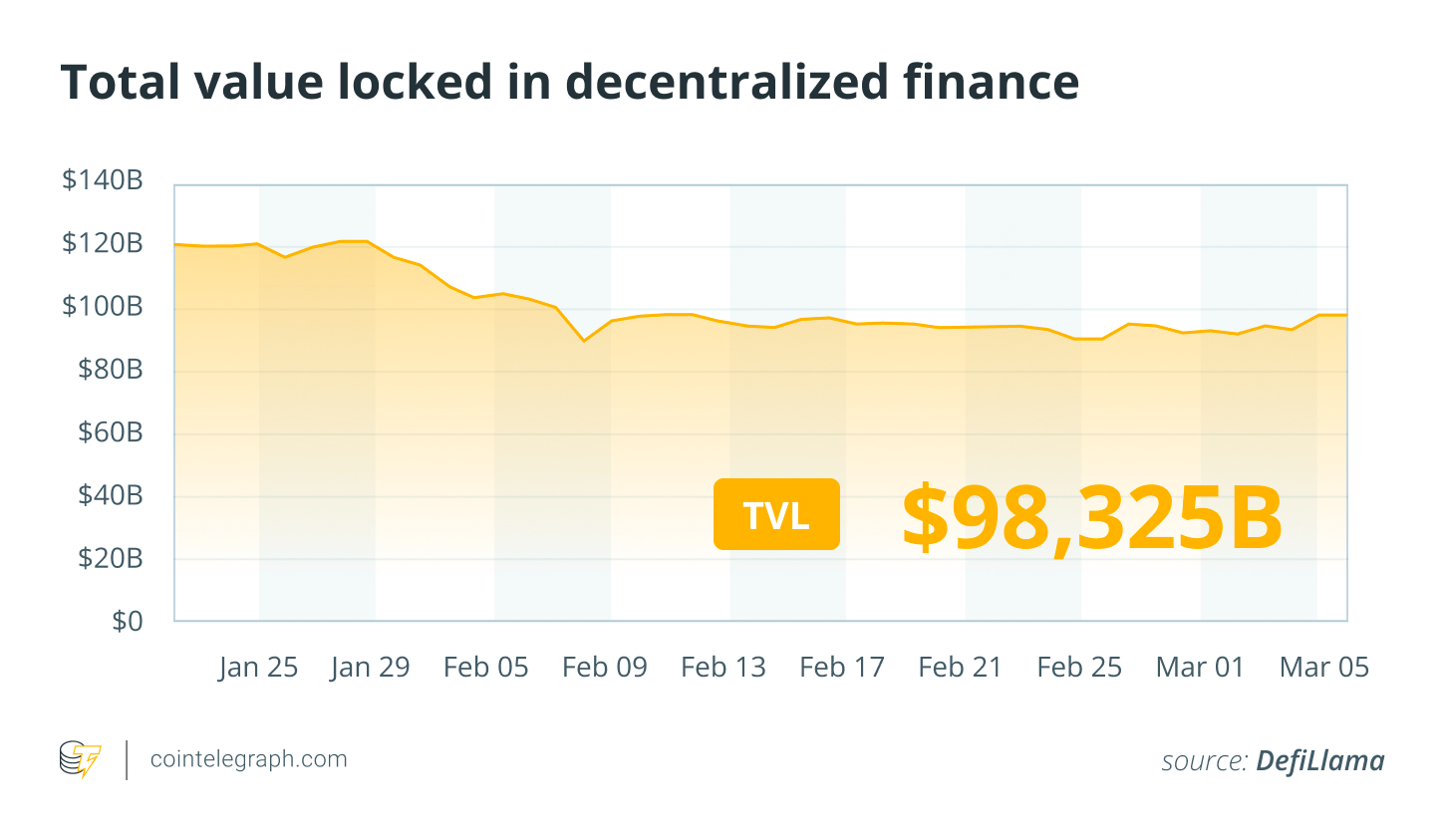
According to data from Cointelegraph Markets Pro and TradingView, most of the 100 largest cryptocurrencies by market capitalization ended the week in the green.
The River (RIVER) token rose 94% as the biggest gainer of the week, followed by the Humanity Protocol (H) token, up 39% during the past week.
Thanks for reading our summary of this week’s most impactful DeFi developments. Join us next Friday for more stories, insights and education regarding this dynamically advancing space.
Read the full article here
Fact Checker
Verify the accuracy of this article using AI-powered analysis and real-time sources.