

 Freedom Index
Listen to the article
Stani Kulechov, the founder of the decentralized lending platform Aave, says DeFi could benefit from $50 trillion worth of “abundance assets,” such as solar energy, through tokenization by 2050, opening a new class of onchain collateral.
Data from RWA.xyz shows that nearly $25 billion worth of real-world assets have been tokenized onchain, but they are mostly in the form of US Treasury bonds, stocks, commodities, private credit and real estate.
In a post to X on Sunday, Kulechov said he expects these scarce assets to continue growing but that the “biggest impact from tokenization can be achieved by tokenizing abundance assets.”
“Capital is hungry for new collateral, and the world is ready for a transformation that onchain lending can capture and accelerate,” the Aave Labs boss said, while adding that solar could account for $15-$30 trillion of the $50 trillion “abundance asset” market by 2050.
Kulechov said solar debt financiers could tokenize a $100 million solar project while borrowing $70 million to redeploy into new projects, while onchain depositors would have “access to enormously scalable, low-risk yield that is well diversified.”
“An investor might buy tokenized solar, hold for three years, sell at a profit, and immediately redeploy into new development,” Kulechov added, arguing that such a model could significantly increase capital efficiency.
“Traditional infrastructure capital locks up for decades. Tokenized assets allow continuous trading, meaning the same dollar can finance multiple projects over time.”
Kulechov said the same idea extends to batteries for energy storage, robotics for labor, vertical farming and lab-grown food for nutrition, semiconductors for computation and 3D printing for materials.
Abundance assets could offer better returns
Kulechov said these abundance assets could offer higher returns than scarce assets, which he said are heading down “a road toward low, thin margins and diminished profitability.”
“Abundance-backed products offer better returns, better risk characteristics, and better values alignment. They win in the market because they are superior products.”
Aave is the largest DeFi protocol by total value locked, at $27 billion for borrowing and lending, DeFiLlama data shows.
The Tether-issued USDt (USDT) stablecoin, Ether (ETH) and wrapped Ether (wETH) are the most lent and borrowed assets on the platform.
AAVE down 15.2% in 2026
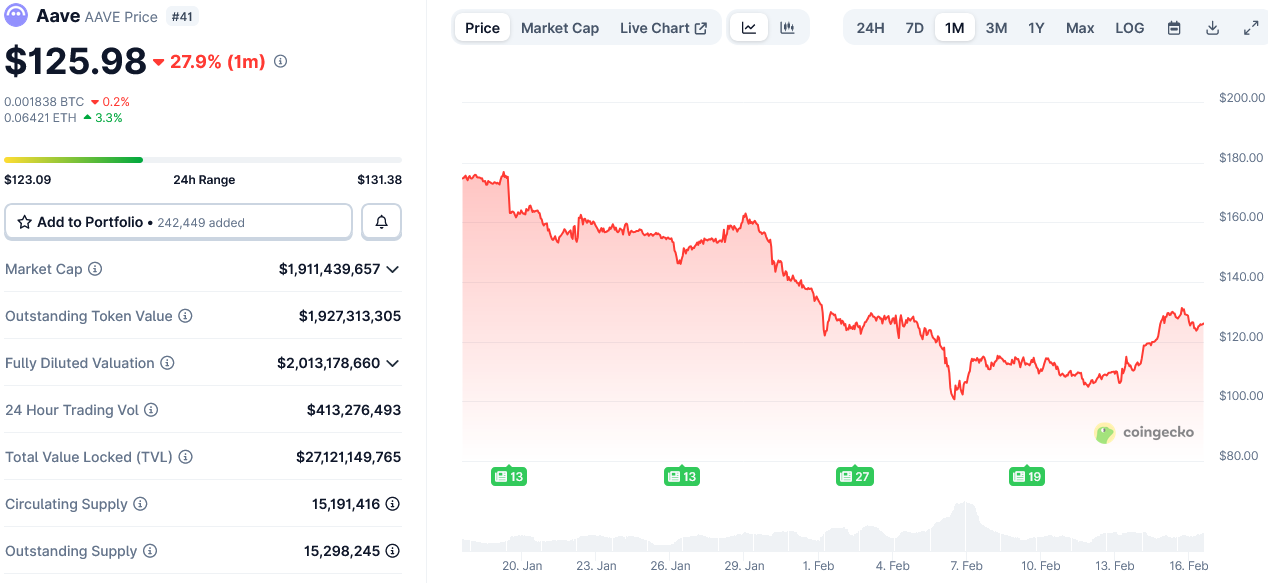
Aave’s native token Aave (AAVE) has not managed to stave off the recent crypto market slump, falling another 1.6% over the last 24 hours, CoinGecko data shows.
Related: Aave winds down Avara, phases out Family wallet in DeFi refocus
AAVE has fallen 15.2% so far in 2026 to $125.98 and is now 81% off its $661.70 all-time high set in May 2021.
Magazine: A ‘tsunami’ of wealth is headed for crypto: Nansen’s Alex Svanevik
Read the full article here
Fact Checker
Verify the accuracy of this article using AI-powered analysis and real-time sources.