

 Freedom Index
Listen to the article
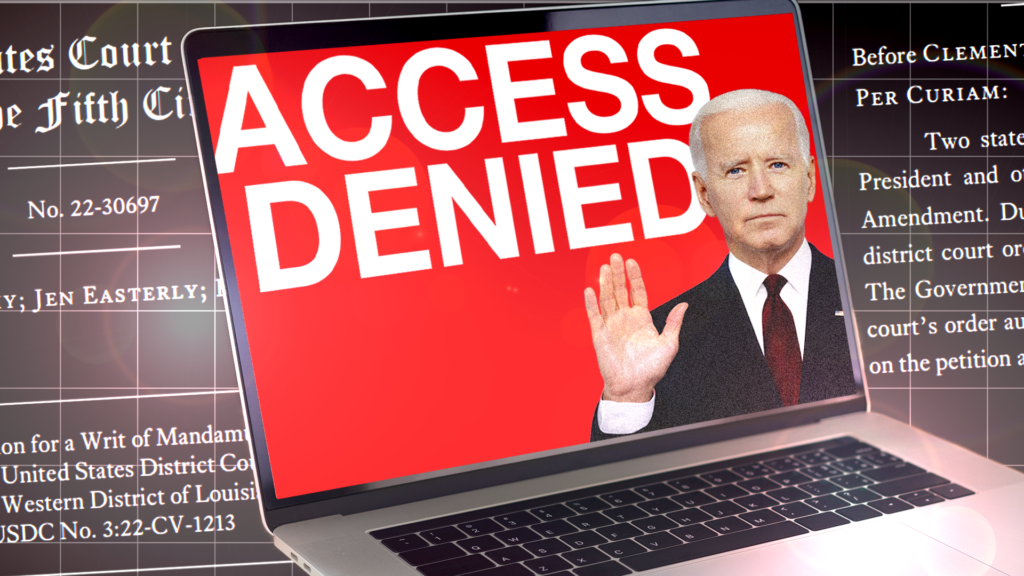
On Tuesday, the New Civil Liberties Alliance (NCLA) announced that it had reached a settlement in Missouri v. Biden, a First Amendment lawsuit challenging the federal government’s attempts to suppress “misinformation” on social media. Under the proposed consent decree, which still needs the approval of U.S. District Judge Terry Doughty, the surgeon general, the Centers for Disease Control and Prevention, and the Cybersecurity and Infrastructure Security Agency will be barred from threatening to punish social media companies for declining to remove or reduce the visibility of “content containing protected free speech.”
The lawsuit, which resulted in rulings against the government by Doughty and the U.S. Court of Appeals for the 5th Circuit before the Supreme Court concluded that the plaintiffs had not shown they had standing to seek injunctive relief, was provoked by the Biden administration’s campaign against online speech it viewed as a threat to public health, democracy, or national security. Given President Donald Trump’s criticism of his predecessor’s social media meddling, it is not surprising that the current administration was willing to settle the case. But that does not mean the Trump administration is prepared to respect the First Amendment right of social media companies to decide which content they want to host or promote, free from the government’s coercive influence.
To the contrary, federal officials still think they have a role in shaping online speech, which they nonsensically portray as an effort to vindicate First Amendment rights. Instead of demanding the suppression of disfavored speech, they insist that social media platforms are obliged, in the name of fairness and balance, to host content they otherwise would be inclined to reject. Although such intervention serves a different political agenda, it is no less objectionable than the Biden administration’s crusade against speech it deemed dangerous.
The settlement involves the two remaining plaintiffs in Missouri v. Biden: health care activist Jill Hines and psychiatrist Aaron Kheriaty, both of whom complained that they had suffered from government-inspired restrictions on speech related to the COVID-19 pandemic. The original plaintiffs also included Jay Bhattacharya, a physician and health economist who is now director of the National Institutes of Health, and Martin Kulldorff, a biostatistician and epidemiologist who also took a job in the Department of Health and Human Services last year. Bhattacharya and Kulldorff, both of whom criticized lockdowns and vaccine mandates during the pandemic, withdrew from Missouri v. Biden because of their new government positions.
The plaintiffs complained that government bullying of social media platforms had transformed what were ostensibly private content moderation decisions into censorship by proxy. By pressuring the platforms to suppress disfavored speech, they argued, the Biden administration had sought to achieve results it could not directly mandate
Some of the evidence supporting that claim came from public pronouncements by federal officials. In July 2021, for example, Surgeon General Vivek Murthy issued an advisory calling for a “whole-of-society” effort to combat the “urgent threat to public health” posed by “health misinformation,” which he said might require “legal and regulatory measures.” The next day, President Joe Biden accused Facebook and other social media platforms of “killing people” by tolerating posts that might discourage vaccination.
“Facebook needs to move more quickly to remove harmful violative posts,” White House press secretary Jen Psaki said around the same time. Because “we’re dealing with a life-or-death issue here,” she explained, “everybody has a role to play in making sure there’s accurate information.” Toward that end, social media platforms “should be held accountable,” said White House Communications Director Kate Bedingfield, raising the possibility of expanding their civil liability for user-posted content.
Psaki noted that the president also “supports better privacy protections and a robust anti-trust program.” She pointed that out right after declaring that “the major platforms have a responsibility related to the health and safety of all Americans to stop amplifying untrustworthy content, disinformation, and misinformation.”
In private, meanwhile, federal officials were pressuring social media companies to remove or downgrade content deemed dangerous to public health and banish the users responsible for it. They alluded to the president’s keen interest in the issue and suggested the administration would take unspecified action if the platforms failed to fall in line. The responses from the platforms, including changes to their moderation policies and practices, showed they were keen to assuage the president’s anger by addressing his concerns.
Meta CEO Mark Zuckerberg would later acknowledge that Facebook had caved to official pressure. “I believe the government pressure was wrong, and I regret that we were not more outspoken about it,” Zuckerberg told the House Judiciary Committee in 2024. “We’re ready to push back if something like this happens again.” Alphabet, which owns Google and YouTube, also eventually confirmed that the Biden administration had pressed it to remove content that did not violate the company’s rules.
In July 2023, Doughty ruled that such interference violated the First Amendment because federal officials had either “coerced” or “significantly encouraged” speech restrictions. Two months later, the 5th Circuit largely agreed with that assessment. But the Supreme Court never resolved the central question in the case, instead ruling in Murthy v. Missouri the following year that the plaintiffs had failed to “demonstrate a substantial risk that, in the near future, they will suffer an injury” as a result of the government’s actions.
Three justices disagreed with the majority’s assessment, saying at least one of the plaintiffs, Hines, had met that test. “For months, high-ranking Government officials placed unrelenting pressure on Facebook to suppress Americans’ free speech,” Justice Samuel Alito wrote in a dissent joined by Justices Clarence Thomas and Neil Gorsuch. “The officials wielded potent authority. Their communications with Facebook were virtual demands. And Facebook’s quavering responses to those demands show that it felt a strong need to yield.”
In November 2024, five months after the Supreme Court remanded the case, Doughty approved further discovery aimed at supporting the plaintiffs’ standing. That ruling came three days after Trump was elected, and the new administration eventually reached the settlement announced this week.
The proposed permanent injunction applies to “formal or informal” actions, undertaken “directly or indirectly,” that involve threats of “an adverse legal, regulatory, or economic government sanction” when they aim to suppress constitutionally protected speech, whether by removing content or by downgrading it, including algorithmic changes that limit its potential audience. The parties agree that “labels such as ‘misinformation,’ ‘disinformation,’ or ‘malinformation'” do not strip speech of constitutional protection.
“Freedom of speech has been powerfully preserved by our clients, past and present, who initiated this suit,” says John Vecchione, senior litigation counsel at the NCLA. “The federal government’s social media censorship was the most massive suppression of speech in the nation’s history,” NCLA founder and CEO Philip Hamburger adds, and “it was profoundly important to resist it.”
As Vecchione notes, the settlement is consistent with an executive order that Trump issued on the first day of his second term. “Over the last 4 years,” he said, “the previous administration trampled free speech rights by censoring Americans’ speech on online platforms, often by exerting substantial coercive pressure on third parties, such as social media companies, to moderate, deplatform, or otherwise suppress speech that the Federal Government did not approve. Under the guise of combatting ‘misinformation,’ ‘disinformation,’ and ‘malinformation,’ the Federal Government infringed on the constitutionally protected speech rights of American citizens across the United States in a manner that advanced the Government’s preferred narrative about significant matters of public debate. Government censorship of speech is intolerable in a free society.”
Although that might sound like a defense of independent content moderation, the Trump administration’s rejection of Biden-style interference should not be confused with a rejection of government involvement in this area. Officials such as Andrew Ferguson, the Trump-appointed chairman of the Federal Trade Commission (FTC), and Brendan Carr, the Trump-appointed chairman of the Federal Communications Commission (FCC), think the government should err in the opposite direction by fighting “Big Tech censorship.”
What does that entail? Last May, Ferguson launched an investigation of “potentially illegal” moderation practices, touting it as a blow against “the tyranny of Big Tech” and “an important step forward in restoring free speech.” He takes a similar view of NewsGuard, a company that rates the transparency and credibility of online news sources.
Ferguson accuses NewsGuard of abetting “censorship” that is “inimical to American democracy.” To “protect the free speech of all Americans,” the FTC has subjected the company to onerous record demands and attacked its revenue by conditioning the merger of two advertising agencies on the resulting company’s agreement to refrain from subscribing to the rating service.
Carr likewise argues that social media companies and services such as NewsGuard pose a threat to freedom of speech. As he tells it, these businesses have conspired to silence “core political, religious, and scientific speech” by “defund[ing], demonetiz[ing], and otherwise put[ting] out of business news outlets and organizations that dared to deviate from an approved narrative.” They have punished Americans for “doing nothing more than exercising their First Amendment rights.”
Although it is not obvious how the FCC has any authority to address that purported danger, Carr thinks the commission “has an important role to play in addressing the threats to individual liberty posed by corporations that are abusing dominant positions in the market.” That mission, he says, requires cracking down on “Big Tech and its attempts to drive diverse political viewpoints from the digital town square.”
Ferguson and Carr conflate private decisions they see as biased against their political team with government censorship. But contrary to their implication, such decisions cannot violate the First Amendment, which applies only to government action.
When a business like NewsGuard offers advice about news outlets, it is not abridging freedom of speech; it is exercising freedom of speech. A social media platform that decides to reject, remove, or disfavor certain kinds of speech likewise is exercising a freedom protected by the First Amendment: the right to editorial discretion, which the Supreme Court has repeatedly recognized. Both of those things are true regardless of whether you think the judgments are reasonable, consistent, fair, or balanced.
Ferguson and Carr, in short, want to restrict First Amendment rights in the name of protecting them. The Supreme Court highlighted the folly of that strategy in Moody v. NetChoice, a 2024 decision addressing Florida and Texas laws that aimed to prevent “censorship” by regulating social media moderation practices.
“This Court has many times held, in many contexts, that it is no job for government to decide what counts as the right balance of private expression—to ‘un-bias’ what it thinks biased, rather than to leave such judgments to speakers and their audiences,” Justice Elena Kagan wrote in the majority opinion. “On the spectrum of dangers to free expression, there are few greater than allowing the government to change the speech of private actors in order to achieve its own conception of speech nirvana.”
Read the full article here
Fact Checker
Verify the accuracy of this article using AI-powered analysis and real-time sources.