

 Freedom Index
Listen to the article
A giant new study of social media use by fourth through twelfth graders found that moderate use of online platforms was “associated with the best well-being outcomes”—better than those seen with kids who abstained entirely.
“Social media’s association with adolescent well-being is complex and nonlinear, suggesting that both abstinence and excessive use can be problematic,” concludes the paper, published in JAMA Pediatrics.
Meanwhile, a British study has found “no evidence that time spent on social media or gaming” predicts later development of depression or anxiety.
You are reading Sex & Tech, from Elizabeth Nolan Brown. Get more of Elizabeth’s sex, tech, bodily autonomy, law, and online culture coverage.
No Use Sometimes Worse Than Heavy Use
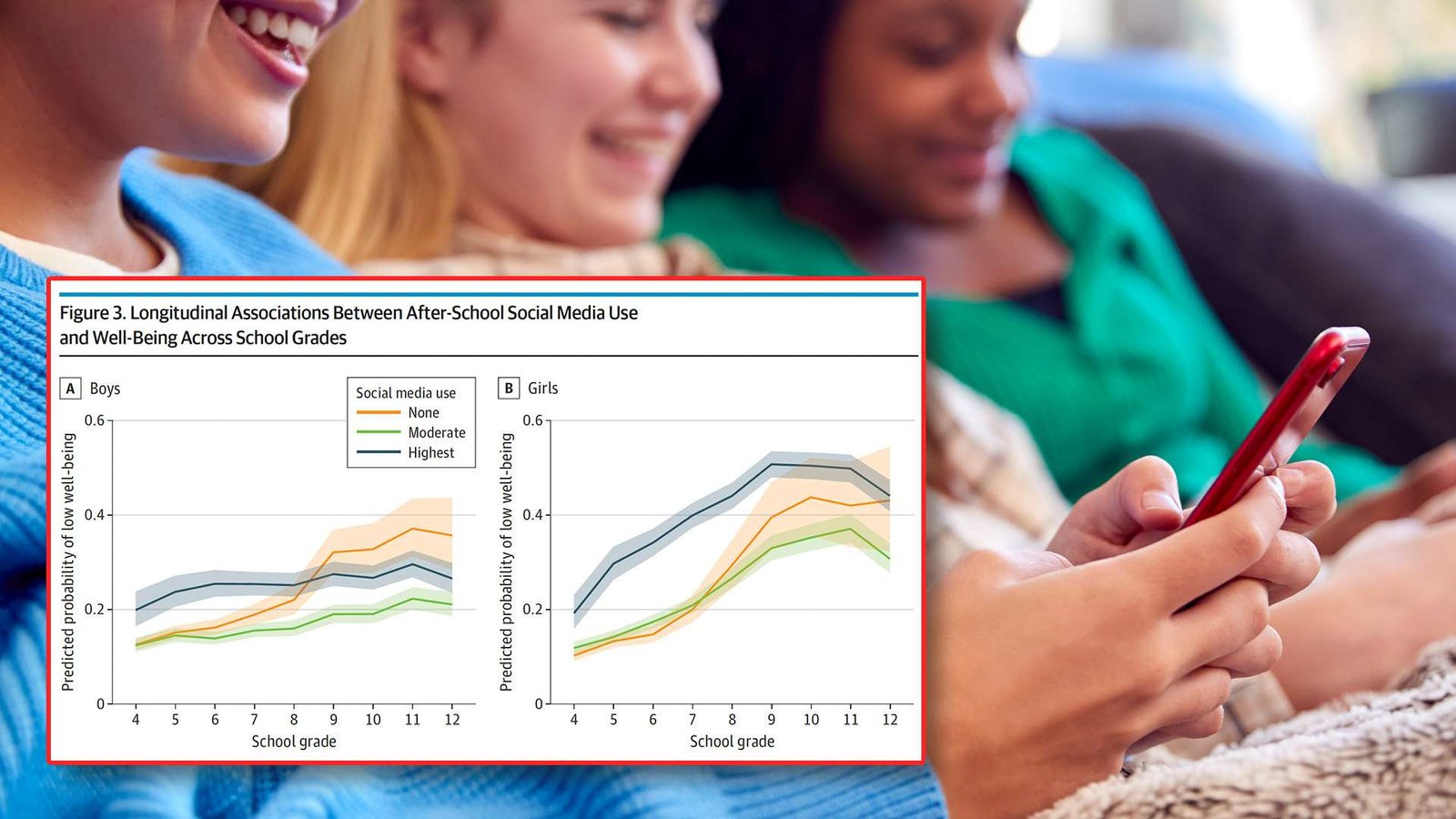
In the JAMA Pediatrics study, researchers at the University of South Australia looked at three years’ worth of data involving 100,991 Australian teens and tweens. It included information on after-school social media use (defined as use between 3 and 6 p.m. on weekdays) and on various measures of well-being, including happiness, optimism, worry, emotional regulation, and cognitive engagement.
The data revealed “a U-shaped association,” where both social media abstinence and heavy social media use were linked to poorer well-being while moderate social media use was linked to better well-being.
For older boys, the risks associated with no use exceeded the risks associated with high use.
“For both boys and girls, those with moderate after-school social media use generally had the lowest odds of low well-being across school grade groupings,” the paper states.
“Among girls, well-being was highest with no use in early adolescence (grades 4–6), but from middle adolescence (grades 7–9) onward moderate use was most advantageous, while high use was consistently adverse and had the greatest association with low well-being in grades 8 and 9,” it elaborates. “Among boys, well-being was similar for nonusers and moderate users in early adolescence (grades 4–6), but from midadolescence (grades 7–9) nonuse became increasingly associated with poorer outcomes, exceeding the risk of high use by late adolescence (grades 10–12).”
“The overall pattern is consistent with the Goldilocks hypothesis,” the authors conclude, “which suggests that moderate digital media is least risky, with very low or very high engagement less favorable.”
What This Study Can’t Tell Us
So what’s going on here? Can we conclude that some social media is actually good for kids?
Not exactly. As someone who is always cautioning against misreading correlational studies as causal when they suggest social media harms, I think it’s important that we exercise the same prudence here. So—throat clearing time: The fact that no use and high use are associated with poorer well-being does not mean that they cause the poor outcomes. Nor does moderate use being associated with better wellbeing mean that moderate use causes better outcomes.
It’s possible that well-adjusted young people with healthy home lives and happy social lives are prone to neither spend too much time on social media nor to avoid it entirely. Meanwhile, people with preexisting mental health problems or life stressors may turn too much to online diversions or avoid it entirely, either by choice or because of parental rules. In other words, poorer or better well-being may drive the amount of social media use rather than the other way around—or some third factor (such as super-strict parents) may drive both the amount of time spent online and overall levels of well being.
It’s also worth noting that this study was conducted in a world where much of our social lives are lived virtually, social media are a primary source of both news and entertainment, and so on. In some alternate world in which none of this is true, the “no use” condition for kids could conceivably be optimal. In the world that exists, being entirely removed from social media can be isolating.
Some might see this as an argument for banning minors from social media entirely. After all, if none of them have social media accounts, the FOMO effect might lessen.
But young people would certainly find other digital ways to communicate—group chats and so on—that would leave out some peers, especially peers who were barred from those avenues of communication. And much of the entertainment and politics and activism world would continue to operate on social media, with or without adolescents watching. So even if this were all about social media itself, I’m not convinced a total ban of under-16s or such would make much difference.
And let’s keep in mind (once again!) that this almost certainly isn’t all about social media itself, since offline conditions and preexisting personalities and problems are likely to drive levels of use at least as much as the other way around.
What This Study Can Tell Us
Come on, those opposed to tech panic can gloat about this study a little, can’t we? you might be thinking.
Yes! At least I think we can. Because here’s what this study does tell us: Moderate social media use isn’t dooming young people. It’s possible for them to use social media moderately and still thrive.
We needn’t know anything about which way the causation flows to come to those conclusions. It’s very clear that, on average, teens and tweens are capable of some social media use while staying sane and healthy.
This counters the narrative put out by a lot of teens-and-tech doomers and the types of people pushing for strict laws that ban teens from social media, require platforms to check everyone’s IDs, and so on. Their ideas are premised on the idea that it would be beneficial to get young people off social media entirely. Studies like this one suggest that may not be true.
Keep in mind that the “moderate use” category in this study was not conservative. Up to 12.5 hours per week of social media use between the weekday hours of 3 and 6 p.m. was defined as moderate. So this isn’t merely a finding that the smallest smidge of social media is OK.
Some Limitations
Some elements of the Australian study leave something to be desired. It relied on self-reports, which aren’t always reliable. It didn’t look at time spent on social media outside just-after-school hours. (It’s possible—though it seems unlikely—that some heavy users during these hours were rarely users at other times, or that some who abstained during these times were heavy users at other times.)
The biggest limitation I see is that the data covered 2020 to 2022—the COVID years. Not exactly a normal observational period. The pandemic was a particularly bad time to be offline.
The main upside here still stands: Moderate social media use didn’t devastate well being.
…But Wait, That’s Not All
Yet another huge study of kids and technology also challenges the idea that screen time is inherently negative. This one, conducted by researchers at the University of Manchester and published in the Journal of Public Health, looked at British 11- to 14-year-olds and found “no evidence that time spent on social media or gaming frequency predicted later internalizing symptoms among girls or boys.”
Internalizing symptoms include indicators of such problems as anxiety and depression.
Using something called the #BeeWell dataset, the researchers studied subjects at three points in time: autumn 2021, autumn 2022, and autumn 2023.
“The lack of evidence linking social media use or gaming frequency to later internalizing symptoms suggests that these activities may not play a causal role in the development of adolescent mental health difficulties,” the researchers conclude.
“Our findings challenge the widespread assumption that time spent on these technologies is inherently harmful and highlight the need for more nuanced perspectives that consider the context and individual differences in their use,” they state.
Notably, the study failed to find a reverse sort of causation either. “Our findings did not support the idea that internalizing symptoms predict later social media use,” notes the paper.
Taken together, this study and the Australian study “land like a sledgehammer” on “the ‘social media is destroying kids’ narrative, popularized by Jonathan Haidt and others,” writes Mike Masnick at Techdirt. But “this shouldn’t be surprising to anyone who has been paying attention,” since study after study has been “showing that the relationship between social media and teen mental health is complicated, context-dependent, and nowhere near as clear-cut as Haidt’s ‘The Anxious Generation’ would have you believe.”
Discord to Start Requiring IDs or Facial Scans
Ugh: “Discord announced on Monday that it’s rolling out age verification on its platform globally starting next month, when it will automatically set all users’ accounts to a ‘teen-appropriate’ experience unless they demonstrate that they’re adults,” reports The Verge.
The “teen-appropriate experience” means “updated communication settings, restricted access to age-gated spaces, and content filtering,” per Discord’s announcement. The company adds:
Beginning with a phased global rollout to new and existing users in early March, users may be required to engage in an age-verification process to change certain settings or access sensitive content. This includes age-restricted channels, servers, or commands and select message requests….
Discord users can choose to use facial age estimation or submit a form of identification to its vendor partners, with more options coming in the future. Additionally, Discord will implement its age inference model, a new system that runs in the background to help determine whether an account belongs to an adult, without always requiring users to verify their age. Some users may be asked to use multiple methods if more information is needed to assign an age group.
More Sex & Tech News
• “Arizona must stop enforcing abortion restrictions that predate and contradict a 2024 voter-approved constitutional amendment guaranteeing abortion rights,” reports the Associated Press, covering a court ruling released on Friday.
• Utah Senate Bill 73 “would impose a new tax on pornographic websites,” reports Fox 13 Salt Lake City. Any money made would be “earmarked for youth mental health resources.”
• Introducing…whatever this is:
Welcome to Headquarters, the new Gen-Z led progressive content hub. pic.twitter.com/7EQyz3DFpd
— Headquarters (@HQNewsNow) February 5, 2026
Read the full article here
Fact Checker
Verify the accuracy of this article using AI-powered analysis and real-time sources.