

 Freedom Index
Listen to the article
Andrew Ferguson, chairman of the Federal Trade Commission (FTC), thinks NewsGuard, a company that rates the transparency and credibility of online news sources, is biased against conservatives. There is not much evidence to support that claim. But even if it were true, NewsGuard argues in a First Amendment lawsuit it filed last Friday in the U.S. District Court for the District of Columbia, Ferguson would have no business using his regulatory authority to harass the company and discourage advertisers from relying on its ratings.
“Under the guise of a supposed antitrust investigation, the FTC has demanded all documents (memos, emails, texts, reporters’ notes, subscriber lists, analyses, financial reports, and more) that NewsGuard has created or received since its founding in 2018,” the complaint notes. The FTC also has directly attacked NewsGuard’s revenue by conditioning the merger of two advertising agencies on the resulting company’s agreement to refrain from subscribing to the rating service.
“NewsGuard’s rating service is quintessential journalistic activity protected by the First Amendment,” says Robert Corn-Revere, chief counsel at the Foundation for Individual Rights and Expression (FIRE), which is representing the company. He adds that the Supreme Court, in the 2024 case Moody v. NetChoice, “unanimously affirmed that the government has no legitimate role in saying what counts as the right balance of private expression—to ‘un-bias’ what it thinks is biased.”
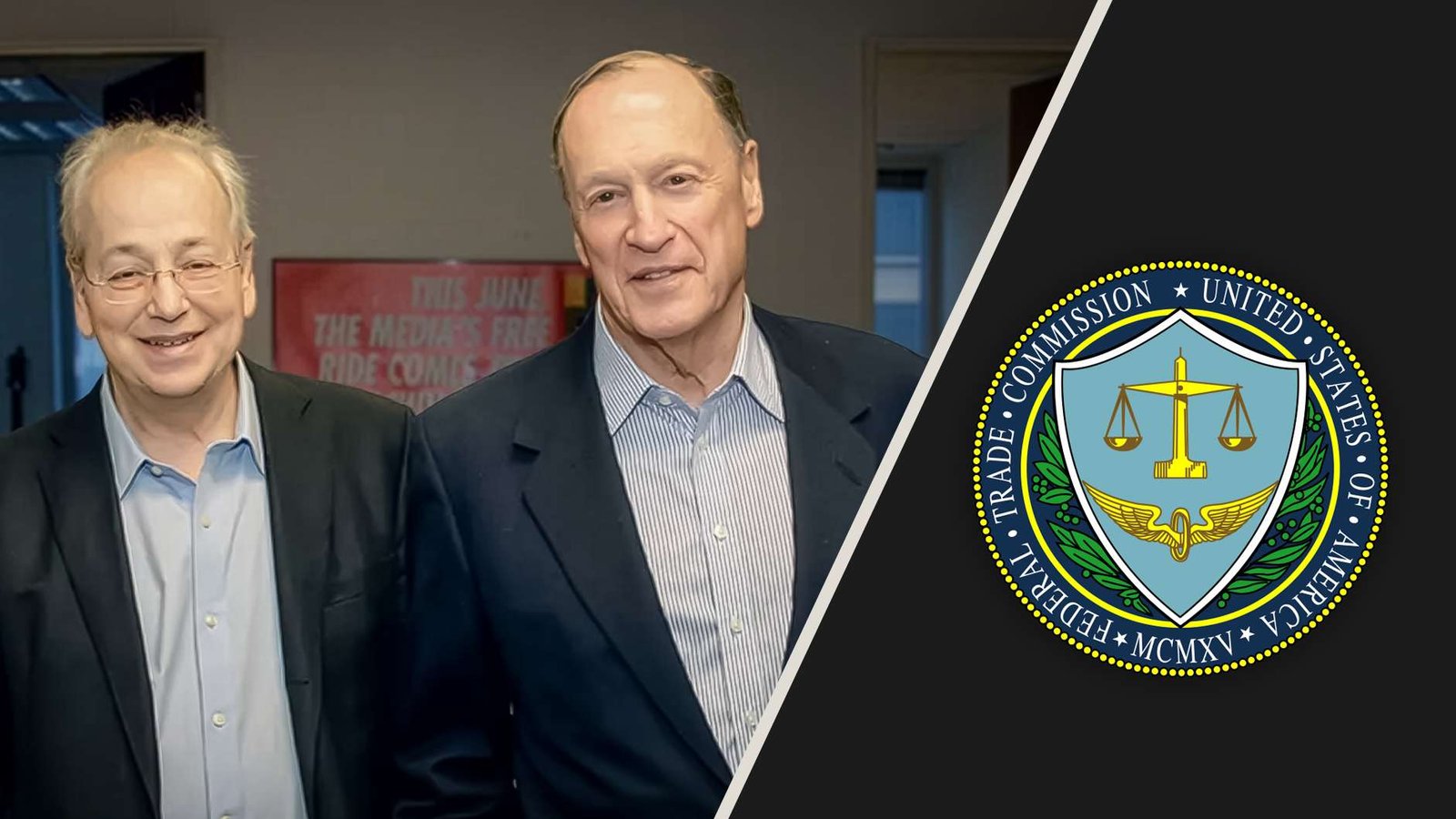
NewsGuard was founded by former Wall Street Journal publisher L. Gordon Crovitz and Steven Brill, founder of The American Lawyer and Court TV. Its subscribers include advertisers, who use its ratings to guide ad buys, and online news consumers, who can access browser extensions that incorporate the ratings.
The ratings are based on what Crovitz describes as “nine apolitical journalistic criteria using a transparent process with multiple layers of review and fact-checking.” The “transparency” criteria include “discloses ownership and financing,” “clearly labels advertising,” “reveals who’s in charge, including possible conflicts of interest,” and “provides the names of content creators, along with either contact or biographical information.” The “credibility” criteria include “does not repeatedly publish false or egregiously misleading content,” “gathers and presents information responsibly,” “has effective practices for correcting errors,” “handles the difference between news and opinion responsibly,” and “avoids deceptive headlines.”
As Ferguson sees it, that ostensibly apolitical process is systematically biased against right-wing voices. As an FTC commissioner in November 2024, he alleged that NewsGuard had “led collusive ad boycotts—possibly in violation of our antitrust laws—to censor the speech of conservative and independent media in the United States.”
The following month, Ferguson returned to that theme in a concurring statement. “If a website gets a poor rating on NewsGuard’s ‘nutrition label,’ it can choke off the advertising dollars that are the lifeblood for many websites—including platforms on which millions of Americans every day speak their minds,” he wrote. “NewsGuard
‘goes to great lengths to create the appearance of nonpartisanship and objectivity,’ but it seems to give a free pass to deceptive and biased news coverage by major left-leaning outlets. NewsGuard is, of course, free to rate websites by whatever metric it wants. But the antitrust laws do not permit third parties to facilitate group boycotts among competitors.”
Ferguson thought the FTC should take action based on that concern. “Censorship, even if carried out transparently and honestly, is inimical to American democracy,” he said. “The Commission must use the full extent of its authority to protect the free speech of all Americans. That authority includes the power to investigate collusion that may suppress competition and, in doing so, suppress free speech online. We ought to conduct such an investigation. And if our investigation reveals anti-competitive cartels that facilitate or promote censorship, we ought to bust them up.”
Ferguson followed through on that threat after President Donald Trump appointed him as chairman of the FTC in January 2025. That May, the FTC issued a 21-page “civil investigative demand” (CID) to NewsGuard seeking “vast numbers of confidential and sensitive documents,” the company’s complaint says. That CID, which included “31 Specifications” with “dozens of subparts,” was “designed to burden and bleed NewsGuard,” the lawsuit alleges.
Under the Federal Trade Commission Act, the CID was supposed to specify the legal violation that the commission was investigating. But the CID conspicuously failed to do so, “leaving the company to guess about what the agency alleged was at issue or how it could have anything to do with legitimate enforcement of antitrust or competition laws.”
All of this was consistent with the modus operandi that Ferguson had described at an antitrust conference in April 2025. “We have a tremendous array of investigative tools,” he bragged. “Those tools are expensive when applied to you even if we don’t win at the end of the day.” Regulators “can show up, they can audit, they can investigate, [and] they can cost you a lot of money,” he noted. The point, he said, is that even if a company thinks it has done nothing wrong, it had better “knuckle under” and “do what we say.”
NewsGuard negotiated with the FTC for seven months in an attempt to mitigate the burden imposed by the CID, arguing that many of the commission’s demands were excessive and noting that “its dealings with customers are plainly protected First Amendment activities.” But in the end, the complaint says, it became clear that the FTC was determined to press “several of the most intrusive, infringing demands,” including “identification of all NewsGuard subscribers,” “communications with customers,” “identification of all entities to which NewsGuard had ever assigned a News Reliability Rating,” “the particulars of each rating assigned to each entity over time,” and documents, including internal correspondence, showing “how NewsGuard has
developed methodologies for ratings.”
Meanwhile, Ferguson was pursuing his vendetta against NewsGuard by exercising the FTC’s authority to review mergers. As a condition for approving the merger of Omnicom Group and the Interpublic Group of Companies, which created “the world’s largest advertising agency and media buying company,” the FTC decreed that the new entity, in placing ads, could not consider “political or ideological viewpoints,” including “viewpoints as to the veracity of news reporting or other politically or ideologically contested facts, such as their characterization as ‘misinformation,’ ‘disinformation,’ ‘bias,’ or similar terms.” Nor could it consider “adherence to journalistic standards or ethics established or set by a Third Party.”
That condition “targets NewsGuard ‘with the precision of a laser beam,'” the lawsuit says. It meant Omnicom and its affiliates could not do business with NewsGuard. And according to the lawsuit, NewsGuard has lost other clients as a result of the Omnicom consent order—a chilling effect it expects will continue to curtail its revenue.
Given Ferguson’s “tactics and pronouncements” about “targeting tech and media companies supposedly associated with a ‘censorship cartel,’ NewsGuard has ample grounds for concern that the FTC aims to find NewsGuard’s customers to pressure them, too,” the complaint says. “Though today such improper tactics to impose informal censorship are called ‘jawboning,’ the FTC’s demands are also reminiscent of the witch hunts of the McCarthy era.”
The motivation for the NewsGuard-excluding merger provision was clear from comments that Ferguson made during negotiations with Omnicom. “Industry groups and private organizations have publicly sought to use the chokepoint of the advertising industry to effect political or ideological goals,” he complained in June 2025. In a footnote, Ferguson cited a 2024 House Committee on Small Business staff report “describing NewsGuard and other organizations’ steering of advertising revenue with ‘an unavoidable partisan lens.'”
Ferguson dresses his critique of NewsGuard, which echoes complaints from Brendan Carr, chairman of the Federal Communications Commission, in the language of antitrust enforcement, an FTC bailiwick. But as the lawsuit notes, “the company’s share of the market for advertiser brand safety tools is so de minimis—less than 0.1%—that NewsGuard could not possibly be a legitimate target of an antitrust investigation of that market.”
Rather than make that implausible argument, Ferguson frames his actions against NewsGuard as an effort to save “American democracy” by preventing “censorship” and protecting “free speech.” But his understanding of censorship and free speech is fundamentally misguided. The First Amendment is a constraint on government, not on private actors. Yet Ferguson claims he is protecting freedom of speech by attacking NewsGuard’s exercise of it.
That position is consistent with Ferguson’s claim that social media platforms “may have violated the law by silencing and intimidating Americans for speaking their minds.” He touted that investigation as a blow against “the tyranny of Big Tech” and “an important step forward in restoring free speech.” His chief complaint, as with his beef against NewsGuard, is that “Big Tech censorship” discriminates against Republicans and conservatives. But even if that were true, there would be nothing inherently illegal about it.
Although Ferguson suggested that social media platforms may be engaging in “unfair or deceptive acts or practices,” his comments make it clear that his actual aim, as in the NewsGuard case, is to correct an alleged bias against his political team. But the FTC has no authority to do that, and overriding the editorial discretion of private businesses in the name of free speech would itself violate the First Amendment.
NewsGuard’s lawsuit alleges that the FTC’s attack on the company has been driven largely by complaints from NewsMax, a right-wing cable TV outlet that has received low NewsGuard ratings. Those low ratings are not surprising given the channel’s record of reality-defying journalism.
NewsMax has been a leading promoter of Trump’s baseless claims that systematic election fraud deprived him of his rightful victory in 2020. In September 2024, NewsMax settled a defamation lawsuit by Smartmatic, one of the companies implicated in Trump’s stolen-election fantasy, for an undisclosed sum. Last August, it announced a $67 million settlement with Dominion Voting Systems, which likewise figured in that fantasy.
Despite those settlements, Newsmax insists there was nothing wrong with its reporting on the 2020 presidential election. “Newsmax believed it was critically important for the American people to hear both sides of the election disputes that arose in 2020,” the outlet said after the Dominion settlement. “We stand by our coverage as fair, balanced, and conducted within professional standards of journalism.”
Newsmax’s complaints about NewsGuard’s alleged ideological bias nevertheless have been echoed by Ferguson, Carr, legislators such as Sen. Ted Cruz (R–Texas) and Rep. James Comer (R–Ky.), and conservative organizations such as the Media Research Center. In rebuttal, NewsGuard notes that “many left-leaning outlets receive lower scores than comparable right-leaning sources.” For example, “Fox News scores higher than MSNBC, the conservative Washington Examiner outscores the liberal Daily Beast, and the conservative Daily Caller outscores the liberal Daily Kos.”
The complaint adds that “Newsmax’s offensive against NewsGuard appears to be motivated by the fact that it has received lower reliability ratings than other conservative news sources such as Fox News, the National Review, and the Washington Times.” NewsGuard notes that “Newsmax competes with these sites for advertisers.”
Whatever you make of this dispute, NewsGuard’s supposed bias is irrelevant to the constitutional question of whether Ferguson’s actions are consistent with the First Amendment. In Moody v. NetChoice, which involved Florida and Texas laws that aimed to prevent “censorship” by restricting the moderation practices of social media platforms, the Supreme Court made it clear that the government has no business trying to shape online speech in the name of balance.
“This Court has many times held, in many contexts, that it is no job for government to decide what counts as the right balance of private expression—to ‘un-bias’ what it thinks biased, rather than to leave such judgments to speakers and their audiences,” Justice Elena Kagan wrote in the majority opinion. “On the spectrum of dangers to free expression, there are few greater than allowing the government to change the speech of private actors in order to achieve its own conception of speech nirvana. That is why we have said in so many contexts that the government may not ‘restrict the speech of some elements of our society in order to enhance the relative voice of others.'”
The FTC “has pursued its campaign because Chairman Ferguson does not like NewsGuard’s news ratings, which he views as biased against conservative publications,” the company’s lawsuit says. “That is wrong—NewsGuard’s ratings and journalism about news sources are non-partisan and based on fully disclosed journalistic criteria. But the FTC’s actions [would be] plainly unconstitutional even if that were not the case. The First Amendment does not allow the government to pick and choose speech based on what it likes or dislikes.”
NewsGuard argues that the FTC’s investigation and the Omnicom consent order amount to unconstitutional retaliation for constitutionally protected speech. It notes that federal courts reached a similar conclusion regarding oppressive CIDs that Texas Attorney General Ken Paxton and Missouri Attorney General Andrew Bailey (now deputy director of the FBI) issued against Media Matters for America. Paxton and Bailey decided to investigate the organization, ostensibly for deceptive trade practices, after it irked X owner Elon Musk by calling attention to “extremist and racist rhetoric” on his platform, reporting that X had placed some large companies’ ads “next to pro-Nazi content.”
In August 2024, U.S. District Judge Amit Mehta issued a preliminary injunction against Paxton’s CID, a decision that the U.S. Court of Appeals for the D.C. Circuit affirmed in May 2025. The D.C. Circuit said Media Matters was the “target of a government
campaign of retaliation” and an “arguably bad faith investigation” that infringed
“exercise of their First Amendment rights” and imposed “special burdens on their
newsgathering activities and operation of their media company.”
Mehta also issued a preliminary injunction against Bailey’s CID. He noted that Bailey had described Media Matters as a bunch of “radicals” and “progressive tyrants” who were “masquerading” as journalists when their real goal was to “wipe out free speech.” Media Matters had “pursued an activist agenda in its attempt to destroy X” and was “rigging the system to take down X,” he averred. Displaying confusion similar to Ferguson’s, Bailey described Media Matters’ criticism of X as “a new front in the war against the First Amendment.” He said his probe was part “the war for free speech,” which he emphasized was “really critical…especially as we move into an election cycle in 2024.” In light of those comments, Mehta said, “a reasonable factfinder” would be likely to conclude that Bailey was “targeting Media Matters not for legitimate law enforcement purposes but instead for its protected First Amendment activities.”
The FTC has launched its own investigation of Media Matters, likewise motivated by the organization’s reporting about X, which the commission says encouraged an advertiser boycott that had a dramatic impact on the platform’s revenue. In June, Media Matters filed a First Amendment lawsuit challenging the FTC’s investigation.
Last August, U.S. District Judge Sparkle Sooknanan granted the organization’s request for a preliminary injunction, concluding that “Media Matters is likely to show that retaliatory animus was the but-for cause of the FTC’s CID.” The FTC sought a stay from the D.C. Circuit, which FIRE opposed in a brief supporting Media Matters. In September, the appeals court declined to issue a stay, saying the FTC “has not shown a strong likelihood of success given the unique and (thus far) undisputed facts of this case.”
Media Matters, unlike NewsGuard, has a clear ideological agenda. But as NewsGuard emphasizes, a speaker’s bias—whether explicit or inferred, actual or imagined—does not affect his protection under the First Amendment.
“While the FTC has jurisdiction over unfair competition in commerce and agreements that unreasonably restrain trade, here it is brazenly using its power not for any issue concerning trade or commerce, but rather to censor speech,” NewsGuard says. “And it has done so simply out of disagreement with NewsGuard’s First Amendment-protected journalistic judgments about the reliability of news sources.”
FIRE’s Corn-Revere has a warning for conservatives who might be inclined to support the FTC’s campaign against NewsGuard because they think the commission is on their side. “Disagreement over news coverage is precisely the kind of expression the First Amendment protects,” he says. “If the government, regardless of the party in charge, can use its levers of power to punish an organization over its coverage, there’s no reason it can’t do the same to pursue other news organizations that it disfavors.”
Read the full article here
Fact Checker
Verify the accuracy of this article using AI-powered analysis and real-time sources.