Close Menu
FSNN | Free Speech News NetworkFSNN | Free Speech News Network
  • Home
  • News
    • Politics
    • Legal & Courts
    • Tech & Big Tech
    • Campus & Education
    • Media & Culture
    • Global Free Speech
  • Opinions
    • Debates
  • Video/Live
  • Community
  • Freedom Index
  • About
    • Mission
    • Contact
    • Support
Trending

Denial of Pistol Permit Based on Allegedly “Unsubstantiated” Past Allegations of Sexual Misconduct and Child Abuse

17 minutes ago

Inside Turkey’s Lawfare: How Turkey uses its disinformation law against journalists

25 minutes ago

SEC approves first 3x bitcoin and ether ETFs in the U.S.

32 minutes ago
Facebook X (Twitter) Instagram
Facebook X (Twitter) Discord Telegram
FSNN | Free Speech News NetworkFSNN | Free Speech News Network
Market Data Newsletter
Monday, October 5
  • Home
  • News
    • Politics
    • Legal & Courts
    • Tech & Big Tech
    • Campus & Education
    • Media & Culture
    • Global Free Speech
  • Opinions
    • Debates
  • Video/Live
  • Community
  • Freedom Index
  • About
    • Mission
    • Contact
    • Support
FSNN | Free Speech News NetworkFSNN | Free Speech News Network
Home»News»Media & Culture»America Hits a New Debt Record at $40 Trillion and Counting
Media & Culture

America Hits a New Debt Record at $40 Trillion and Counting

News RoomBy News Room2 hours agoNo Comments5 Mins Read2 Views
Share Facebook Twitter Pinterest Copy Link LinkedIn Tumblr Email VKontakte Telegram
America Hits a New Debt Record at  Trillion and Counting
Share
Facebook Twitter Pinterest Email Copy Link

Listen to the article

0:00
0:00

Key Takeaways

Playback Speed

Select a Voice

Before the COVID-19 pandemic, in 2020, the Congressional Budget Office (CBO) did not include the $40 trillion mark in its gross national debt projections for the coming decade, forecasting a gross federal debt of $36 trillion in 2030. By 2022, the CBO expected the country to cross $40 trillion in 2030. A year later, that date had moved up to 2028, and by 2024, it had moved to 2027. The most recent report, from February 2026, projected that we would end the current fiscal year at $39.4 trillion. We have now surpassed the $40 trillion mark.

The last time the federal government had a budget surplus was in FY 2001. Since then, Congress and presidents have overseen deficit after deficit. The previous record holder for the most debt amassed was President Barack Obama, whose two terms saw a $13.2 trillion increase in the national debt, adjusted for inflation.

Eighteen months into his second term, President Donald Trump has already surpassed that. Adjusted for inflation, Trump’s first term added $9.8 trillion in debt, and his second term has already added more than $3.5 trillion, bringing his total to $13.3 trillion—making him the president who oversaw the largest real increase in federal debt in history.

There’s more to come. The CBO expects that by the end of 2028, the gross national debt will be $43.3 trillion, meaning that by the end of Trump’s second term, he will have overseen a total of $7.1 trillion more in nominal debt. And the actual number will likely be higher: The CBO’s forecast was done before Trump started his war with Iran, which is adding significant unforeseen spending.

Debt held by the public currently stands at about $32 trillion. Unlike gross national debt, that measure excludes intragovernmental debt—the debt the Treasury owes to federal trust funds and other government accounts. Setting aside those obligations, public debt is still roughly 100 percent of GDP.

Total debt amassed is not solely a presidential scorecard. Presidents don’t have unilateral power and don’t start from a blank slate. They must work with Congress, and they inherit entitlements, spending, and tax regimes. They also face external circumstances that may be beyond their control, such as recessions and pandemics.

It is hard to blame presidents alone for the debt when the main source of spending growth is not discretionary, but long-established entitlement programs that no president or Congress has been brave enough to tackle: Social Security, Medicare, and Medicaid, which together account for about half of the federal budget today.
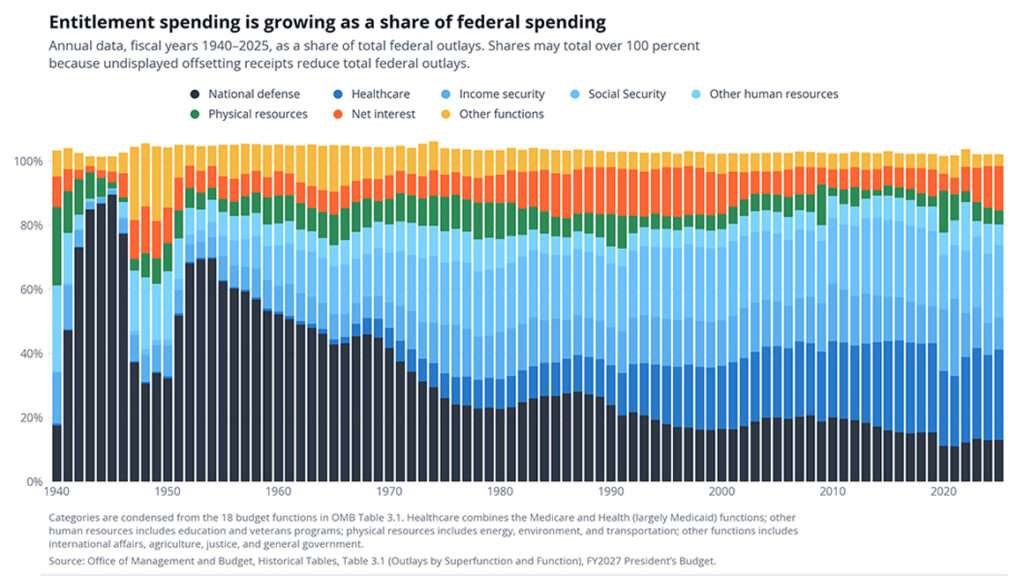
Sources: Office of Management and Budget, Historical Tables, Table 3.1 (Outlays by Superfunction and Function), FY 2027 President’s Budget

Trump did not create—nor has he addressed—our entitlement programs. But many of his policies have contributed to the acceleration of the accumulation of debt. The CBO estimates that the One Big Beautiful Bill Act of 2025 increased projected deficits by $4.7 trillion over 2026–2035. Some of these deficits were expected to be eased by consumers paying Trump’s tariffs, but that offset diminished after the Supreme Court struck down many of them.

Reason Foundation, the nonprofit that publishes Reason, synthesizes an array of government financial data in its annual Debtor Nation report. The largest spending category in the federal budget is Social Security, which accounted for 23 percent of net outlays in 2025. Social Security has promised more in benefits than it can finance. The middle fifth of the income distribution will receive about 50 percent more in benefits than they contributed over their lifetimes. This is becoming an impending problem as the worker-to-beneficiary ratio declines, moving from a relatively stable 3.2 to 3.4 from 1974 to 2008 to 2.6 in 2025.

Defense spending was to blame the last time the gross national debt exceeded 100 percent of GDP. America’s last record was in 1946, when the country reached a debt-to-GDP ratio of 119 percent due to World War II. In 1945, the military accounted for 90 percent of all federal spending.

Despite America’s constant involvement in wars abroad, defense has declined from our largest spending category to just another line item. Military spending exceeded $900 billion in 2025, but the federal budget has grown so much that it now makes up only 13 percent, with veterans’ benefits adding another 5 percent.

Decades of deficits have led us to a reality in which interest expense on the debt represents a larger share of net outlays than the military. (For perspective, the Department of Defense is the single largest employer in the country.)

The national debt is unfair to future generations, leveraging the state’s coercive power to force the people of the future to pay for services enjoyed by the people of the present. But beyond fairness, a more immediate concern is its costs and sustainability.

Americans have come to treat deficits and rising debt as normal. Unlike previous episodes of extraordinary borrowing, there is no plan to reverse course. Each debt milestone now arrives faster than the last.

This article originally appeared in print under the headline “A New Debt Record.”

Read the full article here

Fact Checker

Verify the accuracy of this article using AI-powered analysis and real-time sources.

Get Your Fact Check Report

Enter your email to receive detailed fact-checking analysis

5 free reports remaining

Continue with Full Access

You've used your 5 free reports. Sign up for unlimited access!

Already have an account? Sign in here

#Democracy #Journalism #MediaEthics #NarrativeControl #OpenDebate
Share. Facebook Twitter Pinterest LinkedIn Tumblr Email Telegram Copy Link
News Room
  • Website
  • Facebook
  • X (Twitter)
  • Instagram
  • LinkedIn

The FSNN News Room is the voice of our in-house journalists, editors, and researchers. We deliver timely, unbiased reporting at the crossroads of finance, cryptocurrency, and global politics, providing clear, fact-driven analysis free from agendas.

Related Articles

Media & Culture

Denial of Pistol Permit Based on Allegedly “Unsubstantiated” Past Allegations of Sexual Misconduct and Child Abuse

17 minutes ago
Cryptocurrency & Free Speech Finance

Morning Minute: Uptober Off to a Green Start

42 minutes ago
Media & Culture

The Federal Government Ran Up a $2 Trillion Deficit in 2026

1 hour ago
Cryptocurrency & Free Speech Finance

OKX and NYSE Owner ICE Plan 24/7 Tokenized Stock Trading Under SEC Exemption

2 hours ago
Media & Culture

Brickbat: No Right to an Attorney

3 hours ago
Media & Culture

Federal Circuit Again Excludes Judge Newman From Group Photo

8 hours ago
Add A Comment
Leave A Reply Cancel Reply

Editors Picks

Inside Turkey’s Lawfare: How Turkey uses its disinformation law against journalists

25 minutes ago

SEC approves first 3x bitcoin and ether ETFs in the U.S.

32 minutes ago

Payward Partners with Singapore Gulf Bank for 24/7 Settlement

38 minutes ago

Morning Minute: Uptober Off to a Green Start

42 minutes ago
Latest Posts

The Federal Government Ran Up a $2 Trillion Deficit in 2026

1 hour ago

Bitcoin holds $86,000 as dollar strengthens and European risks mount

2 hours ago

Will Vivek Ramaswamy Focus on Crypto in his Gubernatorial Run?

2 hours ago

Subscribe to News

Get the latest news and updates directly to your inbox.

At FSNN – Free Speech News Network, we deliver unfiltered reporting and in-depth analysis on the stories that matter most. From breaking headlines to global perspectives, our mission is to keep you informed, empowered, and connected.

FSNN.net is owned and operated by GlobalBoost Media
, an independent media organization dedicated to advancing transparency, free expression, and factual journalism across the digital landscape.

Facebook X (Twitter) Discord Telegram
Latest News

Denial of Pistol Permit Based on Allegedly “Unsubstantiated” Past Allegations of Sexual Misconduct and Child Abuse

17 minutes ago

Inside Turkey’s Lawfare: How Turkey uses its disinformation law against journalists

25 minutes ago

SEC approves first 3x bitcoin and ether ETFs in the U.S.

32 minutes ago

Subscribe to Updates

Get the latest news and updates directly to your inbox.

© 2026 GlobalBoost Media. All Rights Reserved.
  • Privacy Policy
  • Terms of Service
  • Our Authors
  • Contact

Type above and press Enter to search. Press Esc to cancel.

🍪

Cookies

We and our selected partners wish to use cookies to collect information about you for functional purposes and statistical marketing. You may not give us your consent for certain purposes by selecting an option and you can withdraw your consent at any time via the cookie icon.

Cookie Preferences

Manage Cookies

Cookies are small text that can be used by websites to make the user experience more efficient. The law states that we may store cookies on your device if they are strictly necessary for the operation of this site. For all other types of cookies, we need your permission. This site uses various types of cookies. Some cookies are placed by third party services that appear on our pages.

Your permission applies to the following domains:

  • https://fsnn.net
Necessary
Necessary cookies help make a website usable by enabling basic functions like page navigation and access to secure areas of the website. The website cannot function properly without these cookies.
Statistic
Statistic cookies help website owners to understand how visitors interact with websites by collecting and reporting information anonymously.
Preferences
Preference cookies enable a website to remember information that changes the way the website behaves or looks, like your preferred language or the region that you are in.
Marketing
Marketing cookies are used to track visitors across websites. The intention is to display ads that are relevant and engaging for the individual user and thereby more valuable for publishers and third party advertisers.