

 Freedom Index
Listen to the article
Jalal “Jay” Shehadeh had no reason to believe he was under suspicion from the government. A former assistant state attorney in Florida, he traveled frequently without problems and was preapproved for fast-track border access under the Global Entry program. And he had no problem getting through Israel’s notoriously strict airport security while visiting family in the Palestinian territories. But on the way home, U.S. Customs and Border Protection (CBP) held Shehadeh for four hours at Newark Liberty International Airport with no explanation and seized his cellphone.
“I’m sitting there and nobody’s even telling me why I’m here. It’s a very bizarre thing to be an American coming into America, being put into a room like this when you’re coming home,” Shehadeh, who was born in New Jersey and spent several years of his childhood in the West Bank, tells Reason. “It’s wild to think a Palestinian who grew up in Palestine was able to get through border control in Tel Aviv in less than 10 minutes, but this is what happens to me when I come into the United States.”
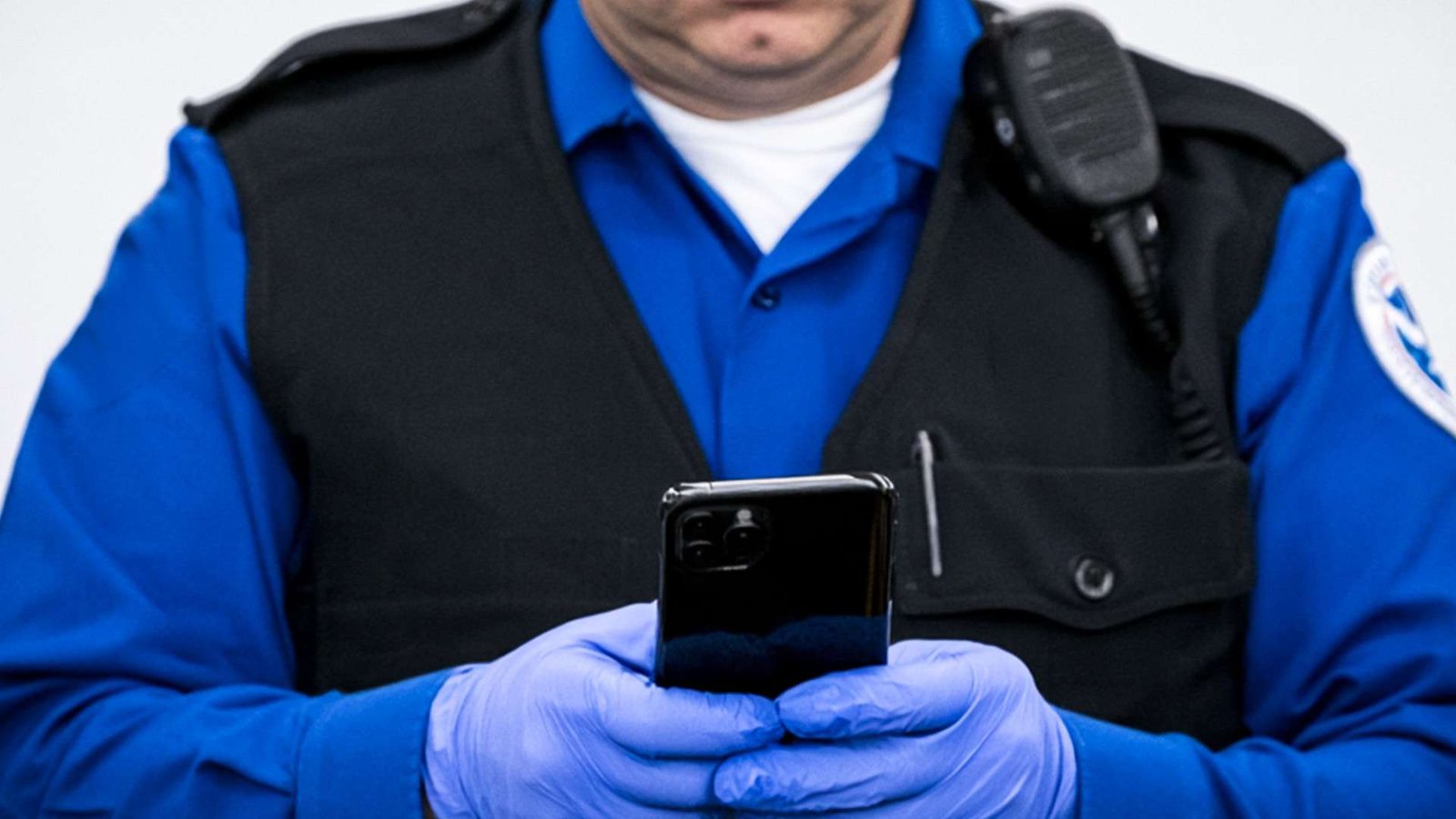
Under the “border exemption” to the Fourth Amendment, the government has the power to search travelers entering the country for contraband. Courts are divided on whether this authority includes travelers’ electronic data, and while the Supreme Court considers whether to weigh in on the question, CBP has gotten increasingly brazen about using this authority. From April to June this year, CBP conducted a record-high 14,899 electronic searches at the border.
This week, both Shehadeh and Ph.D. student Thomas Kennedy sued CBP to get their phone data back. Although the two plaintiffs weren’t aware of each other when they sued, the cases have an uncanny resemblance to each other. Both U.S. citizens live in Florida. Both are politically outspoken. Both were traveling back from the Middle East. And both had their phones taken despite warning CBP about attorney-client privileged data. They are suing to have the government not only return their property but also delete any copies CBP made.
Attorney-client privilege, a centuries-old privacy protection, forbids the government or anyone else from snooping into conversations between lawyers and the people they represent. That hasn’t stopped CBP from seizing and searching phones belonging to attorneys.
There are some indications that the second Trump administration has gone out of its way to target lawyers for these searches. Amir Makled, a Michigan defense attorney whose phone was searched last year, told Reason that a CBP agent began his interrogation with, “We know that you’re an attorney, and we know that you take some high-profile cases.” Earlier this year, an immigration lawyer accidentally discovered a Department of Homeland Security “watch list” filled entirely with the names of other immigration lawyers.
Kennedy, an Argentinian-American researcher specializing in (ironically enough) immigration and surveillance, helps coordinate legal cases for a Miami immigration law firm. In a way, he was on the opposite side of Shehadeh. Rather than representing the state government, Kennedy sued the state in 2022 for retaliating against him after he heckled Republican Gov. Ron DeSantis. Returning from a recent trip to see the pyramids in Egypt, with a stop in Turkey, he was flagged by an automatic border control kiosk at Miami International Airport and detained by CBP.
When Kennedy refused an initial phone search, agents took him to a back room and said, “You can just give it to us and make this easy, or we can take your phone and this whole process is going to be longer for you, and we’ll hold on to the phone indefinitely,” he recalls. (CBP’s own guidelines say that the agency should hold devices for no longer than five days.) The agents took his phone, then handed it back at the end of his two-hour detention. Kennedy doesn’t know what CBP did to his phone while they had it, and says that several online platforms have been giving him “alerts of attempted logins” from unknown users.
Shehadeh and Kennedy are demanding that CBP hand over any copies of their data (and in Shehadeh’s case, the phone itself) under Rule 41(g), which requires the government to give back seized property that is no longer useful for a criminal proceeding. They are leaning on the recent success of Max Blumenthal, a journalist who had his electronics seized by CBP after covering the funeral of Ayatollah Ali Khamenei in Iran. (Blumenthal and Shehadeh are both represented by lawyers from the American-Arab Anti-Discrimination Committee.) Although CBP tried to moot the case by arguing that it already gave the phone back, a judge is allowing Blumenthal to press forward to discover what exactly the government did to his data.
Kennedy is also claiming that he was the target of retaliation for activities protected under the First Amendment. He says that CBP agents asked unprompted whether he was an immigration attorney and grilled him over the publications in his suitcase—a (very critical) history of the Iranian revolution, a book on Israeli military tech, and some vintage Egyptian magazines that Thomas bought “because they looked cool,” according to the lawsuit.
“It’s ridiculous, especially considering that Egypt is the second-largest recipient of U.S. military aid. Because they asked me a few times why I went there, at one point I was like, I wanted to see what my tax dollars are buying in Egypt,” Kennedy tells Reason, adding that Turkey is also a U.S. ally. “I’d like to just be able to travel as a citizen of a supposedly free and open society, travel unhindered. What are we, Cuba like 20 years ago, where you couldn’t get out of the fucking country?”
Shehadeh had fewer hints about why he was being detained. It was the first time he had ever been pulled into secondary screening at the U.S. border. Although the first agent told him he had been selected for a “random customs check,” Shehadeh says that CBP barely searched his belongings and barely asked him about his time in the West Bank. Instead, the agency made him wait long enough to miss a connecting flight as he was shuffled from agent to agent.
His best guess is that he, too, was flagged for his political activities. Shehadeh is on the board of directors for the Palestinian American Bar Association, and his wife Katherine Giannamore is currently pursuing an ethics complaint against a federal judge for anti-Muslim and anti-Palestinian bias.
The last set of agents asked Shehadeh if he could point out which apps on his phone were protected by attorney-client privilege and which he would let them search. An agent began to tell Shehadeh that “we’re looking for evidence of—” before he cut her off. “It doesn’t really matter what you’re looking for. My phone has attorney-client privileged information, so you can’t look through it. That’s the problem. It’s not really the nature of the things you’re looking for,” he says, recounting the conversation to Reason. At that point, CBP seized the phone and let Shehadeh go.
According to CBP’s internal rules, agents who encounter a device protected by attorney-client privilege should “seek clarification” about what data are privileged and consult with the associate/assistant chief counsel office about how to “segregate” them from the rest. Shehadeh says one of the agents from earlier in his detention told him that CBP counsel would be able to look through his phone because “attorneys, they’re able to look at attorney-client privileged information, so it’s not going to be a problem.” Kennedy, meanwhile, says that no one asked follow-up questions after he said that some of the messages on his phone may be protected by attorney-client privilege.
In a statement to Reason, a CBP spokesperson said that electronic “searches are conducted to detect digital contraband, terrorism-related content, and information relevant to visitor admissibility, all of which play a critical role in national security.” The spokesperson did not address the two lawsuits.
Jenin Younes, president and legal director* for the American‑Arab Anti‑Discrimination Committee, who represents both Shehadeh and Blumenthal, says that she is “basically seeking a judge saying, you can’t do this under the Fourth Amendment, and there are First Amendment issues too. It violates the law, and you can’t do it in the future.” The current system “is just giving the government unfettered access to people’s property, essentially, and their very, very personal thoughts and ideas,” according to Younes.
The entire battle may come to a head with the case of George Anibowei, an immigration lawyer who had his phone searched five different times. He is now petitioning the Supreme Court to hear his case. On Tuesday, the Supreme Court ordered the government to respond to Anibowei’s writ of certiorari by October 29, a sign that the court is looking to take up the case. Younes sent a brief to the court on Blumenthal’s behalf, backing Anibowei.
“The government asserts the authority to search the phone of every American for any or no reason other than that he or she has chosen to travel outside the country for business, pleasure, family, or another reason,” she wrote. “Americans have a right not only to clarity on the extent to which their electronic devices are subject to border searches, but also to have a determination from this Court that reflects the Fourth Amendment’s promise that we be ‘secure in [our] persons, houses, papers, and effects” from unlawful government intrusion.'”
*CORRECTION: The original version of this article misstated Younes’ title at the American-Arab Anti-Discrimination Committee.
Read the full article here
Fact Checker
Verify the accuracy of this article using AI-powered analysis and real-time sources.