

 Freedom Index
Listen to the article
Hating data centers might be misguided, but it’s also ubiquitous, at least in the U.S. And politicians have been capitalizing on this to score populist points by pushing through burdensome regulations. What’s an artificial intelligence company to do?
Go seasteading, possibly.
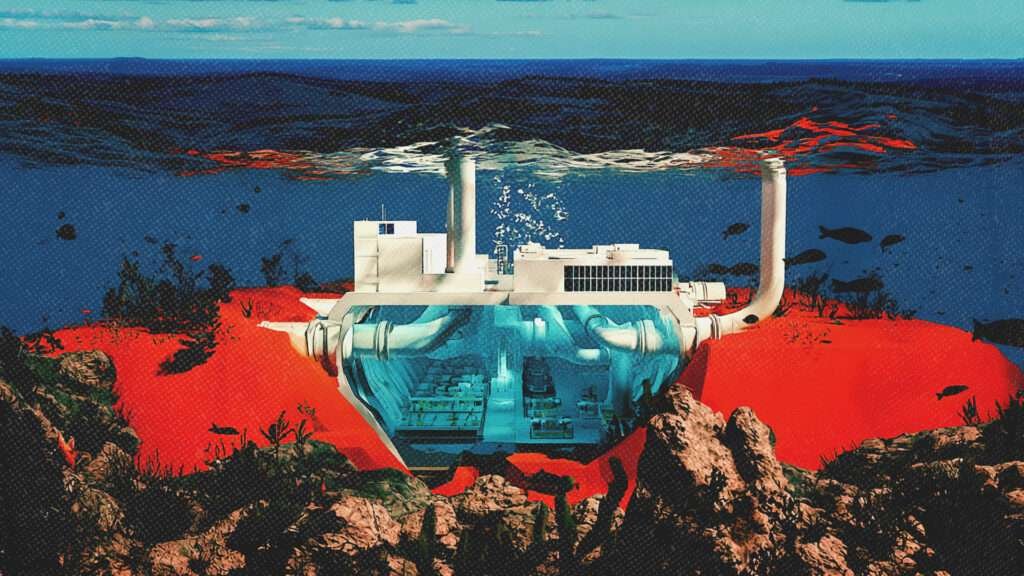
“Some developers are now exploring the ocean as a new location for AI infrastructure in the hopes that underwater data centers could improve energy use and cooling efficiency while using less fresh water and land area than onshore buildings,” writes University of North Carolina Greensboro management professor a promising new approach for supporting the growth of AI.”
You are reading Sex & Tech, from Elizabeth Nolan Brown. Get more of Elizabeth’s sex, tech, bodily autonomy, law, and online culture coverage.
Underwater data centers would be not technically be “seasteaders”—autonomous entities based far enough offshore that they’re not subject to the rules of any government.
Even if underwater data centers could be based physically far enough from shore that they’re not in anyone’s national waters—not necessarily impossible, but impractical, costly, and a logistical nightmare—they would still be subject to various rules of international waters and would still need cables connecting them to land. They would also be run by tech companies based within an existing country’s borders and subject to that country’s oversight and regulations.
So while building underwater might solve some energy and land-use issues, it wouldn’t solve what are gearing up to be the main barriers to data center construction: political animus and overregulation.
Microsoft has already shown that underwater data centers are not just possible but potentially better than their landlocked counterparts. From Kshetri:
In 2015, Microsoft launched a research project to explore the feasibility, benefits and challenges of underwater data centers. Part of that effort included setting up a waterproof data center on the seafloor near Scotland’s Orkney Islands in 2018. It contained 864 servers and was connected to shore by an underwater cable.
After two years, Microsoft reported that the servers in the underwater data center failed at about one-eighth the rate of servers in comparable land-based data centers. The company is still studying the possible reasons but hypothesizes that in a sealed underwater environment the equipment is less exposed to oxygen, humidity and temperature fluctuations—as well as less jostling from people working to replace broken components.
Microsoft concluded that underwater data centers “are reliable, [are] practical and use energy sustainably.” But it also ended this experiment in 2024 and hasn’t started any more underwater data center since.
“The company didn’t say why,” notes Kshetri, “but others’ analyses suggest the reasons could include regulatory concerns, including the need for environmental permits, as well as a desire for faster upgrades and replacements for the computer equipment inside.”
It seems that people—not technology—could be the biggest obstacle to building more coastal data centers.
And,if that’s the case, we could miss out on a useful and environmental friendly innovation that enables technological progress while still respecting many communities’ desires not to have data centers built in their backyards.
A wind-powered underwater data center in China, launched last year, “uses at least 30% less electricity than traditional data centers, and offshore wind turbines reduce reliance on fossil fuels and cut the data center’s carbon emissions,” Kshetri reports.
Floating data centers like those being tested in Japan and South Korea could also mean less land use and less resource-intense operations.
Moving data centers off shores does create “new concerns about harm to the marine environment,” writes Kshetri. It’s not yet clear “whether the ocean can become AI’s next computing frontier without becoming its next environmental problem.” But with the the right approach, he suggests, underwater data centers could “become sustainable alternatives to traditional data centers.”
Some people are betting big money on that. For instance, Peter Thiel–backed Panthalassa, “a U.S.-based start up betting on ocean waves to power a fleet of floating data centers, announced $140 million in funding” in May, per Fortune magazine.
And federal regulators might not kill this sort of innovation before it takes off. In August, “the Federal Energy Regulatory Commission accepted DeepGreen Western Passage SPV’s filing for a preliminary permit to build a $100 million underwater data center” off the coast of Maine, reports The Maine Monitor. “DeepGreen applied for the 48-month preliminary permit in February to conduct engineering and environmental studies required to secure funding and launch the project. This is not a permit for construction.”
But animosity toward artificial intelligence could still stave off such experiments.
In Maine, DeepGreen’s “application drew an almost immediate response from residents and Passamaquoddy officials, who strongly oppose the development, and prompted two citizen-initiated petitions designed to halt the proposal,” notes the Monitor. “Earlier this month, the city council voted unanimously to enact a 180‑day moratorium, giving city officials time to review and possibly amend local zoning ordinances.”
More Sex & Tech
>try to warn conservatives about runaway AI
>think up a strategy
>’What’s something scary?’
>eureka!
>tell them agents are ‘algorithmic immigrants’ pic.twitter.com/5wsChzmERY— Crémieux (@cremieuxrecueil) September 10, 2026
• Anthropic reports that it “disrupted” people in Yemen trying to use Claude to develop guided weapons. “We do not have evidence the actors succeeded in fielding an operational device; but they did test-fire a guided rocket,” Anthropic reports. “This field test appears to have failed: within hours, the actors returned to Claude to work out why it failed.” It also reportedly discovered “three Iranian state-aligned accounts that were using Claude to set up influence operations campaigns,” including “planning and prepping content to support what they called a ‘soft war’ or ‘cognitive warfare’ program.”
“planning and prepping content to support what they called a ‘soft war’ or ‘cognitive warfare’ program.”
• A California woman was arrested after repeatedly driving by a multi-racial family and accusing the man of trafficking his daughter.
• The “government mandated girlfriend” meme is back.
• Why is Apple bringing back flip phones?
Read the full article here
Fact Checker
Verify the accuracy of this article using AI-powered analysis and real-time sources.