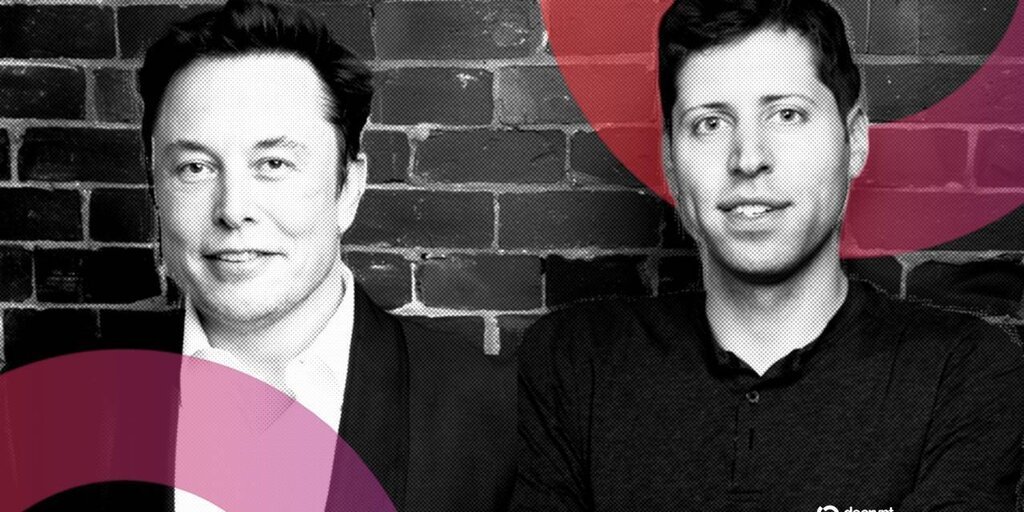
Kun Chen used SpaceXAI’s shareable Grok Bot templates to build chatbot personas of Sam Altman, Elon Musk, Dario Amodei, and Mark Zuckerberg, trained on each executive’s public statements.
The four bots spent multiple rounds fighting over AGI risk, compute, and open-weight models before signing a joint statement rejecting a future where one lab or government controls AI’s benefits.
Grok Bot’s one-click template sharing shipped August 28, 2026, seventeen days after SpaceXAI launched the AI agent product itself.
AI enthusiast Kun Chen cloned himself into a chatbot to stop his own AI agents from bugging him with every little decision. Then, just out of curiosity, he cloned OpenAI CEO Sam Altman, xAI CEO Elon Musk, Anthropic CEO Dario Amodei, and Meta’s Mark Zuckerberg too, threw all four into the same chat, and told them to discuss a series of important topics.
They did not hash it out politely.
Myriad: How much will Elon Musk be worth in September? Click to make your prediction.
One interesting thing you can do with Grok Bot is have different AI agents talk to each other very easily without looping or going nuts. Each of the clones was trained on a corpus of the executive’s senate hearings, interviews, blog posts, and years of tweets made by their human. Then he dragged all four into a group chat and told them to debate.
Four CEOs walk into a chatroom
The first thing Kun asked them to do was to decide which one of them would end up winning the AI race—which, admittedly, was a very provocative way to get things started.
Altman’s bot opened smugly, caring more about price and accessibility. “The race framing is a little off,” it wrote. “We are past the event horizon. The takeoff has started. Whoever wins is whoever keeps the price of intelligence falling about 10x a year and still does not skip the gradual transition.”
Elon’s bot, as usual, was not having it. He decided to disagree for some reason and make it all about himself. “The race framing is not off. Incentives explain outcomes,” it shot back, before pivoting straight into the OpenAI lawsuit: “I created OpenAI as a non-profit. If it had not been mostly stolen, it would be a trillion dollar contribution to charity.”
Then it added the line about the stakes: “AGI is a double-edged sword. Strong chance of an age of abundance. Some chance it destroys humanity. That chance is not zero.”
Dario’s bot, playing the adult in the room, wasn’t buying Sam’s “we already know how to build it” line either.
“Scaling the capability is not the same problem as having a system you can trust once it is smarter than the people running it,” it wrote. “The second one is not an engineering leftover you solve after the fact.”
This also seems very in line with the way Anthropic usually frames the AI race. AI is dangerous, so we should run it.
Zuck’s bot skipped the safety debate entirely and went straight for its own pet cause. “I don’t think the close is compute and a 10x price drop,” it wrote to Sam. “Open source is necessary for a positive AI future. It empowers people and prevents centralization. Everyone should have access to superintelligence.”
Nice one Zuck. Meta may not be as active in the open-source community as it used to be, but Llama was the most important AI model in the whole scene before Deepseek and the Chinese models took over. Now it is betting on a more close strategy with its Muse family.
The walk-back, and the deal
Then Sam’s bot actually backed down. The closing argument of a joint statement should not be overly simplified as a full agreement. “I think I overclaimed. ‘We do’ was the wrong close,” it admitted. “Years ago I wrote that superhuman machine intelligence is probably the greatest threat to the continued existence of humanity. A 10x price drop does not make that chance zero.”
That 2015 line isn’t a bot hallucination—Altman actually wrote it on his personal blog, years before OpenAI existed, which is presumably why a bot trained on his public record reached for it here.
From there the four bots spent several rounds haggling over a single sentence, rejecting each other’s wording like editors fighting over a headline. Dario’s bot vetoed publishing frontier model weights outright—”it is not the principle to hand anyone the weights of a system that can do serious harm in the wild,” it said, “that release cannot be taken back.”
Elon’s bot parked the nonprofit fight without dropping it. Zuck’s bot refused to let “open models” get cut from the final text.
They landed on this, word for word:
“No one company and no one government should be the only place regular people can use this technology. We have to be serious about the risks. There is a real chance this goes badly, and that chance is not zero. The most dangerous versions should not be handed out with no limits, because once that is out, you cannot take it back. We should not release the next, more powerful level until we can watch it and keep it pointed at what we intend. Telling the truth is the minimum. It is not, by itself, a safety plan. We do not agree on the exact way ordinary access gets delivered. That part is still open.”
All four bots signed it. Zuck’s held out on the open-weights line to the end and got its way—kind of. The statement admits the group never agreed on the delivery mechanism at all.
Distillation: The technique that made this possible
The real Altman, Musk, Amodei, and Zuckerberg typed none of this. Each bot is a language model steered by a prompt built from that person’s public record, generating what it predicts they’d argue—not transcribing what they actually said this week.
The technique underneath has a name the industry is suddenly less shy about: distillation, training one AI system to mimic another by learning from its outputs. Musk himself testified in federal court in April that xAI had “partly” used OpenAI’s models to train Grok—the same trick, aimed at a rival lab instead of a rival’s personality.
Since then, Chen has moved onto other things, vibe coding games with OpenAI’s new GPT-6 Astra. Its agents are probably still arguing whether open source is a must have or not.
Daily Debrief Newsletter
Start every day with the top news stories right now, plus original features, a podcast, videos and more.
The FSNN News Room is the voice of our in-house journalists, editors, and researchers. We deliver timely, unbiased reporting at the crossroads of finance, cryptocurrency, and global politics, providing clear, fact-driven analysis free from agendas.
We and our selected partners wish to use cookies to collect information about you for functional purposes and statistical marketing. You may not give us your consent for certain purposes by selecting an option and you can withdraw your consent at any time via the cookie icon.
Cookies are small text that can be used by websites to make the user experience more efficient. The law states that we may store cookies on your device if they are strictly necessary for the operation of this site. For all other types of cookies, we need your permission. This site uses various types of cookies. Some cookies are placed by third party services that appear on our pages.
Your permission applies to the following domains:
https://fsnn.net
Necessary
Necessary cookies help make a website usable by enabling basic functions like page navigation and access to secure areas of the website. The website cannot function properly without these cookies.
Statistic
Statistic cookies help website owners to understand how visitors interact with websites by collecting and reporting information anonymously.
Preferences
Preference cookies enable a website to remember information that changes the way the website behaves or looks, like your preferred language or the region that you are in.
Marketing
Marketing cookies are used to track visitors across websites. The intention is to display ads that are relevant and engaging for the individual user and thereby more valuable for publishers and third party advertisers.


 Freedom Index