

 Freedom Index
Listen to the article
Reason‘s October 2026 cover story is an expansive exploration of prison reform in America:
Last December, on a bitterly cold afternoon, I stood inside the walled yard of Philadelphia’s Eastern State Penitentiary while I waited for a museum docent to start a tour. I stamped my feet and blew on my hands to keep warm, much like I imagined tourists and incarcerated men did there two centuries ago.
Eastern State Penitentiary is one of the places where the American prison experiment began, and where one of its most bizarre iterations was tested on human beings. After it opened in 1829, Eastern State was, as it is now, a tourist attraction. In 1858, more than 10,000 visitors paid entry fees to gawk at the building and the men confined inside it.
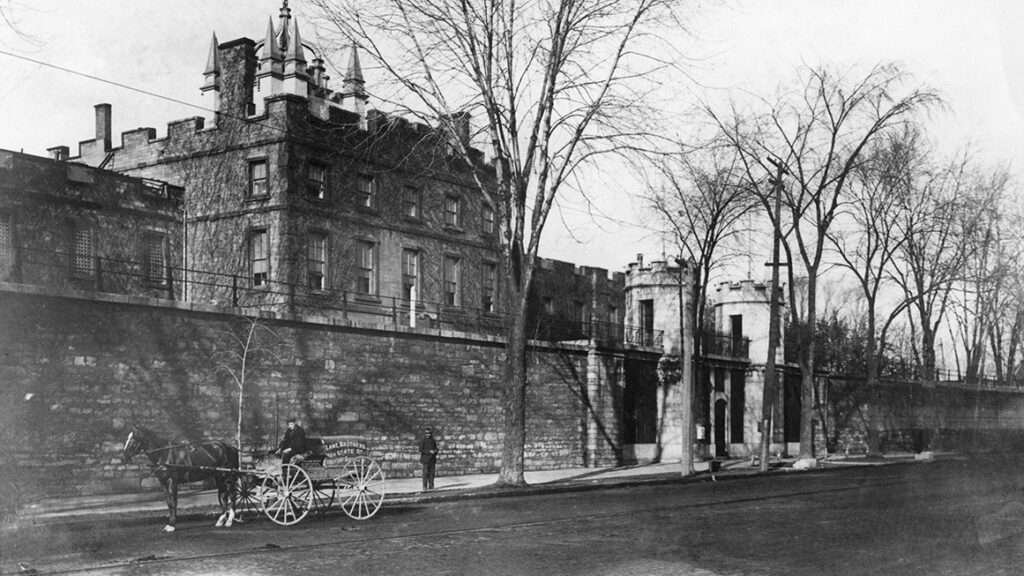
The walls are what everyone sees first when they come to Eastern State. The prison, located on a rise in what is now Philadelphia’s Fairmount neighborhood, is skirted by imposing 30-foot-high granite walls, crenelated turrets, and a medieval gatehouse. It was designed to intimidate, and it has always done its job.
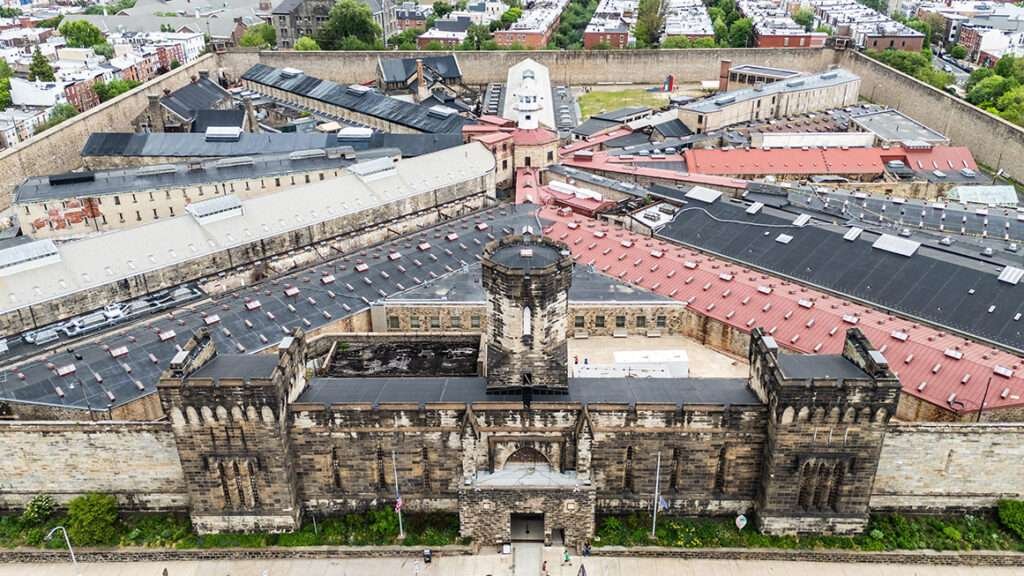
When the Marquis de Lafayette, a hero of the American and French revolutions, passed through Philadelphia on an 1824 tour of all 24 U.S. states, city leaders showed him the facade of Eastern State, then still under construction. According to all accounts, Lafayette recoiled at the sight. Thomas B. McElwee wrote in an 1835 history of the prison that the “form of the edifice was disapproved by LaFayette, in the memorable expression which he uttered as he crossed its threshold for the first time, ‘What! Have you Bastilles in this country?'”
Eastern State cost $780,000 to construct, making it one of the most expensive buildings in the country when it opened and one of the most expensive in the world. The paradox of the place was that this fearsome fortress represented the liberal ideals of the young American republic and an investment in building a more humane justice system.
“Prisons were really supposed to be these republican machines,” says Ashley T. Rubin, an associate professor at the University of Hawaii at Mānoa and author of The Deviant Prison, a history of Eastern State Penitentiary. “Crime was one of the main ways that you could basically corrupt the nation, because virtue was essential to what it meant to be a good republican, and criminals are by definition not virtuous, so we had to make them into virtuous citizens.”
What drew visiting dignitaries, Enlightenment intellectuals, and everyday lookie-loos to Eastern State after it opened—and what still draws tourists today—was the unprecedented experiment to produce virtuous citizens behind its walls.
It’s an experiment that continues, in fits and starts, today.
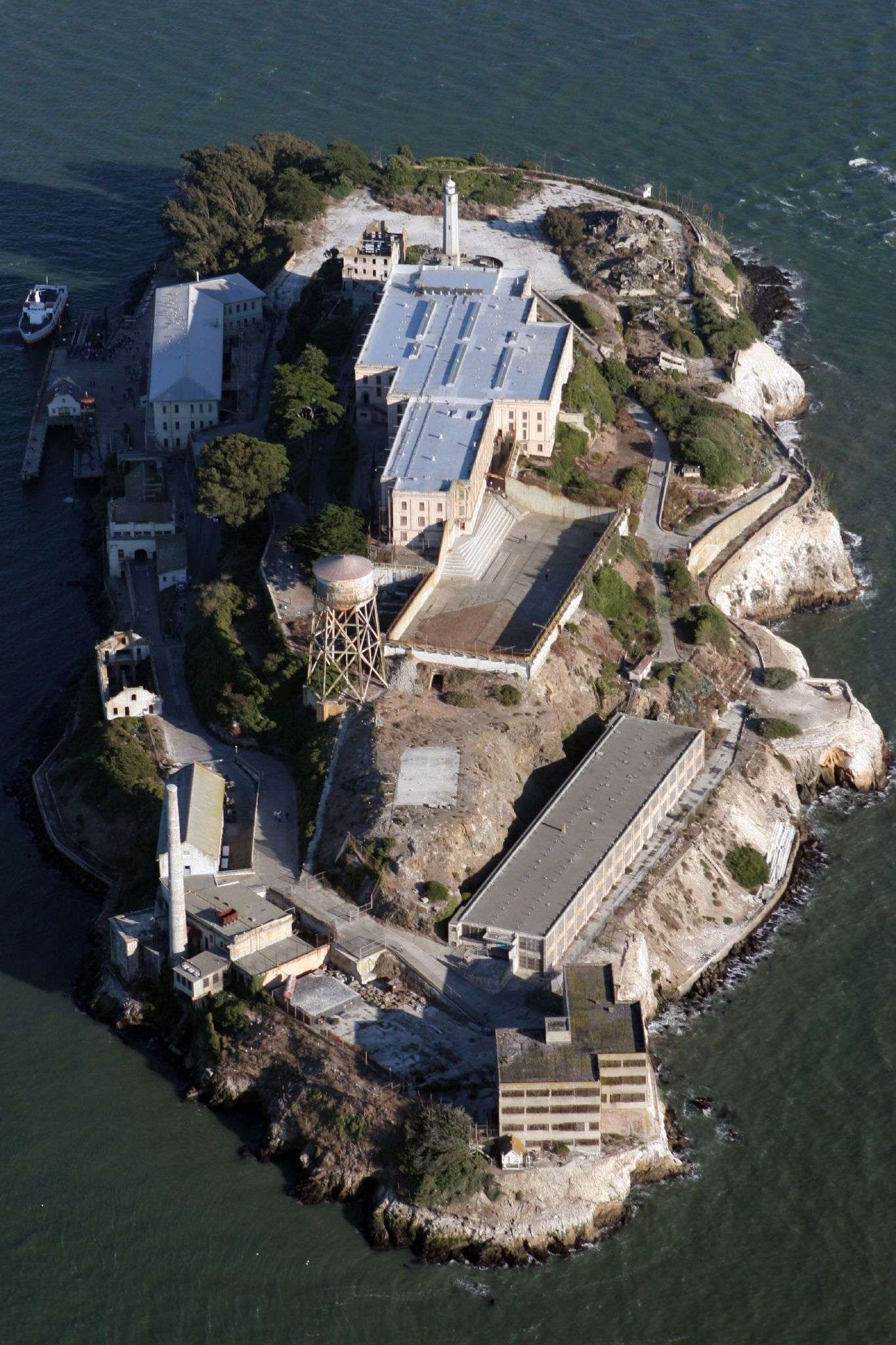
Last year President Donald Trump announced to the surprise of everyone that Alcatraz prison would be reopened. “The reopening of ALCATRAZ will serve as a symbol of Law, Order, and JUSTICE,” the president posted on social media.
The news was unexpected, not just because the island prison is currently under National Park Service management and has been rusting to pieces in the salt air of San Francisco Bay for decades, but because the federal Bureau of Prisons (BOP) has been in a yearslong decline and can barely staff its existing prisons. The BOP has almost 6,000 fewer staff than its target number, and many of its facilities are, if not as decrepit as Alcatraz, in need of serious repairs.
Nevertheless, the White House requested $152 million from Congress this April to reopen Alcatraz. Whether or not it ever reopens, the efforts are notable because Trump is claiming a national ideology of punishment, symbolized by the notoriously harsh prison. “When we were a more serious Nation, in times past,” Trump wrote, “we did not hesitate to lock up the most dangerous criminals, and keep them far away from anyone they could harm.”
Trump was espousing a particular theory of prisons, one that emphasized pain and punishment. It’s a popular notion. It also happens to be wrong.
The modern prison is widely considered an American invention, one born out of a peculiar American mix of Christian theology and Enlightenment confidence. Much as the Founding Fathers sought to constrain the passions of majorities and lawmakers through checks and balances, prison advocates in the early republic wanted to use architecture and discipline to mold convicts into productive citizens while avoiding the sadism and spectacle that typified criminal justice in Europe.
Despite those best intentions, our prisons have been the sites of unremitting horrors for 250 years and counting. Administrative whippings and outright torture—such as electrocuting inmates with jerry-rigged crank telephones—persisted until the end of the 1960s. After judges and state oversight boards got too nosy, the punishments moved off the books.
Today multiple state prison systems are in states of crisis as bad as or worse than the BOP. The Justice Department sued the state of Alabama in 2020 over its failure to protect incarcerated people from rampant violence and sexual assault. Despite that, shocking levels of corruption and death have persisted, verging into the macabre. In 2024, multiple families of deceased inmates filed lawsuits alleging that the University of Alabama at Birmingham had, without consent, retained their loved ones’ organs after autopsies for student research. In 2022, a federal judge ruled that Arizona prison officials were deliberately indifferent to appalling and sometimes fatal medical neglect, including a case where a woman’s multiple sclerosis was left untreated until she was nearly completely paralyzed by age 36. “No legitimate humane system would operate in this manner,” Judge Roslyn O. Silver of the U.S. District Court for the District of Arizona concluded.
Yet this is the system that prevails in much of the United States. It has endured since the country’s founding, despite reliable 40- to 50-year cycles of reform. The prison is a problem our republic has never solved in any of its various modes: the Jacksonian Era, the Progressive Era, the wave of prison building in the 1980s that launched the age of mass incarceration, or the attempts over the last decade to roll back mass incarceration’s excesses.
After 250 years of the American prison experiment, we need to ask why we’ve never been able to maintain prison systems compatible with our Constitution or our national ideals. While American prisons were initially designed as reactions to the savagery of European criminal codes, it might be time to examine how some European countries’ rehabilitative models could provide the foundations for the next historic American innovation in criminal justice.
To understand this system, and grapple with both its moral failures and its hold on American society, I traveled to the places where it was born and where it has evolved. I saw solitary confinement cells where people were left to find God or madness, watched incarcerated men ride wild bulls at a rodeo inside a state penitentiary, and talked to a man who saw the best and worst of what’s possible in prison before his life sentence for murder was overturned.
What I found was a country that can’t decide what it wants its prisons to be: civic engines for rehabilitation and character formation, or state warehouses for relentless and remorseless dehumanization. The question of what criminal punishment should look like is one of the longest-running and most significant debates over what America itself stands for.

BOOK ONE: PROTO-PRISONS AND THE JACKSONIAN ERA (1790–1870)
The American prison experiment has often proceeded as a series of calls and responses, each era a backlash to what came before. The first penitentiaries of the Jacksonian Era were a reaction to the chaotic jails of the 18th century and to fears of social disorder. As such, the architects of these first prisons tried to create environments of systematic, unyielding discipline to mold convicts into productive citizens. They were essentially creating the field of penology on the fly, and the results were both groundbreaking and frequently tragic.
The grand theories and systems of the first wave of U.S. prison building would all fall into disrepute by the end of the 19th century. But they provided a template—and a belief in the human capacity for redemption—that influences American corrections to this day.
A Place for Moral Instruction
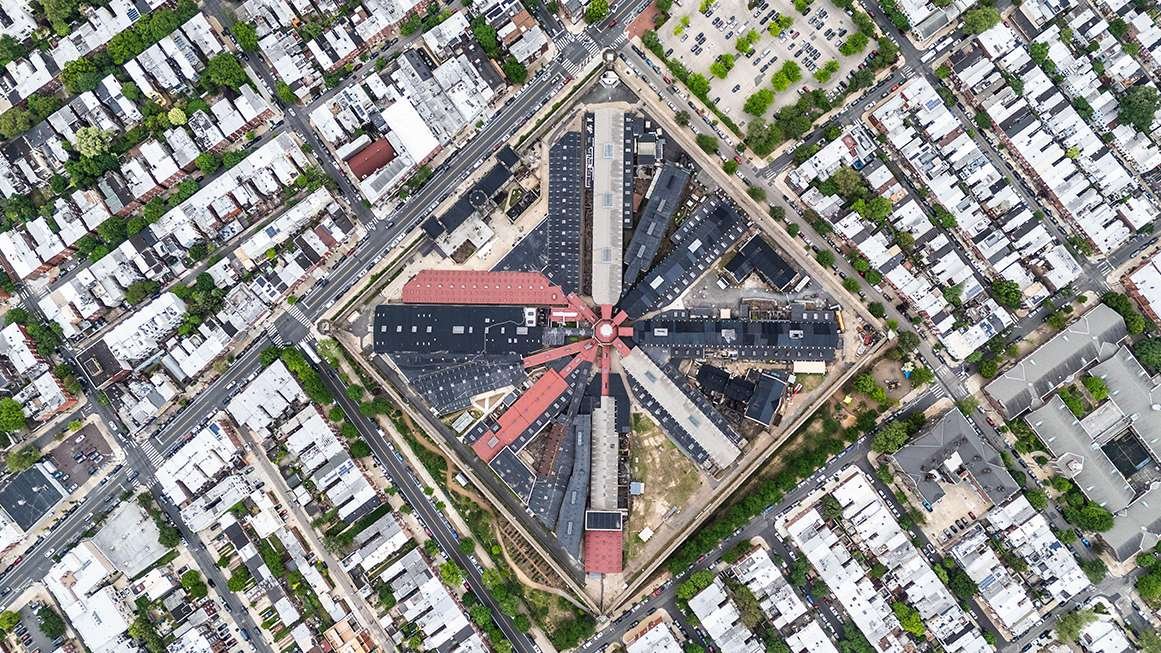
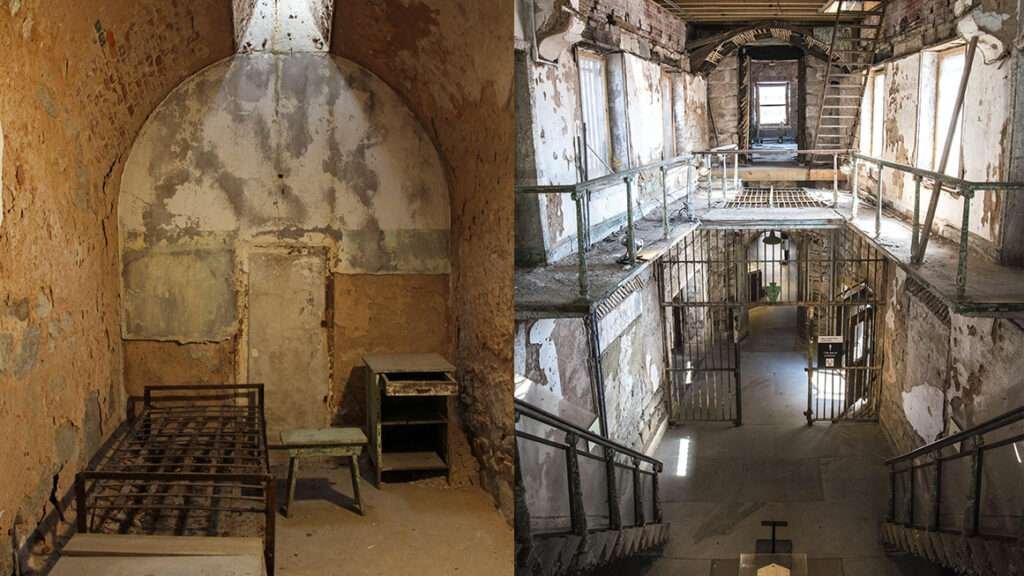
Unlike in the jails of the 18th century, everything in Eastern State was designed for the purpose of corrections. The prison was built around a central hub, from which cellblocks extended radially like spokes on a wagon wheel. Newly arriving prisoners were brought in wearing hoods, given identification numbers that replaced their names while they were incarcerated, and put in isolation cells where they spent 23 hours a day. Inside each cell were a bed and a worktable, where inmates spent daytime hours at trades such as making shoes.
The thing former Eastern State inmates most often recalled was the profound, tomblike silence. Prisoners were never allowed to talk to each other. The barrel-vaulted ceilings were designed to amplify sound, so from the central hub a guard could hear the faintest whisper or languid sigh. To maintain the atmosphere, guards padded through the cellblocks in wool socks.
The only human contact the incarcerated people of Eastern State Penitentiary were allowed was a weekly meeting, through a grated door, with local ministers. The ministers acted as “moral instructors” and kept notes on the prisoners’ prospects for rehabilitation.
The philosophical cornerstone of Eastern State was laid in 1787 at Benjamin Franklin’s house, when the humanitarian Benjamin Rush first proposed building a “house of repentance” for convicts. Rush wrote that inmates should be subjected to strict routines of “BODILY PAIN, LABOR, WATCHFULNESS, SOLITUDE, and SILENCE,” joined with “CLEANLINESS and a SIMPLE DIET.”
Although the modern prison or penitentiary is often considered an American invention, contemporary workhouses and prisons in Europe provided the template. When the influential English jail reformer John Howard toured Europe in 1775–76 for research, he visited the Ospizio di San Michelein Rome—an orphanage and hospice run by the Catholic Church that also included prison wings for licentious women and juvenile delinquents. Boys were held in isolation cells at night and worked silently in a common room during the day, beneath a sign that read: “Silentium.” Also inscribed in the workroom was a Latin motto that translates to “It is of little advantage to restrain the Bad by Punishment unless you render them Good by Discipline.”
This was the purest expression of reformers’ belief that punishment must include rehabilitation through work, moral instruction, and social hygiene. By applying the correct dosages of each, Michael Ignatieff wrote in A Just Measure of Pain, the penitentiary promised “a technology of salvation.” Likewise, W. Fitzhugh Brundage writes in Civilizing Torture: An American Tradition that Rush “inspired like-minded reformers to envision penitentiaries as the young republic’s humanitarian temples.”
It was to be an elegant dovetailing of state and church priorities—if it worked. When the Pennsylvania Legislature approved plans for the construction of Eastern State in 1821, the U.S. criminal justice system felt, as it does now, like it was teetering on the verge of failure.
Since the American Revolution, the nascent states had been working to reform their jails—usually nothing more than a filthy common room that held men, women, and minors together—and rewrite their laws to sever themselves from England’s despised criminal code, which by the end of the 18th century included more than 200 capital offenses. The reform movement was propelled by anti-royal sentiments, by the spread of Howard’s theories among the elite, and by theological objections to capital and corporal punishment—particularly in Pennsylvania, with its high number of Quakers. “As the sect with the strictest definition of what was due Caesar, [Quakers] were in perennial conflict with Caesar’s laws,” Ignatieff writes. “Hence of all sects they asked the most searching questions about the right of the state to coerce citizens.”
The problem with getting rid of the whipping post and stocks was figuring out their replacement. In 1786, Pennsylvania briefly tried sentencing criminal offenders to public labor repairing roads and digging ditches, but it discovered that leaving gangs of convicts to wander freely through the streets was a poor idea. The laborers, who became derisively known as “wheelbarrowmen,” wore degrading uniforms and were mocked by onlookers. There were also escapes, violence, and, in one incident, an attempt to rob Alexander Hamilton’s carriage as it returned from the Constitutional Convention. Public opinion quickly turned against what one Philadelphia Evening Post columnist called the “lawless and wandering banditti of wheelbarrowmen.”
Rush argued convincingly that public punishment degraded both the convict and the society that witnessed it. In 1790, Philadelphia’s Walnut Street Jail opened a wing of 16 isolation cells based on Rush’s ideas. It was initially touted as a success and copied in many other U.S. cities, but within several years these “proto-prisons,” as Rubin calls them, fell prey to the same overcrowding, riots, and arsons that they had supposedly cured. By 1810, the newfangled “penitentiary house” that had made Philadelphia a worldwide leader in criminal justice reform was widely seen as a failure, too small and poorly designed for its requirements. State authorities had to call up militias to quell prison riots and mass breakouts in New York, Pennsylvania, Maryland, and Virginia.
“American states’ first sustained experiments with long-term confinement as punishment for convicted offenders, drawing on Pennsylvania’s example, had failed—visibly and spectacularly,” Rubin writes.
In response to the failure of the proto-prisons and a rising fear of social disorder, there were proposals to abolish the penitentiary mode of punishment and return to hard labor, corporal punishment, and even banishment. In his 1818 address to the New York Legislature, Gov. DeWitt Clinton called incarceration a “failure” that enrolled criminals in a “school of turpitude.” Several states reauthorized capital punishments they had stricken from their books.
But reformers convinced state legislatures that what was needed were networks of larger penitentiaries located outside of major cities. This launched the first wave of American prison building. Overcrowding at New York’s first state prison, Newgate, led to construction of Auburn prison in 1816. Pennsylvania lawmakers approved the construction of Western State Penitentiary, based on Jeremy Bentham’s panopticon, near Pittsburgh in 1818, followed by plans for Eastern State in 1821.
“There were a couple of moments where we almost got rid of the prison,” Rubin says, “where people were like, ‘This isn’t working.’ But the majority response was, ‘Let’s stick with incarceration. This is a good republican punishment, not a monarchical punishment.'”
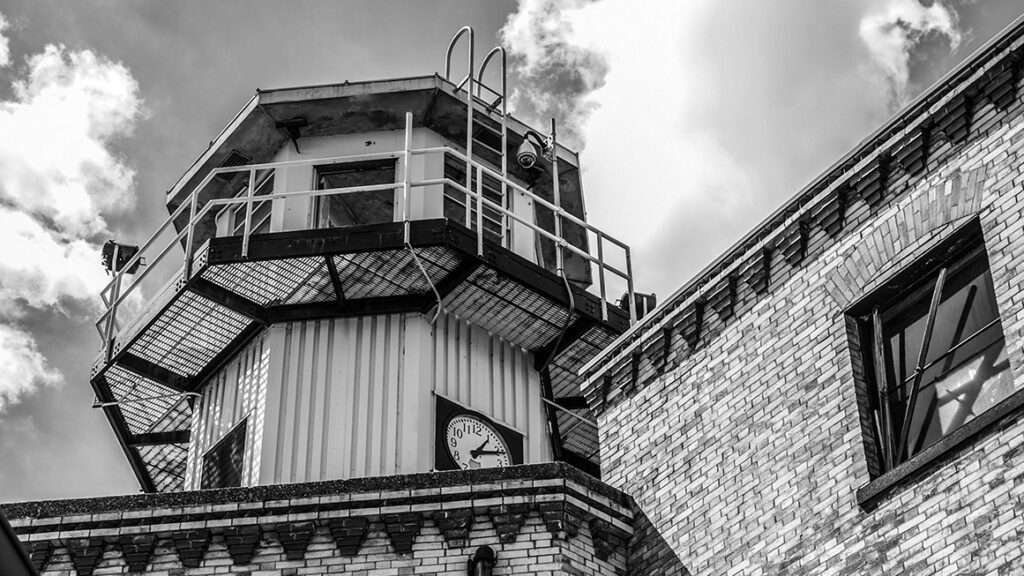
There were strong doubts, though, even among some of the staunchest supporters of penal reform. When Lafayette blurted out his unflattering first impression of Eastern State, he was in a delicate position not just diplomatically but ideologically. He and many other European liberals wanted to tout the success of Pennsylvania’s legal and penal reforms and were anxious about calls for their repeal. But Lafayette had also spent five years imprisoned in Prussian and Austrian dungeons, one in complete isolation following a failed escape attempt. (“The change in his looks was frightening,” one of Lafayette’s daughters wrote of their 1795 reunion in prison.)
Although Lafayette’s exact words to Philadelphia’s dignitaries were not recorded, his secretary, Auguste Levasseur, wrote: “The frankness and conviction of the general, overcame his repugnance, and with all the regard and respect which were due, and which his personal situation rendered still more necessary, he represented to them that solitary confinement was a punishment which should be experienced to be rightly appreciated.”
It was a lesson that another prison had already learned the hard way.
‘A Silent and Insulated Working Machine’
On Christmas Day 1821, 80 inmates at New York’s Auburn prison were moved into a newly constructed wing of isolation cells as an experiment. The cells were only 4 feet wide and had nothing in them but a bed and a Bible. The results were later described by Alexis de Tocqueville and Gustave de Beaumont, who toured the prison in 1831.
“This trial, from which so happy a result had been anticipated, was fatal to the greater part of the convicts,” the two reported. “The unfortunates, on whom this experiment was made, fell into a state of depression, so manifest, that their keepers were struck with it; their lives seemed in danger, if they remained longer in this situation; five of them, had already succumbed during a single year; their moral state was not less alarming; one of them had become insane; another, in a fit of despair, had embraced the opportunity when the keeper brought him something, to precipitate himself from his cell, running the almost certain chance of a mortal fall.”
Another inmate “beat and mangled his head against the walls of his cell until he destroyed one of his eyes,” wrote Auburn superintendent Gershom Powers. Auburn shut down the isolation wing in 1823. The New York governor pardoned roughly two dozen atrophied and mentally scarred survivors, and the rest were moved back into the general population. Twelve of those released recidivated within a few years, one committing a burglary the night he was let out.
Tocqueville and Beaumont’s conclusion on endless solitary confinement was unsparing. “This absolute solitude, if nothing interrupts it, is beyond the strength of man,” they wrote. “It destroys the criminal without intermission and without pity; it does not reform, it kills.”
Out of the failure of perpetual isolation, Auburn instead developed what became known as the silent system—or the Auburn system. Warden Elam Lynds said his goal was to create an environment that broke convicts’ spirits and reduced them to “a silent and insulated working machine.”
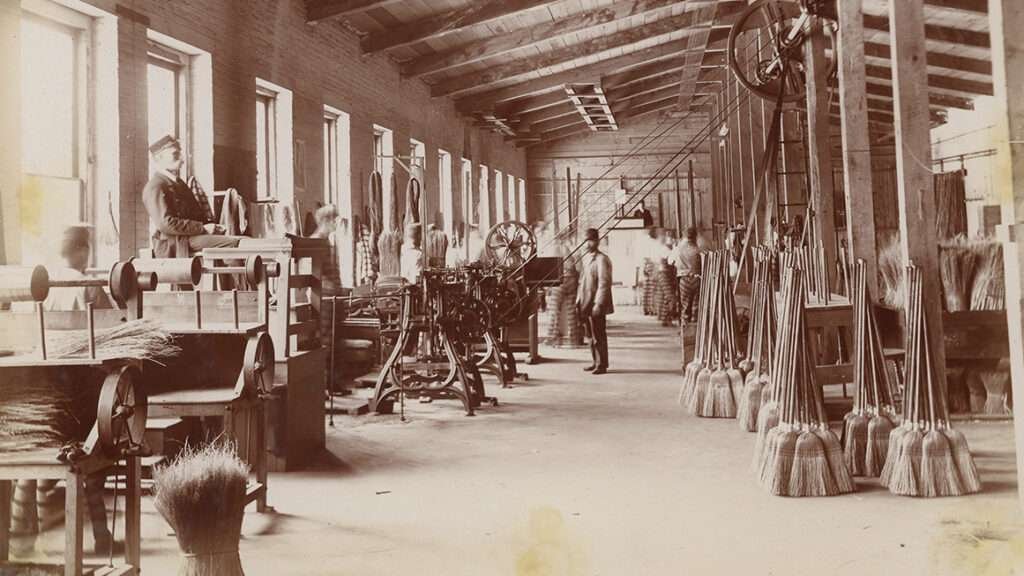
The Auburn system created the iconic image of the American prisoner in a white-and-black-striped uniform. Inmates worked in common rooms at factory-style jobs during the day and were returned to single cells at night. They marched in lockstep from room to room and were not allowed to speak to each other while working, eating, or marching. Nor were they allowed to “sing, dance, whistle, run, jump, or do anything which will have the least tendency to disturb or alarm the prison,” Powers wrote (emphasis in original). A “standing rule” also forced inmates to always stand in their cells unless ordered to sleep.
The Auburn and Pennsylvania systems became the two dominant penal theories of the first wave of Jacksonian Era prison building, and there were fierce debates and pamphleteering wars between the two camps. (Americans have never been able to resist a duopoly.) One of the most remarkable things about the era was the intense public discourse about what the means and ends of criminal justice should be. “In the starkest terms, antebellum Americans confronted the challenge of calibrating penal punishments and distinguishing legitimate punishments, consonant with American legal and constitutional principles, from forms of cruelty and torture,” Brundage writes in Civilizing Torture.
Everyone had an opinion on the subject. For example, James Madison wrote in an 1828 letter that “On the questions incident to solitary confinement, the facts and reflections are peculiarly interesting. They amount to a very strong proof that it is inadmissible, in the constancy and inoccupancy which have been supposed to constitute its aptitude for its contemplated purpose.”
While supporters of the Auburn and Pennsylvania systems were busy casting aspersions on each other, both models ran into early problems with discipline. Torture was no longer an acceptable criminal penalty, but when some inmates failed to respond as expected to the salutary effects of silent reflection and labor, states authorized corporal punishments as administrative discipline.
The New York Legislature legalized whippings as prison punishments in 1819. Six years later, a pregnant woman was flogged in Auburn, even though women were exempted from the law. She died six weeks later after giving birth. New York lawmakers repealed the measure in 1847 after a mentally ill man was whipped to death, receiving at least 300 lashes.
Eastern State administrators prided themselves on not whipping inmates, but the differences between the two systems were sometimes superficial. In 1833, a mere four years after Eastern State opened, the Pennsylvania Legislature launched an investigation into practices at the prison after an inmate died from being gagged with a torture device. Testimony revealed that guards employed a variety of brutal disciplinary measures. Brundage writes in Civilizing Torture that these methods included “being drenched with freezing water outside during winter months, getting strapped into chairs with tight leather restraints and beaten for days on end, being put into a pit called ‘The Hole’ where they had scant food and no light or human contact for as long as two weeks, and having a five-inch device fitted over their tongues and chained to their wrists, which were crossed behind their backs, so that any struggling against the fetters caused their tongues to tear.”
The use of “The Hole,” or dark-celling, was widely employed at other U.S. prisons throughout the 19th and 20th centuries.
Eastern State held juvenile offenders, too. The youngest recorded inmate was an 11-year-old black boy, who served five years for setting a barn on fire. He was one of 294 minors incarcerated at the prison between 1833 and 1850.
Many 19th century writers and thinkers, including from Europe, visited Eastern State and Auburn. Their narratives often have a creeping sense of horror, as the authors realize that the best humanitarian intentions had somehow created something indescribably monstrous. After Charles Dickens toured Eastern State in 1842, he wrote an attack on solitary confinement that has been quoted by opponents of the practice ever since: “I believe that very few men are capable of estimating the immense amount of torture and agony which this dreadful punishment, prolonged for years, inflicts upon the sufferers; and in guessing at it myself, and in reasoning from what I have seen written upon their faces, and what to my certain knowledge they feel within, I am only the more convinced that there is a depth of terrible endurance in which none but the sufferers themselves can fathom, and which no man has a right to inflict upon his fellow creature. I hold this slow and daily tampering with the mysteries of the brain to be immeasurably worse than any torture of the body; and because its ghastly signs and tokens are not so palpable to the eye and sense of touch as scars upon the flesh; because its wounds are not upon the surface, and it extorts few cries that human ears can hear; therefore the more I denounce it, as a secret punishment which slumbering humanity is not roused up to stay.”
Supporters of solitary confinement—the “separate system,” as it was known—doggedly defended it, but it’s hard to win a P.R. war when Charles Dickens is on the other side. The Auburn model was far more widely adopted, largely on the belief that it was less expensive and easier to implement than the Pennsylvania system. By the outbreak of the Civil War, the Pennsylvania system was confined to its namesake alone, having been abandoned and criticized by several other states that had attempted to use it.
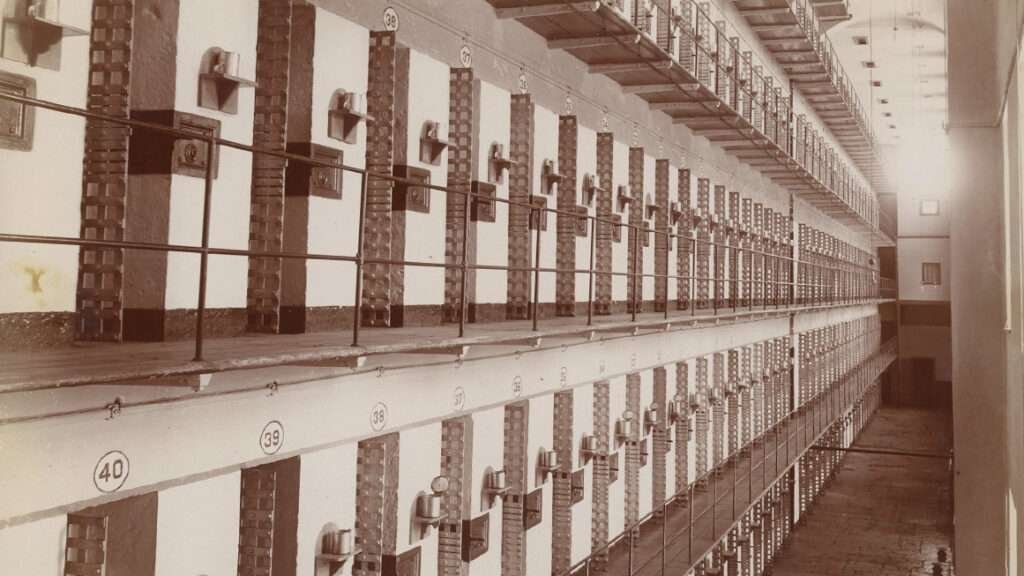
The Pennsylvania system was hard to maintain in ideal conditions, and it fared even worse during crime waves. Overcrowding in the 1860s and 1870s led to the end of single-celling in many prisons across the country, including the de facto end of the separate system at Eastern State, which was penned in by its walls and had no room to build more isolation cells. Eastern State wouldn’t officially abandon the separate system until 1913, but by then it hadn’t existed in practice for decades.
Still, behind the system was a genuine desire for rehabilitation that stands in sharp contrast to later eras of incarceration. Rubin says that Eastern State’s “administrators really saw themselves as benevolent gentlemen, and they wanted the prisoners to succeed.” They gave departing inmates fresh clothes and money earned from work during their incarceration, and the staff maintained a strict policy of keeping inmates anonymous, so that their prison sentence wouldn’t be linked to their names after their release.
The policy of anonymity was absolute. In the middle of Eastern State there is a brass plaque that survived the 1980s and ’90s, when the prison was abandoned for several decades and left to be picked over by looters and punk bands. The plaque is dedicated to the “everlasting honor” of the 120 inmates who served in World War I after receiving special dispensations to enlist. They are listed by their four-digit inmate numbers—not to dehumanize prisoners but to preserve the dignity of free men.
BOOK TWO: THE PROGRESSIVE ERA AND DECLINE (1870–1955)
By the late 19th century, the public failures of the Auburn and Pennsylvania systems led prison administrators to search for new models. In 1870, then–Ohio Gov. Rutherford B. Hayes convened the first Congress of the National Prison Association. In its declaration of principles, the group declared that “the supreme aim of prison discipline is the reformation of criminals, not the infliction of vindictive suffering.” New York’s Elmira prison, the first “reformatory” in the country, opened in 1876 based partly on practices in Irish and Australian prisons. It rejected the dogmas of silence and isolation and introduced innovations, such as adjusting inmates’ privileges based on good behavior. Yet prison conditions continued to decline. In 1913, inmates at New York’s Sing Sing prison protested by throwing their daily bread rations through the exterior windows. The loaves were so stale that the fusillade shattered the glass panes.
The rapidly declining state of Jacksonian Era prisons and the corresponding rise of Progressive reform campaigns—which targeted a variety of institutions, including mental asylums and schools—led to the second great wave of change.
Quakerish discipline and obedience were replaced with a more tolerant strain of mainline Protestantism and liberal moralism. But while Progressive-Era reforms demonstrably improved the day-to-day life of inmates—abolishing some forms of convict labor, getting rid of silence rules, and permitting outdoor exercise—the Progressives’ attempts to run prisons more like enlightened schools and hospitals would be short-lived.
The End of Auburn’s Silent System
In 1913, the same year that Pennsylvania gave up on the separate system, the end of New York’s silent system arrived in the form of Thomas Mott Osborne, a rich and idealistic New York Democrat who used his political connections to get appointed head of the State Commission on Prison Reform.
Osborne decided that the only way to understand the prison was to experience it from an inmate’s point of view, so he arranged to have himself incarcerated for a week at Auburn under the pseudonym “Tom Brown.” Osborne kept a journal during his incarceration, which he would later publish as Within Prison Walls, a shocking (for the time) first-person account of daily life under the silent system.
Osborne already believed in prison reform on an intellectual level when he arrived at Auburn, but his experience made him a zealot. On his last night, Osborne got himself thrown into one of the dark cells used as punishment for any sort of infraction, such as whispering to another inmate or shirking work. The small unit of cells was across from the death chamber. Their floors and walls were made from riveted sheet iron, and there was no bedding. Inmates were given a slice of bread and three gills of water (about one and a half cups) a day.
Osborne was spared from true isolation by being able to talk to other inmates in nearby cells, but what alarmed him most about his experience was the intense misanthropy that welled up in him after spending less than a night in the bare, bedbug-infested cell. As the hours wore on, Osborne described being seized by a murderous rage and “lunatic obstinacy” at the sight of the guards, who denied water to another sick inmate and shined flashlights in Osborne’s face whenever he managed to drift to sleep.
“An aching, overwhelming sense of the hideous cruelty of the whole barbaric, brutal business sweeps over me; the feeling of moral, physical and mental outrage; the monumental imbecility of it all; the horrible darkness; the cruel iron walls at our backs; the nerve-racking monotone of the whirring dynamo through the other wall; the filth; the vermin; the bad air; the insufficient food; the denial of water; and the overpowering, sickening sense of accumulated misery—of madness and suicide, haunting the place. How can I speak of these things? How can I not speak of them?”
When dawn finally broke and Osborne was released from his cell, he later wrote, he fell on his knees and prayed to be an instrument of God to open others’ eyes to what he had seen, and for the strength to persevere in what he now knew was his life’s duty: to help the men he left behind in those cells and those who would come after them. Benjamin Rush had predicted that isolation cells would produce religious epiphanies in men, but this was probably not what he had in mind.
Within Prison Walls was a wild success, and for a short period it made Osborne the most prominent penal reformer in the country. Prisoners, he argued, should be built up rather than broken; they should be given a degree of autonomy, work voluntarily, and be paid regular wages for their labor.
He was appointed warden of New York’s dreaded Sing Sing prison in 1914, a structure that The Atlantic described as “physically a disgrace to civilization.” Osborne implemented radical reforms, including a Mutual Welfare League that allowed prisoners to largely police and discipline themselves. (“OSBORNE SETS UP CONVICT REPUBLIC,” a New York Times headline declared.) But Osborne’s tenure was cut short after a state investigation led to his indictment on charges of perjury, neglect of duty, and salacious accusations of “unnatural and immoral acts” with male inmates. Osborne was acquitted and reappointed, but he resigned in 1916, his reputation ruined.
Nevertheless, his advocacy led to the eventual end of the silent system in New York, along with other important reforms, such as a new rule allowing Auburn’s inmates to exercise in the prison yard. The morning after Osborne collapsed from a heart attack in 1926, the guards at Auburn opened the cells and announced that Tom Brown had died. His funeral service at the Auburn chapel was attended by 1,400 inmates, and he was buried in a prison uniform.
The ecstatic vision of the early prison reform movement—that criminality and possibly all other manner of social degeneracy could be reliably and humanely remolded by unyielding discipline and isolation—was just that, a fantasy. Isolation and silence are anathema to human nature. You can enforce them on a group of people as easily as you can lasso the moon.
Unlike the failures of previous prisons, though, the end of the Jacksonian-Era penitentiary systems did not lead to calls for abolition or for a return to earlier modes of punishment. By now the prison was institutionalized in America, and Progressive reformers like Osborne saw it as a blank template onto which they could impress their ideas.
“The prison is endlessly customizable,” Rubin says, “and if you go through subsequent history, you can see how we just keep tweaking the prison.”
This tendency to constantly iterate and problem-solve is “a deeply American ethos,” Rubin says. “We’re really good at coming up with a new version of something and saying, ‘This is going to fix the problem.'”
A Prison Without Bars Turns Into the ‘House of Pain’
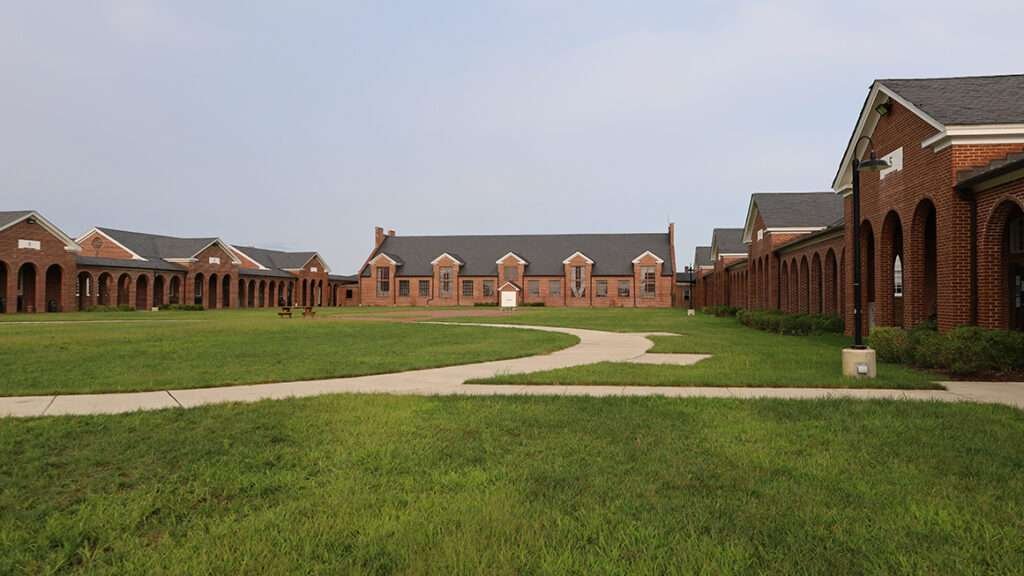
In 1910, 29 prisoners stepped onto a wooded spit of land along the Occoquan River in what is now Lorton, Virginia, and began felling trees. They had been dispatched from Washington, D.C., via river barge to build a new type of prison, a workhouse and true reformatory that would ennoble them with fresh air and skilled trade rather than leaving them idle in noxious jailhouse cells.
Touring the grounds a year later, The Washington Post wrote that it was a one-of-a-kind institution “where honor is the bolt and trustworthiness the bars; where there is neither lock nor key, and where the prisoners come and go apparently of their own free will; where there are no grim-visaged buildings nor frowning walls.”
The impetus for this new reformatory was, once again, failure. The D.C. workhouse and jail had been overcrowded, disease-ridden public nuisances for decades. In 1908, President Theodore Roosevelt had formed a commission to investigate the conditions.
“The report sets forth vividly the really outrageous conditions in the workhouse and jail,” Roosevelt wrote after reading the commission’s findings. “The overcrowding is great in the workhouse, and greater still in the jail where, of the six hundred inmates, five hundred are serving sentences in absolute idleness, with no employment and no exercise….It is no longer a question of what shall be done, for it is quite impossible that the existing condition should continue. The present antiquated and unsatisfactory plan ought not to be considered for a moment.”
Rather than cellblocks and walls, inmates at the Occoquan Workhouse lived in dormitories on an open-air campus, connected by green quads. “Nothing helps to improve a man’s mind more than the sight of flowers,” the prison superintendent told The Washington Post. The prison was meant to be self-sufficient. Inmates engaged in a wide variety of farming and industry, including using on-site kilns to produce bricks to build the prison’s later structures.
A brick reformatory for more serious offenders was completed in 1916. But only a year later, this high-minded Progressive project would become home to one of the most infamous events of the decade.
In Washington, D.C., suffragists calling themselves the “Silent Sentinels” began picketing outside the White House for the right to vote. President Woodrow Wilson at first tolerated the protesters, but after several months he started having them arrested for obstructing the sidewalks. On Labor Day of 1917, 11 Silent Sentinels were arrested for picketing a war draftee parade. Instead of paying their fines, the suffragists chose to be imprisoned in the D.C. Jail, where they soon went on hunger strike.
The other Silent Sentinels continued to protest, leading to the subsequent arrest of 32 suffragists, including Lucy Burns, co-founder of the National Woman’s Party, and Dorothy Day, who later co-founded the Catholic Worker Movement. Wilson had the arrestees sent to the Occoquan Workhouse rather than the D.C. Jail to teach them a lesson.
When the women arrived at the reformatory on the evening of November 14, 1917, they demanded to be treated as political prisoners. The club-wielding guards obliged them. The hours of beatings and abuse that followed became known as “the Night of Terror.”
Burns was left handcuffed in a stress position in her cell all night. “I saw Dorothy Day brought in,” Mary Nolan, the oldest of the prisoners at 73, remembered. “She is a frail girl. The two men handling her were twisting her arms above her head. Then suddenly, they lifted her up and banged her down over the arm of an iron bench. Twice.”
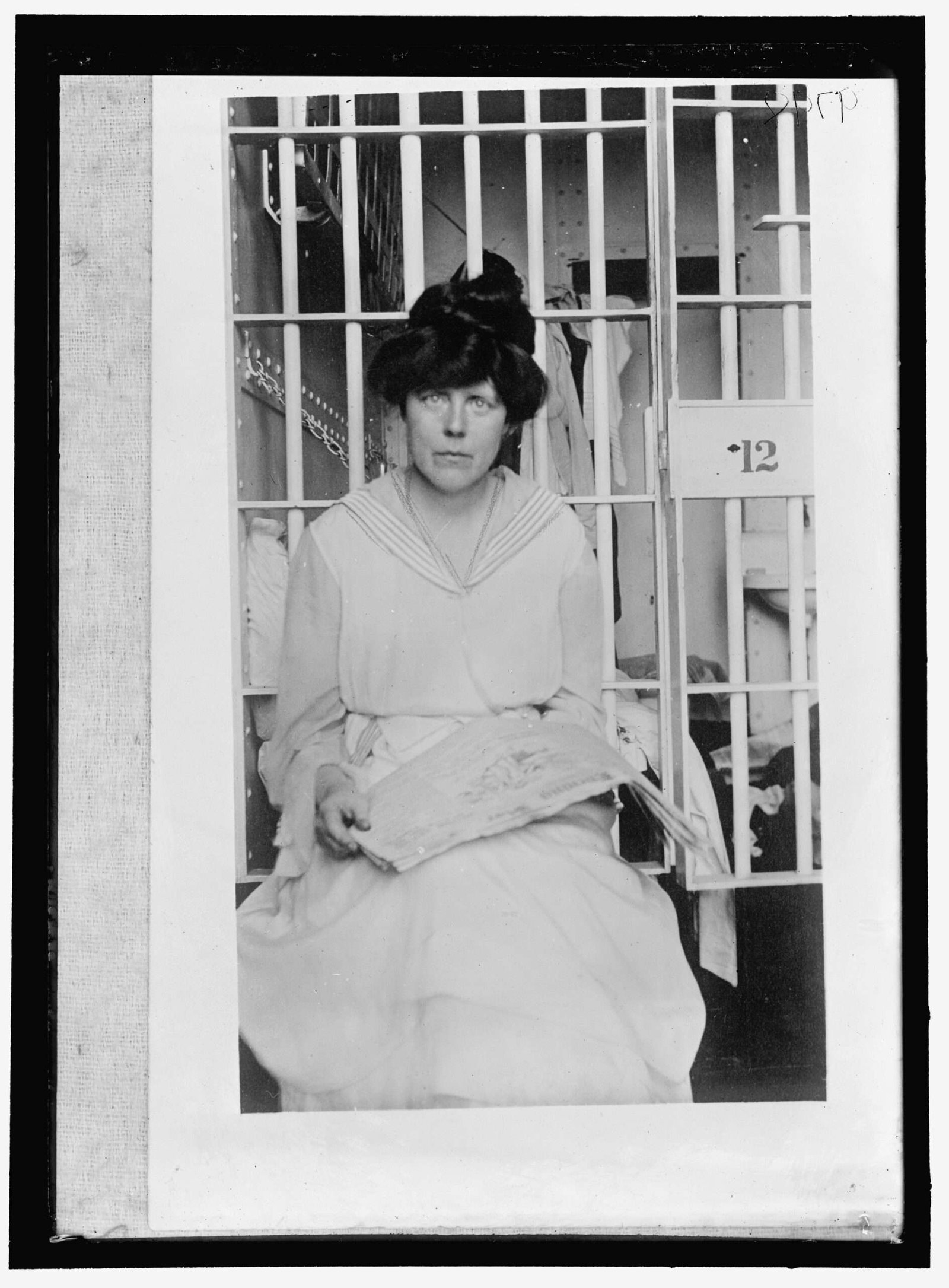
The incarcerated suffragists launched a hunger strike to protest their treatment. After three days of failing to break the hunger strikers by taunting them with hot meals—”They think there is nothing in our souls above fried chicken,” Burns sneered—the guards dragged Burns to a room away from the other prisoners, held her down, and force-fed her with a feeding tube.
“I was held down by five people at the legs, arms and head,” Burns later wrote. “I refused to open my mouth, [Dr. J.A.] Gannon pushed the tube up my left nostril. I turned and twisted my head all I could, but he managed to push it up. It hurts nose and throat very much and makes nose bleed freely. Tube drawn out covered with blood.” (It wasn’t the first time Burns had been force-fed. She had gotten the same treatment while on hunger strike in an English jail in 1909.)
A lawyer for the Silent Sentinels filed successful habeas corpus petitions to a judge securing their immediate release, and the Night of Terror caused enough of a public uproar that Wilson announced his support for the 19th Amendment two months later. In total, 72 suffragists were imprisoned at Lorton, the prison without bars or punishment, for exercising their constitutional right to protest.
The original Progressive ethos of the Lorton Reformatory, as it had become known, would not survive long, due to changing crime trends. William J. Stuntz writes in The Collapse of American Criminal Justice that “two migrations and two crime waves largely define the history of crime and punishment in the United States”—the late 19th and early 20th century wave of European immigrants, and the 20th century black migration from the South to northern cities. From the early 1920s to the late 1930s, the national imprisonment rate nearly doubled, from 74 to 137 per 100,000.
The increase in the number of criminal offenders led to harsher prison policies across the country, including at Lorton. A walled complex with guard towers was completed in 1930, followed by a wing of solitary confinement cells in 1935, once again dubbed “The Hole.” Barbed wire was added in 1950, and the name was changed to the Lorton Correctional Complex soon after, completing the transformation into a typical prison.
Elsewhere, the federal government opened Alcatraz in 1934 to house dangerous offenders and would-be escapees. The ruinous operating costs of maintaining an island prison would lead to Alcatraz’s closure in 1963.
Throughout the 1950s and ’60s, Lorton continued to offer work opportunities for inmates, but the programs couldn’t keep up with overcrowding, and reform was no longer the guiding principle of the prison.
By the 1980s, the dilapidated Lorton complex had descended into chaos due to overcrowding and corruption. Correctional officers and offenders often grew up in the same small D.C. neighborhoods. Guards ran prostitution rings and heroin-smuggling operations from inside. The prison’s solitary cellblock for mentally ill and troublesome inmates was known as “the house of pain.” One correctional officer testified in court, “If you fuck up we deal with you on our own basis.”
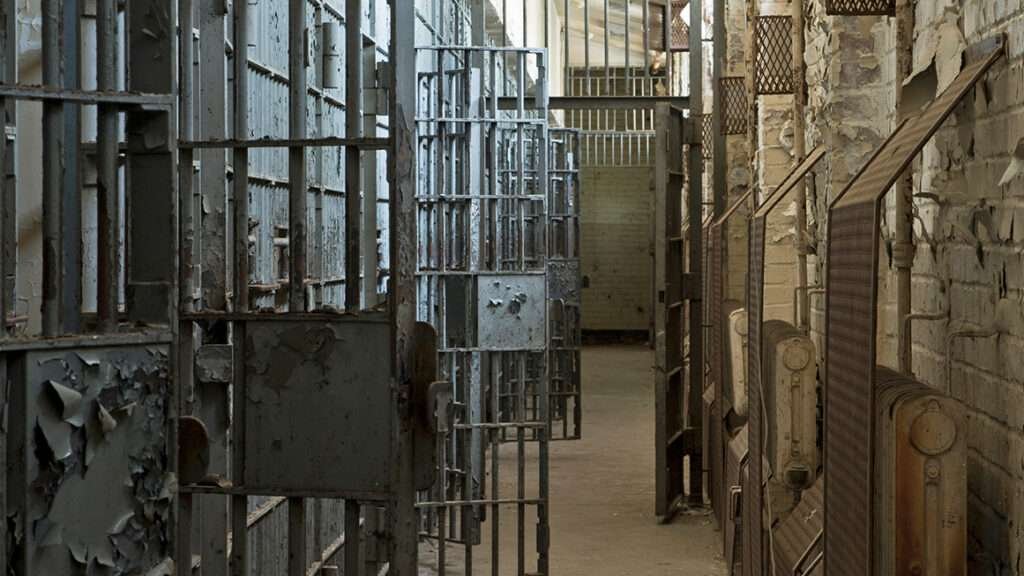
In 1997, Congress passed the National Capital Revitalization and Self-Government Improvement Act, which moved much of the administration and costs of D.C.’s criminal justice system to the federal government. Lorton closed in 2001, and the last of its inmates were transferred to federal prisons. Felony offenders in the District of Columbia now serve their sentences in federal prisons, often hundreds of miles away from their families.
Today the old Lorton grounds are a bucolic spot for Northern Virginians to spend an afternoon. On the day I visited in mid-March, runners were crossing a finish line near the center of the old workhouses, and a local brewpub was doing brisk business. Many of the workhouses have been turned into artist studios. The Lorton Prison Museum, a free two-room museum, gives visitors the history of the reformatory and its connection to the suffragist movement.
One of the most interesting pieces of curio in the museum is the crucifix that used to hang in Lorton’s chapel. It was sculpted and painted by inmates; in a bit of heavy-handed artist’s commentary, the head of Christ was modeled after a murderer serving a life sentence. The wound in Christ’s side was also omitted, indicating that he is still alive and a prisoner in Roman custody.
Lorton has always embodied the contradictions of its era, and it still does to this day. The penitentiary structures—built with bricks fired and laid by incarcerated labor—have been converted into commuter-class apartment units. The developers dubbed the complex Liberty Crest Apartments.
BOOK THREE: THE SOUTH (1870–1970)
The South’s criminal justice system was warped by chattel slavery and profiteering. From Reconstruction through the early 20th century, the vast majority of Southern convicts were leased to private companies to perform brutal labor.
Although Southern states adopted the Auburn model when they built prisons, they also ran large prison farms, which were often former slave plantations. Until whistleblower scandals and lawsuits brought more attention in the 1960s and ’70s, these prison farms forced inmates to work in wretched conditions, beyond oversight or any hope of relief.
‘The Wildest Show in the South’
After Reconstruction, the history of the U.S. prison experiment forked between the industrial North and the agrarian South. The South took a different approach to incarceration, and to understand it I had to go to a rodeo.
In mid-April, I drove north from Baton Rouge to Louisiana State Penitentiary, an 18,000-acre parcel of rolling farmland nestled between two bends of the Mississippi River. There, in the middle of the largest maximum security prison in the country, behind razor wire fences and guard towers, there is a rodeo arena. Thousands of people buy tickets every year to watch incarcerated men ride bulls and horses.
Marketed by the prison as “the wildest show in the South,” this was the 60th annual Angola Prison Rodeo. It’s a local institution in multiple senses of the word. Billboards advertised the rodeo miles before the turnoff, and when I arrived, a long line of cars was queued up at the prison gate. Correctional officers waved drivers along to the parking areas in the large grass fields in front of the perimeter fence that surrounds the rodeo grounds.

Louisiana State Penitentiary is commonly called “Angola” because that was the name of the plantation that previously occupied the land. That name, in turn, was lifted from the colony in Africa that the slaves came from.
After the Civil War, the plantation was bought by former Confederate Major Samuel James, who turned it into a private labor camp for state convicts. This arrangement, under which private companies paid to lease convicts from the state for labor, was the dominant type of incarceration in the South from Reconstruction through the early 20th century. By 1888, nearly all of Alabama’s male prisoners, the vast majority of them black, were leased to two coal mining companies.
Convict leasing was wildly profitable for all the wrong reasons. The convicts were often treated worse than slaves, since they didn’t even have value as property and were a plentiful resource. From 1870 through 1901, about 3,000 convicts died at Angola under the James family’s watch. In 1884, an editor at the New Orleans Daily Picayune wrote that it would be “more humane to punish with death all prisoners sentenced to a longer period than six years.” Shane Bauer, author of American Prison, has written that annual convict death rates across the South during the time ranged from 16 percent to 25 percent, “a mortality rate that would rival the Soviet gulags to come.”
Louisiana abolished convict leasing in its 1898 constitution, and in 1901 the state purchased the Angola prison camp from the James family. The rest of the South mostly outlawed convict leasing after 1922, when a white man was whipped to death in a Florida lumber camp.
The mood in Angola on rodeo day was more Shaboozey than Solzhenitsyn. Women wore bedazzled cowboy hats. The air smelled of fried dough and manure. The only other noticeable differences from a regular rodeo, besides the razor wire, were the lack of alcohol sales and the large number of black attendees. (Louisiana State Penitentiary’s incarcerated population is 73 percent black.) Adults could buy souvenir shot glasses that read, “Angola: a gated community.” For the kiddos, a booth called “parole-a-bear” was selling stuffed animals. Vendor booths sold food and drinks to raise money for the various clubs around the penitentiary: the Lifers Association, the Angola Fatherhood Association, and The Angolite, an award-winning publication written by Angola inmates.
One of the first events of the rodeo was a demonstration by the Angola Rough Riders drill team, which practices horsemanship. The Rough Riders were wearing crisp, blue button-down shirts and cowboy hats, unlike the bull and bronco riders, who wore black-and-white-striped shirts reminiscent of the classic Auburn prison uniform. The riders coaxed the horses through a series of formations before galloping out of the arena.
Afterward, I caught up with one of the Rough Riders, an Angola inmate named Kenny Rice. It was, in fact, Rice’s first rodeo.
Rice said that he and his horse were both nervous, but everything went all right, especially considering he had never ridden until he got the opportunity to join the team about a year and a half ago.
“I started off as a stable boy, cleaning stalls, cutting grass, feeding horses, and later on they started showing me how to ride—the tricks of the trade,” Rice says. “As I got in tune with the horses, I took a liking to it.”
Not only that, but it’s given him a skill that he can take with him out of prison. “It’s also a good trade to have,” Rice says. “I can always go to a racetrack, be a trainer.”
A 2019 state legislative audit found that one-third of incarcerated people working in the Louisiana prison industries program were being trained in shrinking labor markets such as textile factory work and agriculture, concluding that many “may not be learning job skills that could help them after they are released.” But hearing Rice talk about what the experience has given him, training horses seems much more beneficial than stamping license plates.
The rest of the rodeo events are less about skill than reckless bravado. The bull and bronco riders don’t have any chance to practice before the rodeo, meaning some of them had zero experience with hopping onto a slobbering-mad, 2,000-pound bull. Almost none of the riders lasted the necessary eight seconds to post a score. Most barely made it out of the chute. Broken bones and concussions are common, although everyone at this year’s spring rodeo appeared to escape major injury.
On the first day of the rodeo, the best bronco rider in the field was a 74-year-old man nicknamed “Cracker,” who not only held on until the buzzer but nearly made a clean dismount. The rodeo announcer called Cracker one of the winningest cowboys in the rodeo’s history.
This year was also the first that the rodeo allowed a few nonincarcerated “free riders” to participate. (“When you tell people you’re in the Angola rodeo, it’s usually not a good thing,” the announcer jokes.)

The bull and bronco riders wore helmets with full face masks and other protective gear, and there were professional rodeo clowns and a pair of mounted cowboys to keep everyone safe. Nevertheless, some of the events are designed for carnage.
In one event, called “bull soccer,” three inmates squeezed themselves into large inflatable balls that ensconced them from their heads to their waists. “What you are about to see is borderline insanity,” the announcer says as a bull is released into the arena.
In another game, called “convict poker,” four Angola inmates sat at a card table, and a bull was released. The goal is to be the last one seated. The table and chairs ended up in pieces, and the bull violently tossed one of the participants into the air.
The finale of each rodeo is a game called “guts and glory,” where a poker chip is tied to a bull’s head and the inmate brave enough to snatch it from between the animal’s horns wins $1,000—a small fortune for an incarcerated person. (This is not an Angola invention. Southern France has a traditional bullfighting game where young men compete to cut ribbons and tassels from a bull’s horns for cash prizes.) The most effective tactic is to sit on the ground in front of the bull and goad it into lowering its head and charging. It’s not a move for the faint of heart, but as the rodeo announcer says, “One thing about Angola, what do you have to lose?”
Next to the rodeo arena there is a popular crafts market, where Angola inmates sell leather goods, jewelry, wood crafts, artwork, furniture, and even metal grills and smokers. All of it is handcrafted.
“In the middle of being incarcerated, it’s a blessing to be able to do what we do,” Darryl J. Brown says as he stamps a woman’s name onto a belt using his leatherworking tools. Brown has been incarcerated at Angola for 28 years. He’s nicknamed “the belt man” and says he’s been making them for 15–20 years. “It keeps me out of trouble,” he says.
Like other inmates selling their crafts, Brown is a trusty, meaning he’s earned the privilege of being allowed to participate through good behavior. The highest level of trusties can mingle and talk freely with visitors. This is the real heart of the rodeo. While the cowboys inside the arena risk life and limb, many of the trusties spend the afternoon lounging in the shade with friends and family.
Equally important, the Angola men can earn more money in a single day at the market than they could working a year for their typical prison wages. It’s hard to overstate the significance of this. In the U.S., prisoners often are paid little to no wages for their labor. The 13th Amendment’s ban on slavery and involuntary servitude contains an explicit exception for “punishment for crime whereof the party shall have been duly convicted.” A 2022 report by the American Civil Liberties Union (ACLU) found that incarcerated workers in Louisiana made between two cents and 40 cents an hour.
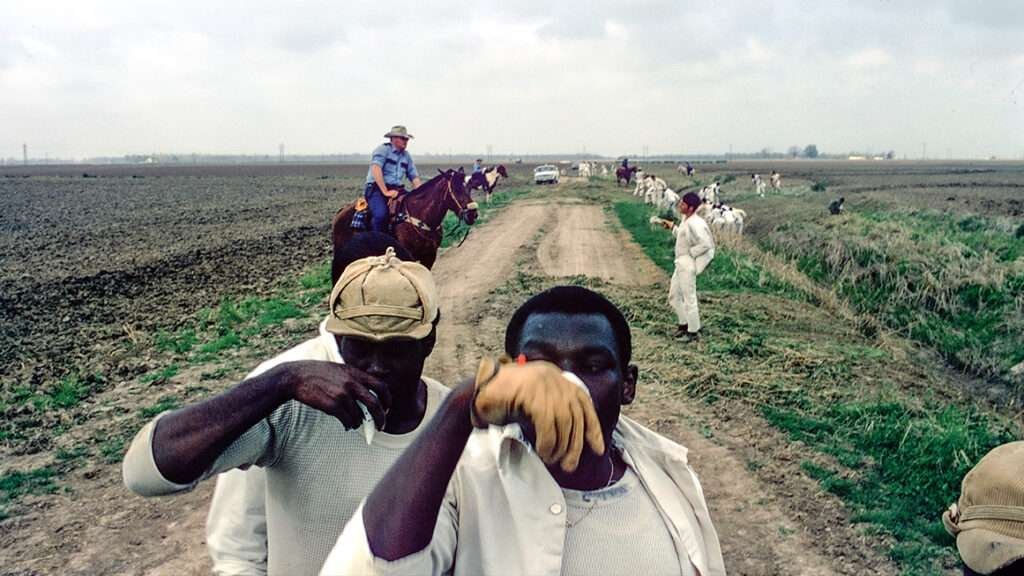
What the spectators who come to Angola to watch bull riding and rodeo clowns don’t see is the compulsory field labor, known at Angola as the “farm line.” Almost every man who arrives at Angola is put on the farm line for a mandatory six months at least. They pick crops by hand—including cotton—and do other manual labor under the watch of a rifle-toting guard on horseback. Besides a few cosmetic details, it’s not much different from what one would have seen at Angola in 1840.
Many incarcerated men told the ACLU that those on the farm line who failed to meet quotas, or couldn’t or wouldn’t work, faced being put in administrative segregation, or solitary confinement. “In the field each inmate is given a number to a row of crops to be cultivated or pulled and bagged which is about a half mile,” one Angola inmate told the ACLU. “The gun guard on the horse said she wanted 30 sacks of greens and was keeping count. I was on sack 23 before the specified time and was transported to segregation.”
Angola has gone through cycles of reform and backsliding over the decades, but the farm line has been a constant. In 1951, 37 incarcerated men at Angola slashed their own Achilles tendons to protest the brutal field labor and living conditions. For most of the mid–20th century, it was known as “the bloodiest prison in the South.”
In 2024, a federal judge ruled that Angola inmates with “serious illnesses or pre-existing conditions were laboring in the field under no work restrictions” and that prison officials displayed “deliberate indifference” to the risks of sending men with serious health issues to work in the fields in sweltering heat. The ruling was in response to a class-action lawsuit filed by incarcerated men alleging that they were forced to work in the heat without adequate shade, breaks, water, or accommodations for sick or disabled inmates.
“If you can’t keep up or you refuse to do the work, they threaten you with calling the truck to bring you to the dungeon,” Bobby Wallace, a former Angola inmate, told the Louisiana Illuminator.
A 2024 Associated Press investigation tracking the use of prison labor in the nation’s food supply chain found that cattle raised by inmates at Angola were later sold at auction to a livestock dealer, who in turn sold them to a Texas slaughterhouse that supplied some of the largest supermarkets and fast-food chains in the world.
I didn’t ask the incarcerated men at Angola about any of that, because I didn’t want to expose them to retaliation. And none volunteered to talk about it. People’s thoughts are elsewhere on rodeo day. Despite occasional vibes of the Roman Colosseum or Squid Game, the rodeo is the closest the Angola inmates get to experiencing an open model of incarceration like what Thomas Mott Osborne called for or what some modern-day European prison units look like. The men of Angola can sell their crafts at a fair price, support their families, and talk to visitors face-to-face. They can dare, compete, and thrill inside the rodeo arena.

A handful of Angola cowboys were even allowed to participate in the three-day Hondo Rodeo Fest in New Orleans’ Caesars Superdome this April, with prize winnings split between a state crime victims fund and the participants’ families. Capital B reported that in the central event for the Angola segment, “incarcerated men stood inside a hula hoop on the floor while a bull was released toward them, trampling each of them until only one man remained standing.”
“Couple of them came back with concussions,” Rice says, “but they lived to tell, and they’re ready to go do it again.”
The man who won “guts and glory” on the rodeo’s second day got thrashed by the bull, but he hobbled to his feet, took off his helmet, and raised it to the cheering crowd. Pickup trucks drove away loaded down with rocking chairs and Louisiana State University–themed cornhole boards. The world ebbed out of Angola like an outgoing tide.
In May, a federal judge tossed out the lawsuit challenging conditions on the farm line. He wrote that he would have ruled otherwise but was bound by a recent 5th Circuit Court of Appeals decision making it even harder to prove cruel and unusual punishment under the Eighth Amendment. Under the new standard, the judge wrote, Louisiana State Penitentiary couldn’t be found deliberately indifferent if it took some measures to address extreme heat—emphasis in the original—”even though these remedial measures are inadequate to cure the constitutional violation.”
The Arkansas Prison Scandal
After the end of convict leasing, Southern prison farms adopted a trusty system, where much of the operations and oversight were outsourced to inmate trusties. This kept staff costs low and maximized profits, but it led to endemic corruption and barbarism. At their worst, the Southern prison farms of the mid–20th century resembled Lord of the Flies.
When Thomas Murton, a reform-minded penologist, arrived at Arkansas’ Tucker prison farm in 1967 to assume his new role as warden, he discovered he’d been put in charge of a small slice of hell. The prison farm was largely run by trusties—they even manned the guard towers with loaded rifles, although they were locked in the towers. The trusties got extra privileges in exchange for making sure, by whatever means necessary, that the rest of the prisoners grew and harvested enough crops to fulfill the prison’s contracts and turn a profit. Everything at the prison farm was managed through payoffs and extortion. Those who couldn’t pay worked 14–16 hours a day shoeless, subsisting on a daily spoonful of watered-down rice and a piece of weevil-infested cornbread. When Murton arrived at Tucker, most of the inmates were 40–60 pounds underweight. It was a purely extractive enterprise. Even the dentist charged $15 an extraction.
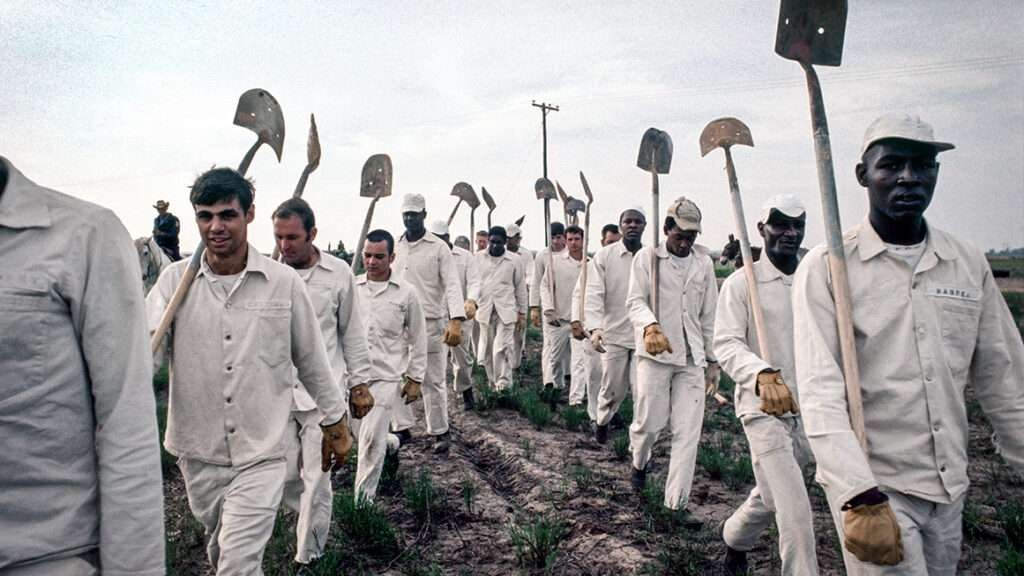
For the inmates who caused problems—malingering, writing complaints, owing money—the consequences ranged from a standard beating to being flogged with a 5-foot-long leather strap to more novel means of torture. Shortly after arriving, Murton discovered a jerry-rigged crank telephone used to electrocute inmates.
“The telephone, designed by prison superintendent Jim Bruton, consisted of an electric generator taken from a crank-type telephone and wired in sequence with two dry-cell batteries,” Murton wrote in Accomplices to the Crime, an account of his time at Tucker. “An undressed inmate was strapped to the treatment table at Tucker Hospital while electrodes were attached to his big toe and to his penis. The crank was then turned, sending an electrical discharge into his body. In ‘long distance calls’ several charges were inflicted—of a duration designed to stop just short of the inmate’s fainting. Sometimes the ‘telephone’ operator’s skill was defective, and the sustained current not only caused the inmate to lose consciousness but resulted in irreparable damage to his testicles. Some men were literally driven out of their mind.”
The old-timers at the prison told Murton there were even darker secrets buried on the prison grounds, and he suspected they were telling the truth. He knew that more than 200 inmates had been listed as unrecovered escapees over the years, a number that seemed far too high.
On a rainy, muddy day in January 1968, Murton and 15 inmates, joined by a gaggle of reporters, started digging in three spots where Murton had been told bodies were buried. They found coffins in all three spots.
“The skull in the third grave was no bigger than a grapefruit, and it obviously had been crushed or shattered,” Murton wrote. “The bones and skulls in the other graves were whole. In the Number 2 grave I noticed that both of the lower leg bones had been severed from the thigh bone and stacked in beside the knees. It looked as though the legs had been cut off to get the man into the box. The skull was lying under the skeleton’s right arm. The body in the first grave had been decapitated.”
The story ignited an international media frenzy. But while Murton had hoped to bring attention to dire conditions in Arkansas prisons, the rest of the state government was less enthusiastic. State police quickly took over the investigation and claimed that Murton had merely stumbled onto an old pauper’s graveyard. The excavations stopped and never resumed. Both chambers of the Arkansas Legislature condemned Murton for “destroying the image of the State of Arkansas,” and a grand jury was impaneled to investigate him for felony grave robbery. The state board of corrections performed the coup de grâce on March 7, summarily firing Murton.
The Arkansas governor vowed his office would investigate the scandal. In the report it eventually released, a state pathologist who examined the three exhumed skeletons found no evidence of trauma or violent death. Murton called the report a “deliberate fraud.” He never worked in corrections again.
The days of the old trusty system were over, though. In 1970, federal Judge J. Smith Henley ruled that the Arkansas prison system violated the Eighth Amendment’s prohibition against cruel and unusual punishment and the 14th Amendment’s Equal Protection Clause, since the prisons were racially segregated.
“For the ordinary convict,” Henley wrote, “a sentence to the Arkansas Penitentiary today amounts to a banishment from civilized society to a dark and evil world completely alien to the free world, a world that is administered by criminals under unwritten rules and customs completely foreign to free world culture.”

The ruling, the Harvard Law Review reported, was the first where “an entire prison system faces possible abolition on constitutional grounds.”
It wouldn’t be the last. In 1972, another federal judge ruled that Mississippi State Penitentiary—better known by its old plantation name, Parchman Farm—was an affront to “modern standards of decency” and abolished its trusty system. The U.S. Court of Appeals for the 5th Circuit upheld the ruling two years later, leading to the end of the old trusty system in the South.
Judges were issuing similar condemnations of prison conditions across the country. As U.S. prisons decayed through the 1960s and 1970s, leading to deadly riots and disorder, federal courts issued some of the 20th century’s most important rulings regarding the rights of incarcerated people.
BOOK FOUR: RESISTANCE AND MASS INCARCERATION (1971–2009)
Although prison scandals in the 1960s and 1970s forced state leaders to promise reforms, their prison systems were under growing pressure from problems without easy solutions: overcrowding, outdated facilities, and racial tensions due to changing demographics. In states like New York, prison populations became increasingly nonwhite and urban, while the overwhelming majority of correctional officers remained white and rural. In the late 1960s and throughout the 1970s, those tensions erupted into hundreds of prison uprisings across the country—the most turbulent period in the history of American prisons.
Policymakers responded with the largest prison-building spree in U.S. history, a phenomenon that would later be called “mass incarceration.” The 1970s and ’80s saw a profoundly punitive shift in how the public viewed criminals and the purpose of imprisonment compared to previous eras. As a result, the American prison experiment would reach its volumetric zenith, giving the U.S. the highest incarceration rate in the world.
The End of Rehabilitation
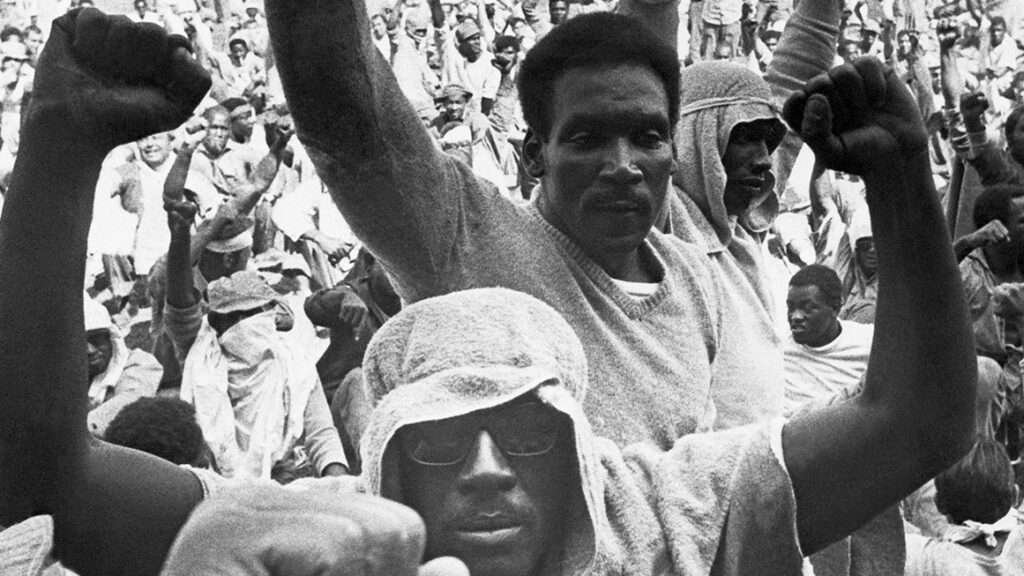
On September 9, 1971, in the yard of Attica Correctional Facility in upstate New York, Elliott “L.D.” Barkley stepped forward to address the world on behalf of the 1,281 inmates who had seized control of the prison that day. Barkley announced that he and his fellow inmates had “set forth to change forever the ruthless brutalization and disregard for the lives of the prisoners here and throughout the United States.”
What followed was the bloodiest, most dramatic event in the history of U.S. prisons.
The Attica inmates had taken over the prison almost by accident during a confused melee earlier in the day, fatally injuring a guard and taking numerous hostages. Now they were using the opportunity to address years of festering grievances.
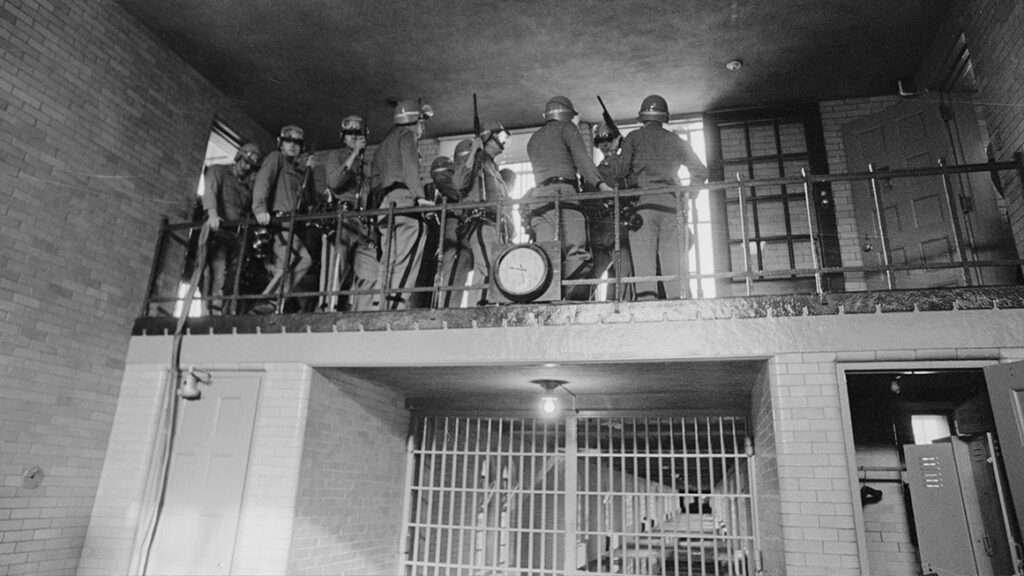
Most of the Attica men’s demands were related to atrocious medical care, censorship of books and newspapers, political and religious repression, and racism. But they also wanted amnesty from prosecution and the resignation of the warden, impossible demands for the state to swallow.
Four days later, with negotiations at a standstill, roughly 550 New York law enforcement officers retook the prison by force, shooting indiscriminately into a fog of tear gas. “The bullets were coming like rain,” one hostage remembered. The officers killed nine hostages and 30 inmates, including Barkley, who was shot in the back.
Attica was only one of hundreds of riots, hostage situations, and violent episodes throughout the late 1960s and 1970s. A few weeks before the Attica takeover, black radical George Jackson was killed during an armed escape attempt in California’s San Quentin State Prison, prompting the Attica inmates to go on a hunger strike.
The radicalization of incarcerated people and official repression fueled each other. Louis Nelson, the warden of California’s San Quentin, summed up the attitude in 1971, when he told a newspaper, “If the prisons of California become known as ‘schools for violent revolution,’ the Adult Authority would be remiss in their duty not to keep the inmates longer.”
What’s often forgotten about the era is that conditions at Attica and other U.S. prisons improved somewhat in the years that followed. The New York Times reported a year after the Attica riot that most of the inmates’ demands had been met. Inmates won victories elsewhere on such issues as political censorship, access to legal resources and libraries, and living conditions.
The federal judiciary issued a series of rulings in the 1970s defining baseline constitutional rights for incarcerated individuals. In 1974, the U.S. Supreme Court ruled that it was unconstitutional to censor mail between inmates and law students regarding prison conditions. “When the prison gates slam behind an inmate, he does not lose his human quality; his mind does not become closed to ideas; his intellect does not cease to feed on a free and open interchange of opinions; his yearning for self-respect does not end; nor is his quest for self-realization concluded,” Justice Thurgood Marshall wrote in a concurrence. “If anything, the needs for identity and self-respect are more compelling in the dehumanizing prison environment.”
The Supreme Court would go on to hold in 1976’s Estelle v. Gamble that prison staff could not show “deliberate indifference” to an incarcerated person’s medical needs. In 1979, the 9th Circuit Court of Appeals ruled in Spain v. Procunier (a lawsuit brought by several San Quentin inmates who had been placed in maximum security isolation cells for their alleged roles in Jackson’s deadly escape attempt) that denying outdoor exercise to inmates constituted cruel and unusual punishment.
The rulings, though, were an attempt to backstop a principle that lawmakers, the public, and prison staff no longer really believed in. Rehabilitation, or even half-hearted gestures toward it, had been abandoned as one of the main goals of incarceration. Prisoners were no longer seen as part of the same social fabric of the republic as the rest of Americans—fellow citizens who must be taught virtue—but as a permanent and incorrigible criminal class: serial killers, drug dealers and addicts, gang members, black radicals. Instead of setting the minimum standards for life in prison, those court decisions defined the best that incarcerated people could hope for; judicial deference to what the court in Procunier called prison wardens’ “unenviable task of keeping dangerous men in safe custody under humane conditions” would be cited in court rulings rejecting inmate lawsuits for decades to come.
State legislatures passed determinate sentencing schemes that removed discretion from judges, making sentences uniform. In many cases this was intended to mitigate sentencing disparities due to judicial bias, but in practice it moved power to prosecutors, who could significantly change the sentencing outcomes of cases based on their charging decisions. This also gave prosecutors much more leverage to negotiate plea deals with defendants. As the number of criminal prosecutions and the average lengths of sentences both began to soar in the late 1970s, the largest wave of prison building in U.S. history began. After all, states would need a place to put all of these new prisoners.
Unlike the penitentiaries and reformatories of yesteryear, these new prisons weren’t built with the hope that people would leave them as better citizens. The hope was that they would never leave at all.
‘A Perpetual State of Emergency’
Under the system of total incapacitation that emerged in the 1980s, wardens rolled back most of the marginal policy victories that incarcerated people had won on issues such as free speech, recreation, and living conditions, reverting to the idleness and overcrowding that Teddy Roosevelt had decried. In an influential 1992 essay, Malcolm Feeley (then at the University of California, Berkeley) and Jonathan Simon (then at the University of Michigan) dubbed this “the new penology.” This new method of operating prisons, they wrote, was “markedly less concerned with responsibility, fault, moral sensibility, diagnosis, or intervention and treatment of the individual offender. Rather, it is concerned with techniques to identify, classify, and manage groupings sorted by dangerousness. The task is managerial, not transformative.”
California alone built 21 new prisons between 1980 and 2005. The state’s inmate population increased 500 percent between 1977 and 1998. Several of these new prisons included supermax security wings where inmates, mostly alleged gang members, were kept in indefinite solitary confinement.
For example, California’s Pelican Bay State Prison, which officials lauded as “state-of-the-art,” included a 1,500-capacity Secure Housing Unit (SHU). This was a bureaucratic term for solitary confinement. Inmates were kept in windowless cells for 22.5 hours a day and not allowed access to the group exercise yards or work programs. Although the danger of severe mental degradation in solitary confinement had been well-documented since the disastrous 1821 Auburn experiment, Pelican Bay didn’t have a resident psychiatrist or organized mental health screening system for its first two and a half years after it opened in 1989, except for one psychiatrist who resigned after a month.
Pelican Bay’s SHU quickly attracted litigation. In 1995, a federal judge ruled that “subjecting individuals to conditions that are ‘very likely’ to render them psychotic or otherwise inflict a serious mental illness or seriously exacerbate an existing mental illness can not be squared with evolving standards of humanity or decency,” and that “a risk this grave this shocking and indecent simply has no place in civilized society.” But the ruling was narrow and didn’t stop the use of solitary confinement at Pelican Bay or elsewhere in California.
Despite its prison-building spree, California’s prisons became chronically overcrowded. This overcrowding was not a temporary exception or unfortunate side effect of mass incarceration, Simon later wrote in Mass Incarceration on Trial, but a “method of governing prisons by putting them in a perpetual state of emergency.” The overcrowding led to men being left in “dry” cages the size of telephone booths and stuffed into gymnasiums full of bunk beds, as well as atrocious delays in medical care.
The explosion of the prison population also led to a flood of lawsuits. In response, Congress passed the Prison Litigation Reform Act in 1996, which requires inmates to exhaust administrative grievance processes before they can challenge prison conditions in court.
Nevertheless, litigation challenging inferior healthcare and overcrowding in California prisons culminated in 2009, when a panel of U.S. District Court judges ruled in Brown v. Plata that pervasive conditions in California prisons violated the Eighth Amendment. The court ordered California to reduce its prison population to within 137.5 percent of its rated capacity. The Supreme Court upheld the ruling in 2011. The ruling amounted to the “largest prison injunction order in history,”Simon wrote.
While the Plata order set into motion a massive overhaul of California’s criminal justice system, it did little to touch the ongoing use of solitary confinement in the state. Inmates at the Pelican Bay SHU, some of whom had been in solitary confinement for more than a decade, launched two hunger strikes in 2011 and 2013 demanding an end to indefinite solitary confinement based on unchallengeable gang designations.
The second hunger strike spread throughout the California prison system, with 30,000 incarcerated people refusing meals at its peak. It ended after 60 days, when state legislators promised to hold hearings on the issue. The Los Angeles Times reported that by the last week of the strike, “nearly 10 protesters a day were collapsing or otherwise required medical care.” California would later agree to sweeping changes of its solitary confinement rules.
By then, the incarcerated men of Pelican Bay were no longer fighting alone.
BOOK FIVE: CRIMINAL JUSTICE REFORM (2009–The Present)
The laws and charging practices of mass incarceration locked America into a continually growing prison population, even as crime started to fall in the mid-1990s. In the early 2000s, the excesses of mass incarceration began to attract an ideologically diverse coalition of opponents. There were a growing number of families and formerly incarcerated people speaking out, but also disillusioned prosecutors and judges, business groups that wanted to improve job training and reentry programs for incarcerated people, and evangelical Christians such as Chuck Colson, the former Watergate conspirator, who lobbied for laws to stop prison rape.
By 2009, when the U.S. incarcerated population in jails and prisons hit an all-time peak at roughly 2.3 million, lawmakers were willing to listen if it meant getting a handle on their exploding prison budgets. Over the next decade, both red and blue states around the country passed bills rolling back mandatory sentences for nonviolent offenders, expanding prison job training and reentry programs, and otherwise establishing quality-of-life improvements for prisoners. Although the criminal justice reform movement wouldn’t achieve its loftiest goals before it suffered a partisan crackup, it produced a sea change in how Americans perceived both their criminal justice system and the people inside it.
‘They Were Growing by 1,500 Incarcerated People a Year’
By the time John Wetzel was appointed secretary of the Pennsylvania Department of Corrections (DOC) in 2011, a transpartisan consensus had emerged in state legislatures across the country that something had gone deeply wrong with the criminal justice system. In Pennsylvania, as in many other states, prison costs were soaring due to aging populations and crumbling infrastructure, and more inmates kept pouring into the prisons.
“During the transition process, it was very clear that nobody was happy with how the state prisons were operating,” Wetzel says. “They were growing by 1,500 incarcerated people a year over the 24 years before we came in.”
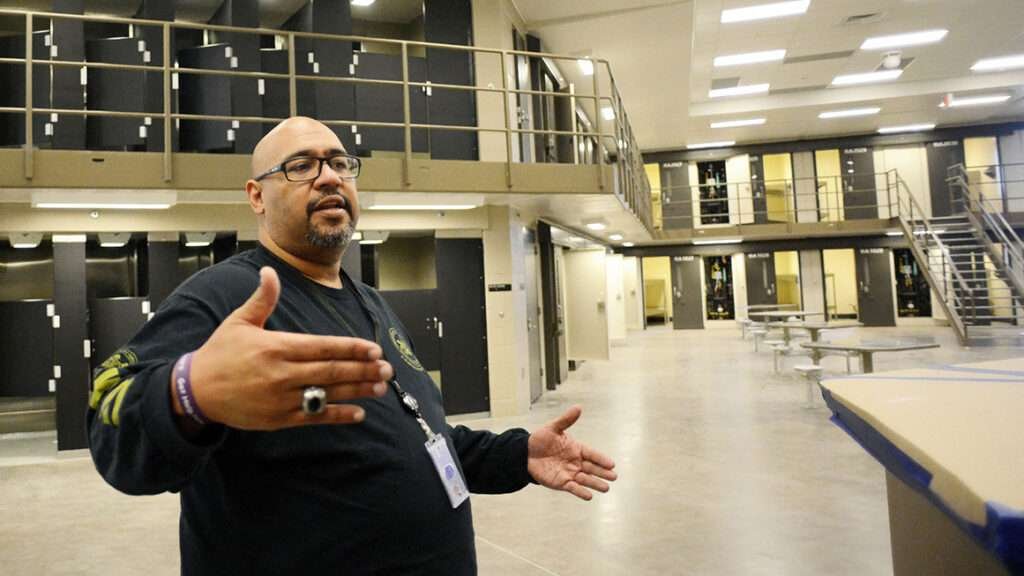
Wetzel had come up through the system as a correctional officer and jail warden, but he also had an academic interest in criminal justice policy and reform. He had been a football offensive line coach too, and he has a coach-brained enthusiasm for analytics and for determining where a system is breaking down. His early focus was on reforming Pennsylvania’s parole system, which, like the probation and parole systems in many other states, was returning a high number of offenders to state prisons for rule violations and recidivism.
In 2013, Wetzel got an interesting offer from Don Specter, the executive director of the Prison Law Office, a public interest law firm, and attorney for the lead plaintiff in the Plata case. Specter’s court-awarded attorney fees for Plata, which had dragged on for a decade, were substantial. Specter had teamed up with the Vera Institute of Justice and begun using the money to send prison officials, lawmakers, and other policymakers to tour European prisons.
No other country spends as much on incarceration as the U.S., and no one of any political stripe who has any familiarity with our prisons—correctional officers, lawmakers, incarcerated people—thinks we’re getting our money’s worth. But it’s hard to imagine what a better prison would look like.
Specter’s idea was simple: Don’t tell Americans that a more humane prison is possible. Show them.
Wetzel was skeptical at first. “I’m an ugly American,” he says. “I didn’t even really want to leave the country, and I didn’t think I had anything to learn.”
But when Wetzel and other officials toured prisons in Germany and the Netherlands, they were gobsmacked by the atmosphere in the units.
In Germany, prisoners wear their own clothes, cook their own food with real knives, are allowed generous family visits and furloughs, and earn regular wages for their work. They even have porcelain toilets in their rooms—unthinkable freedoms and luxuries in American prisons.
“Understand, I started as a 20-year-old kid as a part-time correctional officer. I learned the field from the ground up, and I never in my career experienced an environment that was solely focused on what’s the next best thing for these individuals, so when they get out they’ll be less likely to commit a crime,” Wetzel says. The inmates “didn’t really have the baggage of punishment. Our system is based on retribution. It’s just deserts. And that’s not an opinion. That’s what the Pennsylvania system is based on.”
Germany spends more per prisoner than the United States. But with far fewer prisoners and much shorter sentences, it can invest more in services and resources for inmates. Its recidivism rate hovers around 40 percent. According to the most recent report by the Bureau of Justice Statistics, 62 percent of U.S. prisoners released across 34 states in 2012 were arrested within three years, and 71 percent were arrested within five years.
Jennifer Doleac, an economist and the executive vice president of criminal justice at Arnold Ventures, argues that it’s more instructive to look at countries with closed prison models more similar to the U.S., such as Italy, which spends roughly the same amount per inmate. Italy’s prisons are also chronically overcrowded. But Italy has an institution near Milan, the Bollate Prison, which operates on an open model, where inmates can move about mostly unrestricted.
“There’s a restaurant there that the inmates run,” Doleac says. “People can cook for themselves. Some of them can leave during the day to go to work and come back. There’s more freedom, and I think the idea is that freedom and thus responsibility to use your time well begets rehabilitation.”
The medium-security prison screens inmates for rehabilitation potential and security risk but also takes random transfers from other overcrowded prisons. The clincher is the cost. The average annual expense per inmate of running Bollate is about $28,000 vs. $49,000 in other Italian prisons, which require more guards. For an economist such as Doleac, these kinds of findings are the mythical “free lunch”—a benefit without any apparent tradeoff.
Wetzel and other Americans returning from Europe wondered whether a unit like this would work in the U.S.
The trip had a disturbing coda. Shortly after arriving back in the U.S., Colorado Department of Corrections Executive Director Tom Clements was shot and killed on his doorstep. The main suspect was a troubled 28-year-old man who had recently been released from state prison. He would die in a police shoot-out two days later. Two years prior to Clements’ killing, the young man’s father had testified before the Colorado Legislature about how solitary confinement was eating away at his son.
Little Scandinavia in Pennsylvania
Looking over both the distant and the recent past, one could be forgiven for feeling pessimistic about the prospects of a European-style open prison being established in the United States. Even when American administrators sincerely believed they were in the business of redemption, such as at Eastern State and Lorton, they seemed inevitably to regress to a mean of brutality. True reformers like Osborne and Murton were sandbagged.
And on its face, the current political climate doesn’t look promising. After summer 2020 and the subsequent two-year spike in violent crime, the national bipartisan consensus on criminal justice reform collapsed in Washington, D.C. The country’s incarceration rate, which had dropped 31 percent from its 2009 peak, started to creep back up. On the Trump-dominated national stage, woke was dead and Alcatraz was declared alive.
Behind the scenes, though, criminal justice reformers kept quietly working in states both red and blue. State lawmakers may have changed the language they used to talk about their criminal justice systems, but they still saw the same glaring problems.
“We live in a world right now where there has been a fundamental change in how Americans think of the system, and there’s widespread recognition that it’s broken,” says Udi Ofer, a lecturer on public and international affairs at Princeton University and the former deputy national policy director of the ACLU.
Still, Kevin Bowman didn’t believe it when he first heard the news about a new experimental housing unit at State Correctional Institution (SCI) Chester, a medium-security prison near Philadelphia. “I thought it was a hoax, thought it was just talk, until I actually saw the construction going on at the unit,” he says.
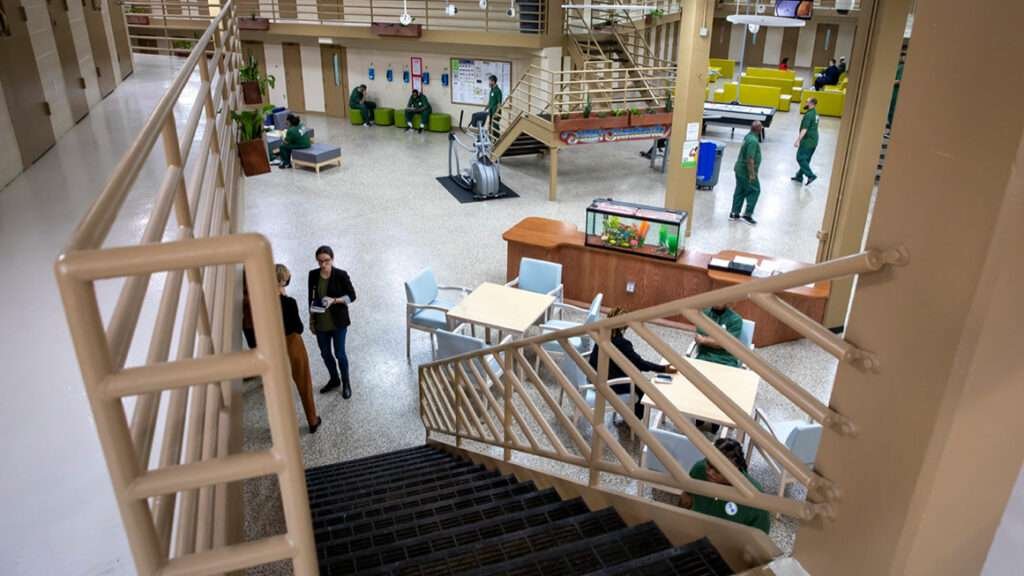
Bowman was serving a life sentence for first-degree murder. “At that point I’d been in jail for probably 30 years, and I’d seen the worst of the worst when it comes to the penal system,” he says.
But Wetzel and the Pennsylvania DOC had actually approved plans to build an open, European-style unit. It would become known as Little Scandinavia. The project, launched in 2019, was a joint effort among the Pennsylvania DOC, Kriminalvården (the Swedish Prison and Probation Service), and Kriminalomsorgen (the Norwegian Correctional Service).
Bowman was even more surprised when he was one of six lifers chosen by lottery to be the unit’s first residents. The “original six,” as they were called, were given the task of brainstorming with staff to come up with how the new unit would operate. (Older lifers are often used as unofficial mediators and stabilizing presences in prisons, since they have the highest stake of anyone in improving the environment.)
When Little Scandinavia officially opened in 2022, it was unlike anything else in the state prison system, or just about anywhere else in the country.
One of the most notable and immediate changes was the radically different relationship between staff and residents (not “inmates”). Ordinarily, there were strict policies about correctional officers’ interactions with inmates, as well as unwritten rules among inmates about talking with staff. “When I came upstate in 1990, there was an old way of doing things, and one of the ways was you didn’t deal with the staff,” Bowman says. “You stayed away from the staff, because you will either be labeled a snitch or a cooperator.”
But in the Little Scandinavia unit, Bowman says, he could sit with staff and talk about his day, or just play cards.
There was relatively unrestricted computer access, another stark difference from a typical prison. Bowman, a gearhead, enjoyed spending time on the internet looking up his dream car, a high-end “580 Mercedes or the 6.3 [liter engine].”
Residents were also paid decently for their work (relative to typical prison wages). Bowman says he could make up to $250 a month, or about $1.45 an hour for full-time work. The normal maximum wage in the state prison system is 50 cents an hour. They could use their money to order groceries and cook their own food. Bowman remembers one day when he and the other men in the unit gathered sheet pans from the kitchen and made banana pancakes from groceries they had ordered.
“That was a high for me,” Bowman says. “I hadn’t had banana pancakes in years.”
Bowman says the extra privileges were in some ways a sharper reminder that he was incarcerated than the privations he had experienced over the previous decades.
“It makes you cherish what you have,” Bowman says. “It makes you understand what you’re missing by being incarcerated, and you have a lot of moments of [thinking], ‘Man, if I’m ever let back out again, I’m going to do things this way. I’m going to do things that way.'”
Bowman got his shot. After 34 years in prison, he was exonerated in 2023 and released.
When Wetzel toured the finished unit, he asked one of the residents to describe to him what the housing unit was about. “He went through and described our vision,” Wetzel says. “I literally walked out and said, ‘I should quit today.’ It was a highlight of my career. You rarely see, especially in a big agency, something you want to translate down through the org chart and actually get interpreted accurately.”
To test whether the unit produces better outcomes than a traditional closed prison, Little Scandinavia residents are not chosen based on good behavior or other criteria. They are selected via lottery, ensuring that the unit reflects the general population of the medium-security prison. Data collection for this randomized trial will continue through the end of 2026, but the Brennan Center for Justice said in a recent report that residents and staff reported high levels of satisfaction. Furthermore, the report said the unit had “fewer disputes than others at SCI Chester, less misconduct, and decreased use of restrictive housing as a form of discipline. There’s also almost no violence. By comparison, facilities statewide experienced a 21.6 percent leap in violence in 2024, to the highest level in 30 years.”
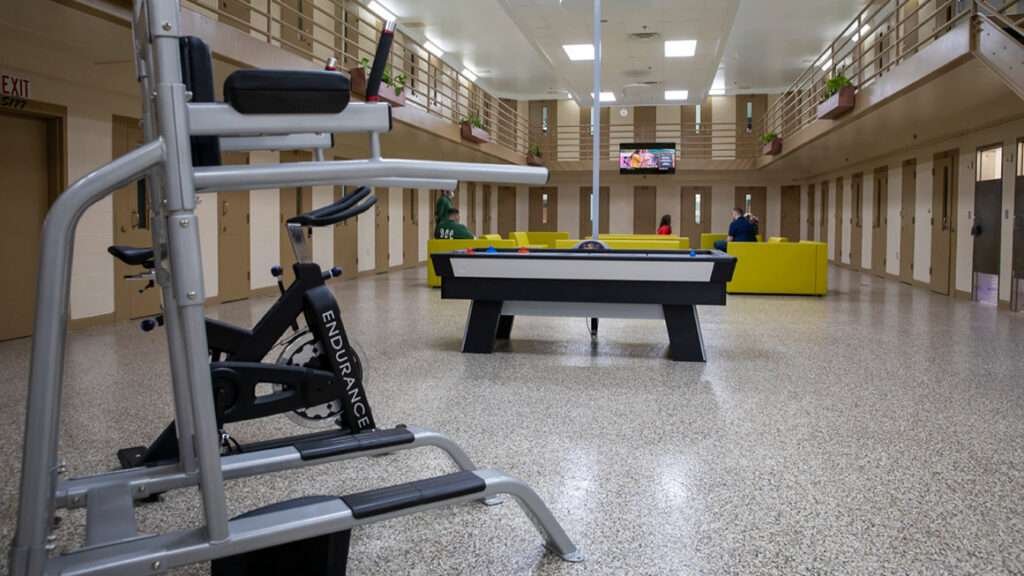
In February, Pennsylvania announced that it’s expanding the pilot program to three other state prisons. Several other states—Missouri, California, Arizona, Oklahoma, and Idaho—have launched similar pilot units.
Such units benefit not just the residents but the correctional officers working inside them. Corrections is a low-pay, high-stress job, and state prison systems were already struggling to retain staff before the COVID-19 pandemic. The trend accelerated during the pandemic, and it has not reversed. The Prison Policy Initiative reported that state prisons “lost 12% of their full-time workforce between 2013 and 2023, with nearly all (93%) of this decline coinciding with the pandemic.” The New Hampshire Department of Corrections reported a 48 percent vacancy rate for entry-level correctional officer roles in 2024. Florida and New York have both deployed National Guard soldiers to staff their prisons in recent years. These chronic staff shortages lead to more violence, delays in medical care, and states of permanent lockdown. It’s fair to say most correctional officers would rather work in an open unit like Little Scandinavia than a wing where angry inmates try to hurl feces at them.
“The feedback from staff has been so positive,” Doleac says. “People love working in these units, and in a context where a lot of prisons are really struggling to recruit and retain officers, that’s a big win.”
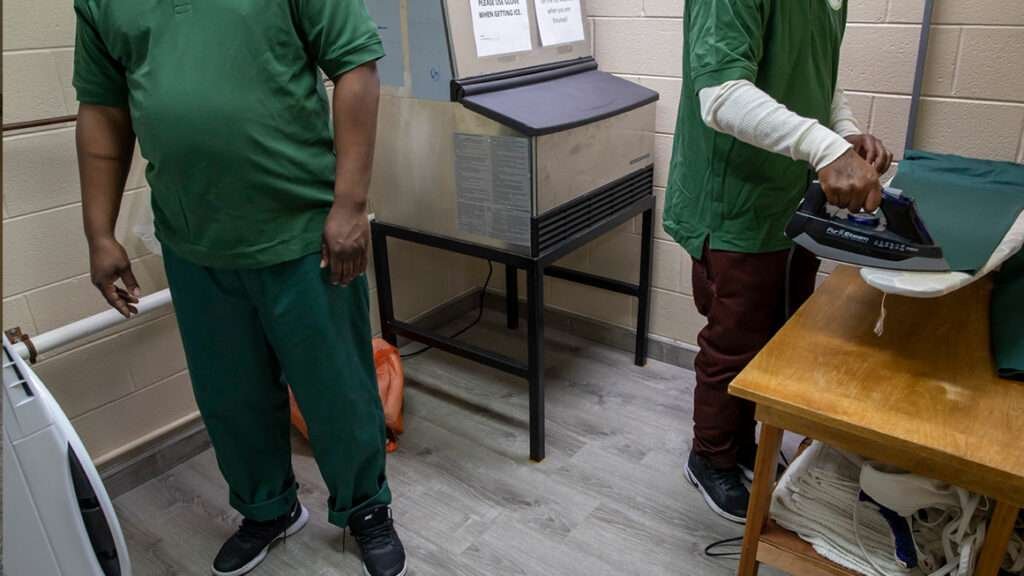
The experimental units still need to be subjected to controlled studies to see if they produce better outcomes than traditional closed prisons, but they at least represent an attempt to reinvent and reorient prisons toward dignity.
As a matter of principle and baseline constitutional standards, much of this is too little, too late. If a prison cannot humanely confine a person, then it must not confine a person. The easiest way to stop prisons from violating human rights is to stop sending people to those prisons.
We have the technology and experience to reduce our reliance on incarceration, and we’ve made significant strides in doing just that over the past decade and a half. The prison isn’t going anywhere as an institution, though, which means Americans must decide—and decide soon—if the next era will be a retrenchment toward the dungeons of yesteryear or an embrace of the spirit of prison reform.
Wetzel is not surprised that Pennsylvania, where the American prison experiment began, is where it is continuing, tempered by the difficult lessons learned over the past 250 years.
“I think that’s the DNA from Benjamin Rush and Ben Franklin and the Quakers,” he says. “I think that DNA is still here. We’ve got to wake it up.”
Read the full article here
Fact Checker
Verify the accuracy of this article using AI-powered analysis and real-time sources.