

 Freedom Index
Listen to the article
Reading bureaucratic correspondence is no one’s idea of fun. But on an otherwise unremarkable day at the British National Archives, I came upon a curious item: a 1972 diplomatic cable from the British embassy in Muscat, Oman, recounting a conversation with the American charge d’affaires. The subject was a certain Robert B. Anderson, President Dwight D. Eisenhower’s onetime treasury secretary, who had recently set up shop in Oman.
What caught my attention was not what the American diplomat said about Anderson, but what he refused to say. He would not dare utter Anderson’s name, referring to him only as “the man we don’t mention in the cables.” For the moment, I had to leave it aside, though I was careful to scrawl “look into Anderson” in my notes for a potential paper down the line.
I am a student of history at the University of Oxford, and my research focuses on intelligence networks in the Middle East and Africa, not America. Yet Anderson kept cropping up. Looking into him, I would soon realize, meant staring into the void.On paper, he was a respectable diplomat, a former treasury secretary whom Eisenhower twice considered presidential material. Outside the official record, he appeared to be something else: a spymaster, treasure hunter, wheeler-dealer, and deep state emissary. Then Anderson’s name popped up somewhere I did not expect: the newly released files on John F. Kennedy’s assassination.
Most coverage of the JFK files focused on the search for a “smoking gun” proving a conspiracy in Kennedy’s murder. Despite disappointments on that front—and the resulting lack of media fanfare around the files—the archives include many fascinating revelations about Cold War history. Anderson’s story is one of them, showing how long a shadow the U.S. government casts beyond its borders.
His official résumé is intriguing enough. Born in 1910 in Burleson, Texas, to cotton farmers, Anderson became a lawyer at 22 and immediately won a seat in the Texas House of Representatives. By the 1940s, Anderson was working for the oil industry, and caught the attention of the Eisenhower campaign in the 1950s.
Anderson’s reach extended well beyond Washington. After the Suez Crisis of 1956, Eisenhower sent him to the Middle East on what became known as the “Anderson Mission.” Presidents Kennedy, Lyndon B. Johnson, and Nixon would continue to appoint Anderson to various official positions. In 1964, Anderson was made a special ambassador to Panama to negotiate the canal’s future. He ultimately failed, having refused a rapid handover to Panama, and resigned in 1973.
After the Watergate scandal and Nixon’s resignation, it seemed that Anderson was locked out of the halls of power—at least British diplomats thought so. But over the years Anderson had built a formidable global consulting operation based out of One Rockefeller Plaza in New York City, with a Rolodex that included foreign heads of state and international tycoons.
By the 1980s, the image of Anderson as a respectable statesman had begun to crack. He became a lobbyist and consultant for Sun Myung Moon’s Unification Church—better known as “the Moonies”—and ran a curious bank in Anguilla, the Commercial Exchange Bank and Trust. Anderson was paid handsomely and discreetly for his services to Moon, with the money safely tucked away in a tax-free Caribbean environment.
In 1987, facing a federal investigation headed by U.S. Attorney for the Southern District of New York Rudy Giuliani, Anderson pleaded guilty to tax evasion and operating an unregistered offshore bank. In addition to laundering his own money, he had taken on clients, including at least one drug dealer. The only treasury secretary ever to have been convicted of a felony, Anderson was sentenced to a few months of house arrest and five years’ probation. He died two years later, in 1989. So ended his overt life.
But there were stories suggesting that his shadow career began much earlier.
One of the most extraordinary stories comes from historians Sterling and Peggy Seagrave. According to their account, shortly after World War II, Gen. Douglas MacArthur and Army intelligence Maj. Edward Lansdale discovered hidden vaults of Japanese war loot in caves north of Manila—the legendary stash that came to be known as “Yamashita’s Gold,” named after the last Japanese military governor of the Philippines. Anderson, then serving on the secretary of war’s staff, was supposedly with them. Rather than declare the treasure and return it to its rightful owners, the story goes, Anderson proposed placing the wealth into secret “black gold” bank accounts around the world for future covert operations.
This rumor has never been confirmed, but the JFK files did show that Anderson was running secret operations with dark money. In 1973, during the recriminations over the Watergate scandal, CIA Director William Colby had his subordinates report to him on all other potentially scandalous CIA activities. The collection of reports was dubbed the “family jewels.” One such memo to Colby, declassified as part of the JFK files, includes a paragraph on Anderson’s activities. During his diplomatic mission in Panama, with riots breaking out against the U.S. presence, Anderson contacted the CIA “offering to insert some $300,000 to try to secure a favorable result in the elections in Panama,” ostensibly from “American business interests.” The CIA turned down his offer—at least that time—according to the memo.
Panama was hardly an isolated venture. Through his international consulting practice, Anderson reportedly ran a worldwide network of informants and agents. Among his associates was Ghassan Shaker, whom Anderson would help insert into the inner sanctums of several Middle Eastern governments, according to archival records I came across. The Saudi-born, Cambridge-educated son of an Ottoman officer, Shaker had been recruited sometime during the 1960s in Beirut, where Anderson and notorious CIA spook Miles Copeland ran a firm called Interser, widely seen as a front for U.S. intelligence in the Middle East. By 1970, both Anderson and Shaker had descended on a little-known and newly independent former British protectorate.
In July 1970, a palace coup in Oman deposed Sultan Said bin Taimur by his 29-year-old son, Qaboos. The new sultan inherited a desperately underdeveloped country, an emerging oil boom, and a civil war against communist insurgents. He had few people he could trust. One was Tim Landon, a 27-year-old British officer who would become almost legendary in Middle Eastern intelligence circles. Although Landon and Qaboos had trained together at Sandhurst—the British equivalent of West Point—they really became friends when Landon arrived in Oman in 1966 as an officer contracted to the sultan’s army, Landon’s friends told me. The two bonded over opera and theater. Landon later helped plan Qaboos’ palace coup against his father; the only casualty was Sultan Said’s foot, wounded by a self-inflicted gunshot.
Anderson soon swooped in. Claiming to speak for the U.S. government and implying to the Omani side that he represented the CIA, Anderson assembled an advisory group for the young Sultan that included Shaker, Landon, and a Libyan asset for the CIA named Yehia Omar. After Moammar Gaddafi overthrew the monarchy in 1969, the CIA smuggled Omar out of Libya in a piano and on a U.S. Air Force plane, according to a cable from the British ambassador.
Local Omanis quickly dubbed Anderson’s circle the “Muscat Mafia.” Its members benefited immensely—and illicitly, according to the historian of Oman John Peterson—from the oil boom and all the lucrative government deals that sprang from it.
Anderson benefited substantially from the arrangement. Qaboos granted him an oil concession and even empowered him to award further oil and mineral concessions on the sultan’s behalf.
British diplomats were astonished. But they were also suspicious. London believed Anderson was trying to replace British influence in Oman with American influence. British diplomats recalled having run-ins with him in newly-independent Kuwait in the early 1960s and viewed his activities with alarm. One report recounts Anderson being asked, “Who is the Ruler of Oman anyway?” He answered, “I am.” Their suspicions about his objectives were right, as Anderson would later tell the press that he was in Oman to get it “out from under the dominance of the British.” He also acknowledged occasionally passing information to the CIA.
His presence in Oman, however, would be short-lived. Anderson told Qaboos that he had to leave because of his wife’s failing health. British officials suspected another explanation: the Watergate scandal and Anderson’s waning influence in the White House. In 1973, Anderson made a hasty exit from Oman, leaving behind the Muscat Mafia to carry on without him.
This did not mean the end of Anderson as the international fixer. He retained his New York office and his relations with world leaders and businessmen. (Anderson, in fact, was a guest at Qaboos’ official reception at the White House in 1983.) His friend Frank Rosenfelt, head of MGM Studios in the 1970s and early 1980s, told journalist Tom O’Neill that Anderson was invited by Egyptian President Anwar Sadat in 1981 to the annual military parade commemorating the Yom Kippur War. Anderson attended with his bodyguard, Reeve Whitson. From their seats, among other VIPs, the two men witnessed Sadat’s assassination up close.
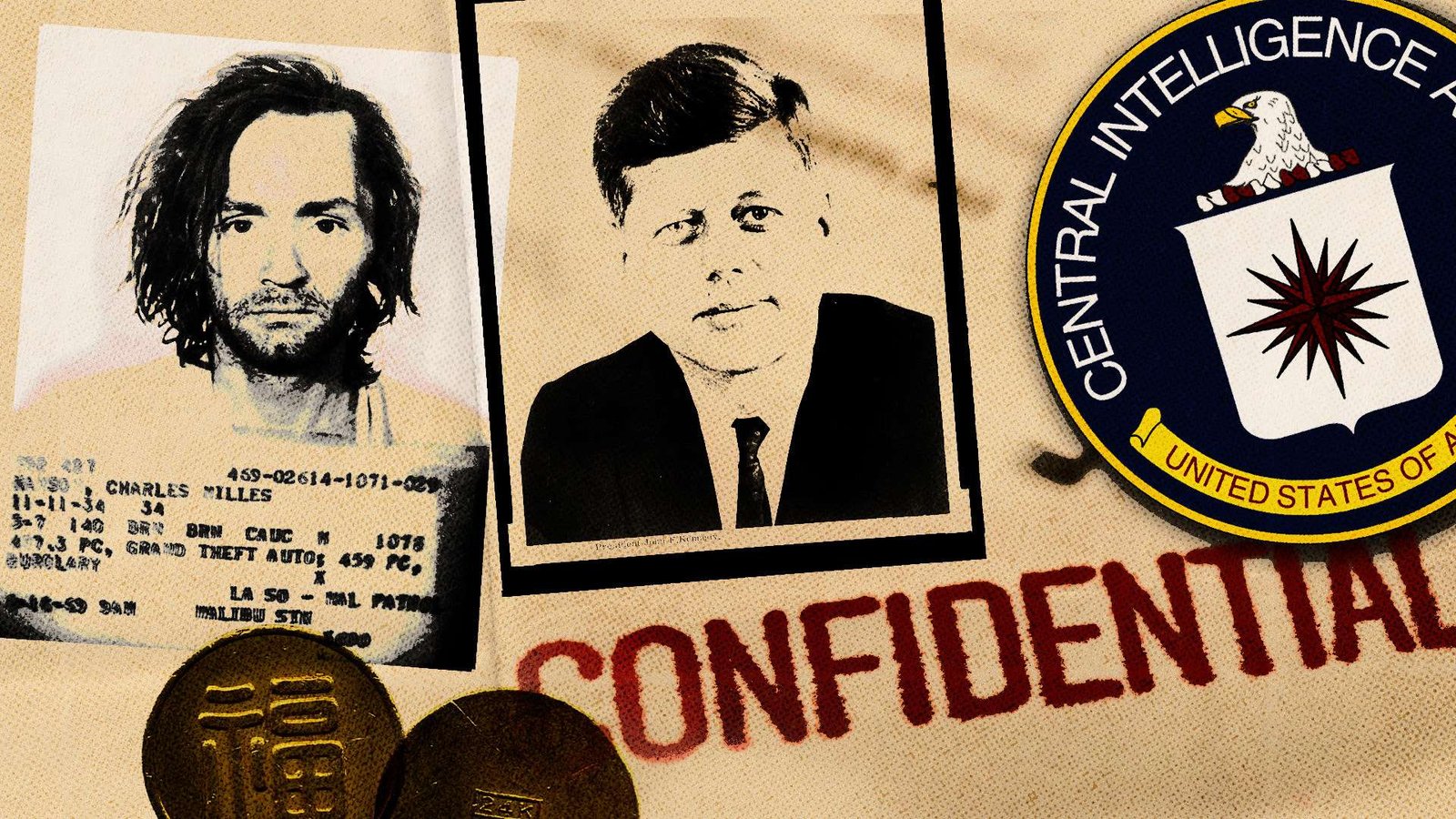
Sadat’s killing was not the only murder that Anderson and Whitson popped up in. O’Neill spent two decades researching the Manson Family killings for his bestselling 2019 book Chaos: Charles Manson, the CIA, and the Secret History of the Sixties. His research suggests that Whitson may have infiltrated the Manson cult as part of a covert CIA operation to discredit the antiwar movement.
According to the book, prosecutor Vincent Bugliosi sent Whitson to intimidate a witness, Shahrokh Hatami, a photographer and Manson victim Sharon Tate’s friend, with threats of deportation. O’Neill also suggests that Whitson knew about the murders before the police did: He reportedly told Hatami about the killings 90 minutes before anyone was called to the scene. He may even have had Tate’s house under active surveillance. Lt. Col. Paul Tate, Sharon’s father and an Army intelligence officer, conducted his own investigation into his daughter’s murder. He repeatedly bumped into Whitson, who always seemed to be one step ahead.
O’Neill, who obtained Tate’s unpublished manuscript and interviewed Whitson’s various friends and associates, collected so much information on Whitson that he couldn’t fit it all into the book. There was simply no room for any mention of Anderson, not even in the extensive endnotes. But O’Neill was kind enough to share some of his research with me, including his interview with Rosenfelt. That material leads back to Anderson.
Anderson’s papers at the Eisenhower Library include financial transfers made out to Whitson in the 1960s. Whitson, meanwhile, was involved in various investment schemes, including a Brigadoon-themed amusement park in Scotland and a maglev train running from Pasadena to Las Vegas, that seemed like barely concealed ways to launder money.
Then there is Panama again. Kenneth Rijock, a former cartel banker and author of The Laundry Man, says he came across Whitson there during the 1980s. According to Rijock, Whitson supervised the Panama leg of the Iran-Contra scheme from a CIA base known as “the Quarry.”
A few years ago, I sat down with a former senior State Department apparatchik who had joined the foreign service in the 1960s and served in Beirut. I was there to interview him about Oman and the Middle East, but before we finished, I could not resist asking one last question: “And what was Robert Anderson up to?”
He smiled, drew a zipper over his mouth, and said, “I could tell you, but then I’d have to kill you.”
Read the full article here
Fact Checker
Verify the accuracy of this article using AI-powered analysis and real-time sources.