

 Freedom Index
Listen to the article
The road to Silver Creek doesn’t so much end as dissolve. It narrows, the pavement crumbles, and soon you’re winding through the Sierra Nevada mountains, rarely passing another car. By the time you reach the campsite and walk down toward the river, the world has gone eerily quiet except for the rush of water. There are no buildings, no cell service, nothing to suggest that 175 years have passed since someone stood in these same foothills and changed California’s history.
I went with a group in late May to pan for gold. The most interesting question was not whether we would find any. It was whether, if we did, we would have the right to take it.
That’s the complex side of gold panning. The technique is ancient and almost comically simple. The property rights system surrounding it is not.
Brian, who asked not to be identified because he has a real job, is a hobby prospector and member of a local miners association. He was our guide for the day. Gold panning, he explains, depends on one fact: “Gold is heavy.” That’s why the technique has endured for centuries. Heavy material settles where water slows, so good prospecting means looking for places where water smashes against rocks, pools in coves, and leaves the densest minerals behind. It “puts you in the mind of a gold nugget,” Brian says, “to figure out where to look.”
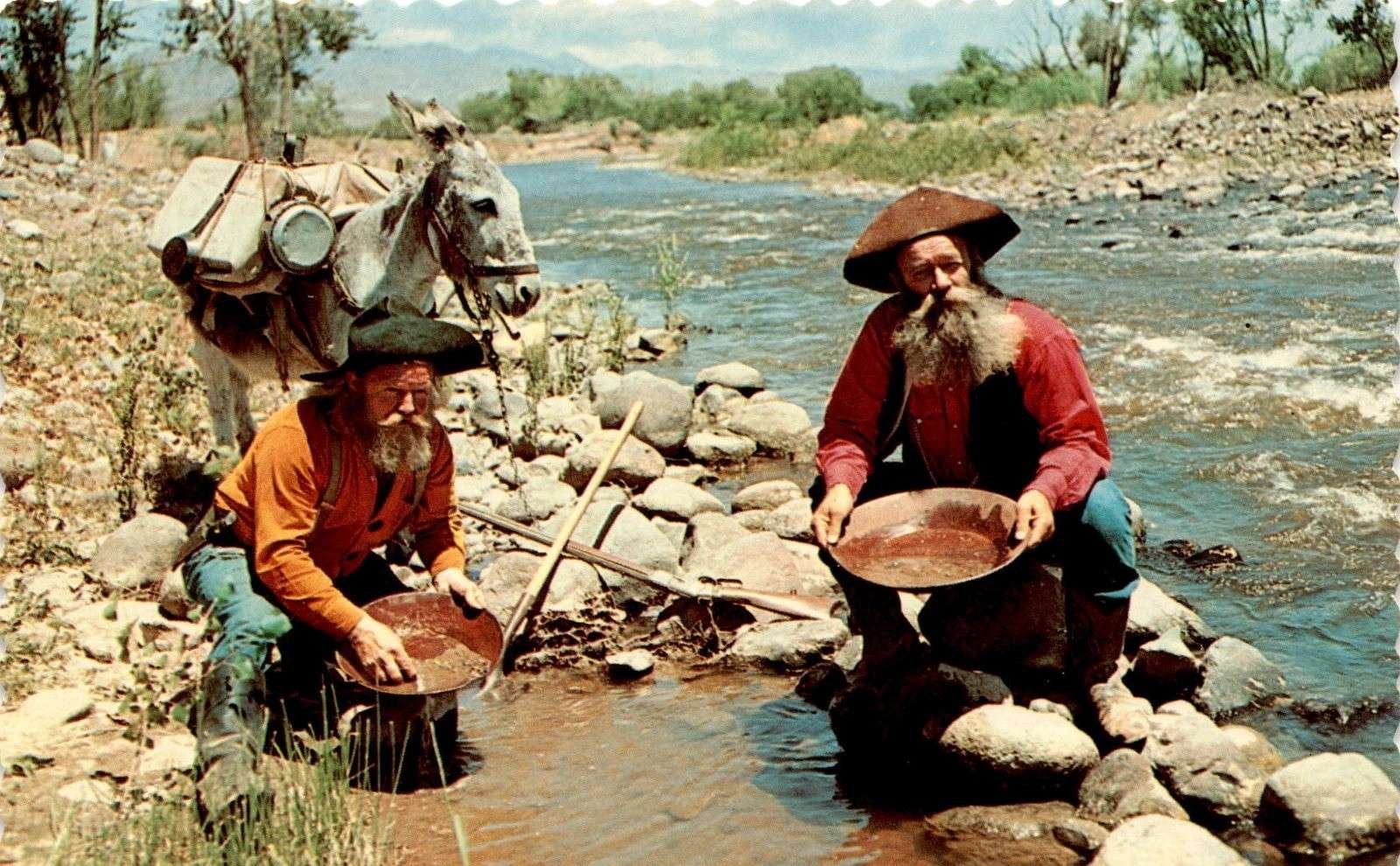
We shoveled the gravel from promising pockets along the riverbed, then used a bucket to scoop it into ridged pans. Add water. Swirl. Let the lighter sediment wash over the edge. Repeat. Repeat again. And again. The process is simple enough to teach in minutes and difficult enough to keep you absorbed for hours. After a while, what remains in the pan is mostly dark, heavy sand. If you are lucky, there is also a glimmer of gold.
We were lucky, but not very. Between the four of us, we found about nine flakes of gold no bigger than specks, which we had to pick up with tweezers and drop into a tiny glass tube. It would take years to accumulate anything worth refining. And even then, refining gold is a costly endeavor.
For Brian, the meager haul wasn’t a disappointment. The appeal is not primarily financial. “It’s a way to spend time outside,” he tells me. “I find it this interesting vestige of California history that you can still access.”
The original California Gold Rush is over, but this region of the state never stopped being Gold Country. Traces of that heritage can be seen in historic mining towns, active claims, tourist panning operations, local prospecting clubs, and hobbyists who spend weekends with pans, boots, and an improbable amount of optimism. Rising gold prices have given the pastime a new jolt, but most modern prospectors are not trying to get rich. They are trying to touch the myth that brought hundreds of thousands of people into these same foothills.
That myth began in January 1848, when James Marshall found gold at Sutter’s Mill along the American River, near present-day Sacramento. Within a year, word had spread across the country and beyond. The Gold Rush catapulted California toward statehood, transformed small mountain settlements into boomtowns, and energized the U.S. economy.
The Gold Rush was not only a scramble for wealth. It was also a scramble for rules.
Free gold created an immediate problem: Who had the right to take it? California was not yet a state when the rush began, and formal institutions could not keep up with the speed and scale of migration. A river full of gold could not remain an ungoverned commons for long. Without some recognized system of claims, every discovery risked becoming a fight. So miners made rules.
Brian describes early mining law as a rough, bottom-up system in which evidence that someone was already working an area could become the basis for a claim. It was, he says, “a loose system of property rights.”
This is the part of the frontier story that is often obscured by the Hollywood image of lawlessness. In The Not So Wild, Wild West, Terry L. Anderson and Peter J. Hill argue that the West was often shaped by “institutional entrepreneurs”—ordinary people who created rules to manage resources, encourage investment, and reduce conflict. “These institutional entrepreneurs saw opportunities in the abundant grass, scarce water, rich ore veins, and the geysers in Yellowstone, all of which offered rewards to those who could hammer out new rules,” they write. Gold mining was one of the clearest examples.
In crafting property rights rules, miners often had the knowledge that lawmakers lacked. They understood the terrain, the tools, the labor involved, and the ore. They knew what counted as abandonment and what kinds of disputes were likely to arise. They also had an incentive to create rules that others would respect. After all, a mining claim is useful only if other people recognize it. Property rights turned a free-for-all into something more stable: a system in which people could pan, work, trade, and settle disputes without constant conflict.
Over time, many of the local customs hardened into law. When territorial and state governments caught up, they often codified rules that mining communities had already developed. Eventually, federal law incorporated that bottom-up order as well.
Those rules still shape modern Gold Country, although the traces are harder to see now. The system is far more formal than it was in 1849, and not necessarily simpler. A promising creek may be closed because it sits inside a national park. A state park may allow panning, but only in certain areas. A piece of public land may be open to recreation but still subject to mining claims. Panning on private land requires permission. A basic pan may be allowed, but mechanized methods such as suction dredging may be restricted for environmental reasons.
Even where panning is authorized, permission can be difficult to untangle. “First, you have to look for who owns the land,” Brian says. “Even if the federal government has the land, then you have to look at who owns the rights to the minerals.”
“It’s difficult to figure out with all these layers whether you have the right to gold pan,” Brian adds, “so a quick shortcut is just to join one of these prospecting clubs.” For about $20 a month, he belongs to a club with claims up and down California, giving members a clearer path to access than trying to sort out every layer on their own.
Once prospectors reach the water, they also rely on maps, local memory, claim markers, and etiquette. Some stretches are open. Others are spoken for. No one needs a statute to know that you don’t jump another miner’s spot.
The mix of public law, private claims, voluntary associations, and informal norms is what makes modern gold panning more than a quaint hobby. It is a small surviving example of how property rights develop.
We did not get rich. The value of the gold we panned amounted to mere cents. But it pointed to something larger than the day’s haul. The Gold Rush did not just leave California with boomtowns, legends, and a state motto. It left behind a lesson in how property rights are born: not always from distant planning, but from ordinary people solving practical conflicts over valuable things.
Read the full article here
Fact Checker
Verify the accuracy of this article using AI-powered analysis and real-time sources.