Close Menu
FSNN | Free Speech News NetworkFSNN | Free Speech News Network
  • Home
  • News
    • Politics
    • Legal & Courts
    • Tech & Big Tech
    • Campus & Education
    • Media & Culture
    • Global Free Speech
  • Opinions
    • Debates
  • Video/Live
  • Community
  • Freedom Index
  • About
    • Mission
    • Contact
    • Support
Trending

Tether Sued Over Frozen ‘Pig Butcher’ Coins, 6,600 Students Get Crypto Loans: Asia Express

12 minutes ago

Bernie Sanders Pushes Bill to Ban Advanced AI Development

15 minutes ago

Congress Is Trying (Again) To Ban Boycotting Israel

39 minutes ago
Facebook X (Twitter) Instagram
Facebook X (Twitter) Discord Telegram
FSNN | Free Speech News NetworkFSNN | Free Speech News Network
Market Data Newsletter
Friday, September 4
  • Home
  • News
    • Politics
    • Legal & Courts
    • Tech & Big Tech
    • Campus & Education
    • Media & Culture
    • Global Free Speech
  • Opinions
    • Debates
  • Video/Live
  • Community
  • Freedom Index
  • About
    • Mission
    • Contact
    • Support
FSNN | Free Speech News NetworkFSNN | Free Speech News Network
Home»News»Media & Culture»Congress Is Trying (Again) To Ban Boycotting Israel
Media & Culture

Congress Is Trying (Again) To Ban Boycotting Israel

News RoomBy News Room39 minutes agoNo Comments5 Mins Read0 Views
Share Facebook Twitter Pinterest Copy Link LinkedIn Tumblr Email VKontakte Telegram
Congress Is Trying (Again) To Ban Boycotting Israel
Share
Facebook Twitter Pinterest Email Copy Link

Listen to the article

0:00
0:00

Key Takeaways

Playback Speed

Select a Voice

Congress keeps coming up with creative end-runs around the constitutional right to boycott. In 2017 and 2018, members of Congress from both parties unsuccessfully pushed a bill that would use export control laws to make encouraging boycotts of Israel punishable by 20 years in prison. Last year, a bipartisan coalition tried to ban “furnishing information” to an international boycott movement against Israel, only to postpone the vote due to opposition from the libertarian-leaning Rep. Thomas Massie (R–Ky.) and other Republicans.

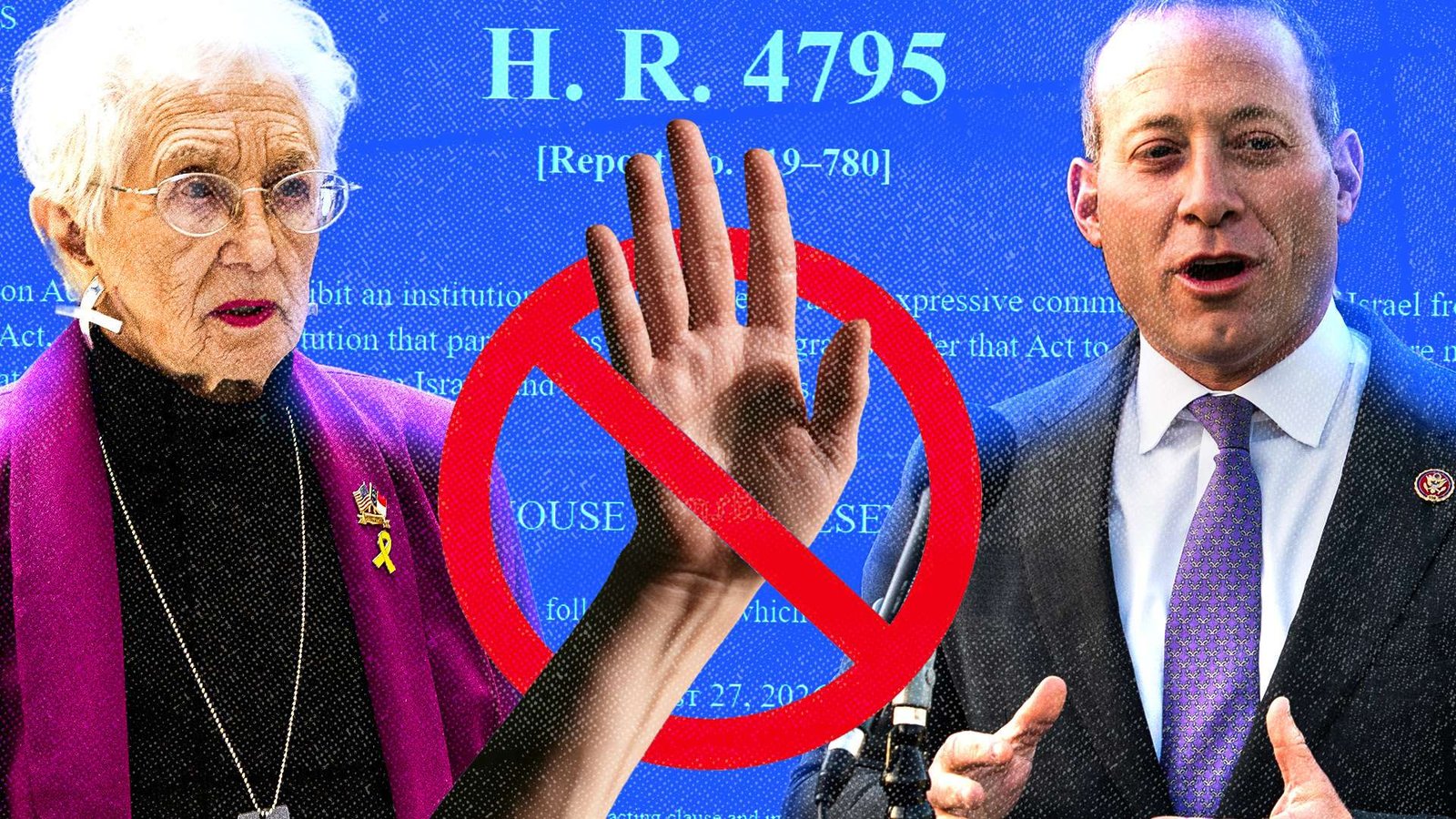
On Thursday, the House of Representatives passed the Protect Economic and Academic Freedom Act, sponsored by Reps. Virginia Foxx (R–N.C.) and Josh Gottheimer (D–N.J.). The bill would require federally funded universities to certify that they “will not engage in a nonexpressive commercial boycott of a major strategic partner of the United States.” It cites only one definition of “major strategic partner,” Section 4 of Public Law 113–296, which states: “It is the sense of Congress that Israel is a major strategic partner of the United States.”

The bill still has to pass the Senate to reach the president’s desk.

Foxx stated that the bill “severs any possible taxpayer support of these concrete campaigns of antisemitism in the form of BDS and academic boycotts of Israel,” using the acronym for the Palestinian-led Boycott, Divest, Sanctions movement. But Lara Friedman, president of the nonprofit Foundation for Middle East Peace, points out that the bill goes far beyond controlling taxpayer funds.

The bill would create a cause for lawsuits under the False Claims Act against universities accused of boycotting U.S. partners, Friedman writes. By making universities “prove a negative” to avoid getting sued, the bill will force them into “prioritizing maximal engagement” with those partners, she adds. In other words, the Protect Economic and Academic Freedom Act would create a kind of affirmative action for foreign nations.

And the congressional report attached to the bill is an all-out attack on Americans’ constitutional right to withhold their money. It argues that the First Amendment “protected the expressive activities accompanying a boycott, not the commercial decision itself to refuse to do business with a particular entity.” Friedman calls it “an alarming and novel interpretation of the Supreme Court’s prior decisions,” which “renders the whole notion of a ‘right to boycott’ meaningless, with alarming implications going far beyond Israel-Palestine issues.”

Several supporters of Israel who otherwise oppose BDS came out against the Protect Economic and Academic Freedom Act, including Rep. Jerry Nadler (D–N.Y.) and the lobby group J Street, which stated that it “believes the most effective way to counter antisemitism on college campuses is through open debate, education, and renewed efforts to achieve a peaceful resolution to the Israeli-Palestinian conflict—not through punitive legislation aimed to curb the freedom to boycott.”

Friedman, Nadler, and J Street also pointed out that the bill’s definition of “Israel” would seem to include Israeli settlements in the Palestinian territories, making selective boycotts of a specific Israeli policy illegal. And that isn’t a theoretical concern. When the ice cream company Ben & Jerry’s announced in 2021 that it would pull out of the settlements while continuing to do business inside Israel proper, several states punished Ben & Jerry’s under their own state-level anti-boycott laws.

A decade ago, the Israeli government began an all-out campaign to counter the BDS movement in America, especially on college campuses. In 2015, the Israeli parliament held a hearing on the international threat of BDS, and future Foreign Minister Yair Lapid warned that a foreign boycott of settlements could “de-facto create a boycott on Israel in all kinds of places.” The newly created Ministry of Strategic Affairs was given a $36 million budget to combat BDS, and the 2019 documentary The Lobby USA found the ministry coordinating with campus-focused activist groups in America.

Several American student councils have voted to cut ties with Israel in response to the war in Gaza—including at Yale University and several University of California campuses—although none of those schools followed through. The Protect Economic and Academic Freedom Act would specifically forbid universities from pulling out of “conferences, teaching exchanges, cultural exchanges, study abroad programs, joint research, and other collaborative educational activities” with U.S. partners.

After the 2024 wave of campus protests, Foxx and Gottheimer took up the mantle of fighting anti-Israel student activism. Foxx has been investigating whether the protesters “have financial ties to designated Foreign Terrorist Organizations,” her office told Reason in May 2024. Meanwhile, Gottheimer pushed the Department of Education to investigate high schoolers for antisemitism and tried to force social media companies to stamp out “terrorist” content.

The Trump administration also used executive powers against the BDS movement. Most notably, it imposed economic sanctions on Italian academic Francesca Albanese, who wrote a report for the United Nations advocating boycotts and legal actions against companies that do business with the Israeli military. Albanese, who is suing the U.S. government over the sanctions, was banned from visiting her American children and had her husband’s apartment in Washington seized by the U.S. Treasury.

While these measures have been focused on Israel’s opponents, they’ve opened the door to force Americans to do business with all kinds of entities. States have built on their anti-BDS laws to ban boycotts of the fossil fuels, mining, agriculture, timber or firearms industries, or even companies with anti-LGBT and anti-abortion policies.

“The road to erasing [the] US right to free speech/protest of ANYTHING in the US is quite literally being paved with laws to protect/promote Greater Israel/Israeli impunity,” Friedman writes.

Read the full article here

Fact Checker

Verify the accuracy of this article using AI-powered analysis and real-time sources.

Get Your Fact Check Report

Enter your email to receive detailed fact-checking analysis

5 free reports remaining

Continue with Full Access

You've used your 5 free reports. Sign up for unlimited access!

Already have an account? Sign in here

#CivicEngagement #NarrativeControl #PoliticalCoverage #PoliticalMedia #PoliticalNews
Share. Facebook Twitter Pinterest LinkedIn Tumblr Email Telegram Copy Link
News Room
  • Website
  • Facebook
  • X (Twitter)
  • Instagram
  • LinkedIn

The FSNN News Room is the voice of our in-house journalists, editors, and researchers. We deliver timely, unbiased reporting at the crossroads of finance, cryptocurrency, and global politics, providing clear, fact-driven analysis free from agendas.

Related Articles

Cryptocurrency & Free Speech Finance

Bernie Sanders Pushes Bill to Ban Advanced AI Development

15 minutes ago
Cryptocurrency & Free Speech Finance

Utah Becomes First State to Target VPNs in Age-Verification Crackdown

1 hour ago
Media & Culture

Trump’s Beef Tariff Cut Accidentally Makes the Case for Free Trade

2 hours ago
Cryptocurrency & Free Speech Finance

Bitcoin Miner Ditches Site for AI Deal That Could Top $1.2 Billion

2 hours ago
Media & Culture

This U.S. Citizen Is Suing ICE for Arresting Him 3 Times. His Lawsuit Is Moving Forward.

3 hours ago
Cryptocurrency & Free Speech Finance

What Is Pons? The Robinhood Chain Meme Coin Factory Token Up 18,000% Since July

3 hours ago
Add A Comment
Leave A Reply Cancel Reply

Editors Picks

Bernie Sanders Pushes Bill to Ban Advanced AI Development

15 minutes ago

Congress Is Trying (Again) To Ban Boycotting Israel

39 minutes ago

BitMEX co-founder contributed 75% of Reform UK’s donations in Q2 2026

1 hour ago

Utah Becomes First State to Target VPNs in Age-Verification Crackdown

1 hour ago
Latest Posts

Trump’s Beef Tariff Cut Accidentally Makes the Case for Free Trade

2 hours ago

CFTC Files to Dismiss CME Lawsuit over Crypto Perpetual Futures

2 hours ago

Bitcoin Miner Ditches Site for AI Deal That Could Top $1.2 Billion

2 hours ago

Subscribe to News

Get the latest news and updates directly to your inbox.

At FSNN – Free Speech News Network, we deliver unfiltered reporting and in-depth analysis on the stories that matter most. From breaking headlines to global perspectives, our mission is to keep you informed, empowered, and connected.

FSNN.net is owned and operated by GlobalBoost Media
, an independent media organization dedicated to advancing transparency, free expression, and factual journalism across the digital landscape.

Facebook X (Twitter) Discord Telegram
Latest News

Tether Sued Over Frozen ‘Pig Butcher’ Coins, 6,600 Students Get Crypto Loans: Asia Express

12 minutes ago

Bernie Sanders Pushes Bill to Ban Advanced AI Development

15 minutes ago

Congress Is Trying (Again) To Ban Boycotting Israel

39 minutes ago

Subscribe to Updates

Get the latest news and updates directly to your inbox.

© 2026 GlobalBoost Media. All Rights Reserved.
  • Privacy Policy
  • Terms of Service
  • Our Authors
  • Contact

Type above and press Enter to search. Press Esc to cancel.

🍪

Cookies

We and our selected partners wish to use cookies to collect information about you for functional purposes and statistical marketing. You may not give us your consent for certain purposes by selecting an option and you can withdraw your consent at any time via the cookie icon.

Cookie Preferences

Manage Cookies

Cookies are small text that can be used by websites to make the user experience more efficient. The law states that we may store cookies on your device if they are strictly necessary for the operation of this site. For all other types of cookies, we need your permission. This site uses various types of cookies. Some cookies are placed by third party services that appear on our pages.

Your permission applies to the following domains:

  • https://fsnn.net
Necessary
Necessary cookies help make a website usable by enabling basic functions like page navigation and access to secure areas of the website. The website cannot function properly without these cookies.
Statistic
Statistic cookies help website owners to understand how visitors interact with websites by collecting and reporting information anonymously.
Preferences
Preference cookies enable a website to remember information that changes the way the website behaves or looks, like your preferred language or the region that you are in.
Marketing
Marketing cookies are used to track visitors across websites. The intention is to display ads that are relevant and engaging for the individual user and thereby more valuable for publishers and third party advertisers.