Close Menu
FSNN | Free Speech News NetworkFSNN | Free Speech News Network
  • Home
  • News
    • Politics
    • Legal & Courts
    • Tech & Big Tech
    • Campus & Education
    • Media & Culture
    • Global Free Speech
  • Opinions
    • Debates
  • Video/Live
  • Community
  • Freedom Index
  • About
    • Mission
    • Contact
    • Support
Trending

My New USA Today Article On Dangerous Similarities Between “Democratic Socialists” and MAGA Nationalists

2 minutes ago

The yen is surging and it’s helping bitcoin, for now

33 minutes ago

Wallet Recovery Experts Crack $1B ETH Wallet… But Find Just $10

38 minutes ago
Facebook X (Twitter) Instagram
Facebook X (Twitter) Discord Telegram
FSNN | Free Speech News NetworkFSNN | Free Speech News Network
Market Data Newsletter
Thursday, September 3
  • Home
  • News
    • Politics
    • Legal & Courts
    • Tech & Big Tech
    • Campus & Education
    • Media & Culture
    • Global Free Speech
  • Opinions
    • Debates
  • Video/Live
  • Community
  • Freedom Index
  • About
    • Mission
    • Contact
    • Support
FSNN | Free Speech News NetworkFSNN | Free Speech News Network
Home»News»Global Free Speech»Malta: The fight for justice for Daphne Caruana Galizia must continue
Global Free Speech

Malta: The fight for justice for Daphne Caruana Galizia must continue

News RoomBy News Room2 hours agoNo Comments4 Mins Read0 Views
Share Facebook Twitter Pinterest Copy Link LinkedIn Tumblr Email VKontakte Telegram
Malta: The fight for justice for Daphne Caruana Galizia must continue
Share
Facebook Twitter Pinterest Email Copy Link

Listen to the article

0:00
0:00

Key Takeaways

Playback Speed

Select a Voice

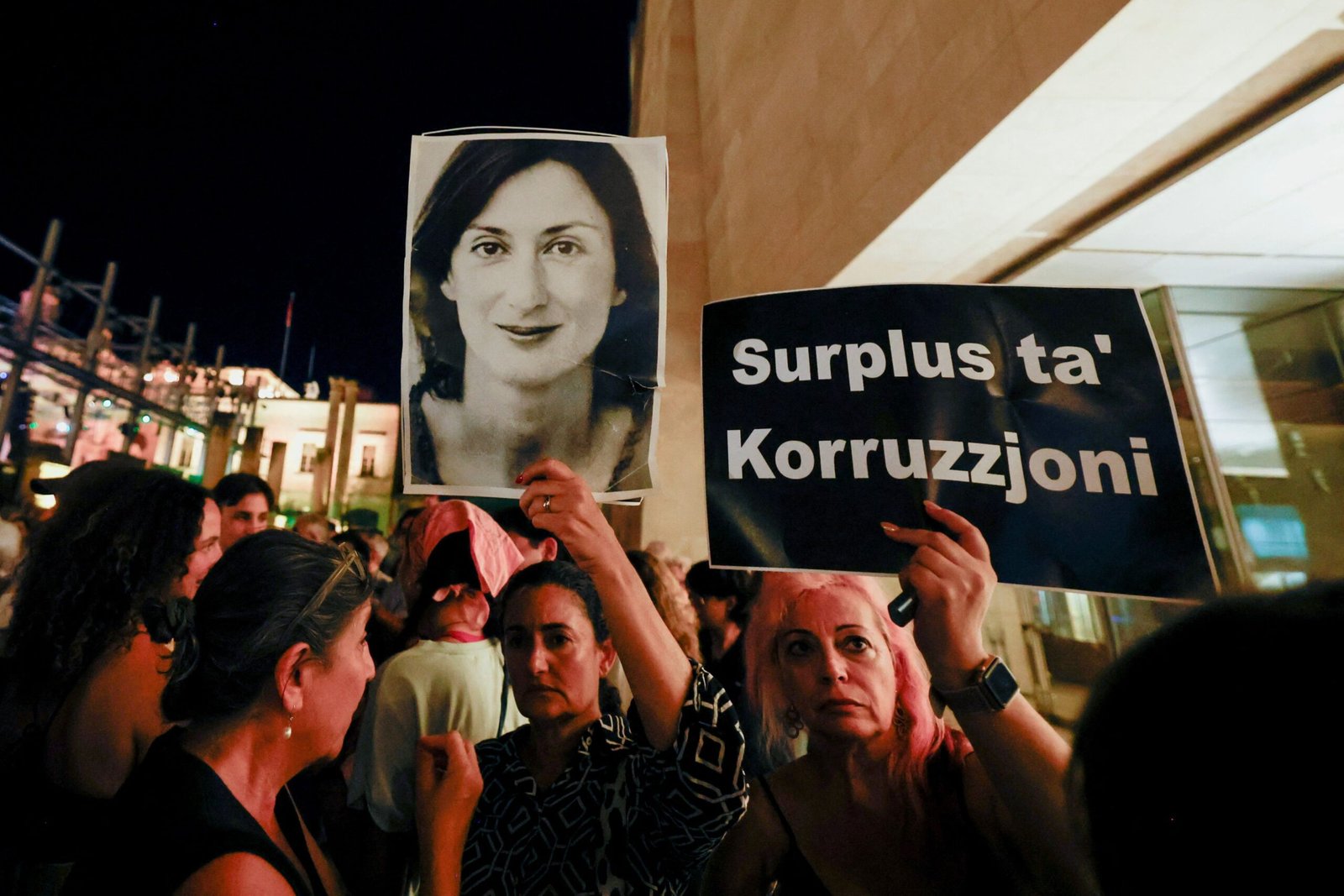
VALLETTA, September 3, 2026—Almost nine years after investigative journalist Daphne Caruana Galizia was assassinated in a car bomb, Malta has still not convicted the person or people who orchestrated her horrific murder, setting a terrible precedent that will resonate across Europe. 

On Wednesday, following an emotional trial that lasted 55 days and gripped the nation, a jury acquitted businessman Yorgen Fenech, who had been accused of masterminding Caruana Galizia’s murder in October 2017, on two counts of complicity and criminal association. When the verdict was read, many people gasped, while others burst into tears. Fenech, who had pleaded not guilty, left the courtroom after the ruling.

While the prosecution is expected to appeal, the verdict was devastating for Caruana Galizia’s family, whose long campaign for justice had already exposed failings by the Maltese state, with a public inquiry concluding that the assassination was both predictable and preventable. 

“Yesterday’s verdict means that almost nine years after Daphne Caruana Galizia’s assassination sent shockwaves through Europe, Malta has still not convicted the person who orchestrated the crime. It is heartbreaking for her family, who have campaigned tirelessly for justice. And it is also devastating for all journalists who seek to hold the powerful to account, in Malta and right across the continent, ” said CPJ’s deputy director of advocacy Tom Gibson, who was in the Maltese capital Valletta for the verdict. 

“Malta has made many promises about journalism safety and upholding the rule of law in the years since her murder but has yet to deliver on most of them. That is unacceptable. We will continue to campaign for reform, and to stand by Daphne Caruana Galizia’s family until justice is served.”

After the ruling, Caruana Galizia’s family said Daphne had been denied the justice she deserved. 

“Today should have belonged to Daphne. Her dreams and ours were shattered when she was killed outside her family home, aged just 53,” the family said in a statement. “During Fenech’s months-long trial, we have heard many people speak, but we will never see or hear Daphne again. Accountability is now overdue for all those who enabled, facilitated, or protected her murderers.”

‘We cannot give up’

Before her murder, Caruana Galizia, who reported extensively on corruption, money laundering, organized crime, and political misconduct in Malta, was subjected to an orchestrated campaign of harassment and vilification by the Maltese government, including legal intimidation, to silence her reporting.

For Herman Grech, editor-in-chief of the Times of Malta, which covered the trial extensively, the fundamental question remains unanswered.

“Someone ordered a journalist to be killed, and nobody has been convicted of doing so. This is devastating for press freedom and sends a chilling message to journalists who confront powerful interests. But we cannot give up. We will not give up,” he told CPJ.

Setback on long road to justice

The Fenech trial represented a major milestone in the years-long search for justice. 

In 2019, a suspected facilitator of Caruana Galizia’s murder received a presidential pardon in exchange for naming those responsible. Since then, five people have been found guilty and jailed for orchestrating or carrying out the murder.

After pressure from the Caruana Galizia family and international institutions, the Maltese authorities set up a separate public inquiry in 2019 to independently examine the circumstances of the murder. Its report said the Maltese state had created an atmosphere of impunity, failed to recognise the risks to Caruana Galizia’s life and did not take measures to protect her. The Maltese authorities have still not implemented most of the inquiry’s recommendations and have not undertaken meaningful press freedom reforms.

The Daphne Caruana Galizia Foundation has said that the failure of Maltese authorities to address the corruption and abuse of power that Caruana Galizia exposed, and that other Maltese journalists continue to investigate, contributes to an environment of insecurity and uncertainty for journalists.

In October 2025, CPJ and other press freedom groups called on Malta to set up a national action plan on media freedom and journalist safety and provided a broad set of recommendations as part of a public consultation set up by the Maltese government. 

Wednesday’s verdict does not represent an end point in the fight for accountability and justice. CPJ will continue to stand by Caruana Galizia’s family as they push for justice and will continue to demand that the Maltese authorities deliver on promises to guarantee journalists’ safety and uphold the rule of law. 

Watch Tom Gibson’s reflections from Valletta here.

Read the full article here

Fact Checker

Verify the accuracy of this article using AI-powered analysis and real-time sources.

Get Your Fact Check Report

Enter your email to receive detailed fact-checking analysis

5 free reports remaining

Continue with Full Access

You've used your 5 free reports. Sign up for unlimited access!

Already have an account? Sign in here

Share. Facebook Twitter Pinterest LinkedIn Tumblr Email Telegram Copy Link
News Room
  • Website
  • Facebook
  • X (Twitter)
  • Instagram
  • LinkedIn

The FSNN News Room is the voice of our in-house journalists, editors, and researchers. We deliver timely, unbiased reporting at the crossroads of finance, cryptocurrency, and global politics, providing clear, fact-driven analysis free from agendas.

Related Articles

Global Free Speech

Defamation charges filed against 2 Peruvian journalists in connection with their reporting

1 hour ago
Global Free Speech

Ricardo Zúñiga shot dead in Puebla, sixth Mexican journalist killed in less than three months

3 hours ago
Global Free Speech

Joshua Wong has spent more than 2,000 consecutive days behind bars More than a decade ago, Hong Kong watched a bespectacled teenager emerge from a student movement and become one of the most recognisable voices of his generation. Joshua Wong was barely old enough to vote when much of the world learned his name. He devoted his adolescence and then his twenties to arguing that Hong Kong people should have a say in their own future. Today, he is 29. He has spent more than 2,000 consecutive days behind bars. And after pleading guilty to another national security charge, he once again doesn’t know when – or whether –he will be free. I met Joshua in 2013, when he was 16 and I was 14. He had recently helped lead a student movement opposing the Hong Kong government’s attempt to introduce Chinese nationalist education into our schools. He was sharp, stubborn, and unapologetic. Most importantly to those of us who were younger, he seemed entirely unconvinced by the idea that being young meant we should remain quiet. Joshua Wong speaks to US congressmen in 2019 Joshua believed we had every right to speak about the future because it was our future too. He went on to become one of the student leaders of the 2014 Umbrella Movement and later co-founded Demosistō, a political party advocating self-determination for Hong Kong. Arrests, court appearances, and prison sentences gradually became part of his life. Then, in November 2020, Joshua entered prison and didn’t come home. The Hong Kong outside his cell has changed almost beyond recognition since then. Newspapers have been forced to close down. Civil society organisations and political groups have disbanded. Democracy activists have been imprisoned or driven into exile, like me. Books disappeared from shelves. People have deleted old social media posts, withdrawn from political life, and learned to choose their words more carefully. Hong Kong’s freedoms haven’t disappeared only through arrest and prosecutions. They’ve disappeared through the fear those prosecutions create. And slowly, Joshua himself has been made to disappear from everyday life. In January 2021, while already detained, he was arrested under the National Security Law for participating in an unofficial primary election held the previous year. He was eventually sentenced to four years and eight months in that case. He had been expected to complete his existing prison term in January 2027. But the authorities weren’t finished with him. In June 2025, while Joshua was still incarcerated, police arrested him again. This time, prosecutors accused him of conspiring to “collude with foreign forces” through international advocacy. He has now pleaded guilty to the charge. His sentencing remains ahead of him, and in cases deemed sufficiently grave, the offence can carry life imprisonment. It would be easy to regard this as simply another prosecution of a prominent Hong Kong democracy activist. That would miss the larger point. Joshua’s case matters not only because the authorities have deprived one man of his freedom. It matters because of what his prosecution tells everyone who once exercised the freedoms Hong Kong was supposed to protect. The prosecution has reached back into Joshua’s public life: his speeches, media interviews, campaigns, social media posts, and meetings with foreign politicians – all before the NSL existed – and presented them as the background to the charge. These weren’t secret acts. They were part of Hong Kong’s public political life. Joshua spoke openly. He met politicians openly. He gave interviews openly. He advocated internationally in full view of the government and the world. A society doesn’t have to formally outlaw every opinion to make people afraid to express one. All it has to do is demonstrate what might happen to those who speak too loudly. This is what makes Joshua’s prosecution bigger than Joshua. The authorities don’t need to imprison every young Hong Konger who attended a protest, who campaigned for democracy, spoke to a journalist or posted on social media. They only need to make an example of someone everybody remembers doing so. They know this well. Joshua was proof to my generation that a teenager’s voice could matter. His imprisonment risks being turned into proof of the opposite: that speaking can follow you for years; that yesterday’s advocacy can become tomorrow’s evidence; and that even after one sentence ends, another can be waiting in the docks. This is how censorship moves beyond newspaper offices and political organisations and takes up residence in people’s minds. People learn to silence themselves, beating the authorities to the punch. For those of us who knew Joshua when we were kids, that transformation is particularly painful. We grew up believing that using our voices was an act of citizenship, and Joshua taught us that. Joshua’s case now poses another question for us: will we learn the lesson his jailers want to teach us – or will we remember the one Joshua taught us first. Frances Hui is the policy and advocacy manager at the Committee for Freedom in Hong Kong Foundation. READ MORE

21 hours ago
Global Free Speech

Journalist İrem Delice arrested in Turkey on suspicion of ‘spreading disinformation’

1 day ago
Global Free Speech

Guidance on public photography should be shared with everyone in the UK not just asylum seekers. Photo: Getty Images for Unsplash+ Asylum seekers in the UK are being misled by the Home Office over laws about photographing people in public places and are being threatened that their asylum claims might be refused and could be kicked out of the country. On 19 August, the Home Office issued a poster entitled “Do not photograph or film people in public” as part of a series of guidance over consequences of behaviour for those seeking asylum. The poster is part of a nine-page booklet that aims to help asylum seekers understand what is expected of them when living in the UK and covers issues such as sexual consent and domestic abuse. The release of the booklet is controversial because the guidance it contains applies to everyone in the UK and not just asylum seekers. Its publication now could be seen as a politically motivated sop to those who want to crack down on all immigration, even though Britain is legally bound to admit genuine refugees. In the introduction, the Home Office says, “We understand that coming to a new country can be difficult, and that laws and customs here may be different from your home country.” The poster says, “In the UK, you should not take pictures or videos of someone without their permission. This includes taking pictures or videos in public spaces, like streets of parks, or in private spaces, like at home.” However, the poster is misleading. There is a common misconception that photographing people in public places without their consent is illegal. It is not. There are some situations where there are restrictions, for example where photography is restricted by law, such as outside military facilities where photography is prohibited because of national security concerns. Photography is also not permitted where an individual has a reasonable expectation of privacy, such as in the changing room of a clothes shop. Many commercial, privately owned spaces also have rules regarding photography. Sheffield’s Meadowhall shopping centre, for example, says filming and photography is not permitted unless authorised. Where there are no restrictions, consent is not required by law but many legitimate street photographers follow codes of conduct where they might seek consent. The Royal Society of Photographers, for example, recommends that “particular care should be taken when photographing children and vulnerable people, with consideration given to consent, safeguarding, privacy and the potential impact of making or sharing an image”. It adds, “Photographers should also consider how images of identifiable people are subsequently used, especially where their use could imply endorsement or raise concerns about commercial exploitation.” Repeated photography of a person without their consent could be illegal if it crosses into harassing behaviour that is likely to cause alarm or intimidation. This is banned by the Protection from Harassment Act 1997. Photographers must also not share pictures of a sexual nature, for example upskirting, without the subject’s permission. This is banned under the Criminal Justice and Courts Act 2015. When asked about the poster, a Home Office spokesperson said: “We expect everyone who comes to the UK to abide by our laws. If they do not, they will face consequences, including the refusal of their asylum claim and removal from the UK.” They added, “These resources were produced for asylum seekers so there can be no possible misunderstanding of what we expect. The poster is designed to communicate two separate messages: Firstly, that individuals should not take photographs of others without their consent. Secondly, that sharing photographs or videos of a sexual nature without someone’s permission is a serious criminal offence.” There are subtle indications that the Home Office knew that what it was publishing was incorrect. Looking at the poster closely, it appears that the word “should” has been added later, suggesting that it previously said “must” – the font used is subtly different (see below). The information contained in a new Home Office poster is incorrect The Home Office did not respond to our request for comment when we asked about this. The spokeperson said of the poster, “It does not suggest that you can go to prison for taking someone’s photo in public.” There are nuances of English grammar at play here. One person who commented on the BPPA’s statement on Instagram said, “It doesn’t say there’s a legal requirement not to? It says you shouldn’t which to be quite frank is good, if simplified, advice for asylum speakers for whom English is not a first language.” However the heading of the poster is unequivocal. It says, “Do not”. Anyone, even those using English as a second language, would be unlikely to misconstrue that. The original wording still appears to be on the Home Office website. In the booklet’s introduction it says: “In the UK, we respect people’s privacy. This means you must not take photographs or videos of someone without their consent.” (emphasis mine). Photographers and photojournalists and their unions have been quick to call on the Home Office to clarify the poster. The British Press Photographers’ Association (BPPA) has commented on the document. It said, “Recently issued Home Office guidance that states permission is needed to photograph people in public is incorrect and harmful. There is no legal requirement to seek permission when photographing in public. The BPPA hopes an immediate correction will be issued.” Séamus Dooley, NUJ assistant general secretary, said: “This communication not only runs the risk of misleading asylum seekers, it could also have serious consequences for our members – particularly photographers and videographers who regularly carry out their work in public places. It also spreads public confusion that could serve to inhibit public interest journalism. Press photographers and other lens-based journalists perform a legitimate and important function in reporting and recording events in public spaces. “The union is very concerned that the spread of inaccurate information around the right to photograph and film people in public without permission could expose our members to increased hostility and harassment as well as wrongful accusations of criminality and unjustifiable stops by the police. This would undermine journalists’ right to report and the public’s right to know. READ MORE

2 days ago
Global Free Speech

CPJ urges Benin’s president to strengthen press freedom

2 days ago
Add A Comment
Leave A Reply Cancel Reply

Editors Picks

The yen is surging and it’s helping bitcoin, for now

33 minutes ago

Wallet Recovery Experts Crack $1B ETH Wallet… But Find Just $10

38 minutes ago

Florida Revenge Porn Law Doesn’t Cover Simulated Sexual Conduct That’s Implied Rather Than Shown

1 hour ago

Defamation charges filed against 2 Peruvian journalists in connection with their reporting

1 hour ago
Latest Posts

SoFi, Kraken tie up as crypto and banking push into each other's turf

2 hours ago

Nvidia buys Hugging Face for $12.9B in push into AI software

2 hours ago

Mamdani Imposes One-Year Moratorium on Generative AI in NYC Schools

2 hours ago

Subscribe to News

Get the latest news and updates directly to your inbox.

At FSNN – Free Speech News Network, we deliver unfiltered reporting and in-depth analysis on the stories that matter most. From breaking headlines to global perspectives, our mission is to keep you informed, empowered, and connected.

FSNN.net is owned and operated by GlobalBoost Media
, an independent media organization dedicated to advancing transparency, free expression, and factual journalism across the digital landscape.

Facebook X (Twitter) Discord Telegram
Latest News

My New USA Today Article On Dangerous Similarities Between “Democratic Socialists” and MAGA Nationalists

2 minutes ago

The yen is surging and it’s helping bitcoin, for now

33 minutes ago

Wallet Recovery Experts Crack $1B ETH Wallet… But Find Just $10

38 minutes ago

Subscribe to Updates

Get the latest news and updates directly to your inbox.

© 2026 GlobalBoost Media. All Rights Reserved.
  • Privacy Policy
  • Terms of Service
  • Our Authors
  • Contact

Type above and press Enter to search. Press Esc to cancel.

🍪

Cookies

We and our selected partners wish to use cookies to collect information about you for functional purposes and statistical marketing. You may not give us your consent for certain purposes by selecting an option and you can withdraw your consent at any time via the cookie icon.

Cookie Preferences

Manage Cookies

Cookies are small text that can be used by websites to make the user experience more efficient. The law states that we may store cookies on your device if they are strictly necessary for the operation of this site. For all other types of cookies, we need your permission. This site uses various types of cookies. Some cookies are placed by third party services that appear on our pages.

Your permission applies to the following domains:

  • https://fsnn.net
Necessary
Necessary cookies help make a website usable by enabling basic functions like page navigation and access to secure areas of the website. The website cannot function properly without these cookies.
Statistic
Statistic cookies help website owners to understand how visitors interact with websites by collecting and reporting information anonymously.
Preferences
Preference cookies enable a website to remember information that changes the way the website behaves or looks, like your preferred language or the region that you are in.
Marketing
Marketing cookies are used to track visitors across websites. The intention is to display ads that are relevant and engaging for the individual user and thereby more valuable for publishers and third party advertisers.