CCI wants non-ETF products to receive regulatory efficiencies similar to those available to ETFs.
A16z said the SEC should assess products according to their assets and risks.
Commenters disagreed over event contracts, confidential filings, staking and retail safeguards.
Crypto firms, asset managers, market makers and consumer advocates pressed the Securities and Exchange Commission with competing plans for regulating a new generation of exchange-traded products, spanning crypto, private assets, event contracts, and leveraged strategies.
“Just as the Commission has modernized rules to promote efficiencies for ETFs, the Commission should consider providing similar efficiencies for non-ETF ETPs to promote regulatory parity, foster innovation, and expand investor choice,” the Crypto Council for Innovation wrote.
Myriad: Will Congress pass the Clarity Act? Click to make your prediction.
CCI’s letter joined submissions from Andreessen Horowitz, the Solana Policy Institute, Grayscale, Chainalysis, Charles Schwab, Jane Street, Franklin Templeton, Kalshi and others responding to the SEC’s request for comment on “novel ETFs”.
The SEC issued the request in June, asking whether existing rules adequately protect investors and whether registration procedures should change to accommodate new products. The letters came in on Monday, the last day submissions would be accepted.
CCI asked the agency to extend some of the regulatory efficiencies available to ETFs registered under the Investment Company Act of 1940 to other exchange-traded products. Many spot crypto products use commodity-trust structures instead of registering as investment companies.
The group also said the SEC should “refrain from updating the definition of investment company,” arguing that a change could create uncertainty without providing a clear benefit to investors.
Exchange-traded products (ETPs) and exchange-traded funds (ETFs) are investments that trade on exchanges and track an underlying asset or strategy. The SEC allowed the first U.S. Bitcoin futures ETF to begin trading in October 2021, then approved the country’s first spot Bitcoin ETFs—which hold Bitcoin rather than futures contracts—in January 2024.
A16z also asked the SEC to retain the statutory definition of an investment company and not automatically bring products holding non-securities under the 1940 Act.
“The Commission should avoid treating all Novel ETFs as a single category because these products raise different market structure, valuation, liquidity, and investor protection considerations,” the firm wrote.
A16z said crypto ETPs already operate under exchange listing standards and established disclosure requirements. That infrastructure, it argued, separates them from products holding illiquid private assets or pursuing less-tested strategies.
The firm also called for closer coordination between fund-registration and exchange-listing reviews, which currently follow different procedures and timelines. It proposed standardized schedules and shorter review periods for certain products.
Other submissions, however, showed a wider split in the discussion around ETFs.
Grayscale opposed new portfolio restrictions for established digital-asset products and supported optional confidential consultations before public filings. Charles Schwab opposed a fully confidential process and proposed making a resulting filing public for at least 75 days before it takes effect.
Blockchain forensics firm Chainalysis said public blockchains could support real-time surveillance, independently verifiable portfolio data and machine-readable disclosures.
“We recommend that, rather than restricting generic listing standards for blockchain-based Novel ETFs, the Commission clarifies through IM guidance that exchanges listing such products deploy monitoring systems meeting defined standards,” Chainalysis wrote. “Exchanges should document their analytical deployment, coverage scope, and identified gaps through periodic reporting.”
Prediction market Kalshi argued that event contracts should remain eligible for registered funds, which are subject to governance and investor-protection requirements.
“When investors seek pooled exposure to these event contracts, we believe the registered fund is an appropriate vehicle,” Kalshi wrote.
Event contracts pay a fixed amount—or nothing—based on a specified outcome. Kalshi acknowledged that some may have less market depth than conventional futures but said those differences “do not warrant categorical exclusion.” It argued that existing fund rules, tailored disclosures and coordination with the Commodity Futures Trading Commission could address risks involving valuation, liquidity, leverage and market surveillance.
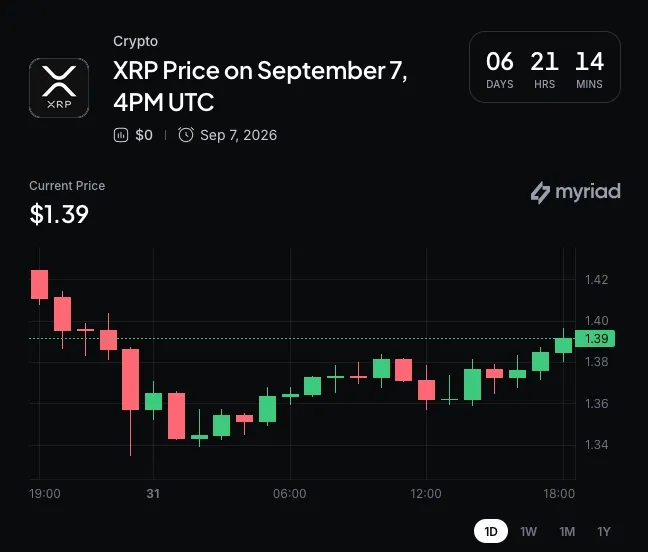
Myriad: Where does XRP price go next? Click to make your prediction.
However, consumer advocacy group Public Citizen opposed that approach, warning that event-contract ETFs would place gambling-like products inside a vehicle retail investors associate with long-term investing.
“Retail investors rely on ETFs as a familiar and trustworthy format, expecting them to represent investments tied to productive economic activity,” the group wrote. “Investors who use ETFs to build long-term portfolios may not understand that these products do not compound, do not track an underlying enterprise, and do not behave like the diversified index funds they are accustomed to.”
The SEC must now determine whether those products require a common regulatory framework or separate rules based on their structures and risks.
Daily Debrief Newsletter
Start every day with the top news stories right now, plus original features, a podcast, videos and more.
The FSNN News Room is the voice of our in-house journalists, editors, and researchers. We deliver timely, unbiased reporting at the crossroads of finance, cryptocurrency, and global politics, providing clear, fact-driven analysis free from agendas.
We and our selected partners wish to use cookies to collect information about you for functional purposes and statistical marketing. You may not give us your consent for certain purposes by selecting an option and you can withdraw your consent at any time via the cookie icon.
Cookies are small text that can be used by websites to make the user experience more efficient. The law states that we may store cookies on your device if they are strictly necessary for the operation of this site. For all other types of cookies, we need your permission. This site uses various types of cookies. Some cookies are placed by third party services that appear on our pages.
Your permission applies to the following domains:
https://fsnn.net
Necessary
Necessary cookies help make a website usable by enabling basic functions like page navigation and access to secure areas of the website. The website cannot function properly without these cookies.
Statistic
Statistic cookies help website owners to understand how visitors interact with websites by collecting and reporting information anonymously.
Preferences
Preference cookies enable a website to remember information that changes the way the website behaves or looks, like your preferred language or the region that you are in.
Marketing
Marketing cookies are used to track visitors across websites. The intention is to display ads that are relevant and engaging for the individual user and thereby more valuable for publishers and third party advertisers.


 Freedom Index