

 Freedom Index
Listen to the article
In New Mexico, Facebook and Instagram are considered a “public nuisance,” but letting artificial intelligence systems record and store young kids’ voices and score their reading prowess is state policy.
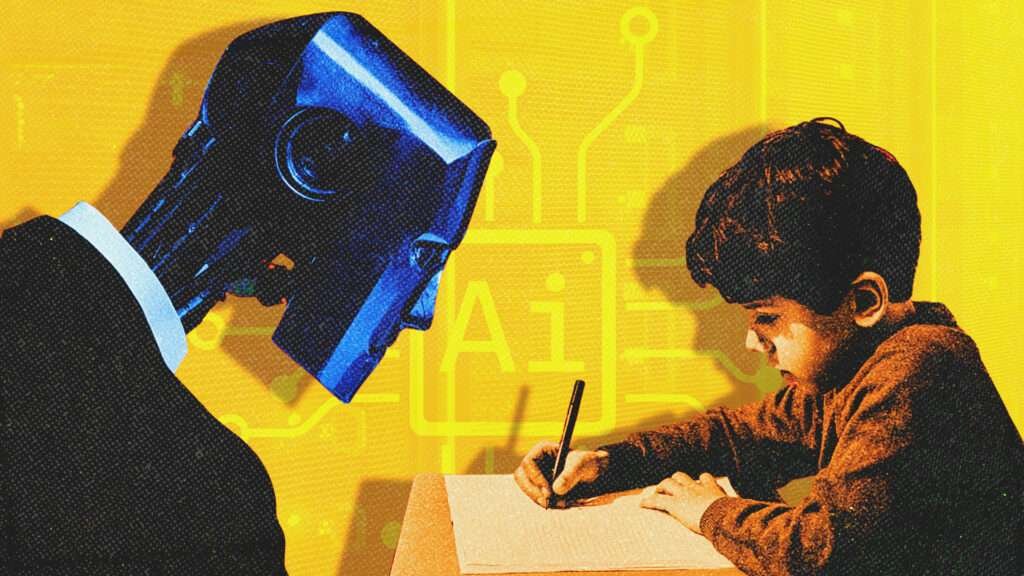
Starting last school year, the state required all public schools to use Amira—a personified AI system designed to assess and instruct elementary school students—for mandatory literacy assessments, dyslexia screenings, and weekly tutoring sessions in kindergarten through second grade.
You are reading Sex & Tech, from Elizabeth Nolan Brown. Get more of Elizabeth’s sex, tech, bodily autonomy, law, and online culture coverage.
As the 2026–27 school year drew to a start, some parents and school districts began pushing back, concerned about how Amira Learning retained and used student voice recordings and whether it was actually effective at assessing student reading skills.
The state’s Public Education Department (PED) responded by granting school districts the right to opt out of Amira this year if they obtain PED approval.
Nonetheless, robo-teachers and testers were rolled out with seemingly little oversight or notice last year and are still being used in most New Mexico school districts this year, despite the fact that evidence on the efficacy of AI tutoring is thin.
And New Mexico isn’t alone in allowing or requiring AI tutors and testers. “Amira is required for assessments in two states—New Mexico and Idaho—and is authorized for state use in California, Georgia, Massachusetts, Michigan, Oklahoma, and Texas though some New Mexico policymakers have admitted its rollout was hasty,” reports the Albuquerque Journal.
Regular readers of this newsletter know that I’m far from an AI skeptic or unilaterally averse to childhood technology use and screen time. But I instinctively balk—perhaps rightly, perhaps wrongly—at using AI to monitor or teach very young students. And from what I’ve learned looking into Amira and New Mexico’s hasty rollout of it, I think parents are right to be concerned.
Recording Children’s Voice
One of the biggest concerns expressed by New Mexico parents and educators concerns the student-reading sessions that Amira records.
“Our families are asking questions we cannot fully answer: Where are these voice recordings stored, and for how long? Who can access them? Are they used to train or refine the vendor’s AI models? What safeguards protect them from breach or misuse?” wrote Jennifer Guy, superintendent of Los Alamos Public Schools, in a July 31 letter to the New Mexico PED. “A child’s voice is effectively biometric data, and parents are rightly uneasy about it being collected and retained by a third-party system as a condition of a state-mandated assessment.”
“We do not believe the state should require children to submit their voices to the platform,” Guy added.
Some of these concerns have since been addressed by Amira or New Mexico education authorities. Amira “does not and will not ever sell student data, or use recordings of New Mexico students to build products for anyone else,” said Amira CEO Mark Angel in an August 28 letter to concerned New Mexico lawmakers.
And “PED made an agreement with Amira so recordings wouldn’t be stored long-term,” according to KOB 4. “Last year’s recordings were deleted, and going forward, the data will be deleted every month unless a district requests otherwise.” What’s more, individual school districts can now set stricter limits on retention of these recordings, and some have.
But this is all being hashed out after schools were already deploying Amira systems in K-2 classrooms for a full school year. And under the state’s new policy, longer data-retention periods are still possible, and schools are still not truly in charge of the data. “We aren’t in control of their server,” as Maxwell Municipal Schools Superintendent Amy Roble said at an August 17 school board meeting during which she voiced concern about student data security.
Hasty Rollout and Little Accountability
“Deploy AI teachers first, ask questions later” seems to be characteristic of New Mexico’s Amira rollout, which happened after its previous student-assessment company, Istation, merged with the AI company Amira Learning.
Beginning in the 2025–26 school year (and continuing this year unless school districts individually opt out), Amira was required for literacy assessments of kindergarten through second-grade students that happen three times per school year and also required for monthly assessments of students identified as having below-adequate reading skills. It’s also used in some schools for first-grade dyslexia screenings and for weekly, individual literacy tutoring sessions.
The results of these required assessments can dictate what further “interventions” are implemented by teachers and schools. And “New Mexico spends $2.7 million on Amira yearly for software use, professional development, data analysis and other additional tutoring and support programs,” according to GovTech.
But “it is unclear what vetting processes and stakeholder input PED used to implement” Amira, a May 2026 report from the state’s Legislative Education Study Committee says. “The state appears to lack a formal mechanism for PED to assess whether a tool like Amira is producing its intended outcomes, to standardize how student reading data are collected and shared across districts, or to provide the Legislature with reliable, timely information about the tool’s impact statewide.” And “New Mexico does not currently have statewide procurement standards for AI tools, student data privacy requirements specific to AI, and a formal evaluation process for AI education tools.”
So, in New Mexico—a state allegedly so worried about minors’ screen time that it took Meta to court and won millions of dollars—schools are taking kids away from time with human classmates and teachers in order to force them to sit down in front of a screen and interact with an AI avatar, and this was apparently implemented without any real proper rules or accountability measures put in place.
But Does It Work?
This is especially concerning given reports from teachers and parents about the ways Amira is incorrectly scoring student reading or causing anxiety in young learners.
“Speech-recognition technology remains imperfect with young voices, developing articulation,” noted Guy in her letter. This has led to Amira scoring some students at levels very different than what parents and teachers would expect based on their own observations, she wrote. “Because teachers are not administering or scoring Amira sessions, and because the ability to correct scoring errors has been removed at the state level, our staff and families may be presented with results that may be wrong and teachers have no means to fix.”
In addition, Amira assessments may be causing—and registering—student anxiety, Guy adds. “Our early-grade teachers and reading interventionists report that the assessment experience itself is a barrier for beginning readers. Children become anxious or restless when the software fails to register their responses or asks them to repeat themselves, and for students already struggling with reading, the technology layer compounds the difficulty….Often, the test results reflected a child’s comfort with a device and a speech engine or the technology failures rather than the student’s actual reading skill.”
“Data shows that Amira is a positive tool that supports improved academic outcomes for students,” said Janelle Taylor García of the New Mexico Public Education Department in an early-August statement.
But Guy and Los Alamos teachers aren’t the only ones who have noticed issues.
“The reason families are outraged is because we were never notified this was happening,” wrote Sally DeRadke, mother of three Albuquerque public schools students, in a Santa Fe New Mexican op-ed. “We had to find out from our 5-, 6-, and 7-year olds who came home and said, ‘Amira is like a new teacher but they don’t actually understand me,’ and ‘I don’t like reading anymore.'”
In Maxwell, “Roble said staff members believed some student scores appeared to reflect speech patterns rather than actual reading ability,” according to the World Journal. “Students with speech delays or other speech disabilities, in particular, sometimes received scores teachers did not believe accurately represented their reading skills.”
There are numerous Reddit posts, purportedly from parents whose kids have had to use Amira or teachers who have had to use it in the classroom, expressing dismay over its use.
According to a poll posted by the state education department, only 8 percent of teachers and administrators surveyed at a training last year said they had “no major concerns” with using Amira.
Fools Rush In
Most of the data on Amira’s efficacy seem to come from Amira, though I did find one doctoral dissertation on the subject that suggests Amira could improve oral reading fluency scores for first graders.
But I think the issue isn’t so much whether Amira in particular or AI tools more broadly can be effective teachers. It’s the sense that schools are using small children as guinea pigs, implementing these tools without any real consideration of data privacy or child development concerns, solid data backing their efficacy, input from parents, or plans to measure their effectiveness.
AI certainly has some place in education. And maybe in time we’ll come to realize that tools like Amira are great for individualized learning, tailoring lessons to each child’s abilities in ways that outperform dedicated human tutoring or, at least, serving as a balm in overcrowded schools where teachers may not have the time to put in individualized work with every student.
But, right now, schools seem to be leaping before looking. There’s just still a lot we don’t know about AI’s effectiveness at teaching young children or the effects of young children interacting with AI systems more broadly, and this feels like an area where public schools should be proceeding with extreme caution rather than rushing in.
We could end up with a great new venue for student learning. But we could also end up with another “iPad for every child” scenario—a costly experiment that doesn’t pay off. Or we could end up with something a lot worse. And until we have more data, public schools should probably chill on the robo-teachers.
More Sex & Tech News
• The Safer GAMING Act, passed last month by the House of Representatives as part of the KIDS Act, would effectively prohibit kids from naming their Pokémon—and a lot more. TechFreedom lawyer Andy Jung explains how this bill ignores the First Amendment by “attempting to silence minors in online video games.”
• There are major First Amendment issues with the Meta settlement, suggests First Amendment lawyer Jeff Kosseff. “Defenders of the settlement would argue that the content restrictions and age assurance requirements are not direct government mandates but, rather, provisions to which Meta voluntarily agreed. But the Supreme Court has repeatedly questioned the purportedly voluntary nature of such restrictions when the government applies pressure.”
• The Anthropic win against the Trump administration reaffirms the idea that private companies can put conditions on their dealings with the government, writes J.D. Tuccille.
• “Many sites are now blocking AI crawlers,” note Australian academics Dana McKay and Damiano Spina. This makes AI summaries less likely to cite their content—which could create problems. “Sites containing misinformation are far less likely to ban AI crawlers, so the AI answers won’t be informed by high-quality sources.”
• “While states’ pro-growth instincts have let data centers down as of late, national security concerns about winning the AI race still afford data centers some support from federal policymakers,” notes Reason‘s Christian Britschgi.
Read the full article here
Fact Checker
Verify the accuracy of this article using AI-powered analysis and real-time sources.