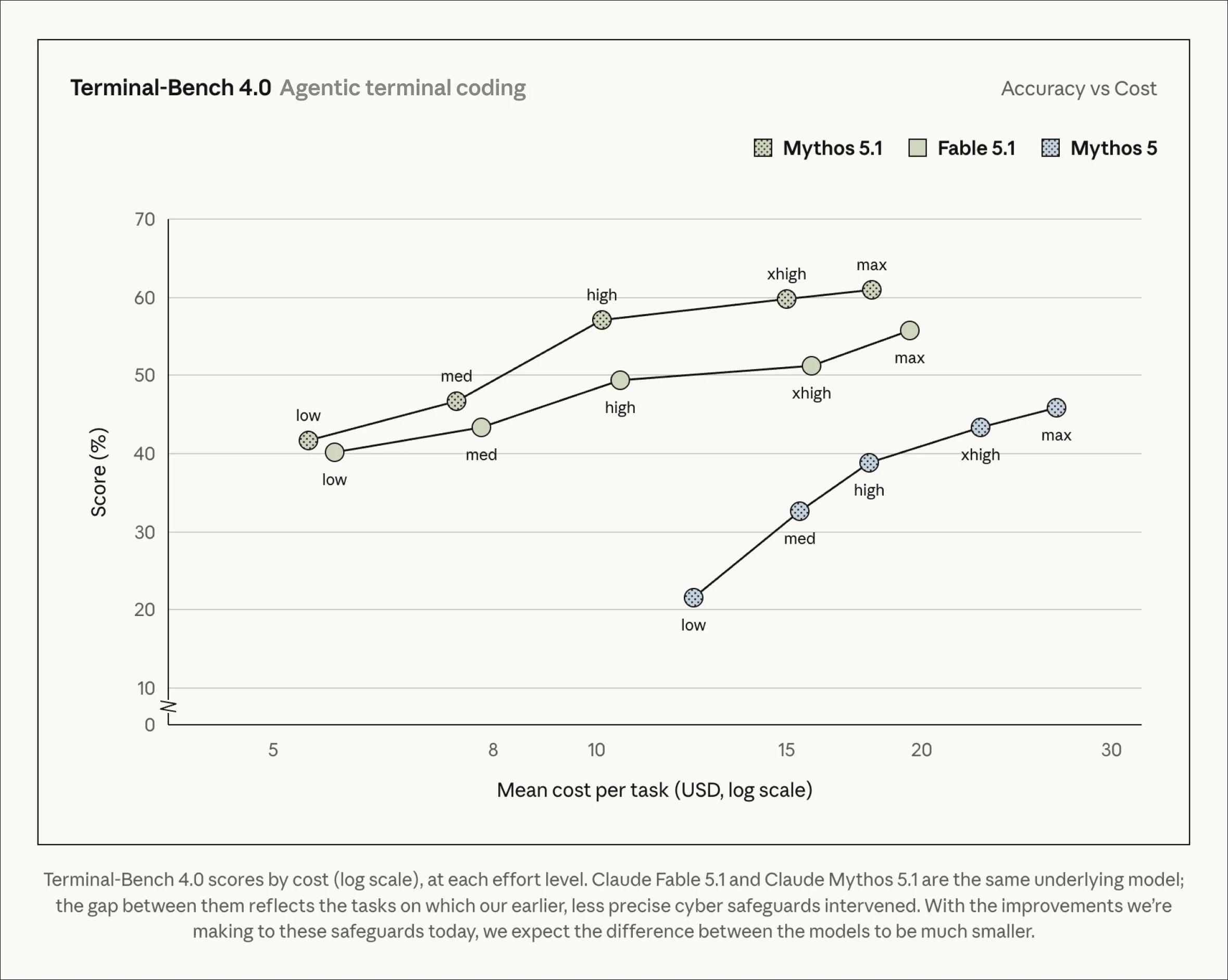
Anthropic released Claude Fable 5.1 and Claude Mythos 5.1 on September 1, scoring 52.6% on Terminal-Bench-Science 0.1 against Fable 5’s 24.7%, and 55.8% on Terminal-Bench 4.0 against 42.0%.
Cache reads now cost 75% less, cutting typical workload costs by roughly 25% and highly agentic workloads by up to 45%, with base pricing unchanged at $10/$50 per million tokens.
Fable 5.1 is not included in Pro plans or standard Team seats, which run it on usage credits; Max and premium Team or Enterprise seats get it included for up to 50% of weekly limits.
Anthropic released Claude Fable 5.1 and Claude Mythos 5.1 on Tuesday, its first update to the Mythos-class model line since Fable 5 launched on June 9.
The company claims new AI models are the world’s “most advanced for coding and knowledge work,” and it lands three months into a launch cycle that has already included an 18-day export-control shutdown, a mid-summer pricing fight over subscription access, and a July release of Claude Opus 5 that undercut Fable 5 on price.
Myriad: When will OpenAI release GPT-6? Click to make your prediction.
Fable 5.1 and Mythos 5.1 are, per Anthropic, the same underlying model with different safety filters bolted on. Fable 5.1 is generally available to anyone with a Claude account. Mythos 5.1 stays restricted to vetted cybersecurity and life-sciences professionals through Anthropic’s Cyber Verification Program and Life Sciences Verification Program, the successor to the Project Glasswing access track that gated Mythos 5.
What the benchmarks actually measure
Anthropic’s headline number comes from Terminal-Bench-Science 0.1, a benchmark that tests whether an AI agent can carry out scientific research tasks inside a command-line environment, scored as a pass rate.
Fable 5.1 hit 52.6% against Fable 5’s 24.7% and Opus 5’s 29.0%, more than double its predecessor.
Terminal-Bench 4.0 tests agentic coding done through a terminal—writing, running, and debugging code across multi-step command-line sessions, scored as a percentage of tasks completed correctly. Fable 5.1 scored 55.8%, up from Fable 5’s 42.0% and ahead of Opus 5’s 52.3%.
Mythos 5.1, running with lighter cybersecurity filters, scored 60.9% on the same test; Anthropic says the gap reflects tasks its safeguards intercepted and rerouted to Opus 4.8.
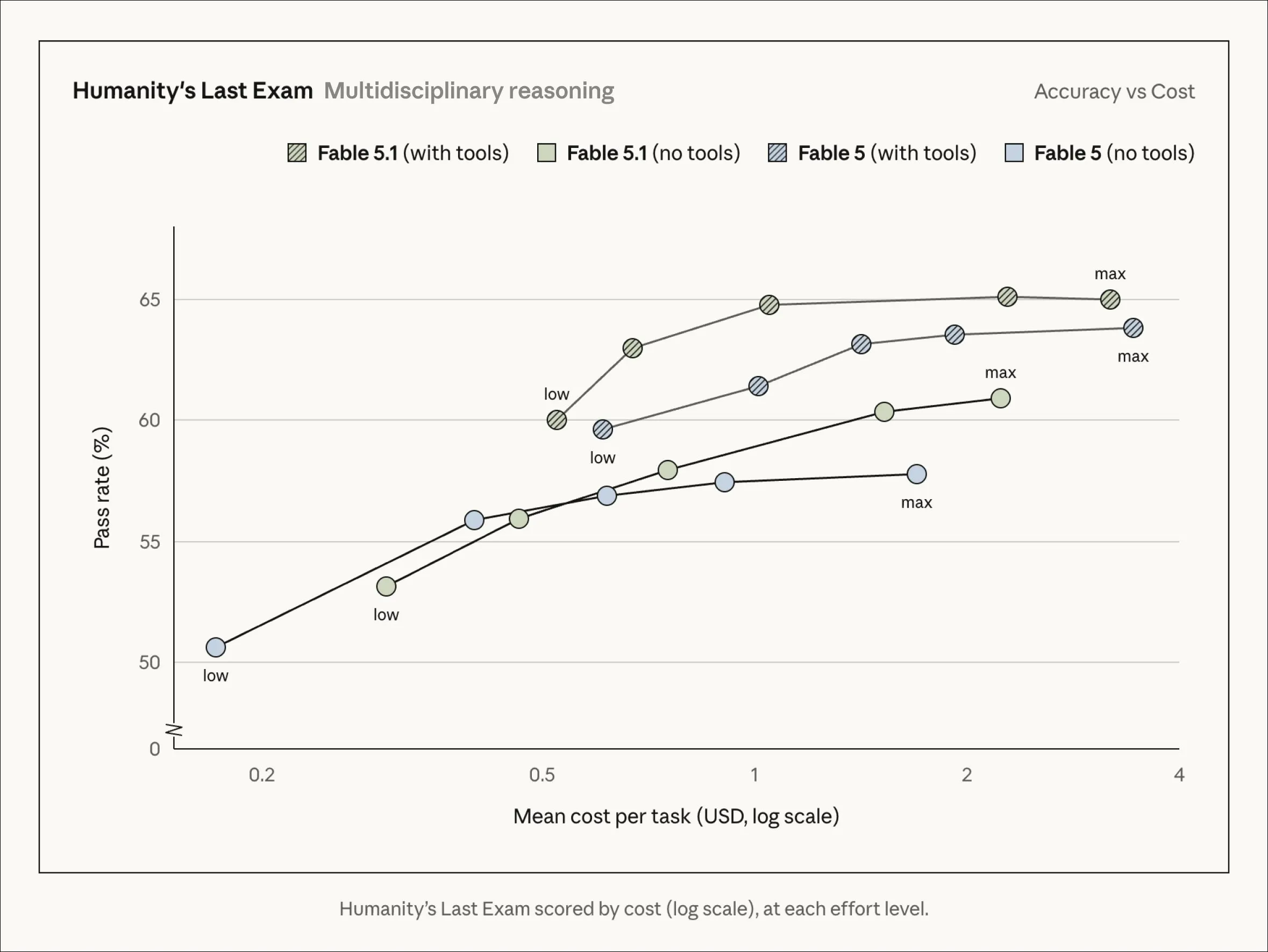
On Humanity’s Last Exam, a multidisciplinary reasoning test built from expert-level questions across dozens of academic fields and scored as a pass rate, Fable 5.1 reached 60.9% without external tools and 65.0% with them, both ahead of Opus 5, showing this is Anthropic’s most advanced model for academic purposes.
Where it beats Opus 5, and where the math gets murkier
Opus 5 launched in July costing half of Fable 5’s per-token price while outscoring Fable 5 on most major benchmarks, effectively making the flagship model redundant for most paying users.
Fable 5.1 reverses that: It now beats Opus 5 on every benchmark Anthropic published, including the ones where Opus 5 had previously beaten Fable 5.
But Fable 5.1 still costs twice as much per token as Opus 5—$10 input and $50 output versus Opus 5’s $5 and $25. Tokens are the basic amount of information a model can handle (usually around two thirds of an average English word), and companies pay for use because heavy workflows usually deplete the quotas set in subscription plans very quickly.
Anthropic’s own pitch for the model leans on effort levels rather than raw scores: it says that running Fable 5.1 at low or medium reasoning effort matches or beats Fable 5’s old results at much lower cost, while reserving the top effort tiers for problems that stump everything else.
For routine work, that argument for skipping Opus 5 entirely gets weaker the lower the effort dial goes.
Access follows the same split that applied to Fable 5 after months of Anthropic adjusting the terms. On Pro plans and standard Team or Enterprise seats, Fable 5.1 draws entirely from pay-as-you-go usage credits billed at the API rate, since it isn’t part of those plans’ weekly limits. On Max plans and premium Team or Enterprise seats, it’s included as a standard part of the subscription for up to 50% of weekly usage.
Claude Fable 5.1 is available now on the Claude API, Amazon Bedrock, Google Cloud, and Microsoft Foundry, under the model ID “claude-fable-5-1.”
Daily Debrief Newsletter
Start every day with the top news stories right now, plus original features, a podcast, videos and more.
The FSNN News Room is the voice of our in-house journalists, editors, and researchers. We deliver timely, unbiased reporting at the crossroads of finance, cryptocurrency, and global politics, providing clear, fact-driven analysis free from agendas.
We and our selected partners wish to use cookies to collect information about you for functional purposes and statistical marketing. You may not give us your consent for certain purposes by selecting an option and you can withdraw your consent at any time via the cookie icon.
Cookies are small text that can be used by websites to make the user experience more efficient. The law states that we may store cookies on your device if they are strictly necessary for the operation of this site. For all other types of cookies, we need your permission. This site uses various types of cookies. Some cookies are placed by third party services that appear on our pages.
Your permission applies to the following domains:
https://fsnn.net
Necessary
Necessary cookies help make a website usable by enabling basic functions like page navigation and access to secure areas of the website. The website cannot function properly without these cookies.
Statistic
Statistic cookies help website owners to understand how visitors interact with websites by collecting and reporting information anonymously.
Preferences
Preference cookies enable a website to remember information that changes the way the website behaves or looks, like your preferred language or the region that you are in.
Marketing
Marketing cookies are used to track visitors across websites. The intention is to display ads that are relevant and engaging for the individual user and thereby more valuable for publishers and third party advertisers.


 Freedom Index