

 Freedom Index
Listen to the article
Last June in United States v. Hemani, the Supreme Court unanimously held that Americans cannot be stripped of their Second Amendment rights or prosecuted for illegal gun possession simply because they use marijuana or other federally prohibited drugs. That decision complicated prosecutions under 18 USC 922(g)(3), which makes it a felony for an “unlawful user” of “any controlled substance” to receive or possess a firearm. It also opened the door to relief for people who had been previously convicted of violating that law based on nothing more than the statutory elements.
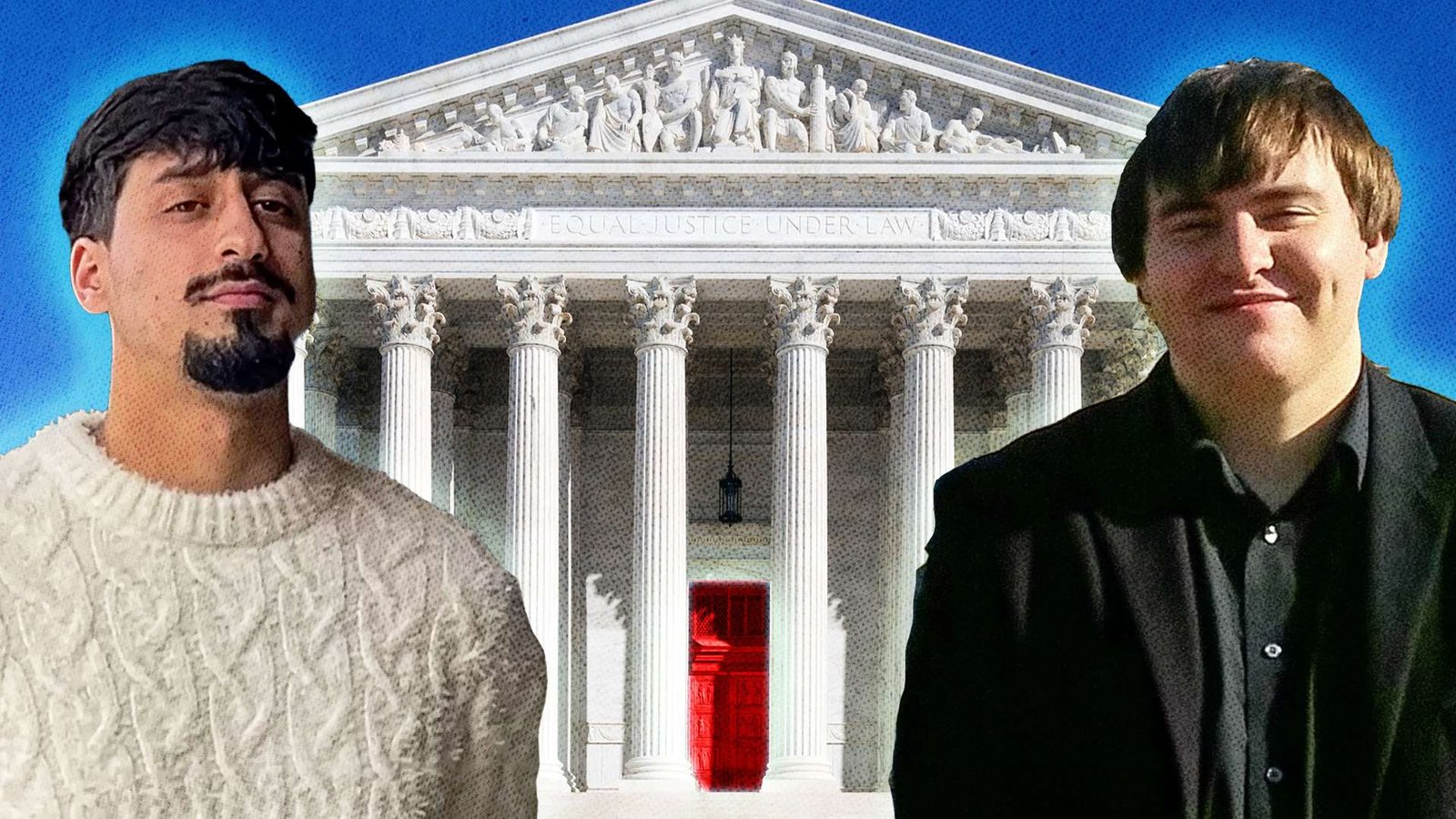
Hemani did not rule out Section 922(g)(3) charges when the government presents additional evidence that a defendant poses a danger to public safety. But prior to Hemani, prosecutors typically did not do that. The question now is how federal courts should deal with such prior convictions: Should they simply be vacated, or should the government get another chance to offer evidence that would meet Hemani‘s new requirements? A pending Supreme Court petition from Alexander Ledvina, an Iowa cannabis consumer who received a four-year prison sentence after he was convicted of violating Section 922(g)(3) in 2023, highlights a circuit split on that crucial question.
Ledvina’s petition, which he wrote himself, stands out because the Trump administration seems to be taking it seriously. On August 3, Solicitor General D. John Sauer requested more time to submit a response, which is now due this Friday.
Ledvina, who had been incarcerated since his arrest in June 2023, was released from the federal prison in Memphis on July 6, thanks to the expanded “good conduct” and “earned” time credits authorized by the FIRST STEP Act of 2018. But he still has to complete three years of supervised release, and he still has a felony record that impairs his economic prospects and permanently disqualifies him from owning guns.
The U.S. Court of Appeals for the 8th Circuit, which includes Iowa, recognized the Second Amendment problems with Section 922(g)(3) even before Hemani. In the 2024 case United States v. Veasley, the appeals court rejected a facial challenge to that provision, saying the defendant had failed to show it was unconstitutional in all its applications. But last January in United States v. Cooper, the 8th Circuit said the defendant, who owned a Glock 20 pistol and admitted to smoking marijuana three or four times a week, should have a chance to argue that Section 922(g)(3) was unconstitutional as applied to him. It therefore vacated LaVance LeMarr Cooper’s conviction and remanded the case for further consideration.
Ledvina, who at that point was still in prison, received a similar response the following month. In United States v. Ledvina, the 8th Circuit vacated his Section 922(g)(3) conviction and remanded the case to the trial court to resolve his as-applied challenge. But it left in place a related conviction under Section 924(a)(1)(A), which makes it a felony to knowingly make a false statement “with respect to the information” that a federally licensed gun dealer is required to record. That conviction hinged on the form that Ledvina filled out when he bought a pistol in July 2022: He checked “no” when asked whether he was an unlawful drug user.
Ledvina thinks the 8th Circuit should have vacated both convictions. But he also argues that the court’s treatment of as-applied challenges to Section 922(g)(3) is fundamentally mistaken because it allows the government to supplement the evidence it used to obtain a conviction. The 8th Circuit’s approach also allows a judge to make the findings necessary to justify a prosecution based on a preponderance of the evidence, a much weaker standard than the proof beyond a reasonable doubt required for a conviction.
Ledvina, like Cooper, was convicted based on stipulated facts after a bench trial. Those facts, U.S. District Judge C.J. Williams concluded, were sufficient to establish beyond a reasonable doubt that Ledvina had violated Section 922(g)(3). But those facts did not include evidence of dangerousness, as required by Hemani. At sentencing, based on a preponderance of the evidence, Williams credited additional allegations, including a claim that Ledvina had accidentally fired a gun while using cocaine with an acquaintance.
Although those allegations had not been established at trial, they nevertheless figured in the punishment that Ledvina received. In sending the case back to Williams, the 8th Circuit was essentially inviting him to again rely on those claims, this time to reject Ledvina’s as-applied challenge, still without requiring the government to prove them beyond a reasonable doubt.
In Veasley, the 8th Circuit concluded that Section 922(g)(3) was “consistent with this Nation’s historical tradition of firearm regulation,” the Second Amendment test established by the Supreme Court’s 2022 ruling in New York State Rifle & Pistol Association v. Bruen. The appeals court perceived two “relevantly similar” historical analogs: “confinement of the mentally ill” and “criminal prohibition on taking up arms to terrify the people.”
The Supreme Court decisively rejected that first analogy in Hemani. And while the justices did not address the second analogy, the 8th Circuit itself has conceded that Section 922(g)(3) “is not automatically analogous to founding-era ‘going armed’ laws” because those laws were “not about mere possession” of firearms. Rather, they required “the offensive use of a firearm in a way that terrorized others.”
Still, the 8th Circuit’s conclusion in Cooper was broadly consistent with what the Supreme Court would later say in Hemani. A Section 922(g(3) conviction is constitutional, the appeals court said, if the defendant “pose[s] a danger to others.”
As the appeals court saw it, that requirement raised questions about Cooper that had not yet been resolved: “Did using marijuana make Cooper act like someone who is
‘both mentally ill and dangerous’? Did he ‘induce terror,’ or ‘pose a credible threat to the physical safety of others’ with a firearm?” Unless “one of the answers is yes” or “the government identifies a new analogue we missed,” the 8th Circuit said, the prosecution fails the Bruen test.
The appeals court thought a remand was necessary to address those questions. In Ledvina’s case, it likewise said Williams needed to consider whether Ledvina’s marijuana use made him “act like someone who is both mentally ill and dangerous” or “would cause [him] to induce terror, or pose a credible threat to the physical safety of others with a firearm.” It settled on a similar solution last July in United States v. Striplin, which likewise involved a bench trial based on stipulated facts.
The same month, in United States v. Baxter, by contrast, the 8th Circuit did not think a remand was necessary. Like the other defendants, Benjamin Baxter had been convicted by a judge based on stipulated facts that established a violation of Section 922(g)(3). But the appeals court ruled, based on a preponderance of the evidence, that Baxter, a gang member who allegedly had carried a pistol during a fight and fled from the police afterward, posed a danger to others.
“We conclude that the district court did not err in denying Baxter’s motion to dismiss as the Government met its burden in demonstrating that Baxter’s conduct was sufficiently analogous to the conduct prohibited by the Founding-era Terror of the People laws,” the 8th Circuit said. “The Supreme Court’s very recent unanimous decision in United States v. Hemani is not to the contrary.”
How so? In the majority opinion, the 8th Circuit noted, Justice Neil Gorsuch had left open the possibility that “the government could bring a prosecution under §922(g)(3) accompanied by individualized proof that the defendant’s use of marijuana (or any other drug) renders him a danger to himself or others.”
Gorsuch did not address what should happen in cases where the government had already obtained convictions without such “individualized proof.” The 8th Circuit’s answer is that dangerousness can be established after the fact by a preponderance of the evidence, which in some cases may require a new evidentiary hearing.
“We conclude that the Government must establish the facts necessary to demonstrate that Baxter’s conduct is consistent with a historical analogue by a preponderance of the evidence,” the 8th Circuit said in that case. It agreed with the trial court that “adopting a preponderance standard does not violate Baxter’s due process rights because determining whether the application of § 922(g)(3) as applied to him is consistent with the Nation’s historical tradition of firearm regulation is not an element of the crime.”
In Baxter, the 8th Circuit thought the government had already presented enough evidence to meet that standard. In the other cases, including Ledvina’s, it said the trial court should take another look. But that approach lets the government retroactively repair its constitutionally deficient case based on new allegations that it does not have to prove beyond a reasonable doubt.
The 8th Circuit’s handling of those cases does not seem consistent with the outcome in Hemani. That case involved a Texas man, Ali Hemani, who owned a pistol and admitted that he used marijuana a few times a week. After a judge dismissed the gun charge against Hemani on Second Amendment grounds, the U.S. Court of Appeals for the 5th Circuit upheld that decision. The Supreme Court unanimously rejected the Trump administration’s attempt to revive the charge. Unlike the 8th Circuit in Ledvina, neither the 5th Circuit nor the Supreme Court thought it was appropriate to remand the case for further consideration.
Nor did the 5th Circuit think a remand was necessary in United States v. Connelly, the 2024 precedent on which it relied in Hemani. That case involved “non-violent, marijuana smoking gunowner” who was charged with violating Section 922(g)(3). After concluding that her prosecution failed the Bruen test, the 5th Circuit upheld the dismissal of her indictment.
The 5th Circuit “has no qualms about resolving as-applied challenges itself,” Ledvina notes in his Supreme Court petition. And in the 2025 case United States v. Seiwert, “the Seventh Circuit joined the Fifth in resolving as-applied challenges without a remand.”
By contrast, the 8th Circuit, the 3rd Circuit, and the 10th Circuit “have all remanded as-applied challenges to the district court to redetermine them under their newly minted tests and make further findings,” Ledvina says. While the 3rd and 10th circuits did so in response to pretrial motions to dismiss, the 8th Circuit “has gone even further by remanding for further findings even after trials.”
That approach, Ledvina argues in a supplemental brief, is inconsistent with Hemani. “Rather than remanding for further fact finding to see if the prosecution is permissible under some other test, the Court affirmed the dismissal on the factual record before the district court at the time the motion was decided,” he writes. “If further fact finding was unwarranted in Hemani before the case ever reached trial, it is even less appropriate when a trial has already occurred.”
Ledvina argues that such remands violate the Fifth Amendment. He says they amount to double jeopardy because they give the government a “second bite at the apple” and violate the Grand Jury Clause by allowing the government to “establish criminal liability on facts that were never alleged in the indictment.” He also sees a due process problem and a violation of the Sixth Amendment right to trial by jury.
“Baxter approved the finding of facts necessary to establish criminal liability by a judge in post-trial hearings under the preponderance of the evidence standard,” Ledvina writes. “This procedure violates the Fifth and Sixth Amendment right to have all facts necessary for punishment be found by a jury beyond a reasonable doubt.”
The 8th Circuit said that standard does not apply in cases like Ledvina’s because the constitutionality of a Section 922(g)(3) prosecution is not an element of the offense. But under Hemani, such a prosecution is doomed right out of the gate without “individualized proof” of dangerousness. Going forward, in other words, the government cannot convict someone of violating Section 922(g)(3) unless its evidence goes beyond the statutory elements. Yet the 8th Circuit says prior convictions can be validated after the fact by evidence that was never presented at trial.
When the government “makes an increase in a defendant’s authorized punishment contingent on the finding of a fact,” the Supreme Court held in the 2002 case Ring v. Arizona, that fact “must be found by a jury beyond a reasonable doubt.” The “relevant inquiry” is “one not of form, but of effect,” it explained in the 2000 case Apprendi v. New Jersey. “Does the required finding expose the defendant to a greater punishment than that authorized by the jury’s guilty verdict?” The Court’s 2024 decision in Erlinger v. United States reaffirmed that principle: “The government must prove beyond a reasonable doubt to a unanimous jury the facts necessary to sustain the punishment it seeks.”
Under Hemani, dangerousness is a fact that the government must prove to “sustain the punishment it seeks,” Ledvina argues. “The additional facts required to establish the constitutional application of a statute fit firmly in this definition because they are essential to any punishment. Without them, the statute cannot constitutionally be applied to the defendant at all.”
What if a defendant agrees to a bench trial, as Ledvina did? “When defendants enter into such a trial arrangement, they typically go in with the understanding that their criminal liability [will] be determined [based] on a fixed universe of facts,” he says. “They agreed to a bench trial based on the facts in the stipulation, not other allegations. They could not have predicted that their culpability would later be decided in a post-trial hearing with outside evidence and a lower evidentiary standard. This type of bait and switch gives the government its benefits while robbing the defendant of ‘the benefit of his bargain.'”
Ledvina argues that his case is “an ideal vehicle for definitively resolving the ongoing circuit split concerning as-applied challenges to § 922(g)(3).” Given what happened in Hemani, I suspect the Trump administration will disagree.
Read the full article here
Fact Checker
Verify the accuracy of this article using AI-powered analysis and real-time sources.