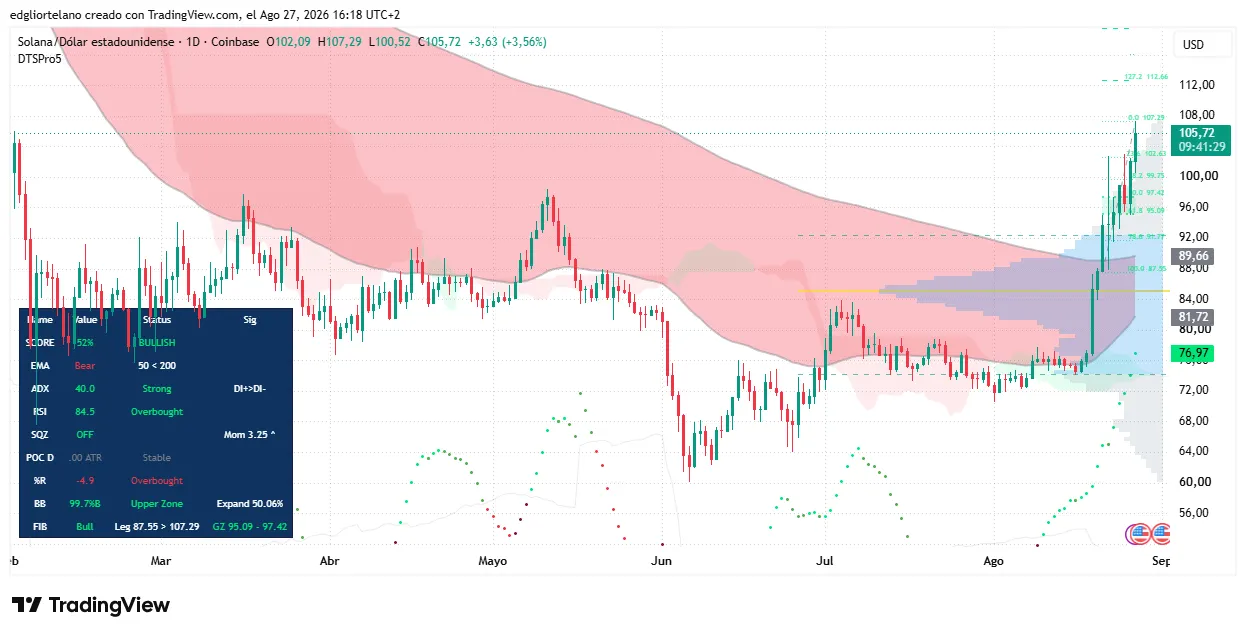
Solana (SOL) is up more than 8% in the past 24 hours and roughly 44% this month, its strongest month since 2024, pushing the token back above $105.
The rally lands the same day the Solana network closes its first-ever binding governance vote, deciding whether to double the network’s disinflation rate and burn far more SOL per day.
Nasdaq-listed Solana Company backs the new governance framework itself but is voting against both economic changes, citing timing rather than disagreement with the goals.
Solana is up. A lot. SOL climbed more than 8% in the past 24 hours and is closing in on its best month since 2024, up roughly 44% since August began and back above $105 for the first time since January.
The rally lands on the same day network validators close out a major vote in Solana’s history, to decide whether the network prints less SOL and burns a lot more of it.
Myriad: Solana’s next price move? Click to make your prediction.
Coincidence? Not really. Traders appear to have spent the week pricing in a supply squeeze before it’s even official.
Voting wraps around 15:30 UTC today, when epoch 1023 ends—an epoch being roughly a two-to-three-day stretch of network activity Solana uses as its internal clock. The vote bundles three proposals under Solana Governance Proposals, or SGPs, a brand-new on-chain system that lets validators and the people who delegate SOL to them cast binding, stake-weighted votes for the first time ever.
One ratifies a Solana Constitution formalizing how that voting works going forward. The other two are the ones moving the price conversation: SIMD-550 and SIMD-553.
SIMD-550: printing less SOL
SIMD-550, filed by engineers at Solana infrastructure firm Helius, would double Solana’s disinflation rate—the yearly pace at which new-token issuance shrinks—from 15% to 30%. Solana’s inflation already declines a bit every year on its way to a fixed 1.5% floor. SIMD-550 just gets there faster, hitting that floor by 2029 instead of 2032, which works out to roughly 18.9 million fewer SOL created over the next six years.
That’s not free, though. Inflation is what pays stakers—people who lock up SOL to help secure the network—their yield. Cut issuance that hard and, per a 21Shares analysis, staking yield falls from around 5.25% today to about 2.25% within three years. It’s like a Bitcoin halving but for staking. But a few smaller validators could become unprofitable in the process, so it’s not all good news for everyone.
SIMD-553: burning a lot more SOL
SIMD-553, from Solana R&D firm Temporal, hits supply from the other direction: burning, meaning SOL gets sent to an address nobody can ever spend from, permanently taking it out of circulation. It splits Solana’s transaction fee into two pieces—a base “inclusion fee” that still pays the validator, and a new “resource fee,” tied to how much computing power a transaction eats up, that gets destroyed outright.
That one change would take Solana’s daily burn from about 650 SOL, worth roughly $48,000, to as much as 9,000 SOL, worth around $668,000—a 12-to-14x jump depending on network activity. It already cleared code review from Solana’s two client teams, Anza and Firedancer, back on July 20. Today’s vote decides whether it turns on, not whether it’s ready.
Nasdaq-listed treasury firm Solana Company, which trades as HSDT, is backing the constitution but voting against both tokenomics changes. Management says the objection is about timing, not the goal—predictable yield matters more to institutional stakers right now than a faster cut does.
Solana Validator Governance
Voting is now live for SGP 1, SGP 2, and SGP 3.
– SGP-0001: The Solana Constitution – SGP-0002: Double Disinflation – SGP-0003: Resource and Inclusion Fee
Voting lasts until the end of epoch 1023 (Thursday at approximately 15:30 UTC).
See the…
— Solana Developers (@solana_devs) August 23, 2026
Both proposals need a two-thirds supermajority of participating stake, voted on independently, so a rejection of one doesn’t sink the other.
None of that has slowed the chart down. SOL’s 14-day RSI, a momentum gauge where readings above 70 typically flag an asset as overbought, is sitting near 84.5 right now. Results from today’s vote are expected within hours of epoch 1023 closing.
Daily Debrief Newsletter
Start every day with the top news stories right now, plus original features, a podcast, videos and more.
The FSNN News Room is the voice of our in-house journalists, editors, and researchers. We deliver timely, unbiased reporting at the crossroads of finance, cryptocurrency, and global politics, providing clear, fact-driven analysis free from agendas.
We and our selected partners wish to use cookies to collect information about you for functional purposes and statistical marketing. You may not give us your consent for certain purposes by selecting an option and you can withdraw your consent at any time via the cookie icon.
Cookies are small text that can be used by websites to make the user experience more efficient. The law states that we may store cookies on your device if they are strictly necessary for the operation of this site. For all other types of cookies, we need your permission. This site uses various types of cookies. Some cookies are placed by third party services that appear on our pages.
Your permission applies to the following domains:
https://fsnn.net
Necessary
Necessary cookies help make a website usable by enabling basic functions like page navigation and access to secure areas of the website. The website cannot function properly without these cookies.
Statistic
Statistic cookies help website owners to understand how visitors interact with websites by collecting and reporting information anonymously.
Preferences
Preference cookies enable a website to remember information that changes the way the website behaves or looks, like your preferred language or the region that you are in.
Marketing
Marketing cookies are used to track visitors across websites. The intention is to display ads that are relevant and engaging for the individual user and thereby more valuable for publishers and third party advertisers.


 Freedom Index