

 Freedom Index
Listen to the article
On a Wednesday afternoon in February 2008, Houston police raided a house at 5603 Elmlawn Drive, where they found a gram of PCP and 132 grams of cocaine. They arrested several men at the property, including Byron Prophet, then 23, who was ultimately convicted of two drug charges and sentenced to 16 years in prison.
During Prophet’s trial, Gerald Goines, a narcotics officer who had been employed by the Houston Police Department (HPD) for 24 years, testified that he saw the defendant enter the house twice through a door from the garage, unlocking the bars covering the entrance with a key that was later found in his pocket. Prophet testified that he had never been inside the house and had no key.
Although the jury believed Goines, a deadly 2019 drug raid that he instigated by fabricating a heroin sale revealed that he was completely untrustworthy. Thanks to the belated scrutiny triggered by that scandal, the Texas Court of Criminal Appeals vacated Prophet’s convictions in 2024. But Prophet, who was released on parole in 2014, had already served nearly six years in prison based on the unquestioned word of a drug cop with a long history of lying to obtain search warrants, justify arrests, and secure convictions. The case illustrates how the war on drugs invites police mendacity that may go undetected for years thanks to lax supervisors and credulous courts.
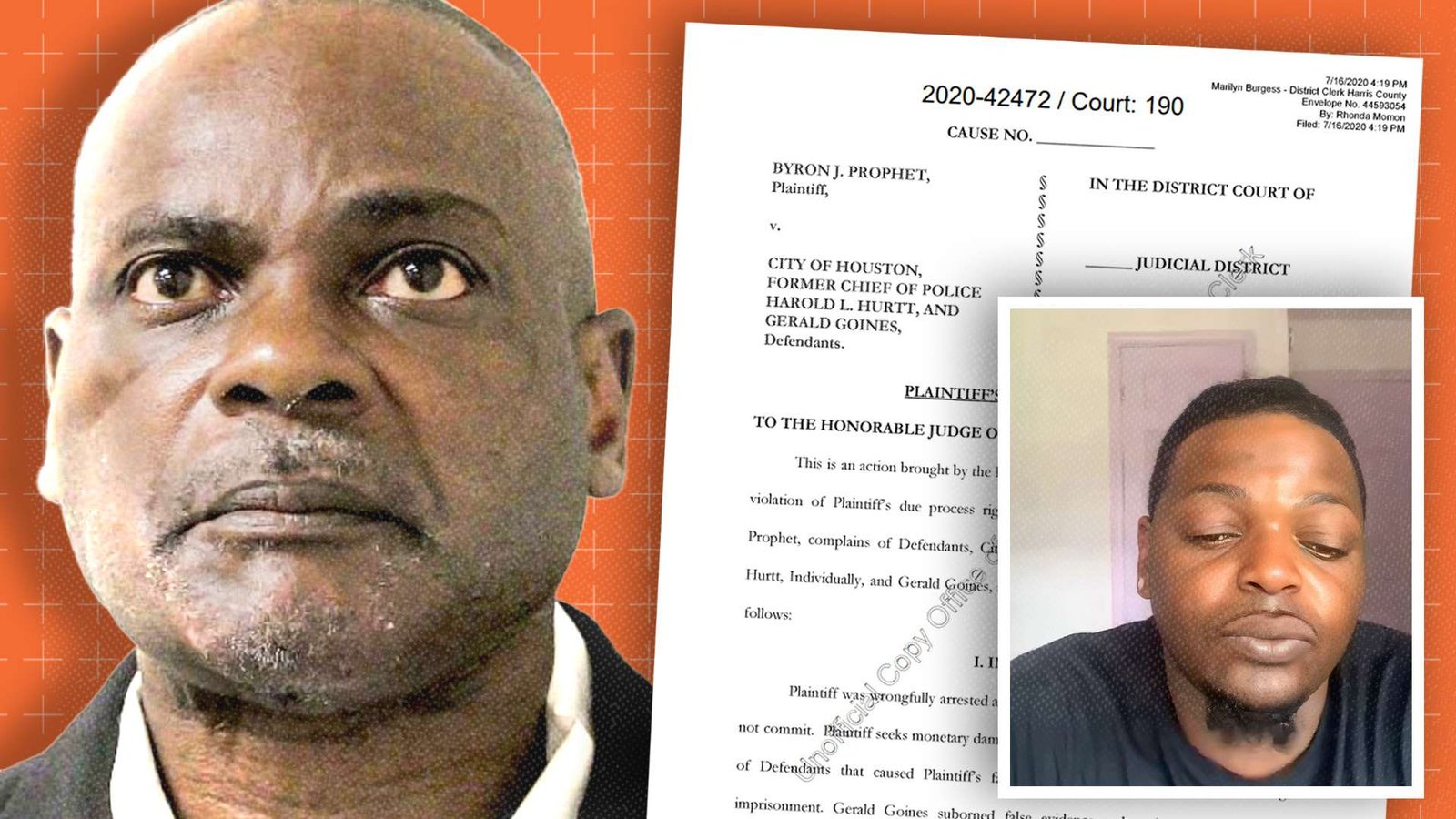
In a federal lawsuit filed last week, Prophet argues that the responsibility for the injustice he suffered extends beyond Goines, who is currently serving a 60-year sentence for his role in the 2019 raid. Long before that incident, Prophet says, Goines’ supervisors were or should have been aware that he had a habit of framing innocent people.
That is what Goines did in 2019, when he obtained a no-knock warrant to search the home of Dennis Tuttle and Rhogena Nicholas, a middle-aged couple he falsely implicated in drug dealing. As Goines later admitted, his search warrant affidavit described a heroin purchase that never happened. As a result of that fraudulent affidavit, police broke into the couple’s home and shot their dog. After Tuttle responded to that home invasion by grabbing a revolver and firing at the intruders, police killed him and Nicholas, who was unarmed. Several officers, including Goines, were grievously injured during the raid, mainly by friendly fire.
That fatal fiasco prompted the Harris County District Attorney’s Office to re-examine thousands of drug cases involving Goines. It concluded that 69 people might have been convicted based on false evidence he provided. Prophet was one of them.
Prophet has always insisted he had nothing to do with the drugs that police found in the house on Elmlawn Drive. By his account, he rode his dirt bike to his grandmother’s house that afternoon. His uncle, a mechanic, also lived in the neighborhood, and Prophet wanted his help in repairing the dirt bike. Prophet found his uncle working on a car in front of Louis Pugh’s house, the target of the raid, which was a few doors down from his grandmother’s home.
Prophet testified that he did not associate with Pugh, who was a friend of his uncle’s, and never entered the house, although he fetched tools from Pugh’s garage. Goines, by contrast, claimed that Prophet repeatedly entered the house, spending a total of 13 minutes inside. He also claimed to have seen Prophet’s state-issued identification card on a kitchen counter near the PCP and cocaine. He said Prophet tried to flee when the raid started and had a key to the house in his pocket when he was searched.
According to Prophet, none of that was true. But the case pitted a veteran narcotics officer against a young man who admitted that he had previously been convicted of burglarly and three minor drug offenses. The jurors, who apparently did not seriously entertain the possibility that Goines was lying, accepted his account. So did the 1st District Court of Appeals, which upheld Prophet’s convictions in 2010. The court deemed Goines’ testimony sufficient to establish Prophet’s alleged connection to the drugs.
The jurors might have been less inclined to believe Goines if they had known how he obtained the warrant for the raid on Pugh’s house. “Goines wrote in the application that a confidential informant had performed a controlled drug purchase for the police at the property two days earlier,” the lawsuit says. “In reality, there was no genuine confidential informant and no drugs were purchased.”
That fabricated evidence foreshadowed the fraud that would culminate in the deaths of Tuttle and Nicholas 11 years later. And according to the lawsuit, it was part of a pattern that should have been clear by the time of Prophet’s arrest.
At that point, Goines was “well-known” for submitting search warrant affidavits that “falsely claimed a confidential informant had purchased drugs” at the targeted property, the complaint says. “Goines would fabricate evidence that led to drug raids, falsify reports, and ‘pay off’ officers by falsifying overtime records of officers who participated in the drug raids. The City of Houston and HPD officials were aware that Defendant Goines used these tactics and had a problematic history of violating resident’s constitutional rights, but allowed him to continue operating in such fashion.”
In addition to Goines, the defendants in Prophet’s lawsuit include two other officers, the city of Houston, and former Police Chief Harold Hurtt, who ran the HPD from 2004 to 2009. The complaint alleges that Officers James Yencha and Richard Salter conspired with Goines to violate Prophet’s constitutional rights and that the HPD “turned a blind eye” to their misconduct.
During “the period leading up to Mr. Prophet’s wrongful conviction” in October 2008, the HPD “engaged in a systematic pattern of fabrication of evidence, withholding of exculpatory information, and other illegal tactics, the sum total of which completely corrupted the investigative process,” the complaint says. “Before the investigation at issue here and continuing afterwards, dozens of cases have come to light in which Houston police officers were involved in suppressing exculpatory evidence or fabricating false evidence to cause the conviction of an innocent person for serious crimes they did not commit.”
In 2002, the lawsuit notes, KHOU, the CBS affiliate in Houston, “conducted an investigation into HPD and revealed there was a culture of untrained staff, missing exculpatory records, contaminated evidence, and inadequate supervisory oversight of officers.” Although those findings should have prompted “drastic change within HPD,” the complaint says, Houston officers “continued to fabricate evidence, suppress evidence, and use other illegal tactics.”
The lawsuit mentions several other people who were arrested by Goines, including George Floyd, who lived in Houston at the time and would later be killed by police in Minneapolis. In 2004, the complaint says, Goines claimed Floyd had “sold $10 of crack cocaine to a third party,” but “the alleged drug money was never recovered” and the alleged buyer was never identified.
Two years later, according to the lawsuit, Goines “falsely claimed” Reginald Christain “informed officers that there were drugs in his vehicle prior to its search.” Goines “fabricated this statement by Christian, as well as the drugs purportedly found in Christian’s vehicle.”
Prior to Prophet’s arrest, “dozens of residents made complaints to HPD about the wrongful arrests, fabricated evidence, and suppressed evidence, but the Department turned a blind eye,” the complaint says. “Nor did the City of Houston end Defendant Goines’ employment when it learned he was fabricating informants, evidence, and reports, and suppressing the truth.”
The pattern continued after Prophet’s arrest. In April 2008, Goines arrested Steven Mallet and his brother, Otis, claiming they had sold him crack. But that was not true, and the brothers were exonerated in the wake of the raid that killed Tuttle and Nicholas.
The National Registry of Exonerations lists more than three dozen drug defendants, including Prophet, the Malett brothers, and Frederick Jeffery, whose convictions were vacated after Goines’ dishonesty came to light. If supervisors like Hurtt had done their jobs, Prophet argues, that list would be shorter.
“We have zero indication that this is a systemic problem with the Houston Police Department,” Police Chief Art Acevedo, who was in charge of the HPD from 2016 to 2021, said after Goines was charged with felony murder in August 2019. Acevedo reiterated that take after Goines was indicted on federal civil rights charges three months later, dismissing “the chances of this being systemic.”
Harris County District Attorney Kim Ogg saw things differently. “Houston Police narcotics officers falsified documentation about drug payments to confidential informants with the support of supervisors,” she said in July 2020. “Goines and others could never have preyed on our community the way they did without the participation of their supervisors; every check and balance in place to stop this type of behavior was circumvented.”
Contrary to what Acevedo seems to think, these are systemic issues. So are the incentives created by the war on drugs. When a crime consists of nothing but handing a police officer or an informant something in exchange for money, the evidence often consists of nothing but that purported buyer’s word, along with drugs that easily could have been obtained through other means. This situation invites dishonest cops to invent drug offenses and take credit for the resulting arrests, as Goines did for years with impunity.
When your job is to create crimes by arranging illegal drug sales, it is not such a big leap to create crimes out of whole cloth, especially if you are convinced that your target is a drug dealer. And when that happens, defendants cannot count on jurors or judges to detect the deception, as Goines’ many victims discovered.
Read the full article here
Fact Checker
Verify the accuracy of this article using AI-powered analysis and real-time sources.