

 Freedom Index
Listen to the article
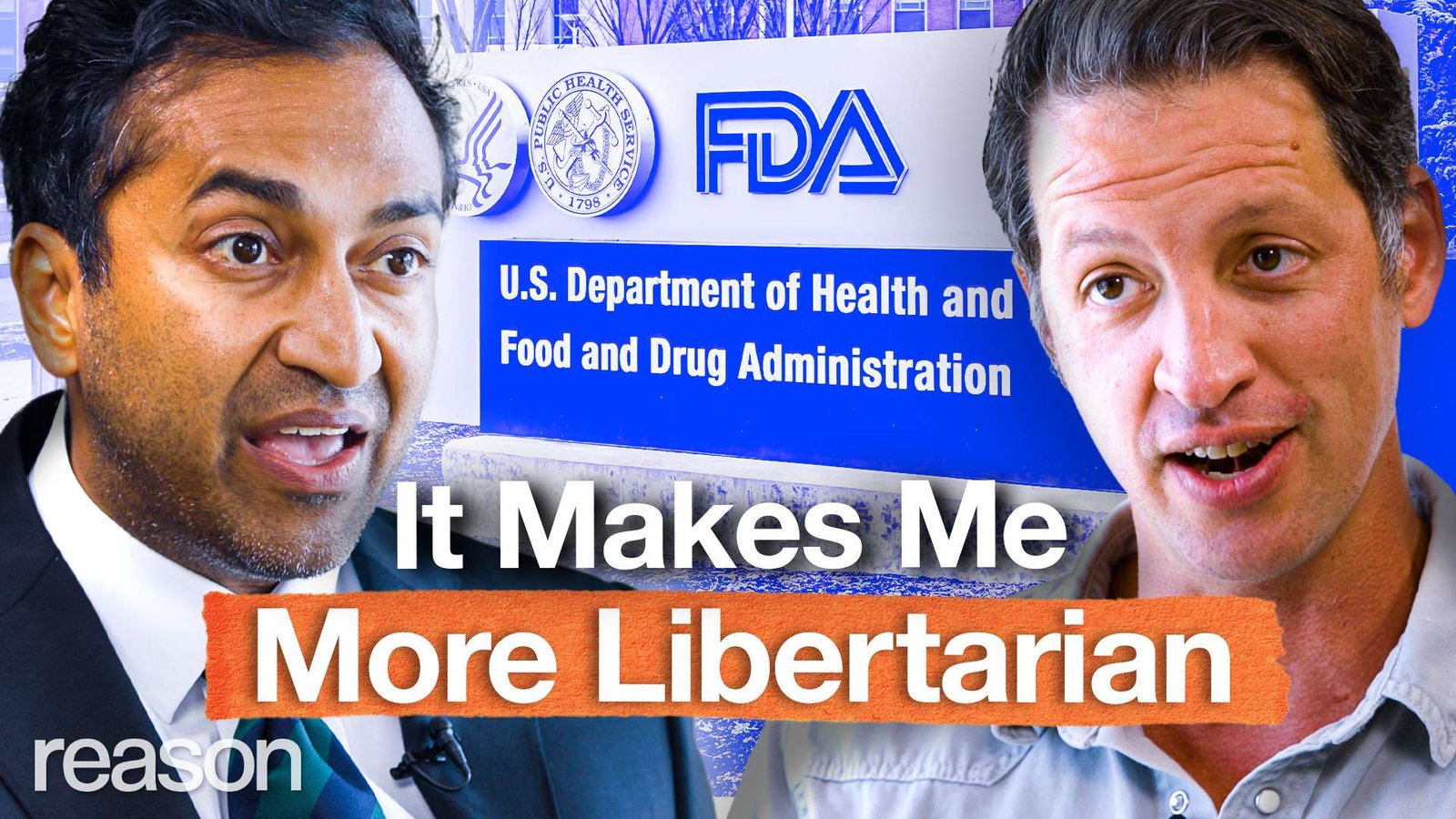
Vinay Prasad rose to fame as a COVID-era public health establishment critic. Then he became part of the public health establishment. Now he’s back on the outside following his controversial tenure at the Food and Drug Administration (FDA) as director of the Center for Biologics Evaluation and Research (CBER), which is responsible for approving vaccines and gene therapies.
In this interview with Reason‘s Zach Weissmueller, Prasad, a physician, author, and professor at the University of California, San Francisco, responds to the array of intense criticism he received during his tenure, ranging from agency insiders complaining about his management style to Wall Street Journal editorial writers branding him a “Bernie Sanders acolyte in MAHA drag” to conservative influencers such as Laura Loomer deriding him as a progressive-left “saboteur.”
He defends his decision to reject Moderna’s mRNA flu vaccine application, which the agency has since approved following his departure, and explains a controversial internal memo in which he wrote that “at least 10 children have died after and because of receiving COVID-19 vaccination” and that “for the first time, the US FDA will acknowledge that COVID-19 vaccines have killed American children.” The official FDA report made public after Prasad left identified zero “certain” childhood deaths linked to the vaccine, with five classified as “possibly” and two as “probably.”
“They changed the report. I had a draft report with 10 [likely deaths]. They changed it after the media publicity of my letter,” says Prasad, who believes the data were altered for “political or professional” reasons.
While he entered the job with the intention to raise the standards for drug approvals, Prasad says his firsthand experience witnessing just how entrenched the political and bureaucratic problems at the FDA are has made him “a bit more libertarian” and open to the idea of “Consumer Reports–style agencies” competing with the government on drug approvals, which would offer “people in America greater flexibility in what kind of products they can try.“
Prasad also reacts to the recent publication of top COVID adviser Anthony Fauci’s diaries, whom he says is likely guilty of criminal conduct for his role in funding gain-of-function research.
“I can’t think of a single policy [Fauci] actually got right when he was running the federal health policy,” says Prasad.
Watch the full interview above. The transcript below has been edited for style and clarity.
0:00—Teaser
0:48—Transitioning from FDA critic to insider
2:39—Fauci’s diaries
7:40—The origins of COVID-19
9:11—Did Fauci commit any crimes?
11:53—Aspirations for public health reform
13:22—Vaccine skepticism and criticisms
20:10—Moderna mRNA flu vaccine
26:35—COVID-19 vaccines and children
34:00—The Trump administration and deregulation
37:51—Drug approval barriers at the FDA
42:01—Wall Street Journal criticism
46:45—Has Prasad become more libertarian?
53:36—Anthropic CEO Dario Amodei’s criticisms of the FDA
57:46—Peptides
59:45—Why did Prasad leave the FDA?
1:02:43—Is true government reform possible?
1:05:45—How can public health regain public trust?
Producer: Paul Alexander
Director of photography: Kevin Alexander
Audio mixer: Ian Keyser
Transcript
This is an AI-generated transcript. Check all quotes against the audio for accuracy.
Zach Weissmueller: Vinay Prasad went from COVID-era public health establishment critic to public health establishment insider and back out again. He is a physician, an author, a professor at the University of California, San Francisco, and former director of the Center for Biologics Evaluation and Research at the FDA. Vinay Prasad, thank you for talking to Reason today.
Vinay Prasad: It’s good to be back with you.
So, we had this clearing out of the old guard, the Walenskys and Faucis and Collinses, and this replacement with the new guard, the COVID dissidents such as yourself, Marty Makary, Jay Bhattacharya. What was it like, and did you have any misgivings about stepping away from the role of academia and sort of outside critic and into the public health bureaucracy?
So, I guess one thing to point out is that maybe we changed 4 percent, 2 percent of the FDA. I mean, the FDA is an 18,000-person agency. There’s tens of thousands of people still there. Before Marty, the commissioner, and I got there, DOGE had just struck, and maybe they got rid of a couple thousand people. But I think one thing to point out is the system is largely the same as it’s always been. And then I think the next thing I’d point out is there are critics of the COVID pandemic response, and then there are critics. And although Marty, Jay, and I are critics of many aspects of the response, I think we don’t go as far as some of the most extreme critics out there. So am I glad I did it? Yes, I think I’m glad I did it. It was an adventure. It was a learning experience. I feel like I learned more in one year than I’ve learned in the prior decade about how the world works. And I’m glad to have improved, I think, some aspects of government, which I think will be enduring, and at least tried to improve other aspects of government, which may not be enduring.
And yeah, I want to ask you a little bit about—or actually quite a bit about—what you learned from that experience. But first, let’s stay on the context of that era, that transition. And I think the person who personified kind of the old guard was Anthony Fauci, and he’s recently been in the news because he appeared in front of Congress, yet again pleading the Fifth, as Rand Paul kind of exposed or published his diaries. What did those diary entries reveal to you about Fauci’s character, the way he was operating through that time?
I think that Fauci has made a lot of serious errors. And I think probably the greatest news story is that the mainstream media, I think, refuses to be honest about his legacy. Anthony Fauci was in his late 70s when the pandemic began. And had he retired, you know, at a ripe old age of 75, I think he would be leaving behind a stellar legacy. But he continued. He pushed it. He stayed through the whole pandemic, and he was the face of many things that I think his diaries get into: what he privately thought while he was publicly saying different things.
Where to begin? The origins of the pandemic. Fauci has not only been a proponent that the only answer to where the virus came from is a natural spillover event. He’s gone further than that. He orchestrated a paper published in Nature Medicine called “The Proximal Origin Paper,” written by a bunch of people who bolstered that point of view. He, of course, edited that paper before it was published. Then in public, he pretended like he didn’t know those people. It was an independent group that validated what he was saying, whereas, in many respects, he sort of puppeted that paper. The people who wrote that paper—Rand Paul has released their Slack channel messages—showing they don’t really even believe what they were writing. I mean, their messages reveal considerable ambiguity about lab leak versus natural spillover event.
So in terms of the origin, he also funded EcoHealth Alliance, of course, which had a subcontract to Wuhan. He had a huge role in the origins and sort of at least trying to frame the narrative, making lab leak—you couldn’t even discuss it. You know, Facebook put a ban on even talking about the topic.
All right, that’s just one thing. Then masking, masking 2-year-olds. I mean, he played a huge role in that. Lockdowns, school closure. He said he didn’t close any schools. In his own diary, he says, “I told Bill de Blasio, you need to close schools in New York City.” At some point, the man’s got to take ownership over the decisions he did make and advocated for. When DeSantis in Florida reopened schools in the spring of 2020, he went on every television show to say what a bad idea that was. Of course, now I think it’s very clear. Many of us said so at the time. School reopening was always the right decision. You know, maybe it could have been closed for a week or two, but certainly not beyond that. Fauci kept it closed much longer.
Vaccines. I think vaccines make a lot of sense. COVID vaccines for elderly people who had not yet had COVID. But do they need to be given to a 4-year-old, a 7-year-old, a 12-year-old, a 22-year-old who’d also already had COVID? This is where considerable ambiguity exists. But Fauci, the answer was clear: You need all the shots. You need the initial series. You need a yearly booster. It doesn’t matter how young you are or how many times you’ve had COVID.
Then, of course, Fauci was wrong about—I think he’s wrong about almost every single pandemic policy he advanced. Some of his defenders say to me, “Well, at least he didn’t tell people to drink bleach.” And I said, “Well, is that the bar for a guy who’s a doctor and a scientist?” I mean, of course, yeah, drinking bleach is not a good idea. But that’s not the bar for an Anthony Fauci-level figure. He should be saying things that are correct, and if they’re not correct, he should be collecting evidence to weigh in. He did none of that.
Why do you think that there was such a large disconnect between his public and private thoughts on the virus throughout this? Just as someone whose job it is to communicate science to the public, why wasn’t he communicating what he actually knew at the time? For instance, about the origins of the virus.
In the case of the origins, I think he doesn’t want to communicate, then or now, because he looks a little bit culpable.
Is it 2011? He writes a Washington Post op-ed called—the title of the paper is “A Flu Virus Risk Worth Taking”—about why we ought to fund gain-of-function research, or research to manipulate the genomes of viruses to perhaps make them more transmissible or lethal, in an effort to get ahead of that and cure it. But that’s a gamble. Is that a sound strategy? I think it’s pretty clear to say that it has not led to any cures and may have led to one of the worst pandemics in the last 50 years. You know, so that was a bad idea. He’s on record as saying that. He’s on record as having funded the EcoHealth Alliance group in 2014, despite an Obama-era sort of prohibition on that funding, and he has a presidential pardon that extends so far back that it covers his potential funding of EcoHealth Alliance. So, boy, nobody would rather you think it comes from a natural origin than this guy. He’s conflicted. That’s the bottom line on that issue.
This is why Rand Paul is pursuing this, because he seems to be wanting to uncover what the origins of the virus are, which somehow we still don’t know. It’s unclear if we ever will. Do you have any sense, based on what we know now, what’s your inclination as to where this came from?
So I use an analogy, and an analogy is you can look at biology or you can look at intelligence. So imagine somebody comes out of the kitchen and they say, “You know what? That waiter peed in the soup.” You’re going to say, as a biologist, “How can I prove he peed in the soup?” You can sample the soup. You can look for urine metabolites and cells from the bladder. And you could try to figure it out that way. Or you could interview three people in the kitchen who say, “I saw the guy pee in the soup.” OK.
And my point is that we have the Central Intelligence Agency, the Department of Energy, the FBI, and they have made an intelligence assessment that they believe it to be a lab leak. In Fauci’s own diary, he says he was pulled into the SCIF, which is sort of a confidential room, and he was given information by the CIA where they intercepted some transmissions from China that make them sort of suspicious that it was, in fact, a lab leak incident.
To me, I think the public may never have the full evidence, but I suspect that many intelligence people do, in fact, know the answer. And that answer is probably lab leak. Whether it’s malicious or unintentional, I think people can wonder about that. Fauci’s own diary admits that the Wuhan wet market, which he went on TV and said was the origin—in his own diary, he writes, at best, it was an amplifying event. He doesn’t believe it to be the origin.
You mentioned this pardon that stretches back to 2014, this era when the funding was—when he was authorizing funding in contravention to current U.S. policy, which is we’re not going to do gain-of-function research. Do you think he actually committed a crime?
Yes. I mean, I think funding—I think the other thing about it is people will say, “Did that money go directly for this research?” The money went for viral genomic research at a Chinese institute, very similar to the sorts of things we would be worried about. I think that was a crime for which he’s been pardoned. I think it’s not just my assessment. That’s what Joe Biden’s autopen thought when he signed—or whoever signed the pardon—that he committed a crime. That’s why he has a pardon that goes that far back. I think it was a crime. Now that he’s been pardoned for it, I don’t know what you can do about it.
How do you think history will remember, or should remember, Anthony Fauci?
I think very poorly. I think this is where the media is completely enraptured by the guy. Put aside the origin. This is a guy who went on TV and told you that you should make your 2-year-old wear a cloth mask. He told you, “Stand 6 feet apart.” Later he says, “Oh, the 6 feet, we just made that number up.” He told you you should lock down schools. He called Bill de Blasio in his own diary and told him to close schools. Later he says, “Who started this whole school closure thing?”
He said you’ve got to get a shot, even if you’ve had COVID and even if you’re 20 years old and living in a dorm, even if you had myocarditis. He actually told Rochelle Walensky in his diary to downplay the evidence…
So let’s go back to 2021. In 2021, we learned that even if you’ve been vaccinated, you can contract and spread the virus. I think initially we didn’t think that to be true, but certainly by the summer, with different escape variants, we thought that to be true. The decision to mandate a vaccine was not until the fall of 2021, long after we knew vaccinated people could get the virus and spread the virus.
The moment you knew they could get and spread the virus, it doesn’t make sense to have a mandate. The whole prerequisite for a mandate is there’s got to be enough benefit to a third party that it justifies taking away your autonomy about your body. But he knew that you couldn’t justify the benefit if you can still spread it. But he writes in his own diary, “We can’t have Rochelle Walensky telling people that fact because it will undermine DOJ’s efforts for a mandate.” So he knowingly is hiding scientific truths to facilitate a policy preference of a Democratic president with whom he aligns himself. And he does that over and over.
Finally, if you’ve had and recovered from the COVID virus, we’ve never had any evidence that you need any additional shots. And yet he never made that an exemption. I think that’s a very damning thing. So I can’t think of a single policy he actually got right when he was running the federal health policy.
And you kind of rode in on this wave of anti-Fauciism, in a way. At the head of that would be someone like RFK Jr., who’s the head of HHS. What was your big hope? We’ll get into the specifics of what you were doing at the FDA, but what was your biggest hope as to what the kind of new version of public health might look like or changes that might be made?
Well, I had a very narrow mandate because I was just in charge of biologics at the FDA, and the hope continues, which is that public health could aspire to be honest, to use its powers proportionately and judiciously, to exercise humility. Public health is far from these things. Public health could actually aspire to be bipartisan. Public health does not. It’s becoming an increasingly entrenched left-wing discipline run by left-wing ideologues, reaching even more and more absurd conclusions. So what public health can be and what it is are still light-years apart.
So you don’t think that has changed very much?
Not much at all. No. I mean, I think changing an entrenched organization with tens of thousands of people is very difficult. There have been some changes. I suspect that there’s sort of been a catalyst. The pandemic has been a catalyst. But I don’t think a real reform is possible. I suspect it’ll splinter into different sort of public health groups and senses of that.
And your role was at CBER, which is the part of the FDA that oversees what they call biologics. So that would be things like vaccines or gene therapies. Vaccines obviously became an increasingly polarized and politicized issue during COVID. What was your goal going in there pertaining specifically to vaccines?
You know, people ask me, like, they say, “Vaccines save lives.” I say, “Drugs save lives.” Like, the right drug given to the right person at the right time is life-saving, but the wrong drug given to the wrong person at the wrong time can be harmful. Vaccines are the same way. You can’t say anything about all vaccines, just like you can’t say anything about Tylenol, aspirin, and Plavix all in the same breath. They’re all very different drugs.
And yet I think there is a mentality in the mainstream media that vaccines are perfect. They’re always perfect. More of them is always better than less of them. There are no problems in the current system. They can never be questioned. And I think that dogma has to go away. But that dogma continues. I mean, you want a recent example? This miscarriage argument. Fauci, in his diary, he says, “Boy, you know, that COVID shot’s very reactogenic. People get fevers and they feel terrible. Possible that it will increase the rate of miscarriage.”
Now I read people say, “We know for sure it doesn’t.” Really? You know for sure it doesn’t? Well, that’s the part where I call it into question. I’m happy to concede that the best available evidence excludes a very large risk of miscarriage. There are some people on the right who said it was an 80 percent risk of miscarriage. That’s ridiculous. This is not even possible. 80 percent miscarriages, you’d see that from a mile away. It’s not an 80 percent risk of a miscarriage. But neither do we know it’s a 0 percent risk. And science has to be very careful to say what we do know and what we don’t know.
Pfizer was actually asked to do a randomized study of pregnant women. They were randomizing 4,000 pregnant women in the course of that randomized study to learn whether or not the vaccine is safe and effective and whether it causes birth defects or miscarriage. They’re going to look at 4,000 women being randomized. During the course of that study, the American College of Obstetricians and Gynecologists said all women should just get it. And they stopped their study with 300-some women randomized, and the study is inconclusive. It was never run to conclusion. So I think we should be very careful to say we actually don’t know about a very modest increased risk of miscarriage. Even to this day.
This dogma that you describe of, you can’t criticize anything about vaccines—to the extent that it exists, I imagine it’s because of the very strong anti-vaccine movement that’s been prominent in American history, spearheaded by people like RFK Jr., who—people kind of jump to these extreme claims of vaccine harms, whether it’s the 80 percent miscarriage rates, claims about autism, and so forth. How do you balance that? Like, how do you talk honestly about vaccines without feeding into irrational fears?
Yeah, that’s a really good question. I think the only way to do it is to just be completely honest about it. There will always be someone on the internet who says something wrong. But the public health instrument, the professors of the world, the doctors of the world, you can’t respond to that by lying in the other direction, to give false statements that are not true in the other direction. But that’s what’s happening.
On every issue, I just think—hepatitis B at birth. You want to talk about that? This happened while I was there. Bobby Kennedy and others had the idea that in America, if a mother tests negative for hepatitis B, maybe that baby doesn’t need the Hep B shot at birth and can wait up to two months to get the shot.
So a rational person would look at that and say, “Boy, there are pros and cons to this.” OK. If the mother’s really negative, and we know how Hep B is transmitted, largely through bodily fluids and intravenous drug use and these kinds of things, there is still a small chance the baby will get Hep B in the first two months. But it’s really small. I mean, let’s be honest, it’s going to be quite small.
And is there a downside to delaying two months? Maybe you’ll actually lose a few people. They won’t come back and get follow-ups, so it’ll be an additional loss. But what’s the upside? Maybe the upside is you’ll give people a little bit more control over their bodies and control over their children. They might feel a little better. We live in a time where people are sort of unsure about vaccines.
So I think a fair narrative would be, like, there are pros and cons about this approach. On balance, the numbers here are very, very small. If they want to make this a provision that some people could delay two months if the mother tests negative, I think it’s probably reasonable, you know? But that’s not the way the narrative was, right? “Bobby Kennedy is going to kill people.” And then they said things like, “Before the Hep B vaccine, 50,000 people died a year.” OK, sure. That’s true. But what does it have to do with his specific policy of shifting from zero to two months in a subset of women who test negative or low-risk?
It’s completely tangential.
They’ve overhauled the childhood vaccine schedule. What are your thoughts on that?
I think that it’s—you know, people make a big deal about it, but I don’t know—the executive order… I don’t know how much it’s actually going to do. I think we’re going to see the endgame play out, which is the following: There are going to be different vaccine schedules. If you’re in San Francisco, where we’re sitting right now, you’re going to get the full-court-press liberal vaccine schedule, and if you’re in Texas, you’re going to get the conservative vaccine schedule.
And to me, it’s going to create probably a variety of vaccine schedules. I have mixed feelings about that. I think that it’s very likely you’ll get errors in both directions. You’ll have some people given too many vaccines you don’t need, and there are some people omitting vaccines they do need.
At the same time, the pro of this is that it does kind of shatter this idea that there’s a one-size-fits-all federal government vaccine solution that can be deployed to 400 million people, and it’s going to be perfect. I think it creates sort of different opportunities to think about it.
There have been a number of measles outbreaks. Do you attribute that to sort of either a loosening of vaccine policy or just a general skepticism, rising skepticism toward vaccines?
I think it’s difficult to attribute. People like to attribute it to what Bobby Kennedy has done, but surely, in order to have the outbreak now, people have to forgo measles vaccines in years prior. And it’s also going on in Canada. So I don’t know how he jumped across the border and did it.
I mean, the truth is there is a growing distrust of establishment medicine. It was precipitated by the pandemic, and it probably is also precipitated by, you know, fringe anti-vaccine voices, and they’ve shattered confidence in the measles vaccines. And so, you know, there’s lower uptake of the measles vaccines. There’s going to be measles outbreaks. To blame it on one person doesn’t make sense to me.
I want to look at a specific example of a different way that you approach vaccines than your predecessors. Moderna came to the FDA with an application for an mRNA flu vaccine. You sent that back and said, “This is not good enough.” What was wrong with that? This was like a billion-dollar study. So what was wrong with that study from your point of view?
Initially, the company asked for approval of the vaccine in anyone over the age of 50 and a regular approval, meaning there would be no further post-marketing efficacy commitment. That was what they asked because they did a randomized controlled trial of their new vaccine against an older vaccine in that age group.
Now, we issued a refuse-to-file because, for at least 10 years, that’s not the standard of care for people over the age of 65. If you go to the vaccine experts right now, they’re going to say you need a high-dose or adjuvanted flu vaccine if you’re elderly, because these vaccines have beaten this older vaccine for 10 years. We’ve known about it for 10 years. You go to a pharmacy here, you go ask these vaccine experts, they’ll say, “This vaccine doesn’t cut it if you are 66, 67.”
And yet they used that as the control arm of this study. This happens all the time in drug approval. The companies use a control arm that is not the best available American standard of care. In my opinion, that’s unethical. The control arm participants are getting worse care than they would if they just walked into the MinuteClinic.
So yeah, your view then is that for this to proceed, it needs to outperform the best vaccine on the market.
The statutory language is that in order to file, you need an adequate and well-controlled study, and it is not well-controlled on the plain-English meaning of it because it is not the best available standard of care in America. In fact, it subjects the control arm to higher risk. They’re getting a vaccine that’s not as good as what they would get if they go to CVS or Walgreens or see me in clinic. So it’s not the best available care. So that is a refuse-to-file.
Now then, we accepted a resubmission while I was there, but it split the application into two parts: a regular approval, 50 to 64, and an accelerated approval, 65 and up, which they ultimately got. People say that we’ve done a 180, but we’ve actually given a very different approval. They have a confirmatory efficacy study, 65 and up, and that study will answer the question whether or not their vaccine is as good or better or worse than the correct control arm.
OK, so the fact that the FDA has approved it for certain populations since your departure, you’re generally supportive of that decision.
I guess I’m generally supportive of the fact that it’s better than what came in the door in the first place. I think there are open questions which people should ask, which is: Would you rather get the shot or the flu? You can go look at the rate of grade 3 adverse events in the clinical study and compare it against the actual rate of influenza seen in the study.
So lots of questions that are—those are review questions. Those are questions about the review process. I wasn’t part of it, so I don’t know the file very deeply there. But the initial question was a question about what are they asking for, and is that something that’s an acceptable thing to consider? And we changed that. I think that was the right call.
I think the media coverage of that topic is terrible. I don’t know a single media story that draws the distinction between the resubmission and splitting the age group and the original submission. I don’t know a single media story that asks: The control arm of that study, what evidence is there for a 67-year-old? You pull the control arm, you pull the package leaflet, and you’ll see there are no efficacy data. It’s an immunobridging agent, so it’s antibody titers for these older groups. It is a very flimsy control arm.
The media want to portray it as, you know, “You’re either pro-mRNA vaccines or you’re against it.” But again, like I say, it’s just right drug, right place, right time, all wrong.
So this is the same—in your view, this is the same phenomenon that we observed during COVID, where you’re either for the vaccine or you’re against it. You’re either for this medicine or against it, and not sort of breaking it down by what age are you, how healthy are you, and so forth. Everything kind of has to be flattened or compressed.
One-size-fits-all public health, where the shoe doesn’t fit the guy with the big foot or the person with the small foot. I mean, it’s just completely—a completely wrong view of public health. And COVID is a great example. An 80-year-old who’s never had COVID, who, you know—and we’re talking about February of 2021—should they get a vaccine? Absolutely. A 7-year-old who’s had COVID, and we’re talking about 2022? No. That makes no—the healthy 7-year-old makes no sense.
So public health is, in this country, so broken, it cannot appreciate these distinctions. And I think the Moderna flu is another one.
One more point: Why do some people like the Moderna flu, despite the limits of it? They think the mRNA platform can change quicker than the older egg-based production platforms. That’s a hypothesis you can actually test. You could run a study in a season where you compare the flu shot as it’s conventionally manufactured against an mRNA flu shot that’s made closer to the date of deployment. Presumably, by being closer, they can pick the antigens better than by starting production earlier.
We could ask that question, but there is no appetite for asking that question. People assume the very thing they set out to prove, which is it must be better because it can be adapted quicker, rather than testing that formally.
So yeah, this has been something you’ve been writing about for a long time, is the poor experimental design for drugs. And I assume that’s something that you wanted to change when you came into FDA. Do you feel like you made any progress toward that goal?
I mean, I think in one year, we did more than, you know, what our predecessors have done in a decade. You can look at just the sheer number of announcements and policy changes we’ve made.
And we’re talking a lot about one side of the coin, which is where the companies are not doing the right study to inform the American public. We’re not talking about the other side of the coin, where FDA is asking them to do things that don’t make any sense at all, that burden them, that cost money, and that are wasteful. We did a lot of work in that space too.
And so I think FDA makes both errors. I mean, of course, they also do a lot of things right. But they make both errors, and they can get better. And I guess I’m glad we did some of the things we did to change it.
A memo leaked during your tenure. It was from you informing your staff that FDA’s vaccine safety evaluators have discovered at least 10 children have died after and because of receiving COVID-19 vaccination, and that the real number is higher. You wrote that a public report would be forthcoming, marking the first time that the U.S. FDA will acknowledge that COVID-19 vaccines have killed American children.
Five months later, there’s no report and you were gone, and an FDA official report then came out a month after you left saying that zero childhood deaths were definitively linked to the vaccine. So what actually happened there?
Yeah, that’s—that’s the reading of that. OK. Well, I would say that that’s part of that report. Ron Johnson got part of it. “Certainly linked.” OK, so when we talk about attribution of what’s the cause of death, there is certain, there’s likely, there’s probable, there’s possible, there’s uncertain. You know, the standard for certain is unattainable. Ok? You need to—for instance, if you give the MMR vaccine to kids, occasionally they get a granuloma, and you can biopsy it and you can find vaccine product in the granulomas. If you give the chikungunya vaccine and somebody dies from it, you can sample the CSF and you’ll find the vaccine strain chikungunya in there. You’re not going to find that with myocarditis.
OK, but absolutely, is it the case that kids died of myocarditis from the COVID-19 vaccine? Yes, absolutely, it is the case. And just because the death isn’t coded as certain and is coded as probable or possible, that doesn’t negate the fact that it is attributable. In fact, the standard across all of drug development is possible and probable are attributable, I would say—
Just to be very specific about that, then, yeah, it said there were zero childhood deaths definitively linked to the vaccine. Five deaths were classified as possible and two as probable. So that’s still less than the 10 that originally—
They changed the report. I had a draft report with 10. They changed it after the media publicity of my letter.
Who changed it?
The people who did the report, the people who said that they had been looking into this issue for years. Let’s make a few points. OK, I want to back up. I want to make one point.
Yeah.
If a million people trip on one stair, what’s going to happen? A million people fall down just one stair. 999,000 just walk it off. A thousand people twist an ankle. Maybe 10 people fall and get a gash on the forehead. But one person is going to die. Just a million people fall off one stair, somebody’s going to die, right? That’s just the law of big numbers.
Myocarditis is a known side effect of mRNA COVID-19 vaccines, occurring at a frequency as high as one in 3,000, per the original Israeli report. And you’re getting lots and lots of people to have it. We know that some of those people can actually get scarring of the heart. Some people require pressor support. They go into the ICU. Somebody’s going to die. In fact, there are many case reports published globally. You can just look in the published literature of people who’ve died globally from this. There’s a South Korean study that shows something like 20 deaths.
So, of course, if the answer was zero people died of COVID-19 vaccine-related myocarditis, that would be the controversial outcome. OK? So the media somehow want to defend the idea that zero people die. That’s preposterous.
Somebody’s got to die.
So what happened was they say they adjudicate all the deaths that come in in the VAERS system. This is a passively reported system. So a lot of people may have gotten the shot and died, but nobody decided to report it to the FDA. Or they started the report process, they never completed it. We have data that most people who start the process don’t complete it. Of the reports that get completed, they get sent to the FDA, and then they start to look into them.
A contractor’s supposed to pull the autopsy reports, but this contractor sometimes doesn’t pull the autopsy. So we don’t have autopsy reports on some of these deaths, which make it difficult to adjudicate and make them unlikely to say even possible for those deaths. So this is the process.
Tracy Beth Høeg, who was the CDER acting chief, she started to investigate these deaths. She thought she found some that were really kind of telling. Kid gets the vaccine and then is found dead with a heart with lymphocytes infiltrating, looks like myocarditis, rather plausible. The staff that’s worked there for years are very concerned. It undermines what they’re supposed to have been doing all these years, surely, because if you’re supposed to be looking at safety and you never found it, now somebody new comes along and says, “You’ve got this problem,” you’re also, just like Fauci, a bit conflicted about whether or not you’re the best person to investigate.
But having said that, I still tasked them with looking into it. They sent me a report with 10 deaths: possibles, probables, and likelies. And I wrote my memo saying that a lot has to change because how come this is the first time where we’re talking about it? They downgraded the memo to seven.
The point still stands. Seven or 10, the vast majority of these deaths are probably not even reported into the system. It’s a passive collection system. And I’m surprised it’s provocative. It shouldn’t be provocative that a vaccine with a known side effect of myocarditis—and myocarditis is bad, it can be very bad—that it would kill somebody. That’s got to be not that—it would be more implausible that it killed zero people.
Do you believe the memo was downgraded for a political reason?
Political or professional reasons, that nobody wants to look like, you know, this problem is as bad.
Do you know who leaked the memo?
Who leaked the—Ron Johnson posted the memo. Like, it’s not leaked. Ron Johnson has subpoena power, so Ron Johnson got the memo, and he has the final memo. There’s an additional memo looking at another age group. Ron Johnson hasn’t subpoenaed that. Maybe he doesn’t even know that exists. But there’s a few more deaths in that one. There’s three more deaths in that one, so it’ll be something like 10 deaths.
So what should the public take away from this information, given that even if this higher estimate is accurate, that’s sad, but it’s not a lot. And even COVID can kill children, even though that’s also very rare. So what should people make of all that?
I think people should make of it: It was a really bad idea to vaccinate healthy kids for COVID and force them to do it, especially college kids. There are, on average—college kids did, in fact, probably were harmed on average by that policy, and we published on that before I got to the FDA.
I think public health has to take ownership of the fact that the one-size-fits-all COVID-19 policy and boosters was a bad thing for young people. It did damage. They won’t—mean, if you can’t admit what you got wrong, you know…
So I don’t know what to take away from it. I think that it’s disappointing that—why, I guess, to me what’s disappointing is that there are people who say incorrect things about vaccines, that they have microchips, OK, or whatever, all sorts of crazy things. I hear a million crazy things, OK? They’re crazy people.
So is the response to that to lie about the real safety concern? I don’t think that makes sense. Just be honest about it, and then maybe don’t mandate it in 20-year-old boys who are going to dorms, who just had COVID. Why do they do that? That’s a Fauci policy. That makes no sense, you know? Like, so just admit we got that one wrong.
You clearly came in wanting to raise the bar for vaccine and gene therapy approvals. Was there tension with the Trump administration’s deregulatory impulses, the desire to make it easier to access certain kinds of drugs?
I guess one thing I want to point out about “Right to Try”, which is Trump’s signature policy, is it’s right to try, but it’s not mandate to pay. You know, it’s a big difference. Right to try means you should have the ability to try an investigational agent given to you either for free or at the manufacturing price. It doesn’t say given to you for $4 million a pop and force Medicare to pay. And that’s just what the bill says.
The next thing I’d say is I would draw a distinction between vaccine policy and gene therapy and rare diseases. In many ways, we were quite permissive with rare diseases. We created a pathway where you can approve a product that’s individually made for babies with, say, enzymatic process deficiencies, the plausible mechanism pathway. We debuted that sort of pathway. That’s a lot of flexibility. That’s flexibility that didn’t exist before.
For kids who are suffering from, like, incurable and rare diseases, I think we did do a lot of flexible things. We didn’t demand randomized studies. We gave full approval for uncontrolled studies.
The vaccines are a different thing. We’re not talking about people who—there are some vaccines used only for people with rare diseases, but most of them are this one-size-fits-all for every healthy kid. And in that case, I think people in America want to know that they’re safe and effective, including the president. You can see, reading between the lines of his executive order, he has a lot of concerns and doubts. He may not place them in exactly the right places, but he does have those concerns or doubts.
And so in the vaccine space, I do think the bar should be brought up higher. I think it is kept low for political reasons. It is the political preference of the left to have to just say every vaccine is great and to not acknowledge that there are some serious downsides and concerns to some vaccine products.
To not talk about—like, that Hep B debate, I think, was a great example. I mean, the coverage was that if you give an inch on Hep B at birth for mothers who test negative—and, by the way, there are new, some ultrasensitive antigen testing, so they’re pretty confident they’re negative—you’re going to have an epidemic of liver failure as a result. And that’s, come on, that’s just not plausible.
How did working at the FDA affect your own confidence as a consumer in the regulatory system?
I guess it gives me a little bit of pause sometimes. I like to trust but verify. I particularly am cautious always with new therapies and particularly cautious that some safety information is being missed.
And I think it also makes me a bit more libertarian. I can imagine a system where we give people in America greater flexibility in what kind of products they can try. And maybe there are some third-party agencies, like Consumer Reports–style agencies, that give different levels of quality and seals of approval of different products. And people can choose what they want and maybe also have a little bit more skin in the game and use their own money.
And then the moment you start to use your own money, suddenly tiny changes in surrogate biomarkers and elevated liver enzymes take on greater importance in a way that might not exist if you’re using commercial insurance to pay for it.
Is it just you saw something inherent to the process that creates problems or holes or gaps?
I guess that the fundamental idea that there’s this one-size-fits-all balance where safety and efficacy is acceptable. I mean, what might be acceptable to you and acceptable to me might be different. I might want a little bit more efficacy information, a little more safety validation, and you might be willing to try more.
And the idea that a single monolithic government agency in the suburbs of D.C. can set that bar for every single person in America, that, to me, is a tougher pill to swallow now.
You mentioned there were two sides of this FDA reform. One was to raise the standards for things like vaccines. The other was acknowledging that, yeah, it’s very expensive and cumbersome to get anything approved in the United States. What were the biggest barriers that you saw in the FDA from that side of the equation?
Well, so many. I think I would say that during my time at the FDA, I was often sympathetic to the people who work at companies who told me about sort of the hurdles they were forced to jump through.
And to me, a big set of hurdles are if, you know, FDA does two things. We regulate what’s approved and can be marketed and sold on the U.S. market, but also what you can study. And imagine you’re a researcher and you want to study something. We’re not talking about approve it. You want to gather people together who may be interested in trying something new, have an informed consent, get them to volunteer, but they know that, you know, we don’t know for sure it’s going to work.
We do so many things in that space, regulating what you can study and how you can study it, that I think are sensible. Sure, you don’t want to let people sign up for something that’s going to blind them or maim them. But some things aren’t sensible, that are overly burdensome, that are quality controls that don’t make sense for small companies and super-rare diseases that don’t have a huge budget to study these things.
So I think the regulation in this early side of research is tremendous in the United States. A lot of it well-intentioned, but not all of it fit for purpose.
There was a deregulatory impulse there. Makary talked about wanting to make more things over the counter.
And that still should happen.
RFK Jr. has pushed to make testosterone and peptides and so forth more available and accessible while being more skeptical of pharma more broadly. Yeah, you said you’re supportive of those sorts of ideas, making—
Some of those ideas.
Well, OK, so making over-the-counter medication…
I think simvastatin is a great example. Do you really need to talk to a doctor about a statin these days? You can go get a calculator, and you can decide if you want to take a statin yourself. It’s a great example of something that could be over the counter. There are so many drugs where the doctor or the MinuteClinic or these services, they’re just a gatekeeper from consumers having access to these products.
The peptides, I think, are sort of a mixed bag. There are some peptides that I think have very limited efficacy. There are others that have maybe more efficacy. And some of that battle is not really about safety or efficacy; it’s about profitability. You see right now that—maybe I shouldn’t say the exact peptide—but there’s one peptide that a lot of people are using. They’re getting it through these compounding pharmacies, and the manufacturer that holds a patent on that, they do not like that. They’re going to lose a lot of money, and so they want to kind of fight that off.
So, like so many things, there’s nuance there. There are some peptides that probably would be good for consumers to have a little bit more flexibility in getting through a compounding pharmacy, but not all.
Did you ever feel, sort of, that you were pushing against that? That if there was a deregulatory impulse, but you, in a sense, wanted to make things stricter in certain domains, did you feel a tension working within that system?
I guess I’m always a case-by-case person. So I’m always—you want to talk to me about a specific drug product, specific application, I’ll get to the bottom of it, and I’ll give you a presentation.
And what I found was that, to the credit of Robert F. Kennedy Jr., he listens to when you make the case, you know? And sometimes I make the case to him that wasn’t his initial instinct. But I often think that the way the media do a disservice to him is they say his instinct is always wrong.
One of his instincts is that, you know, for-profit companies sometimes manipulate data to get people to use something to make a lot of money. There’s a kernel of truth in that instinct, isn’t there? And, you know, there’s a kernel of truth in that instinct. So take that kernel and think about where it applies, but also think about where it doesn’t apply, because for-profit companies also make a lot of terrific products that do good. And that’s what I tried to do.
Well, yeah, I wanted to ask about a specific example that was one of the more controversial flash points in your tenure there, which was The Wall Street Journal ran a scathing op-ed whose writer called you a “one-man death panel” because you pushed—you pulled access to some of these experimental treatments, including a gene therapy for a form of muscular dystrophy, following some patient deaths.
Following people dying of it. Yeah, we did restrict that, yeah.
The point that that writer was making is that, again, these are people who have a terminal illness. They want access to this drug, and you, Vinay Prasad, are gatekeeping it from them. What’s your response to that?
Oh my goodness. I guess I’d say nothing could be further from the truth. That drug remains on the market, and anyone can get it for an off-label use. They want the indication so they can force the insurance company to pay the multimillion dollars for it, or whatever it costs.
Certainly, I have a few thoughts. One is the editorial board of The Wall Street Journal, they know nothing about medicine. OK so they make mistakes in both directions too. They want things approved that are harmful and toxic and don’t work, and they’re missing things that are reforms that actually would help the businesses. So I think The Wall Street Journal editorial board, they’re making the same two kinds of mistakes.
I think you’re alluding to the first time I left the agency in the summer of 2025. I mean, you have a drug product that came to the U.S. market where there’s only one person I’m aware of at the FDA who wanted that product on the U.S. market. And that was the person who filed an override memo to approve it against the wishes of all the staff below. Hundreds and hundreds of people with expertise in the disease don’t want to approve it because they think it doesn’t work and has harms. But one person at the top thinks it does work.
Who was that?
That was Peter Marks. That was a Peter Marks override memo on that product. So, famously, blundered everything about the COVID boosters too. OK, so—but I’m happy to let sleeping dogs lie. I mean, it’s been approved, but I can’t go back and revisit every decision.
But then you get deaths. You get people who are getting the product who are dying. Well, what should the agency do about that? A product that has documented memos from review staff believing that they don’t think it’s helping. And now you have people dying.
I think if you’re going to say, “What’s the purpose of the FDA?” And, you know, many libertarians might think, “We don’t need an FDA.” And I’m actually—
We’re going to get to that.
OK, well, I’m kind of sympathetic a little bit.
I have it right here.
I’m like, I can see your point. So I can see that point of view, and I appreciate that point of view. But if it’s going to do anything, surely the one thing it’s got to do is prevent people from taking something that you don’t think helps at all and that can kill them. If it’s going to do anything, surely it’s got to do that.
And so I think that that’s a very reasonable change to the label that occurred in that case, where it was a group of patients—and there’s a group of people that are younger, with lower body weight, who are walking, and the drug remains on the market for those people. And there’s an older group of people with higher body weight—the drug is dosed based on body weight—that aren’t walking, and that’s where the deaths occurred. And it no longer remains on the market for that group of people. But they could still get it off-label, technically.
Part of the backlash to that—and this was the moment that precipitated your first departure from the agency—was Laura Loomer, the MAGA influencer, was blasting you on social media. She called you a “progressive left saboteur of the MAGA agenda.” You didn’t respond to Loomer at the time, but for understandable reasons, now that you’re out, are you a far-left MAGA saboteur?
MAGA saboteur or MAHA saboteur?
I think in many ways, I would say, I don’t know if I’m a MAGA proponent or saboteur, but MAHA—I think the idea that, to Make America Healthy Again, I think there are lots of kernels of truth in that. There are lots of things that Bobby Kennedy is right about in the food supply, dyes in food, pesticides, toxins, and drug reforms, and vaccine reform. I think that there’s lots of kernels of truth in that movement, and health care is kind of my predominant thing.
Laura Loomer is a new type of lobbyist, but I think people shouldn’t forget that we’ve always had lobbyists. There are lobbyists at the FDA for decades and decades. They don’t always come across as a Laura Loomer, but they’re there, and they have influence. So anyone who thinks it’s a system that cannot be lobbied—I hear some people say, like, Laura Loomer is the first to lobby. She’s not the first. She won’t be the last.
To be clear, is this what caused you to be pushed out the first time?
It was interesting timing. I can leave it at that.
OK. You know, you said that your time within the FDA made you somewhat skeptical or maybe more sympathetic to the libertarian critiques of FDA. What about that experience?
I guess I’m really sympathetic in one way, which is, like, the core sympathy is the following: We tax people a lot of money to pay for health care in America. I mean, trillions of dollars. We’re taking trillions from people’s paychecks, from taxation, and we’re taking it for this thing that we think is a benefit to people, which is we’re going to offer a service that is maybe a human right, a societal good.
And surely the service we offer—we do have some of that stuff in there. Like, if you have a heart attack, you go to the doctor here, with or without insurance, they’re going to open up that blockage, like, right now. That’s a great thing.
But along with that package deal, we’re going to insert a few things that may or may not work that cost a lot of money. And all that’s doing is taking lots of money from taxpayers and redistributing it to the shareholders of those companies. It’s a huge financial system with the rare adverse event of helping someone’s health.
And the libertarian comes along and says, “I’d rather not pay the tax, have more skin in the game, decide what’s right for me, and I’m the best person to decide how to use my own money.” And I guess I do feel a sympathy to that point of view because this system has so many places where it can be taken advantage of, where people get something that doesn’t help that much, that only may kill without any possibility of benefit, and you take a lot of other people’s money to pay for that.
Yeah. I mean, one of the specific libertarian proposals—and this was something that was floated by Jim O’Neill, who was the deputy at HHS, another example of maybe the sort of interesting tension—you’ve got RFK and then Jim O’Neill, who once said that FDA should be rolled back to its pre-1962 mandate, where all it does is vet for safety. It doesn’t even gatekeep based on efficacy. The market and doctors sort of will work that out.
My question is: Are we headed that direction? With the way that medicine is changing, do you think the FDA is going to need to be reimagined somewhat?
I mean, I appreciate Jim O’Neill a lot, and I think he’s got a lot of wise ideas. And I think I appreciate that he’s very philosophically consistent. But let me use an analogy, because when we talk about safety, I think we mean two things, not one thing.
OK, we say safety and efficacy is the mandate of the FDA since 1962. OK, when you get in your car and you turn the ignition, the first type of safety is you’ve got to make sure that car doesn’t blow up, OK? You’ve all seen the mafia movie where the car blows up. OK, so that’s a type of safety. We know the car can turn on, the gas line doesn’t explode the car, like, it’s safe.
The next thing is efficacy. You drive down the street. Can the car actually go down the block? That’s efficacy. OK, well, FDA, we definitely do the first thing. I think we definitely show in phase one and early-phase testing, your car’s not going to blow up.
Then we kind of do the second thing. We kind of make sure that cars go down the road a little bit. Some cars may not go as far as other cars, and sometimes we don’t look at how far the car goes. We use the surrogate of the engine’s running, it sounds like it’s going to go. So we use the surrogate. So we kind of monitor efficacy.
But that’s not what we really mean for car safety. What we really mean is 1,000 Volvos have been driven 400,000 miles, and we know that the rate of car accidents and driver fatalities are lower than, let’s say, I don’t know, Chevy. Or—you get the point.
See, that type—that’s what people really mean by safety. That the Volvo is the safest car because with 400 million miles of follow-up, the driver is 20 percent less likely to die than other cars. OK, that is the part of the FDA that we don’t do a good job. We have never done a good job, and we never will do a good job. It requires large sample sizes and unbiased data, and I think that there is very little effort to do that.
So when people say things like, “COVID-19 shots absolutely do not cause miscarriage,” and they cite an observational study where the women who got it and the women who didn’t get it are different women—they chose to do it, right?—that’s not really proving that it doesn’t cause any miscarriage. When you administer a drug to lots and lots of people in a biased way, you can’t really look for small safety signals. So I think that’s a huge failure.
So back to Jim O’Neill’s point. If Jim O’Neill wants a world where we just make sure the car doesn’t blow up when you start it, I think it’s philosophically defensible. If he wants a world where we know that the car will run for many, many miles without causing more fatalities, that’s a tougher pill. That’s not very doable.
Yeah. I mean, isn’t this partly what Makary is trying to push for? He issued a memo saying the FDA is going to become more Bayesian. So we’re going to look—Bayesian statistics is kind of like you’re placing small bets on, like, probabilities that something is safe or not safe. And you can kind of try to zoom in more on a more individualized level, on subpopulations, instead of the one-size-fits-all approach.
Is there a way that you see, from how you observed the machinery operating, that that can be pushed further? That sort of tracking results at that granular level over time, over those 400,000 miles, is something the FDA would be able to do, or, if we’re post-FDA, some other organization would be able to do?
That’s a great question. Well, I definitely think there’s lots of value in the Bayesian methodology, and it will accelerate products to market. It will leverage data from one disease to another disease, one drug to a sister or brother molecule. So I think there is lots of value in Bayesian statistics.
On this question of really safety, let’s talk about it. Let’s imagine I come up with a drug that improves depression, and it really improves depression. But what if it increases the rate of heart attacks by four percentage points? Not 40, not 80 percent, but, like, 4 percent, or 2 percent, or half of 1 percent. At a population level, that could be very bad, like a tiny increase in heart attacks, but it might be very, very difficult to find.
And here’s why. I debut my new depression medicine. Who are the first people who get it? It’s not the average person with depression. It’s going to be the wealthiest person with the best health care and the best insurance. They’re going to be the first people to take it. And that person’s rate of heart attack might be a little bit lower than the other depressed people who are not as well-educated or literate or health-conscious and these kinds of things.
So I think we do have a challenge with phase four post-market surveillance for safety. We have a broad problem with it. We have very weak methods, I think. And I don’t think Bayesian will get around that problem because the problem is the types of people who take it first are different than those who take it second or third.
Well, I mean, another person who has been—another prominent voice who’s been raising concerns about this—because when you’re looking at the risks of drugs, there are two sides of the equation. There’s the risk of approving it and then the risk of not approving it, because if it is an efficacious drug, how many people who would have had access to it earlier could have had their lives saved or prolonged or improved over that time period?
And someone who’s raised that issue in the age of AI is Dario Amodei, the CEO of Anthropic. And I’m just going to read you his quote, because he specifically called out the FDA, and I’m wondering what you think of this. And we’ve already seen AI being integrated into biotech labs. So we know that the idea here is to try to use AI to individualize, like, you know, drugs targeted to specific individuals, genomes, and so forth.
And he wrote that, “Regulatory systems were designed for a slower pace of innovation and we are not prepared for the deluge of new products and advances that AI will bring. AI may also make these downstream technologies safer and more predictable in a way that violates the skeptical assumptions of regulatory agencies like the FDA.”
If Amodei is right about the effect AI is going to have on the field, do you think that the FDA is going to be able to adapt to that future?
Well, it’s a great question. I guess, let me start by saying, I mean, I definitely see kernels of truth in what he’s saying, but maybe I’m not as much of—I don’t go all the way he goes.
Sure.
So where I see, like, the big core truth is, I think the FDA tries to regulate AI itself, medical AI. You wear a watch that’s supposed to give you information, and the FDA wants to do a lot of that regulation. That’s a very tough thing to regulate because this technology is getting so—it’s changing so much faster than our ability to judge it.
And I do agree with Marty and others who think that that’s probably not the best role, for regulating all the potential aspects of digital health and health AI.
And, for instance, you can imagine the absurd where, you know, should government regulate—I’m a doctor. I’m seeing a patient later this afternoon—should government regulate the apps I can use to read, to, like, learn about the disease or ask questions? You know, should it regulate OpenEvidence and those guys? You know, you could ask that question. I don’t think it should.
I mean, you could ask the question. I just spoke to a company called Doctronic that is acting as an AI prescriber in Utah. Utah is allowing the AI to refill prescriptions. So that’s another example of where these questions are going to have to be answered, of where does the government step in and where does it step back.
And I think I have a general philosophic feeling that probably government is much more likely to get in the way of these kinds of innovations. It’s changing so quickly, it’s going to be very difficult for government to regulate that.
Now, you talk about drug discovery and drug science and those kinds of aspects of AI. I think if I was a pharmaceutical firm, I would definitely invest in AI. I think there are so many things around running clinical trials that we can do better with AI, help us run them cheaper and faster and more efficiently.
But I do think when it comes to molecule discovery and basic science, I’m not as optimistic as Dario for a couple reasons. One, I think a lot of the information that is fed into models about cancer biology is basically as close to fraudulent research as you can imagine. We’re talking about, like, the Stanford president whose Western blots—with Photoshop kind of research. You’ve got research that’s not reproducible. It’s not just my opinion. Many companies have taken samples of the literature, and they try to replicate it in their own labs, and they have massive strikeout rates, you know?
So if you train AI on garbage, it’s just not going to—like, what can it learn? It’s trained on, like, inaccurate information. So I think that’s a challenge it faces.
The second challenge is AI will be happy to give you hypotheses to study, but you’ll still need to kind of run it in a few people to kind of validate those hypotheses. I suspect the limiting reactant is not coming up with ideas. We have so many—we have more ideas than we can study with people. The limiting reactant is getting the people to consent and manufacturing the products and those kinds of things.
I hope he’s right, and if he is right, it sounds like a great future. But I’m a little bit skeptical that he’s totally right because I think the biology of it is a lot harder.
What about the role of the FDA in this biohacking movement, which has become more popular? You mentioned peptides recently. That’s the new, sort of, frontier of all this. People are going to these compounding pharmacies, and they’re getting peptides for, quote, “research purposes,” and it’s causing some concern in the media and maybe in the health establishment, and calls that maybe the FDA needs to get more aggressive in this area. What’s your assessment?
Yeah, I feel like it’s the same. But we already struggle with this tension between there are many, many people selling products that are on the cusp of what we can regulate in biologics. How much modification does it have to undergo before it falls under our purview? Versus if it’s just a simple—like, if I take a piece of your skin, I can graft it on the other part of your skin. It doesn’t go through FDA regulation, for instance.
OK, so, but there are people playing around the edge of this for years, and we have enforcement discretion, where we choose to enforce the rules or not enforce the rule based in part on if the juice is worth the squeeze, the patient communities, and those kinds of things. And I think they’re going to continue to walk that line.
But to me, what’s interesting is where you’ve got the compounder and they’re making, like, retatrutide, Eli Lilly’s product, and you’ve got a lot of people taking it, and they are losing weight, and it looks very similar to the clinical study, and you don’t have adverse events different than the study reported. What do you do in that space?
Of course, the company has a strong interest in killing that market off, and they’re probably going to lobby hard to kill it. But is it actually a public health risk, or is it the perception of a public health risk? People always say, “Well, you know, the compounding pharmacy can go bad.” That’s true, but so can the factory, you know, the actual manufacturing plant.
I think that a lot of people are going to watch this interview and wonder, why aren’t you still at the FDA? Your second departure in April of this year—then-FDA chief Marty Makary said your exit was preplanned to coincide with your leave from UCSF, where you still teach. On the other hand, STAT News reported around that time, based on talking to several of your employees, that you were clashing with career bureaucrats, people within the machine, and that they thought your management style was creating, quote, “an environment rife with mistrust and paranoia.”
So what is the truth? Why did you really leave permanently for the second time?
All right, well, first I want to say one thing about how they report. OK, you know, like, the reporting in this space is really bad. OK, we’ve got the big outlets like The New York Times and The Washington Post. They only want to report on a story if it has to do with Robert F. Kennedy Jr. That’s their only interest, because if it’s not Robert F. Kennedy Jr., they don’t care. They don’t care about chikungunya or Replimune or all these things that came up. They just don’t care about those topics. They don’t interest their readers. They don’t think it’s broadly interesting. And so they, poof, they’re gone.
Then you’ve got a group of people that write at outlets for investors. Their audience is investors, and they’re writing for investors, and that’s their prime business. It’s like, who wants to read about this small company except the investors in the company?
And what’s their method to say that my leadership style is whatever they say? They get one person they’ve known for years at the FDA, calls them up, says, “I don’t like this guy, and here’s three of my friends who are going to call you up.” They’re not randomly picking the employees to get a sense of the tenor or tone or anything like that.
So I think that’s all just complete nonsense, like, what the leadership style—go to CBER and just literally pick 50 random people and ask them what you thought of me. And I’m happy to accept whatever they said if you pick them randomly. I’d suspect they’ll say mixed things, like any boss. You know, that I’m really interested in science and I push back on some things, but then there are things I’m indifferent to.
OK, the next thing I’d point out is it is true that I only had a one-year leave to go do it. Then who knows? They’ll give away my job here, you know, and I lived here the whole time. That’s no secret, you know. I was going back and forth.
And my goal in life is not to be a career regulator. That was never my goal in my life. I was doing it because I thought it was a public service, and if you talk so much about the agency and you get a chance to work in the agency, surely you’d be a hypocrite for not taking that chance.
But I do note my leaving, which coincided with the commissioner leaving and with Tracy Beth leaving CDER. And what I find fascinating is there’s not a single news outlet that can tell me how Tracy Beth left. Because Marty had left, I had left, and then Tracy was relieved of duty one day suddenly. And Politico reports that Robert F. Kennedy Jr. doesn’t even know she wasn’t working there anymore.
So who took her out? Not a single news outlet’s interested in that story. I find that fascinating.
People who hear about you leaving, Makary leaving, Tracy leaving, the impression that many will get in the MAHA movement is, “Well, here it is. Here’s Big Pharma pushing out the dissidents yet again.” How accurate or inaccurate is that?
I think all government reform is limited by threatening the profits of very rich people. I think all reform will be limited by that. And where MAHA will succeed is where the money and the mission go together, but in the spaces that we were in, the money and the mission go in different directions. And so I think it’s an uphill battle.
One of your persistent criticisms has been the revolving door. You mentioned your predecessor, Peter Marks, earlier.
Oh, you mean the Eli Lilly vice president of vaccines?
Right. That’s what I was getting at. Is that still looming over government as a problem, in specifically public health?
Absolutely. Public health—it’s the biggest… I see Ashish Jha, who is the White House COVID coordinator, he says, you know, he thinks it’s lab leak after all. It’s funny. He just came to that realization when he created—what is it called?—BioRadar, his company that helps people solve lab leaks, you know? It’s like, what a coincidence. He suddenly realized, that’s a lab leak. I just got a company that works on this issue.
Bob Califf, revolving door of a company. Scott Gottlieb—oh, he’s always quoted as the FDA commissioner. “Scott Gottlieb thinks you should get your Pfizer vaccine.” You mean Pfizer board member Scott Gottlieb thinks I should get a Pfizer vaccine.
So why do I think it’s a problem? I think that most of the people who work at the FDA are super good people, honest people. A few people working at the FDA are definitely making decisions with the goal of wanting to work for these firms when they’re done.
So is the fix to that to have some sort of moratorium or amount of time before you’re allowed to be employed by industry?
I don’t know. Who would do it? To be honest, you already take the terrible pay cut to be in government service. A lot of these people are doctors, and it’s difficult for them to have a practice.
To me, of all the things I miss the most, I miss my clinic the most. I miss that part of—I always say, you can undo everything I did at the FDA, but you can’t undo my last week of clinic. If you really did something, it’s very tangible.
I think that’s a downside of the employment. A lot of these roles, you don’t have a lot of autonomy. And so if you take away the ability to work in the industry, I think you might kill off the entire—who would even work there?
Moratorium, I’m not sure that’s the right answer. I’m genuinely unsure of how to create enough incentive to get great people to work there, but also to safeguard against these perverse interests. And I don’t have the answer to that.
Are you glad that you went to the FDA?
I am glad because I feel like, you know, how often in life do you get to do a job where you really see and learn a lot about things you had only talked about or read about before? That’s one. And, you know, like anything, you get offered these opportunities only once in a life to go do something like this. So I’m glad I did it.
You sort of rose to fame as this COVID critic, COVID dissident, and critic of the lockdowns, masking children, vaccine mandates.
I thought you were going to say because of the book Malignant.
No.
It wasn’t that. That didn’t catch your eye?
We talked to you at one point about a piece you wrote arguing that the public health establishment was right—it’s right that they lost your trust. Do you think that anything has happened, that it’s time for people to start regaining trust in public health?
Oh, no way. Oh, no way. No way. No way. I wouldn’t trust it at all, yeah.
What still needs to happen for public health to earn back, legitimately, the trust of the public?
Boy, you remember monkeypox? And I remember public health experts said, maybe every kid should get—every college kid should get a monkeypox vaccine before going to college. I said, “Do you know how monkeypox spreads?” It’s not every college kid.
“Kids should wear masks in school because of monkeypox.” This is what, like, a former surgeon general said. They’re completely wrong. OK, so that was just one example.
What can they do to regain trust? I don’t know if it’s even possible. I think it’s just so fragmented now. You ask people, and they tell you with a straight face, like people I know, “Anthony Fauci, you know, he made no mistakes. Literally did the best job he could with the information he had.”
And then I said, “Let me just focus on one tiny thing. He did say you should take your 24-month-old kid and put a cloth mask on that kid all day in day care. He said that. You don’t think he had any clues at the time that that was a dumb idea?” I mean, it’s obviously dumb, right? So, like, that’s their position.
On every issue, I’ll give you another example. There was the outbreak of—what is it? Cyclospora. And there was a public health doctor from San Diego who was quoted on NBC that says, for the next few weeks, just don’t eat any fresh fruits or produce at all. Give up all fresh produce.
Can you imagine how myopic you are? OK, so yes, there’s an outbreak. You mean to tell me for a few weeks you want everybody in America, or whatever, to not eat fresh fruits and vegetables? What will happen to the agriculture industry? What will happen to my blood cholesterol? What will happen to my fiber intake? Some of those people may never go back to eating vegetables, a tiny fraction of them will gain weight.
Public health is so myopic. It doesn’t understand that you have to look at the whole issue. And isn’t that a perfect analogy for COVID? You know, “Oh, just don’t go outside. Just stay in your house all day.” As if human beings don’t need contact with other people and see face to face. As if that doesn’t matter at all. “Just don’t eat fresh fruits and vegetables.”
So public health has not learned its lesson. The problem with public health, I think, is that they’re completely politically captured now. Public health and the far-left wing of the Democratic Party are synonyms. There’s no political balance on there.
I think a little balance would go a long way. A little bit of open-mindedness would go a long way in public health. A little humility to just admit a few things we got wrong in the pandemic. They closed schools in this city for 18 months. That was just a self-inflicted wound. Just hurt the kids of this city.
And it didn’t hurt the rich kids in private school. Those kids went—you know, those schools ran. It hurt the poor kids in public school, which is the exact opposite of the progressive philosophy. So I never understood that.
But, I mean, the federal public health apparatus is still in control, still staffed at the top by RFK Jr., Jay Bhattacharya is still there. Is that not having some sort of trickle-down effect or countercurrent?
I don’t know. I just don’t think it’s—I mean, don’t get me wrong, I love Jay, and I think Jay’s heart’s in the right place, and Jay is going to—he’s already made some really important changes.
And I agree a lot with what the kernel of Bobby’s ideas—I agree with the kernel. I say the kernel because I can think of a way that it makes sense, and I can also think of ways it doesn’t make sense.
But, you know, people, before I went to government, people told me that there is a fourth branch of government, and it’s the career state employees. And I never believed that to be true, but now I’m certain that is true, that you have a lot of people who are in government. They tend to be in just three or four counties in one area, a blue pocket of America. They have strong views, and they really do a lot of the governance of this country.
They make the decisions that regulate all of us in a way that’s unaccountable to Congress and unaccountable to the president. And I suspect they’ll continue to stay.
But I think the COVID pandemic revealed to so many people that we made mistakes, and that distrust in medicine and public health will just continue to grow, and that there will continue to be more of these kinds of reckonings in the years to come.
Last question. What is next for you? What are you doing now?
I’m the vice president of Eli Lilly vaccines. No, just kidding. Joining Peter in the back. No, I’m just kidding.
You know me. You know, I am back to doing what I love. You know, I’m a doctor by training, and so, to me, that was why I got into health, because I like to be in clinic, and I still like to be in clinic. I still like to be on rounds. I think it’s the most interesting part of medicine.
You see a person, you think about their problem, you talk to them about their problems, you advise them, you help them make better decisions. And so I love doing that.
I like making the videos, like you might make the videos. I’m on YouTube, and I’m on Substack writing for Sensible Medicine. And I don’t know, I’m taking a much-needed rest and not in a hurry to get on to the next thing.
I’m a professor. You know how professors are. We just like to sit around and talk.
OK, well, yes, you can read Vinay Prasad’s writing at Sensible Medicine and also your Substack, Vinay Prasad’s Observations and Thoughts, and subscribe to your YouTube channel. Thank you so much for sitting down and talking with me today.
It was a pleasure.
Read the full article here
Fact Checker
Verify the accuracy of this article using AI-powered analysis and real-time sources.